
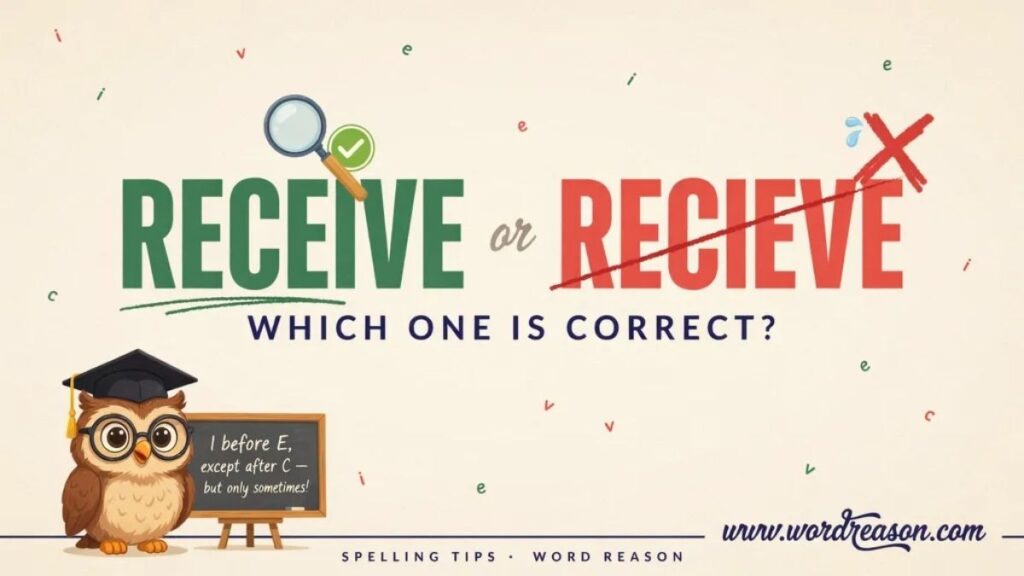
English spelling has a talent for making simple words surprisingly tricky. The confusion between receive or recieve is a perfect example. At first glance, both spellings look reasonable, but only one belongs in standard English. Receive is correct, while recieve is a common spelling mistake caused by putting the i and e in the wrong order. However, there is no need to let this tiny spelling puzzle cause a big headache. This guide explains the correct spelling, meaning, useful forms, common mistakes, and simple memory tricks. By the end, you will know exactly when to use receive and avoid recieve with confidence.
Receive or Recieve Which Is Correct?
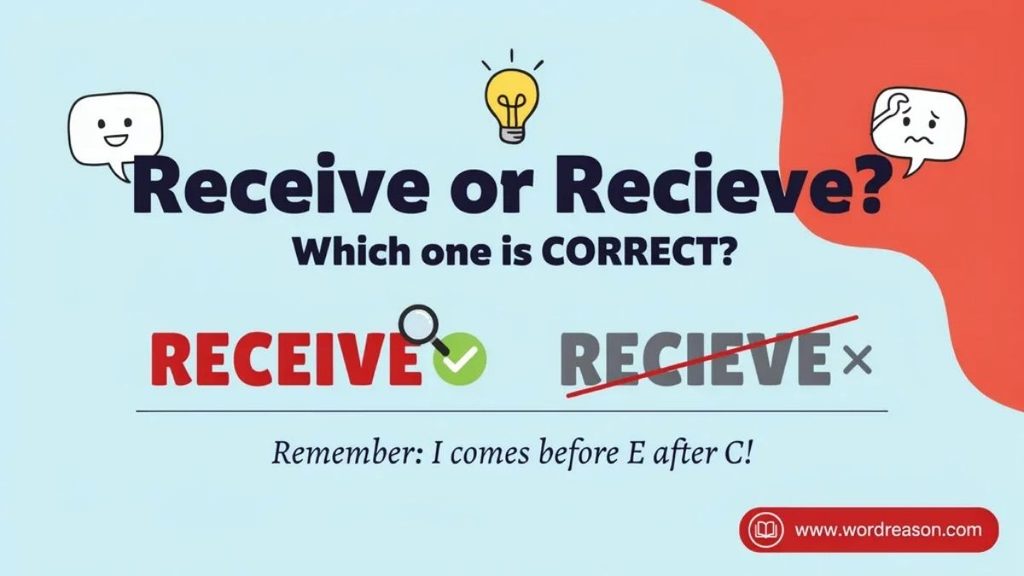
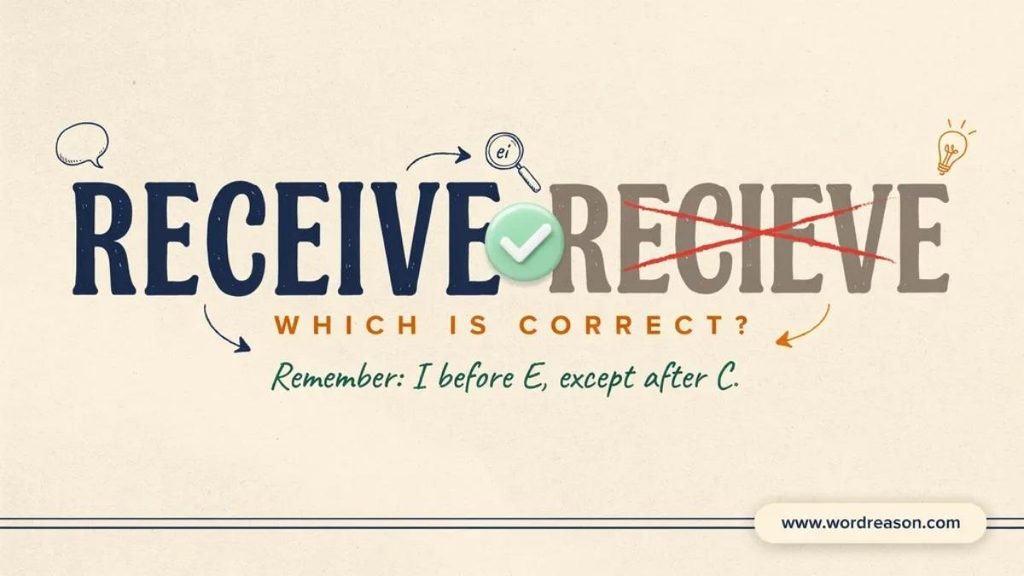
Receive is the correct spelling, while recieve is incorrect.
The word receive is a standard English verb. It commonly means to get something that someone gives or sends to you. It can refer to physical objects, messages, money, information, invitations, awards, support, and many other things.
Recieve, however, is simply a misspelling.
| Spelling | Correct? | Meaning |
|---|---|---|
| Receive | Yes | To get, accept, or be given something |
| Recieve | No | Incorrect spelling of receive |
Therefore, if you are asking receive or recieve correct spelling? the answer is receive.
Likewise, if you search for receive vs recieve, is it receive or recieve, or receive or recieve which is correct, the distinction remains the same: use receive in standard English.
For example
Correct I did not receive your email.
Incorrect I did not recieve your email.
The second sentence may still be understandable to a reader, but the spelling error is easy to spot in formal writing.
Learn the difference between confusing more English words
Volumn or Volume Which Is the Correct Spelling?
Receive Meaning and Definition
IT’s is a verb that generally means to get or be given something. Cambridge Dictionary lists this as one of its main meanings and gives examples involving letters, phone calls, visits, awards, and other things that come to a person.
The word can describe something physical or something abstract.
For example, you can receive a package, a letter, a gift, or a payment. However, you can also receive information, advice, feedback, support, approval, or an invitation.
Consider these examples
I received a package this morning.
She received an email from her manager.
The company received payment from the customer.
We received helpful feedback after the presentation.
They received an invitation to the wedding.
The word can also describe a reaction. If a speech is well received, people reacted positively to it. Similarly, something can be poorly, warmly, coldly, or enthusiastically received. Cambridge lists this use as another established meaning of receive.
Receive also has more specialized meanings. A radio or television can receive a signal, while a player can receive a ball in sports. Someone can also formally receive a guest, meaning that the person welcomes the visitor.
Consequently, receive is much more flexible than the simple synonym get might suggest.
Learn the difference between confusing more English words
Many or Meny Which Spelling Is Correct?
Recieve Why Is It Incorrect?
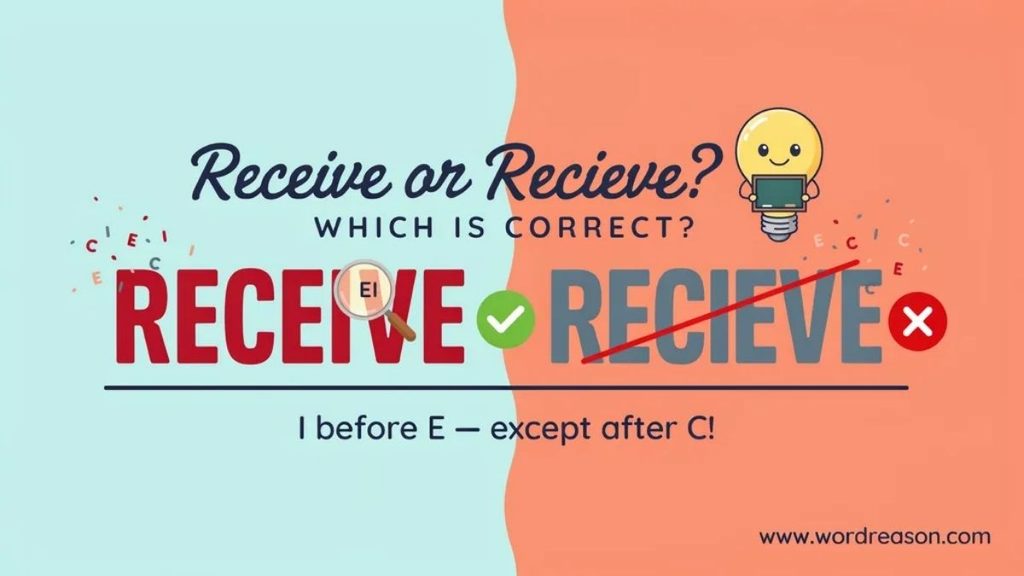
IT’s is a common spelling mistake caused by reversing the order of i and e.
The incorrect form looks like this
rec + ie + ve
The correct form looks like this
rec + ei + ve
That small change creates the entire problem.
English contains many words with ie, including believe, achieve, field, and piece. As a result, writers sometimes automatically place i before e when they encounter a similar-looking word.
However, receive does not follow that pattern.
It uses ei after c.
That is why the correct word is receive rather than recieve.
If you are wondering is recieve a word? the practical answer is no in standard English. It is recognized as a frequent misspelling of receive, but it does not function as a separate standard English word.
The same problem appears in related forms. Someone who writes recieve may also write recieved instead of received or recieving instead of receiving.
Once the basic pattern is understood, those mistakes become easier to prevent.
Learn the difference between confusing more English words
Bareable or Bearable Which Spelling Is Correct?
How to Spell Receive Correctly
If you want to know how to spell receive, focus on the middle of the word.
The correct spelling is
R-E-C-E-I-V-E
The key sequence is CEI.
You can mentally divide the word like this
re + cei + ve
That middle section is what separates receive from recieve.
The incorrect spelling places the vowels in the opposite order
re + cie + ve
A useful visual check is to look at the three letters after re
receive → cei
recieve → cie
Only the first one is correct.
This method works especially well when you are typing quickly. Instead of trying to remember every letter separately, remember the small pattern that causes the confusion.
Learn the difference between confusing more English words
Barrel or Barrell which is the Correct Spelling?
Receive Spelling Rule
The classic spelling rule connected with receive is I before E, except after C.
This familiar mnemonic helps explain why receive contains ei rather than ie.
The word has c immediately before the vowel pair
c + ei
Therefore
re + c + ei + ve
becomes
receive
You can see the same pattern in several other English words
| Word | Important spelling pattern |
|---|---|
| Receive | cei |
| Deceive | cei |
| Perceive | cei |
| Conceive | cei |
This is a useful spelling memory trick, but it should not be treated as a perfect rule for every English word. English spelling has many exceptions, so I before E, except after C works best as a helpful guide rather than an unbreakable law.
Still, for receive, the rule gives you a quick and reliable reminder.
When you hesitate between ie and ei, look at the letter before the pair. In receive, that letter is c.
That gives you the answer
c + ei = cei
So the correct spelling is receive.
Learn the difference between confusing more English words
Speach or Speech Which Is the Correct Spelling?
Why Do People Spell Receive as Recieve?
The mistake usually comes from spelling by memory instead of recognizing the word pattern.
For many people, the phrase i before e is one of the first spelling rules they learn. Consequently, when they hear or type receive, their brain may automatically choose ie.
Pronunciation does not solve the problem either. The spoken word does not clearly tell you whether to write ie or ei. You need to know the spelling pattern.
There is also a broader reason English creates this kind of confusion. English vocabulary has developed through many historical influences, including Old French and Latin. Modern spelling often preserves patterns that do not seem obvious from pronunciation alone.
Receive is a good example.
So, if you have ever written recieve, the mistake does not mean you misunderstand the word. It simply means the vowel order needs a little attention.
Everyday Examples
Receive appears in ordinary conversation, professional writing, school assignments, customer service, and countless other situations.
You can receive a physical object
I received my package this afternoon.
You can receive communication
Did you receive my message?
You can receive money
The business received payment on Friday.
You can receive information
We received new information about the project.
You can receive an invitation
She received an invitation to the ceremony.
You can receive an award
He received an award for his research.
You can receive help
The family received support from their community.
You can receive feedback
The students received useful feedback from their teacher.
You can receive an offer
She received an offer from another company.
You can also receive a response
We finally received a response from the customer.
These examples show why receive is such a useful verb. It works with both concrete and abstract nouns.
Learn the difference between confusing more English words
Studder or Stutter Which Spelling Is Correct?
Receive in a Sentence
The easiest way to understand receive is to see it in different sentence structures.
I receive several emails every morning.
She receives regular updates from the company.
We received your application yesterday.
They will receive their tickets by email.
Did you receive my letter?
He received a gift from his parents.
The team received strong support from its fans.
The customer received a confirmation message.
The proposal was well received by the committee.
The receiver received the signal clearly.
Notice how the form changes according to the grammar of the sentence. The base form is receive, while the third-person singular form is receives and the past form is received.
The meaning also changes slightly with context. Receiving an email means getting it. IT a guest means welcoming the person. Receiving a signal means detecting or processing it. Receiving a ball means catching or controlling it.
Examples
The difference becomes particularly clear when you compare correct and incorrect forms.
| Incorrect | Correct |
|---|---|
| I did not recieve your email. | I did not receive your email. |
| She recieved a letter. | She received a letter. |
| We are recieving messages. | We are receiving messages. |
| He is the reciever. | He is the receiver. |
| Did you recieve the package? | Did you receive the package? |
The important thing is not merely to replace recieve with receive. You should also learn the correct spelling of the related forms.
Otherwise, the same mistake can return when you write received, receiving, or receiver.
Learn the difference between confusing more English words
Monkeys or Monkies Which Spelling Is Correct?
Received and Receiving Spelling
The spelling confusion does not end with the base word.
The correct forms are receive, receives, received, receiving, and receiver.
| Word form | Correct spelling | Example |
|---|---|---|
| Base form | Receive | I receive emails daily. |
| Third-person form | Receives | She receives regular updates. |
| Past tense | Received | We received your message. |
| Present participle | Receiving | They are receiving assistance. |
| Noun | Receiver | The receiver detected the signal. |
Received spelling
The correct past tense is received.
Receive becomes received by adding d
receive → received
For example
I received your message yesterday.
She received the package this morning.
They received approval for the project.
The incorrect form is recieved.
Receiving spelling
The correct present participle is receiving.
When receive takes the -ing ending, the final e disappears:
receive → receiving
The important vowel sequence remains unchanged.
For example
She is receiving a payment.
They are receiving new information.
The office is receiving several calls.
The incorrect spelling recieving reverses the vowel order.
Learn the difference between confusing more English words
Buoy or Bouy which spelling is correct?
Receive, Receiver, Receipt and Reception
Several words related to receive can create additional confusion.
Receive is a verb.
A receiver is a person or thing that receives something.
Reception is a noun connected with the act or process of receiving. It can also refer to a formal gathering, a welcome, or the quality of a signal.
Receipt is commonly used for written or electronic proof that something has been received or purchased.
Although these words share historical connections, their modern spellings are not identical.
The Online Etymology Dictionary traces receive to Old North French and Old French forms that developed from Latin recipere. It also connects related words such as receipt, receiver, and reception with this historical family.
That history explains something important about English spelling: related words can preserve old patterns while developing different forms over time.
Therefore, it is better to learn the spelling of each common word rather than assume that every related word must follow exactly the same pattern.
Learn the difference between confusing more English words
Leasee or Lessee which Spelling is correct?
Receive and Its Word Family
Learning the word family can make the spelling easier to remember.
The main forms are
receive
receives
received
receiving
receiver
The spelling pattern remains recognizable throughout the group.
For example
1.She receives emails every day.
2.She received an email yesterday.
3.She is receiving another email now.
The receiver confirmed the signal.
Once you recognize the common structure, the words stop looking like separate spelling challenges.
Instead, you begin to see the same pattern repeatedly.
That is one of the most effective ways to improve word spelling. Rather than memorizing an isolated word, connect it with the forms you are likely to use.
Learn the difference between confusing more English words
Hoofs or Hooves which spelling is Correct?
British English vs American English
Some English words have different spellings in British and American English. Color and colour are familiar examples, as are center and centre.
However, receive does not have this kind of regional spelling difference.
American English uses receive.
British English also uses receive.
Therefore, recieve is not a British alternative to the American spelling receive.
This distinction matters because writers sometimes see different English spellings online and assume that every variation represents a regional preference. That is not the case here.
If you are writing an American English article, email, essay, report, or business document, use receive. If you are writing in British English, use receive as well.
The Origin of Receive
The history of receive reaches back many centuries.
The word entered English around 1300 in forms such as receiven. It came through Old North French and Old French from the Latin recipere. The Latin word carried meanings connected with taking back, taking in, accepting, or taking possession.
Over time, receive developed a wide range of meanings.
Historical evidence shows uses connected with welcoming someone, catching or taking something, obtaining something as a reward, accepting something as true, and experiencing something. The broadcasting sense also developed much later, with evidence for the radio meaning appearing in the early twentieth century.
The history also connects receive with words such as receiver, reception, recipient, receptive, and receipt.
This background helps explain why receive now works in so many different contexts.
How to Remember the Spelling of Receive
The best memory trick for receive is simple.
Remember
C + EI
Then place that pattern inside the word
RE + C + EI + VE
The result is
RECEIVE
Another useful reminder is the familiar spelling mnemonic
I before E, except after C.
For receive, the important part is after C.
The word contains
CEI
not
CIE
You can reinforce this memory by connecting receive with deceive, perceive, and conceive.
Receive.
Deceive.
Perceive.
Conceive.
Each word contains the same useful CEI sequence.
That repeated pattern makes the spelling easier to recognize.
A Simple Way to Avoid the Recieve Spelling Mistake
When you are unsure, do not try to sound out every letter.
Instead, stop at the middle of the word.
If you have written
recie
check it.
For receive, the correct middle pattern is
recei
That one extra moment can prevent the entire spelling error.
Another useful technique is to write the word in a short sentence.
For example
I will receive the package tomorrow.
I received your message.
She is receiving an email.
Seeing the correct spelling in context helps your memory far more than staring at the isolated word.
Common Mistakes With Receive
The most frequent error is recieve instead of receive.
However, the same vowel reversal can appear in related forms.
The common mistakes include recieve instead of receive, recieved instead of received, recieving instead of receiving, and reciever instead of receiver.
The correct forms are receive, received, receiving, and receiver.
| Common mistake | Correct form |
|---|---|
| Recieve | Receive |
| Recieved | Received |
| Recieving | Receiving |
| Reciever | Receiver |
The underlying problem is usually the same: the writer puts ie where ei belongs.
Once you identify that pattern, correcting the entire group becomes much easier.
A Quick Receive Spelling Test
Choose the correct spelling in each sentence.
| Sentence | Correct answer |
|---|---|
| Did you receive or recieve my email? | Receive |
| She received or recieved a letter. | Received |
| We are receiving or recieving new orders. | Receiving |
| He will receive or recieve the award. | Receive |
| The company received or recieved payment. | Received |
| Did they receive or recieve the invitation? | Receive |
| She is receiving or recieving regular updates. | Receiving |
| I hope you receive or recieve good news. | Receive |
The pattern is consistent. Whenever you see the c followed by the vowel pair, remember ei.
Practice Session
Choose the correct spelling in each sentence.
- Please (receive / recieve) the package tomorrow.
- I (receive / recieve) several emails each day.
- She (received / recieved) a letter yesterday.
- We have (received / recieved) your payment.
- He will (receive / recieve) an award tonight.
- They are (receiving / recieving) new information.
- Did you (receive / recieve) my message?
- The customer (received / recieved) the order on time.
- You should (receive / recieve) a confirmation email.
- She is (receiving / recieving) a delivery today.
Fill in the Blanks
Complete each sentence with the correct form of receive.
- I hope you ______ my email.
- She ______ a gift for her birthday.
- We ______ the payment yesterday.
- Did you ______ the invitation?
- He will ______ the results tomorrow.
- They have ______ your application.
- Please confirm that you ______ the message.
- The students ______ their certificates last week.
- I usually ______ several calls at work.
- She is ______ a package today.
- We ______ an important update yesterday.
- He did not ______ the letter.
- You will ______ a confirmation soon.
- They have ______ excellent feedback.
- I ______ a notification every morning.
- She ______ an award for her work.
- Did the office ______ your documents?
- We are ______ new information from the team.
- He ______ the payment on Friday.
- Please make sure you ______ the correct file.
- The customer has ______ the order.
- I will ______ your response shortly.
- She is ______ support from her teacher.
- They ______ several invitations last month.
- We have ______ your request successfully.
Answers
- receive
- received
- received
- receive
- receive
- received
- received
- received
- receive
- receiving
- received
- receive
- receive
- received
- receive
- received
- receive
- receiving
- received
- receive
- received
- receive
- receiving
- received
- received
Here’s a trusted source for clear more words Comparison:
FAQs
Did you receive or recieve?
Receive is correct. Recieve is a common misspelling.
How do Americans spell received?
Americans spell it received. The spelling is the same in British English.
When do you use receive or received?
Use receive for the present and received for the past. For example, “I receive emails” and “I received an email.”
Which spelling is correct: receive or recieve?
Receive is the correct spelling. Recieve is incorrect.
Is receive an American English spelling?
Yes. Receive is correct in both American and British English.
What is the plural form of receive?
Receive has no plural form because it is a verb. Forms include receives, received, and receiving.
What is the 2:1:1 rule in spelling?
It is a spelling rule for deciding when to double a final consonant before adding a suffix. It does not apply to receive.
What is the rabbit rule in spelling?
The rabbit rule helps learners remember words with a doubled middle consonant, such as rabbit. It does not apply to receive.
Why does egg have two Gs?
Egg is conventionally spelled with two Gs. The doubled letters are part of its standard spelling.
AEO: Quick Answers
What is the correct spelling of receive?
Receive is the correct spelling; recieve is a misspelling.
How do you spell receive?
Receive is spelled R-E-C-E-I-V-E.
Why is recieve wrong?
Recieve reverses the “i” and “e” in the standard spelling.
Is recieve a word?
No. Recieve is generally considered a misspelling of receive.
What is the past tense of receive?
The past tense is received.
What is the present participle of receive?
The present participle is receiving.
What does receive mean?
Receive means to get, accept, or be given something.
How can you remember the spelling of receive?
Remember the “cei” pattern in receive: R-E-C-E-I-V-E.
What are common forms of receive?
Common forms include receives, received, and receiving.
conclusion
The receive or recieve confusion may seem like a tiny spelling problem, but one misplaced letter can quickly turn a correct sentence into a spelling-error alert. The good news is that the solution is simple: receive is the correct spelling, while recieve is a misspelling. Remember the “cei” pattern in receive, and the correct spelling will become easier to recognize. Also, keep in mind that forms such as received, receiving, and receives follow their own spelling patterns. Once you learn these forms, you can write emails, messages, and everyday sentences without wondering which version is right. No more giving recieve an unwanted place in your writing!

Bella AJS
Bella AJS is an experienced blogger and passionate language enthusiast at WordReason. She specializes in English grammar, word meanings, spelling, and commonly confused words. With a clear and practical writing style, Bella helps readers understand tricky language rules without the textbook headache. Her goal is simple: make English easier, clearer, and more enjoyable one word at a time.