

The confusion around Bareable or Bearable is a perfect example. Both spellings look believable, but only one is the standard choice when you mean something that can be tolerated or endured. The correct spelling is bearable, and the reason is easier to remember than you might think. It comes from the verb bear, meaning to endure or tolerate. In this guide, you will learn the difference between bearable and bareable, understand their meanings, avoid common mistakes, and use the correct spelling confidently.
Bareable or Bearable Quick Answer
The correct spelling is bearable.
Bearable is an adjective that means able to be endured or tolerated. It comes from the verb bear, which can mean to endure, tolerate, or withstand something difficult.
For example
The pain was bearable after a few hours of rest.
This means the pain could be tolerated.
The incorrect spelling would be
The pain was bareable after a few hours of rest.
For standard English writing, use bearable when you mean tolerable.
Quick Comparison
| Word | Meaning | Example |
|---|---|---|
| Bearable | Able to be endured or tolerated | The heat was bearable. |
| Bareable | Generally a misspelling of bearable | Use bearable instead. |
| Bare | Uncovered, exposed, empty, or plain | The walls were bare. |
| Barely | Only just or by a small amount | She could barely walk. |
The easiest way to remember the difference is simple: if you can bear something, it is bearable.
Learn the difference between confusing more English words
She or Her the Correct Way to Answer the Phone
What Does Bearable Mean?
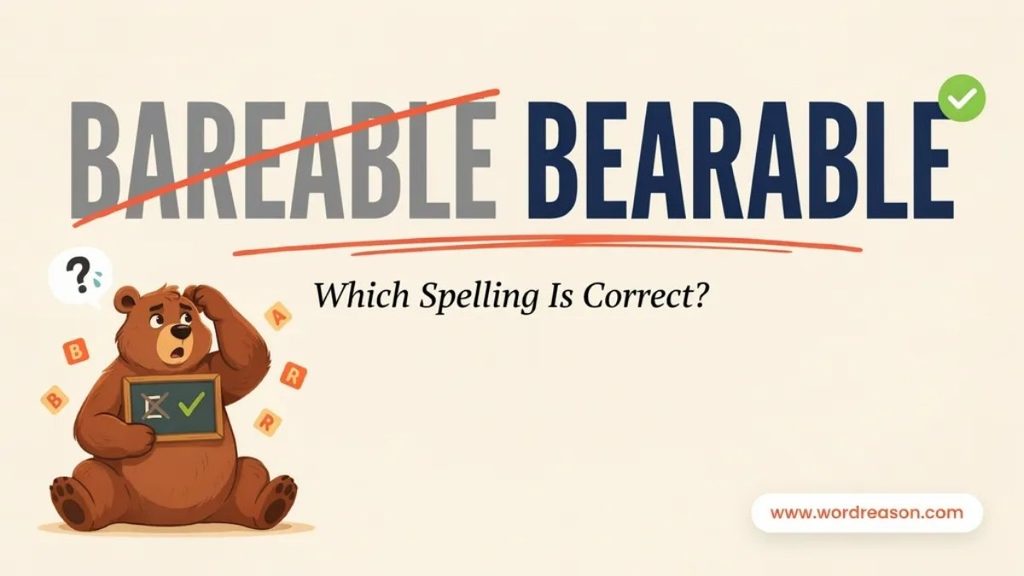
The bearable meaning is closely connected to the verb bear.
One meaning of bear is to endure or tolerate something. When the suffix able is added, bearable describes something that can be endured.
In simple terms, bearable means tolerable.
A situation does not have to be pleasant to be bearable. It only needs to remain within a person’s ability to tolerate.
For example
The heat was bearable after sunset.
The heat may still have been uncomfortable, but it was not impossible to tolerate.
The long flight was bearable.
The flight may have been boring or uncomfortable, but the traveler could still endure it.
This distinction is important because bearable does not mean easy, pleasant, or enjoyable.
Bearable as an Adjective
Bearable is an adjective. It describes something that can be tolerated or endured.
The word can describe many types of experiences and conditions. Common examples include pain, heat, cold, noise, stress, pressure, delays, workloads, costs, and difficult situations.
Consider these examples:
The headache was bearable after some rest.
The heat became more bearable when the wind started blowing.
The workload is bearable this week.
The noise was barely bearable.
The cost is bearable with the discount.
The waiting time was surprisingly bearable.
Each sentence describes something that may be unpleasant or difficult but remains possible to tolerate.
Bearable Does Not Mean Pleasant
A common misunderstanding is to treat bearable as a synonym for pleasant or comfortable. That is not quite right.
Something can be bearable without being enjoyable.
For example, imagine sitting through a long meeting. The meeting may be boring, tiring, and inconvenient. If you can tolerate it without feeling that you need to leave, you might describe it as bearable.
The following words have related but different meanings
| Word | Meaning |
|---|---|
| Bearable | Able to be endured |
| Comfortable | Providing physical or emotional ease |
| Pleasant | Enjoyable or agreeable |
| Easy | Requiring little effort or difficulty |
| Manageable | Able to be handled successfully |
A difficult task can therefore be bearable without being easy.
The exam was challenging but bearable.
This means the exam required effort, but its difficulty remained within a tolerable level.
Learn the difference between confusing more English words
Bougie vs Boujee which one is correct?
Why Is Bearable the Correct Spelling?

The best way to understand the correct spelling of bearable is to look at its base word.
The relevant verb is bear.
In this context, bear means to endure or tolerate something.
When able is added, the result is bearable.
Bear + able = bearable
The meaning follows the base word. Bearable describes something that can be borne or endured.
This explains why bareable is not the standard spelling for this meaning.
Bear and Bearable
Consider the connection between these two sentences:
I can bear the pain.
The pain is bearable.
The first sentence uses bear as a verb. The second uses bearable as an adjective.
The spelling remains connected to the same base word.
Other related words include bearing, unbearable, and bearably.
For example
The noise was unbearable.
This means the noise could not be tolerated.
The connection between bear and bearable provides one of the most useful clues for remembering the spelling.
How the Suffix Able Works
The suffix able often helps form adjectives that describe something capable of being done or experienced.
For example
Read becomes readable.
Wash becomes washable.
Break becomes breakable.
Accept becomes acceptable.
Bear becomes bearable.
This does not mean every English word follows a perfectly predictable pattern. English contains many historical spelling patterns and exceptions. However, the relationship between bear and bearable is clear and useful.
Learn the difference between confusing more English words
Memento or Momento which is the Correct Spelling?
Is Bareable a Word?
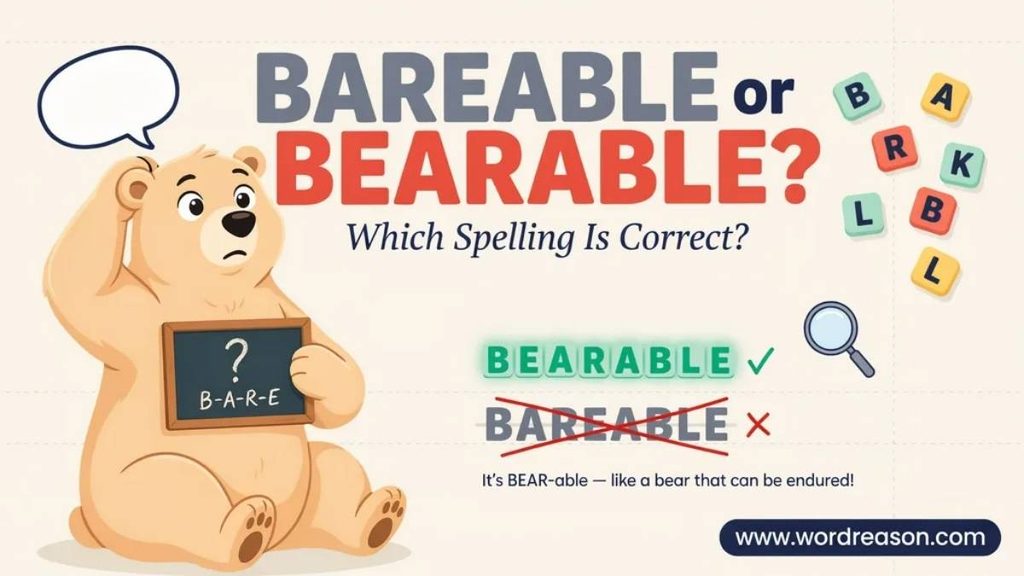
A common question is, is bareable a word?
When the intended meaning is able to be endured or tolerated, bareable is not the standard spelling. In normal modern English writing, bearable is the form to use.
The confusion usually comes from the fact that bare is already a real English word.
Bare means uncovered, exposed, empty, plain, or lacking something that would normally cover or decorate a surface.
For example
The walls were bare.
The tree had bare branches.
The floor was completely bare.
None of these examples relate to the meaning of bearable.
Why Bareable Looks Correct
The spelling mistake is easy to understand.
English has many adjectives that end in able, so someone might naturally look at bare and form bareable. The problem is that the intended meaning does not come from bare.
When you mean that something can be tolerated, the base word is bear.
When you mean something is uncovered or empty, the word is bare.
The meaning determines the spelling.
Learn the difference between confusing more English words
Unformal or Informal Which Spelling Is Correct?
What Is the Difference?
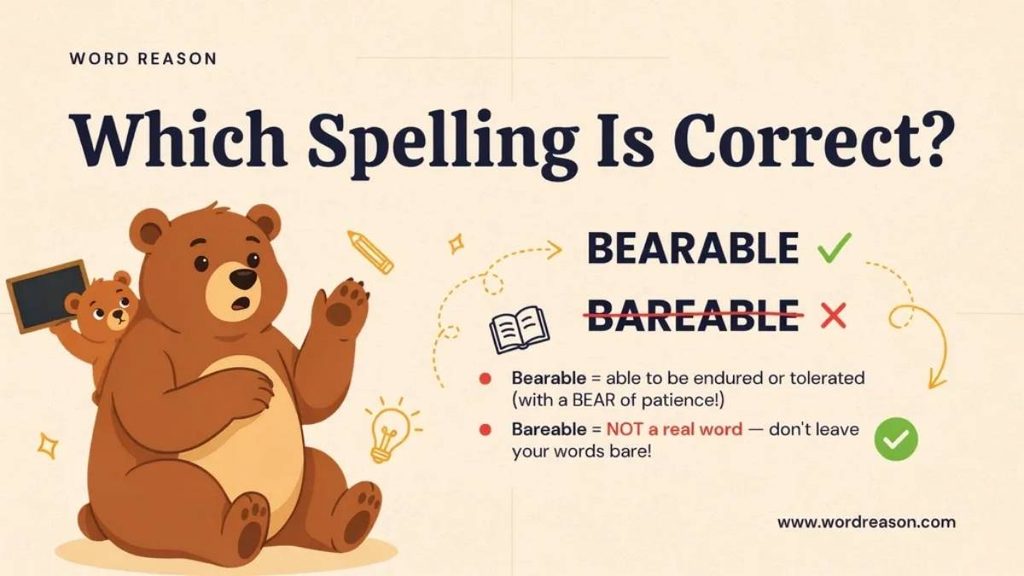
The bearable vs bareable difference becomes clear once the two base words are separated.
Bear can mean to endure or tolerate.
Bare means uncovered, exposed, empty, or plain.
Bearable comes from bear, not bare.
| Feature | Bearable | Bare |
|---|---|---|
| Word type | Adjective | Adjective or verb |
| Main meaning | Able to be endured | Uncovered, exposed, empty, or plain |
| Related base word | Bear | Bare |
| Common examples | Pain, heat, pressure, stress | Walls, branches, rooms, surfaces |
| Example | The pain was bearable. | The walls were bare. |
This explains why bearable and bareable are not simply two spellings that can be chosen freely.
If the sentence means something can be tolerated, bearable is the correct form.
If the sentence describes something uncovered or empty, bare may be the correct word.
Learn the difference between confusing more English words
Optimize or Optimise which spelling is correct?
Understanding the Difference
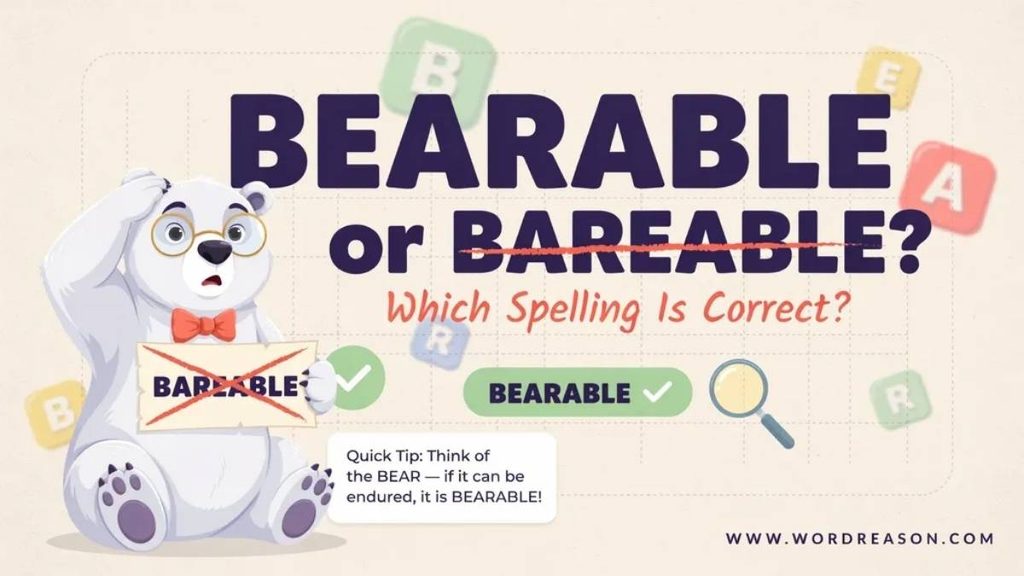
Another source of confusion is the word barely.
Bearable and barely look similar, but they have different meanings and grammatical roles.
Bearable means able to be endured.
Barely means only just or by a very small amount.
For example
The pain was bearable.
This means the pain could be tolerated.
She could barely walk.
This means walking was possible, but only with great difficulty.
| Word | Part of Speech | Meaning | Example |
|---|---|---|---|
| Bearable | Adjective | Tolerable | The pain was bearable. |
| Barely | Adverb | Only just | She could barely walk. |
Barely Bearable
The two words can appear together in the phrase barely bearable.
For example
The heat was barely bearable.
This means the heat was only just tolerable.
The phrase is completely correct because barely modifies bearable.
Other examples include:
The noise was barely bearable.
The pain became barely bearable.
The waiting time was barely bearable.
The conditions were barely bearable.
The similar spelling of the two words does not make them interchangeable.
Learn the difference between confusing more English words
Excel vs Accel which is correct spelling?
Bearable vs Unbearable
Bearable and unbearable have opposite meanings.
Something is bearable when it can be endured.
Something is unbearable when it is too difficult, painful, or unpleasant to endure.
For example
The heat was bearable in the shade.
The heat became unbearable without air conditioning.
The prefix un changes the meaning.
| Word | Meaning | Example |
|---|---|---|
| Bearable | Able to be endured | The noise was bearable. |
| Unbearable | Too difficult to endure | The noise was unbearable. |
This relationship can also help strengthen your vocabulary. If you understand bearable, you can easily understand why unbearable expresses the opposite idea.
How to Use Bearable in a Sentence
Learning the bearable definition is useful, but seeing the word in context makes the meaning much clearer.
Bearable With Pain
Pain is one of the most common situations in which people use bearable.
The pain was bearable after she rested.
The headache became more bearable after some sleep.
The injury was uncomfortable, but the pain remained bearable.
These sentences describe pain that can still be tolerated.
Bearable With Heat and Cold
Weather conditions can also be described as bearable.
The afternoon heat was bearable near the coast.
The winter cold became more bearable after the heater was repaired.
The temperature was barely bearable during the afternoon.
In these examples, bearable does not mean comfortable. It means that the conditions remained tolerable.
Bearable With Stress and Pressure
Bearable can also describe emotional or mental difficulty.
The pressure became more bearable after the deadline was extended.
The uncertainty was difficult but bearable.
With regular breaks, the workload was bearable.
Here, the word describes how much difficulty a person can tolerate.
Bearable With Work and Daily Responsibilities
Everyday situations can also be bearable.
The commute was bearable because traffic was light.
The workload is bearable this month.
The waiting time was bearable because there were enough seats.
The cost became more bearable after the price was reduced.
These examples show how flexible the word can be.
Learn the difference between confusing more English words
Bellies or Bellys Which Spelling Is Correct?
Bearable in Everyday Writing
IT is a standard English adjective that works in casual conversation, professional communication, formal writing, and many other contexts.
Bearable in Emails
A professional email might say:
The revised schedule makes the workload much more bearable.
Another example is
The additional staff should make the current workload more bearable.
The word is suitable for professional communication when the meaning fits the situation.
Bearable in News Writing
A report about weather or difficult conditions might use the word like this
Temperatures remained bearable during the morning hours.
Another example could be
Conditions became more bearable after emergency shelters opened.
The word can describe conditions without automatically suggesting that those conditions were pleasant.
Bearable in Social Media
The word also fits naturally into casual posts.
Three hours in traffic, but at least the music made it bearable.
The heat is barely bearable today.
These examples sound conversational while retaining the standard meaning.
Bearable in Formal Writing
Bearable can appear in academic and formal writing when the context calls for it.
For example
The study examined whether working conditions remained bearable during periods of extreme heat.
The word itself is not informal. Its suitability depends on the subject and surrounding language.
Bearable in Conversation
A natural conversation might look like this
“How was the long bus ride?”
“It was bearable, but I would not want to do it every day.”
The response shows the exact feeling the word communicates. The experience was not necessarily good, but it could be tolerated.
Learn the difference between confusing more English words
Opening or Openning which Spelling is correct?
Bearable in American and British English
There is no standard American versus British spelling difference for bearable.
Both American English and British English use bearable.
This is different from spelling pairs such as color and colour or center and centre.
| Feature | American English | British English |
|---|---|---|
| Standard spelling | Bearable | Bearable |
| Meaning | Able to be endured | Able to be endured |
| Bareable as the standard spelling | No | No |
Therefore, writers do not need to change bearable to bareable when switching between American and British English.
Learn the difference between confusing more English words
Volumn or Volume Which Is the Correct Spelling?
Common Mistakes With Bearable
Understanding the common mistakes can make the spelling much easier to remember.
Writing Bareable Instead of Bearable
The most common mistake is replacing bear with bare.
Incorrect
The pain was bareable.
Correct
The pain was bearable.
The reason is simple. The sentence means that the pain could be endured. The relevant verb is bear.
I can bear the pain.
The pain is bearable.
Confusing Bearable With Bare
Consider these sentences
The room was bare.
The room temperature was bearable.
The first sentence describes an empty or undecorated room. The second describes a temperature that can be tolerated.
The spelling changes because the meaning changes.
Confusing Bearable With Barely
Consider
The pain was bearable.
She could barely move.
Bearable describes the pain. Barely describes how much she could move.
They have different grammatical functions and meanings.
Using Bearable When Unbearable Is Intended
A small prefix can completely change the meaning.
The noise was bearable.
This means the noise could be tolerated.
The noise was unbearable.
This means the noise was too difficult to tolerate.
Always check whether the sentence describes something that can be endured or something that has gone beyond that point.
Assuming Bearable Means Easy
Bearable does not mean easy.
For example
The exam was challenging but bearable.
This means the exam required effort, but its difficulty remained within a tolerable range.
Something can be bearable and still be difficult.
Learn the difference between confusing more English words
Many or Meny Which Spelling Is Correct?
Bearable Synonyms and Alternatives
There are several bearable synonyms, but they do not all work in exactly the same situations.
Common alternatives include tolerable, endurable, manageable, acceptable, livable, sustainable, and reasonable.
| Word | Typical Meaning | Example |
|---|---|---|
| Bearable | Able to be endured | The pain was bearable. |
| Tolerable | Able to be tolerated | The noise was tolerable. |
| Endurable | Capable of being endured | The conditions were endurable. |
| Manageable | Able to be handled | The workload was manageable. |
| Livable | Suitable enough to live with or in | The apartment was small but livable. |
| Acceptable | Good enough to meet a standard | The result was acceptable. |
| Reasonable | Not excessive or extreme | The price was reasonable. |
Bearable vs Manageable
Bearable and manageable overlap in some situations, but they emphasize different ideas.
IT focuses on enduring an experience.
Manageable focuses on successfully handling something.
For example
The pain was bearable.
This means the person could tolerate the pain.
The workload was manageable.
This means the person could handle the amount of work.
A workload can be manageable even if it is not particularly pleasant. Pain can be bearable without being manageable in the same sense.
Bearable vs Tolerable
Tolerable is one of the closest synonyms for bearable.
The noise was bearable.
The noise was tolerable.
Both sentences communicate that the noise can be endured.
The difference is mostly one of wording and context. Bearable often sounds natural in everyday English, while tolerable can sound slightly more formal or evaluative.
Learn the difference between confusing more English words
Happened or Happend which spelling is correct?
How to Remember the Correct Spelling of Bearable
The simplest memory trick is
If you can bear it, it is bearable.
Start with the verb:
I can bear the pain.
Then turn it into the adjective
The pain is bearable.
This connection makes it much easier to avoid bareable.
The I Can Bear It Test
When you are unsure about the correct spelling, ask what the sentence means.
If the meaning is able to be endured, choose bearable.
For example
The cold is ______.
If you mean the cold can be tolerated, the correct answer is:
The cold is bearable.
If you mean something is uncovered, you may need bare instead
The walls are bare.
The meaning provides the spelling clue.
Bearable or Bareable Pronunciation
Pronunciation can add to the confusion because bear and bare are commonly pronounced alike in standard English.
However, similar pronunciation does not mean similar spelling or meaning.
Bear can mean endure.
Bare can mean uncovered.
Because bearable comes from bear in the sense of endure, it keeps the spelling of bear.
This is a useful examplea of Bareable or Bearable and why English spelling cannot always be determined by sound alone.
Bear and Bare Are Homophones
Bear and bare are commonly treated as homophones because they have the same pronunciation but different meanings and spellings.
IT can mean to endure
I cannot bear the noise.
Bare can describe something uncovered
The walls were bare.
From bear comes bearable
The noise was bearable.
That connection provides a reliable spelling clue.
Bearable Word Formation
Bearable also provides a useful example of English word formation.
The suffix able can form adjectives that describe something capable of being done or experienced.
Read becomes readable.
Wash becomes washable.
Break becomes breakable.
Accept becomes acceptable.
Bear becomes bearable.
The pattern is especially helpful here because the meaning of bear directly connects with the meaning of bearable.
Bear means to endure.
Bearable means capable of being endured.
The relationship is straightforward once the correct base word is recognized.
A Practical Example of Choosing the Correct Spelling
Imagine someone wants to describe a very hot afternoon.
They write
The temperature was bareable.
The sentence sounds familiar because bare and bear are pronounced alike. However, the intended meaning is not “uncovered.”
The writer means
The temperature could be tolerated.
The correct base word is therefore bear.
The corrected sentence is
The temperature was bearable.
Now consider another sentence
The tree had bare branches.
Here, bare is correct because the branches are uncovered or lacking leaves.
The two examples demonstrate the main rule
Choose the spelling according to meaning, not pronunciation.
Bearable Examples Correct and Incorrect
| Incorrect or different use | Correct form | Reason |
|---|---|---|
| The pain was bareable. | The pain was bearable. | The pain could be endured. |
| The heat is bareable today. | The heat is bearable today. | The heat can be tolerated. |
| The noise became bareable. | The noise became bearable. | The noise could be endured. |
| The room was bareable. | The room was bearable. | If the meaning is tolerable, use bearable. |
| The walls were bearable. | The walls were bare. | If the meaning is uncovered or empty, use bare. |
The final example shows why context matters.
A room can be bearable if it is tolerable. A room can be bare if it lacks furniture or decoration.
Bearable or Bareable Key Facts
Bearable is the standard spelling when the meaning is tolerable or able to be endured.
Bareable is generally a misspelling when someone intends the meaning of bearable.
Bearable comes from bear in the sense of endure or tolerate, followed by the suffix able.
Bare is a separate word meaning uncovered, exposed, empty, or plain.
Barely means only just or by a small amount.
Barely bearable means only just tolerable.
Unbearable means impossible or extremely difficult to endure.
American and British English both use bearable.
Bearable is an adjective.
The easiest spelling reminder is: If you can bear it, it is bearable.
Practice Session
Fill in the Blanks
- The pain was ______ after I took some rest.
- I cannot ______ this noise any longer.
- The walls of the empty room were completely ______.
- The heat became more ______ after the sun went down.
- She could ______ walk after the long journey.
- The cold was difficult, but it was still ______.
- The constant noise became ______ after several hours.
- Can you ______ the pressure for another few minutes?
- The room looked ______ because it had no furniture.
- The headache was ______, although it was uncomfortable.
- He could ______ see the road through the heavy rain.
- I cannot ______ the thought of losing my phone.
- The waiting time was ______ because we had something to read.
- The tree had ______ branches after losing its leaves.
- The smell was almost ______.
- The workload is challenging but ______.
- She could ______ tolerate the pain.
- You should use ______ when you mean “able to be endured.”
- The apartment was small but still ______.
- I could ______ hear what the teacher was saying.
- The pressure became ______ when the deadline was extended.
- Do not write “bareable” when you mean something that can be ______.
- The floor was completely ______ after the furniture was removed.
- The journey was long, but the discomfort was ______.
- Remember this rule: If you can ______ it, it is ______.
Answer Key
- bearable
- bear
- bare
- bearable
- barely
- bearable
- unbearable
- bear
- bare
- bearable
- barely
- bear
- bearable
- bare
- unbearable
- bearable
- barely
- bearable
- livable
- barely
- more bearable
- endured
- bare
- bearable
- bear, bearable
Here’s a trusted source for clear more words Comparison
FAQs
Is it Bearable or Bareable?
Bearable is the correct spelling when you mean something that can be endured or tolerated. Bareable is generally a misspelling of bearable in this context.
What Does Bearable Mean?
Bearable means able to be endured, tolerated, or handled without becoming impossible to deal with. For example, “The heat was bearable in the evening.”
How Do You Spell Bear as in I Cannot Bear It?
The correct spelling is bear. In “I cannot bear it,” bear means to tolerate or endure something difficult.
What Is Another Word for Bearable?
Tolerable is one of the closest synonyms for bearable. Depending on the context, manageable, endurable, acceptable, or livable can also work.
Is Bearable a Positive or Negative Word?
Bearable is usually neutral. It often describes something unpleasant or difficult that remains possible to tolerate. It does not necessarily mean that something is enjoyable or good.
What Is Another Way to Say More Bearable?
You can say “more tolerable,” “easier to endure,” “easier to handle,” or “more manageable,” depending on the context.
Do I Use Bear or Bare?
Use bear when you mean to endure, tolerate, or carry something. Use bare when you mean uncovered, exposed, empty, or plain. For example, “I cannot bear the pain” but “The walls were bare.”
Is I Can’t Bear It Grammatically Correct?
Yes. “I cannot bear it” and “I can’t bear it” are grammatically correct. Here, bear is a verb meaning to tolerate or endure something.
What Does Not Bearable Mean?
“Not bearable” means something cannot be tolerated or endured. For example, “The noise was not bearable” means the noise was too difficult to tolerate.
What Does The Pain Is Bearable Mean?
“The pain is bearable” means the pain can be tolerated. It may still hurt or feel uncomfortable, but it is not beyond the person’s ability to endure.
How Do You Say Bearable?
Bearable is pronounced with the same opening sound as the word bear. The stress falls on the first syllable.
AEO Questions and Answers
Is Bearable the Correct Spelling?
Yes. Bearable is the standard spelling for something that can be endured or tolerated. Bareable is generally considered a misspelling when used with this meaning.
What Is the Difference Between Bearable and Bareable?
Bearable means capable of being endured or tolerated. Bareable is generally an incorrect spelling when someone intends this meaning. Bare is a separate word meaning uncovered or exposed.
Why Is Bearable Spelled With Bear?
Bearable comes from the verb bear, which can mean to endure or tolerate. Adding the suffix able gives the adjective bearable.
Can You Give an Example of Bearable in a Sentence?
Yes. “The long journey was bearable because we stopped several times along the way.” Here, bearable means the journey could be tolerated.
Is Bearable the Same as Tolerable?
Bearable and tolerable have very similar meanings. Both can describe something that is difficult, unpleasant, or uncomfortable but still possible to endure.
Can Bearable Describe Emotional Situations?
Yes. Bearable can describe emotional or mental difficulties as well as physical discomfort. For example, “The stress became more bearable after the deadline was extended.”
What Is the Opposite of Bearable?
The opposite is unbearable. Bearable means something can be endured, while unbearable means it is too difficult, painful, or unpleasant to tolerate.
What Does Barely Bearable Mean?
“Barely bearable” means only just tolerable. It describes something that is extremely difficult or unpleasant but can still be endured to a small degree.
Is Bearable Used in American and British English?
Yes. Bearable is the standard spelling in both American and British English. There is no American-versus-British spelling change from bearable to bareable.
What Is the Easiest Way to Remember Bearable?
Connect bearable with the verb bear. If you can bear something, that thing is bearable. This simple connection helps prevent the common mistake of writing bareable.
conclusion
The Bareable or Bearable confusion may look like a tiny spelling problem, but one little vowel can send your sentence in the wrong direction. When you mean something that can be tolerated, endured, or withstood, bearable is the correct spelling. Bareable is generally a misspelling in this context. The easiest way to remember it is to start with bear: if you can bear the pain, heat, pressure, or situation, it is bearable. Meanwhile, bare means uncovered, and barely means only just. Once you connect bearable with bear, the spelling becomes much easier to remember. English may keep a few tricks up its sleeve, but this one is easy to bear.

Bella AJS
Bella AJS is an experienced blogger and passionate language enthusiast at WordReason. She specializes in English grammar, word meanings, spelling, and commonly confused words. With a clear and practical writing style, Bella helps readers understand tricky language rules without the textbook headache. Her goal is simple: make English easier, clearer, and more enjoyable one word at a time.