

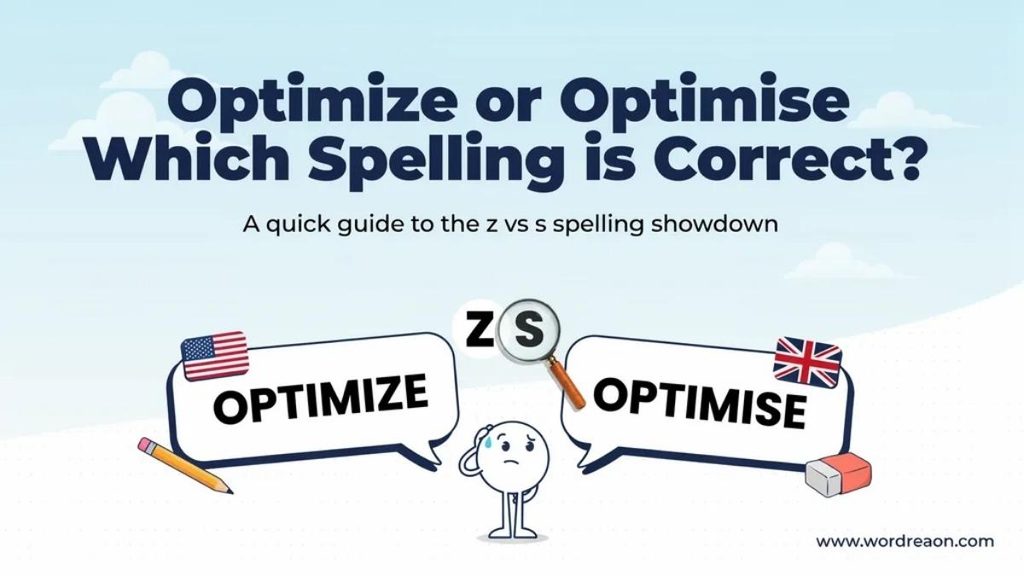
Optimize or optimise two spellings, one meaning, and a surprisingly easy way to second guess your English. If you’ve ever paused while typing and wondered whether the word needs a z or an s, you’re certainly not alone. Both spellings are correct, but they belong to different spelling conventions. Optimize is the standard form in American English, while optimise is widely used in British English. Neither spelling changes the meaning, pronunciation, or grammatical role of the word. Once you understand this simple regional difference, choosing the right form becomes much easier, helping you write accurately and consistently in emails, articles, reports, and professional content.
Quick Answer Optimize or Optimise?
Both optimize and optimise are correct.
- Optimize is the standard spelling in American English.
- Optimise is widely used in British English.
- Both words have the same meaning.
- Both are verbs.
- Both normally have the same pronunciation.
- The difference comes from regional spelling conventions.
- Related forms also vary, such as optimization/optimisation and optimized/optimised.
For example
US English: We need to optimize the website for mobile users.
British English: We need to optimise the website for mobile users.
The spelling changes, but the meaning doesn’t.
Optimize or Optimise at a Glance
| Feature | Optimize | Optimise |
|---|---|---|
| Meaning | Make something as effective or efficient as possible | Make something as effective or efficient as possible |
| Part of speech | Verb | Verb |
| US English | Standard | Less common |
| British English | Used in some styles | Very common |
| Pronunciation | Normally the same | Normally the same |
| Related noun | Optimization | Optimisation |
| Past tense | Optimized | Optimised |
| ing form | Optimizing | Optimising |
Learn the difference between confusing more English words
Girlie vs Girly Which Word Is Correct?
Meaning and Pronunciation
What Does Optimize or Optimise Mean?
The optimize or optimise meaning is to improve something so it works as effectively, efficiently, or successfully as possible.
In simpler terms, when you optimize something, you adjust it to get a better result.
For example, suppose a website takes eight seconds to load. A developer might compress large images, remove unnecessary code, improve caching, and make other technical changes. The goal is to optimize the website so it loads faster and gives visitors a better experience.
The same idea applies outside technology.
You can
- optimize a schedule
- optimize a business process
- optimize software
- optimize a website
- optimize resources
- optimize content
- optimize performance
- optimize energy use
- optimize a marketing campaign
- optimize a workflow
The key idea is improvement toward a particular goal.
That goal might involve speed, efficiency, cost, quality, performance, productivity, or another measurable outcome.
Is Optimize a Verb?
Yes. Optimize is a verb, and optimise is its British spelling variant.
The verb commonly takes a direct object
The company optimized its workflow.
The engineer optimised the system.
We need to optimize the page.
The team needs to optimise its resources.
It can also appear with for when the desired goal or audience matters
- The website was optimized for mobile devices.
- The campaign was optimised for conversions.
- The software is optimized for speed.
This use is important because optimization often involves a specific purpose. You aren’t simply changing something for the sake of change. You’re trying to make it perform better under particular conditions.
Optimize or Optimise Pronunciation
If you’re checking optimize or optimise pronunciation, there’s good news: the spelling difference normally doesn’t create a difference in pronunciation.
The two forms are pronounced the same in standard usage.
In other words, the difference is mainly visible in writing
- optimize → American spelling
- optimise → common British spelling
The final letter changes from z to s, but the basic pronunciation remains the same.
Optimize or Optimise Example Sentences
The following examples show how the two spellings work in equivalent sentences:
| American English | British English |
|---|---|
| We need to optimize the checkout process. | We need to optimise the checkout process. |
| The developer optimized the app. | The developer optimised the app. |
| The company is optimizing its resources. | The company is optimising its resources. |
| The team focuses on optimization. | The team focuses on optimisation. |
Notice the pattern. The meaning and grammar stay the same. Only the spelling convention changes.
Learn the difference between confusing more English words
Masonary vs Masonry Which Spelling Is Correct?
Related Word Forms
The spelling difference doesn’t stop with the base verb. Other forms of the word generally follow the same regional pattern.
Optimization vs Optimisation
The noun follows the same distinction
American English: optimization
British English: optimisation
For example
The company invested in website optimization.
A British style version might read
The company invested in website optimisation.
Both sentences refer to the process of improving a website’s effectiveness or performance.
Optimized vs Optimised
The past-tense and past-participle forms also differ
American English optimized
British English optimised
Examples
The developer optimized the database.
The developer optimised the database.
Again, the meaning doesn’t change.
Optimizing vs Optimising
The present participle follows the same pattern
American English optimizing
British English optimising
Examples
The team is optimizing the website.
The team is optimising the website.
Once you choose a spelling convention, carry it through the related forms. That simple habit keeps your writing polished.
Optimal vs Optimum
The words optimal and optimum belong to the same word family, but they have different grammatical roles.
Optimal is an adjective meaning best or most suitable under particular circumstances.
We need the optimal solution for the problem.
Optimum can function as a noun or adjective and refers to the most favorable level or condition.
The machine operates at its optimum temperature.
By contrast, optimize and optimise are verbs that describe the action of improving something toward that favorable result.
Learn the difference between confusing more English words
Time Off vs Time-Off Understanding the Hyphen Rule
The Origin of Optimize and Optimise
From Optimum to Optimize
The word family behind optimize traces back to the Latin word optimus, meaning “best.”
That Latin connection explains the relationship between words such as
- optimum
- optimal
- optimize
- optimization
They all carry the central idea of achieving or relating to the best possible condition.
English later developed the verb optimize, while different English speaking regions developed their own spelling preferences for the ending.
Why Do Optimize and Optimise Have Different Spellings?
The difference isn’t an accidental typo.
English has several words that appear with both -ize and -ise spellings. Regional usage, dictionaries, publishing traditions, and style guides all play a role in determining which form writers prefer.
American English generally favors ize in this group
optimize
organize
recognize
realize
A common British English convention uses ise
optimise
organise
recognise
realise
However, British English isn’t governed by a simple rule saying that every such word must end in ise. Some British dictionaries and style systems accept or prefer ize spellings.
That’s why calling one version “correct” and the other “wrong” misses the real issue.
Learn the difference between confusing more English words
Patients vs Patient Meaning Difference and Correct Usage
American English Optimize
For American English, optimize is the standard spelling.
You’ll find it throughout US business writing, technical documentation, software development, marketing, academic writing, and everyday communication.
Common phrases include
- optimize performance
- optimize content
- optimize a website
- optimize resources
- optimize a process
- optimize for search engines
- optimize efficiency
- optimize productivity
For example
The marketing team optimized the landing page to improve conversions.
The same American spelling applies to its related forms
- optimized
- optimizing
- optimization
If you’re asking about the American spelling of optimize, the answer is straightforward: optimize.
Learn the difference between confusing more English words
Nosey vs Nosy Which Spelling Is Correct?
British English Optimise
For British English, optimise is a very common spelling.
A British writer might write
The company plans to optimise its production process.
The related forms commonly appear as
- optimised
- optimising
- optimisation
Learn the difference between confusing more English words
in vs On the Same Day no confusion grammar guide
Can British English Use Optimize?
Yes. This detail often gets overlooked.
Although optimise is very common in British English, optimize can also be used in British English under spelling conventions that favor or accept -ize forms.
Therefore, it isn’t accurate to say that
“Optimize is always American.”
A more accurate statement is
Optimize is the standard American form, while optimise is a very common British form.
That distinction matters when you’re writing for international readers or working with a particular publisher.
learn the difference between confusing more English words
She or Her the Correct Way to Answer the Phone
Commonwealth and International English
English has never followed exactly the same spelling rules everywhere. Countries that use English have developed their own conventions through history, education, publishing, and contact with other English speaking communities.
Optimize or Optimise in Australian English
Optimise is commonly used in Australian English.
For example
The company is working to optimise energy efficiency.
Australian spelling generally reflects many British spelling conventions, although individual organizations and publications can establish their own editorial rules.
Optimize or Optimise in Canadian English
Canadian English draws from both British and American influences, so spelling can vary.
Some Canadian writers and publications may use optimise, while others may use optimize. The appropriate choice depends on the publication, institution, or style guide.
Rather than assuming that every Canadian writer follows one spelling rule, check the established style of the document or publication.
International Websites
A website with an international audience can use either spelling.
What matters most is consistency.
If a website follows American English throughout its content, optimize will fit naturally. If it follows British English, optimise may be the better choice.
Mixing the two without a reason can make the writing look inconsistent even though both forms are legitimate.
Learn the difference between confusing more English words
Bougie vs Boujee which one is correct?
Optimize vs Optimise by English Variety
| English variety | Common spelling |
|---|---|
| American English | Optimize |
| British English | Optimise is very common; optimize also occurs |
| Australian English | Optimise is common |
| New Zealand English | Optimise is common |
| Canadian English | Usage varies |
| International English | Follow the chosen editorial style |
These are broad usage patterns rather than absolute rules. Dictionaries, publishers, schools, and organizations can make different choices.
Learn the difference between confusing more English words
Memento or Momento which is the Correct Spelling?
When Should You Use Optimize or Optimise?
Use “Optimize” in American English
Choose optimize when you’re following American English spelling conventions.
It works naturally in
US websites
American business documents
US marketing content
American academic writing
technical documentation
software-related content
For example
Our engineers optimized the system to reduce processing time.
If the rest of your writing uses American spellings such as color, organization, and analyze, then optimize keeps the style consistent.
Use “Optimise” in British English
Choose optimise when your writing follows a British ise style.
For example
Our engineers optimised the system to reduce processing time.
It works naturally alongside spellings such as
colour
organisation
analyse
recognise
The key isn’t to memorize hundreds of isolated spelling rules. Instead, identify the English variety you’re using and apply it consistently.
Keep One Spelling Style Consistent
Consistency makes professional writing look intentional.
Consider this sentence
We optimized the website, organised the content, and analysed the results.
The reader can understand it without difficulty. Still, the mixture of -ize and -ise spellings may look inconsistent if the document otherwise follows one regional style.
An American-style version would be
We optimized the website, organized the content, and analyzed the results.
A British ise version would commonly be
We optimised the website, organised the content, and analysed the results.
Neither regional style is automatically “better.” The important thing is to choose a convention and use it consistently.
Learn the difference between confusing more English words
Unformal or Informal Which Spelling Is Correct?
Optimize or Optimise in Technology and Software
Technology is one of the areas where this word appears most often.
Software Performance
Developers frequently discuss optimizing or optimising
code
databases
applications
memory usage
processing speed
algorithms
system performance
For example
The developer optimized the code to reduce unnecessary processing.
Here, optimization means modifying the code so the system performs more efficiently or achieves a desired result.
Website Performance
Website optimization can involve many technical improvements, such as
reducing image file sizes
improving page loading speed
minimizing unnecessary scripts
improving mobile performance
reducing server delays
improving responsiveness
The exact changes depend on the site’s technical setup and its performance problems.
SEO and Digital Marketing
The word is especially common in search engine optimization, usually shortened to SEO.
You may see phrases such as
- optimize content
- optimise content
- optimize a webpage
- optimise a webpage
- optimize for search engines
- optimise for search engines
- optimize titles
- optimize internal links
- optimize conversion rates
For example
The writer optimized the article around the reader’s search intent.
In SEO, optimization shouldn’t mean stuffing a page with keywords. Good optimization focuses on relevance, clarity, structure, usability, and satisfying the reader’s needs.
Optimize or Optimise in Business and Professional Writing
The word isn’t limited to computers or websites.
Businesses use optimize and optimise when discussing processes, resources, costs, productivity, logistics, and operations.
Business Processes
A company might optimize a process by removing unnecessary steps, reorganizing tasks, or improving how employees and systems work together.
The company optimized its delivery process to reduce delays.
The British spelling would be
The company optimised its delivery process to reduce delays.
Workplace Communication
Professional writing often uses the word when discussing efficiency or performance.
The new system should help optimize workflow.
Here, the word suggests more than simply making the workflow different. It implies improving the workflow toward a better result.
Finance and Resource Management
Businesses can optimize
spending
inventory
staffing
resources
production
operating costs
For example
The retailer optimized inventory levels to reduce waste.
The goal is generally to balance several factors rather than pursue one simple outcome.
Optimize or Optimise in Academic Writing
Academic writers use optimize and optimise when discussing methods, systems, models, experiments, or operating conditions.
For example
The researchers optimized the model to improve predictive performance.
Another example
The study examined how to optimise energy consumption under different operating conditions.
The word can be useful when the research involves improving a system toward a particular objective.
However, academic writers should still choose words precisely. Optimize isn’t simply a more sophisticated substitute for improve.
If something became better in a general sense, improve may be more accurate. If researchers adjusted something to achieve the best practical performance under defined conditions, optimize may be the better choice.
Optimize vs Improve What’s the Difference?
The two verbs overlap, but they aren’t identical.
| Word | Main idea | Example |
|---|---|---|
| Improve | Make something better | We improved the website. |
| Optimize | Adjust something toward the best practical performance or outcome | We optimized the website for mobile users. |
Consider a bicycle.
If you replace a damaged tire with a new one, you’ve improved the bicycle.
If you adjust the tire pressure, seat position, gearing, and other factors to achieve the best performance for a particular ride, you’re optimizing it.
That’s the difference in a nutshell.
Improve is broad. Optimize usually suggests efficiency, effectiveness, or a defined goal.
Common Mistakes With Optimize and Optimise
Assuming “Optimise” Is Wrong
This is perhaps the biggest mistake.
Optimise isn’t simply a misspelling of optimize. It’s a legitimate and widely used spelling, particularly in British English.
Assuming “Optimize” Is Always American
This statement is too broad.
Optimize is the standard American spelling, but -ize forms can also appear in British English.
The exact preference depends on the style system being followed.
Mixing American and British Spelling
Writers sometimes switch between regional spelling conventions without realizing it.
For example
The company optimized the website, organised the content, and analysed the results.
If the document is meant to follow American English, the final two spellings should normally be changed to:
The company optimized the website, organized the content, and analyzed the results.
The issue isn’t that organised or analysed are universally wrong. The issue is inconsistency within a chosen style.
Confusing Optimize With Optimal
These words have related meanings but different grammatical roles.
- optimize = verb
- optimal = adjective
- optimum = noun or adjective
- optimization = noun
- optimized/optimised = past tense or past participle
Compare these examples
We need to optimize the system.
We need the optimal solution.
The machine operates at its optimum level.
Knowing the word forms helps you avoid grammatical mistakes as well as spelling mistakes.
Using Optimize When Improve Fits Better
Not every improvement is an optimization.
If you simply make a paragraph clearer, improve may be the better choice.
If you revise the paragraph specifically to make it clearer, more efficient, and more effective for a defined purpose, optimize may fit.
The context determines which verb communicates the idea more accurately.
Common Phrases With Optimize or Optimise
The word appears in many common expressions, particularly in business, technology, SEO, and professional writing.
Some examples include
- optimize performance
- optimise performance
- optimize efficiency
- optimise efficiency
- optimize resources
- optimise resources
- optimize a process
- optimise a process
- optimize a website
- optimise a website
- optimize content
- optimise content
- optimize for search engines
- optimise for search engines
- optimize workflow
- optimise workflow
- optimize productivity
- optimise productivity
The spelling changes according to regional convention, but the underlying meaning remains the same.
Optimize or Optimise in a Sentence
Seeing both forms in real sentences makes the distinction easier to remember.
American English Examples
The company wants to optimize its production process.
We need to optimize the website for mobile devices.
The software automatically optimizes system performance.
The team is optimizing its advertising campaign.
The developer completed the final optimization.
British English Examples
The company wants to optimise its production process.
We need to optimise the website for mobile devices.
The software automatically optimises system performance.
The team is optimising its advertising campaign.
The developer completed the final optimisation.
The grammar, meaning, and pronunciation remain essentially the same. The spelling follows the chosen English convention.
Why Is Optimize Spelled With Z and Optimise With S?
The short answer is regional spelling tradition.
American English generally favors ize in this group of words, while British English commonly uses ise.
That gives us
American English
- optimize
- optimized
- optimizing
- optimization
Common British ise style
- optimise
- optimised
- optimising
- optimisation
The z versus s doesn’t change the word’s meaning, tense, or basic pronunciation.
Do Optimize and Optimise Mean the Same Thing?
Yes.
Optimize and optimise are spelling variants of the same verb.
For example
We need to optimize the system.
and
We need to optimise the system.
Both statements mean that the system should be improved toward better or more effective performance.
The spelling doesn’t create a different definition.
Case Study Choosing the Right Spelling for a Website
Imagine a technology website that primarily serves readers in the United States.
Its editorial style uses
color
organization
analyze
recognize
One article suddenly uses optimise.
The word itself isn’t meaningless or inherently wrong. However, it doesn’t match the site’s established American spelling style.
In that situation, optimize would be the more consistent choice.
Now consider a British publication that regularly uses
colour
organisation
analyse
recognise
For that publication, optimise would fit naturally with its established style.
What This Case Study Shows
The lesson extends beyond one spelling pair.
Your audience, publication, and style guide should guide your spelling choices.
Professional writing isn’t about pretending that regional variations don’t exist. It’s about making deliberate choices and applying them consistently.
Optimize or Optimise Easy Memory Trick
Here’s the simplest way to remember the difference
US English → Optimize
British English → Optimise
Think of the final letter as a tiny spelling signpost.
Z points toward the common American form.
S points toward the common British form.
Just remember that this is a practical shortcut, not an absolute rule for every British publication.
Optimize vs Optimise Final Comparison
| Question | Answer |
|---|---|
| Are optimize and optimise the same word? | Yes |
| Do they have the same meaning? | Yes |
| Are both verbs? | Yes |
| Are they normally pronounced the same? | Yes |
| Is optimize standard in American English? | Yes |
| Is optimise common in British English? | Yes |
| Can optimize appear in British English? | Yes |
| Does the spelling change the meaning? | No |
| Which spelling should you use? | Match your audience and style |
| Should you mix the forms randomly? | No |
Practice Session Optimize or Optimise
Test your understanding of optimize and optimise by choosing the correct word or spelling for each sentence.
Choose the Correct Spelling
Fill in each blank with optimize or optimise.
- American English commonly uses ______ with a z.
- British English commonly uses ______ with an s.
- We need to ______ the website for mobile users.
- The company plans to ______ its production process.
- Our team is working to ______ website performance.
- The British team decided to ______ the system.
- The software was designed to ______ battery usage.
- The marketing team wants to ______ the content for search engines.
- Engineers are trying to ______ the machine’s performance.
- The company hopes to ______ its resources more efficiently.
Choose the Correct Word Form
Complete each sentence with the appropriate form of optimize/optimise.
- The process of improving performance is called ______.
- The British spelling of the noun is ______.
- The team is ______ the website for better performance.
- The developers have ______ the application.
- The company regularly ______ its business processes.
Complete the Meaning
Fill in each blank with a suitable word.
- To optimize something means to make it as ______ as possible.
- Optimize and optimise have the same ______.
- The main difference between optimize and optimise is their ______.
- American English generally prefers -______ spellings.
- British English commonly uses -______ spellings.
Test Your Understanding
- If you are writing for a US audience, you would normally write ______.
- If you are following a British -ise spelling style, you would write ______.
- Optimization is the American spelling, while ______ is the common British spelling.
- Optimize and optimise are spelling ______ of the same word.
- When choosing between the two spellings, the most important thing is to remain ______ throughout your writing.
Answer Key
- optimize
- optimise
- optimize
- optimize
- optimize
- optimise
- optimize
- optimize
- optimize
- optimize
- optimization
- optimisation
- optimizing / optimising
- optimized / optimised
- optimizes / optimises
- effective
- meaning
- spelling
- ize
- ise
- optimize
- optimise
- optimisation
- variants
- consistent
Here’s a trusted source for clear more words Comparison
Frequently Asked Questions About Optimize or Optimise
Is Optimize or Optimise Correct?
Both are correct. Optimize is standard in American English, while optimise is common in British English.
What Does Optimise Mean?
Optimise means to improve something so it works as effectively or efficiently as possible.
What Is the American Spelling of Optimise?
The American spelling is optimize, with a z instead of an s.
Is Optimise British Spelling?
Yes. Optimise is a common British English spelling.
Do Optimize and Optimise Have the Same Meaning?
Yes. They have the same meaning and pronunciation. Only the spelling differs.
Why Does Optimize Use a Z While Optimise Uses an S?
The difference comes from regional English spelling conventions. American English commonly uses -ize, while British English often uses -ise.
Can Optimize Be Used in British English?
Yes. Optimize is also accepted in some British English styles, although optimise is widely used.
Which Should I Use Optimize or Optimise?
Use optimize for American English and optimise for British English when following the -ise convention.
Are Optimization and Optimisation Both Correct?
Yes. Optimization is common in American English, while optimisation is common in British English.
Is Optimize a Verb?
Yes. Optimize is a verb meaning to improve something for better performance or efficiency.
What Is Another Word for Optimise?
Depending on the context, synonyms include improve, enhance, refine, streamline, and maximize.
What Is the Opposite of Optimise?
Depending on the context, opposites include worsen, impair, hinder, and degrade.
Are Optimize and Optimise Pronounced the Same?
Yes. The two spellings normally have the same pronunciation.
Is Optimise a Different Word From Optimize?
No. They are spelling variants of the same word.
Is Optimize More Correct Than Optimise?
No. Both are correct. The preferred spelling depends on the English variety you are using.
AEO Quick Answers
Optimize or Optimise Which Is Correct?
Both are correct. Optimize is standard in American English, while optimise is common in British English.
What Does Optimize Mean?
Optimize means to make something as effective or efficient as possible.
What Does Optimise Mean in British English?
Optimise means to improve something for the best possible performance or result.
Is Optimize American English?
Yes. Optimize is the standard American English spelling.
Is Optimise American or British?
Optimise is primarily associated with British English.
What Is the Difference Between Optimize and Optimise?
There is no difference in meaning. Optimize uses z, while optimise uses s.
When Should You Use Optimize?
Use optimize when writing in American English or following an -ize spelling style.
When Should You Use Optimise?
Use optimise when following British English or an -ise spelling style.
Can Optimize and Optimise Be Used Interchangeably?
Yes, but keep one spelling consistent throughout the same piece of writing.
How Do You Spell Optimize?
The American spelling is optimize.
How Do You Spell Optimise?
The British ise spelling is optimise.
Conclusion
The optimize or optimise debate is much less dramatic than it first appears. Both spellings are correct, carry the same meaning, and are pronounced the same. The real difference is regional: optimize is the standard American English spelling, while optimise is widely used in British English. So, there’s no need to treat the letter z like a grammar villain or the letter s like an innocent bystander. Choose the spelling that matches your preferred English style, and most importantly, stay consistent. Once this small spelling difference is clear, choosing between optimize and optimise becomes one less thing to overthink.

Bella AJS
Bella AJS is an experienced blogger and passionate language enthusiast at WordReason. She specializes in English grammar, word meanings, spelling, and commonly confused words. With a clear and practical writing style, Bella helps readers understand tricky language rules without the textbook headache. Her goal is simple: make English easier, clearer, and more enjoyable one word at a time.