

Nosey vs Nosy Which Spelling Is Correct? This simple spelling question can cause more confusion than you’d expect. If someone is always asking personal questions or poking their nose into other people’s business, “nosey” might seem like the obvious spelling. However, “nosy” is the standard and more widely used form, particularly in American English. Both spellings exist, but choosing the right one depends on context and style. In this guide, we’ll clear up the confusion, explain the difference between nosey vs nosy, and show you how to use each form correctly with clear examples. By the end, this spelling mystery will be no mystery at all.
Nosey vs Nosy The Quick Answer
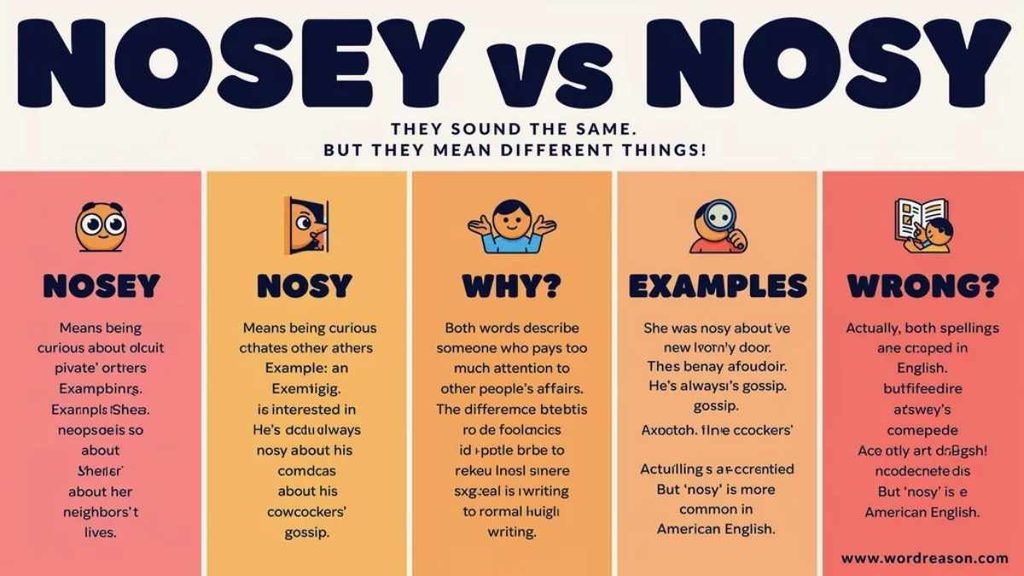
When you’re deciding between nosey or nosy, you don’t need to treat one as correct and the other as a mistake.
Both spellings are recognized.
Oxford lists nosy as an adjective and identifies nosey as an alternative spelling. Cambridge also lists nosey as an alternative to nosy. Both dictionaries connect the word with excessive interest in other people’s affairs.
The practical difference is mainly usage and regional preference, not meaning.
For example
- My nosy neighbor always asks personal questions.
- My nosey neighbor always asks personal questions.
Both sentences mean essentially the same thing.
Quick Rule
Here’s the easiest rule to remember
Nosy and nosey are both correct. For US English, choose “nosy” as the default spelling.
If you’re writing for a British audience, nosey may feel especially natural. However, nosy is also understood and used in British English.
The key isn’t to declare one form wrong. Instead, choose the spelling that suits your audience and use it consistently.
Learn the difference between confusing more English words
Girlie vs Girly Which Word Is Correct?
What Does Nosy Mean?
The nosy meaning is simple: someone who shows too much interest in other people’s private affairs.
A nosy person may ask questions that are too personal, investigate matters that don’t concern them, or try to discover information someone would rather keep private.
For example
My neighbor is very nosy and always asks who visits my house.
The word usually has a negative or mildly critical tone.
However, nosy doesn’t always sound harsh. Friends and family members often use it playfully.
For example
I’m being nosy, but what did you buy?
Here, the speaker recognizes that the question may be too personal and uses the word humorously.
Dictionary Definition of Nosy
The nosy definition can be summarized as
Nosy: showing too much interest in other people’s affairs or activities.
It functions primarily as an adjective.
You can use it to describe
- a nosy person
- a nosy neighbor
- a nosy coworker
- nosy questions
- nosy behavior
- a nosy reporter
Oxford labels the word informal and disapproving. Cambridge also identifies the negative tone associated with the term.
The related noun is nosiness, which refers to the quality or behavior of being nosy.
For example
His nosiness made everyone uncomfortable.
What Does It Mean to Be Nosy?
Being nosy usually means showing curiosity without respecting another person’s privacy.
A nosy person might
- Ask intrusive personal questions.
- Want to know details that aren’t their business.
- Listen to private conversations.
- Look through someone else’s belongings.
- Ask repeated questions after receiving an obvious signal to stop.
- Interfere in another person’s personal affairs.
Still, context matters.
Asking a friend, “How did your interview go?” is normal curiosity.
Asking, “How much money did they offer you, why did you need the job, and what did your spouse think about it?” may cross the line into nosiness.
The difference isn’t simply about asking questions. It comes down to boundaries, context, and intent.
Nosy vs Curious
The words curious and nosy are closely related, but they don’t carry the same tone.
| Word | Meaning | Typical tone |
|---|---|---|
| Curious | Interested in learning something | Neutral or positive |
| Inquisitive | Eager to ask questions or learn | Usually positive or neutral |
| Nosy | Too interested in other people’s private affairs | Usually negative |
| Prying | Trying to discover private information | Strongly negative |
| Intrusive | Interfering with someone’s privacy or space | Negative |
For example
The curious student asked how the experiment worked.
That sounds positive.
Now compare
The nosy neighbor asked why the family had visitors so late.
That suggests unwanted curiosity.
Learn the difference between confusing more English words
Masonary vs Masonry Which Spelling Is Correct?
Key Differences
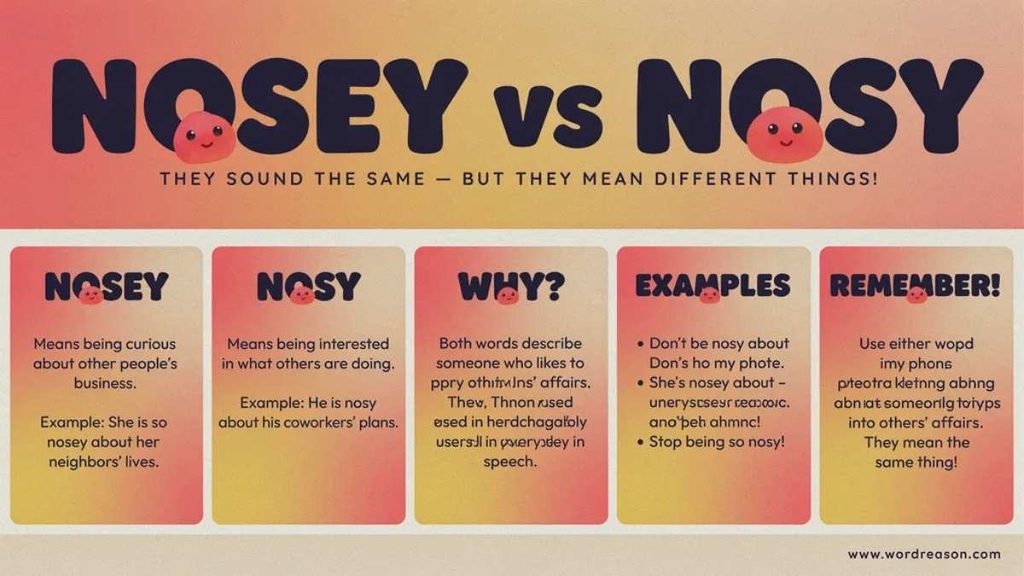
The most important point in the nosey vs nosy debate is that the two spellings generally have the same meaning.
You don’t need to memorize two separate definitions.
Is There a Difference in Meaning?
No significant difference exists in ordinary modern English.
Both nosy and nosey describe someone who is excessively interested in other people’s affairs.
Consider these examples
She is being nosy about my personal life.
She is being nosey about my personal life.
The meaning remains essentially unchanged.
This is why dictionaries treat the two spellings as variants rather than completely different words.
Which Spelling Is More Common?
For American English, nosy is generally the preferred choice.
Oxford’s American English dictionary lists nosy as the main entry and nosey as an alternative.
That doesn’t make nosey incorrect. It simply means that nosy is the more familiar default for many American readers.
Nosy vs Nosey at a Glance
| Feature | Nosy | Nosey |
|---|---|---|
| Correct English word | Yes | Yes |
| Part of speech | Adjective | Adjective |
| Basic meaning | Excessively curious | Excessively curious |
| Pronunciation | Same | Same |
| American English | Very common | Accepted alternative |
| British English | Used | Commonly used |
| Formality | Informal | Informal |
| Meaning difference | None in normal use | None in normal use |
Therefore, nosy correct spelling and nosey correct spelling can both be considered correct.
The best choice depends on your audience and writing style.
Learn the difference between confusing more English words
Time Off vs Time-Off Understanding the Hyphen Rule
Why Are There Two Spellings?
English spelling doesn’t always follow one perfectly consistent formula.
The two forms nosy and nosey developed from the word nose and its figurative connection with curiosity and interference.
The spelling nosey keeps the visual connection to the noun nose.
The spelling nosy drops the final e before adding the -y ending.
Neither spelling changes the basic meaning.
Why Does “Nosey” Have an Extra E?
The spelling nosey is easy to understand if you look at its connection with nose.
You can think of it as
nose + y = nosey
The shorter spelling follows a different spelling pattern
nos + y = nosy
English contains many words with competing or variant spellings. Once a spelling becomes established through regular use and dictionaries recognize it, it can remain part of the language.
That’s why nosey isn’t simply a misspelling of nosy.
Is “Nosey” a Real Word?
Yes.
If you’ve searched is nosey a word, the answer is straightforward: yes.
Oxford lists nosey as an adjective and identifies nosy as its alternative. Cambridge also recognizes the form.
So, if someone writes
Don’t be so nosey.
The spelling may differ from the preferred form in some contexts, but it isn’t automatically an error.
Learn the difference between confusing more English words
Patients vs Patient Meaning Difference and Correct Usage
The Origin and History of Nosy vs Nosey
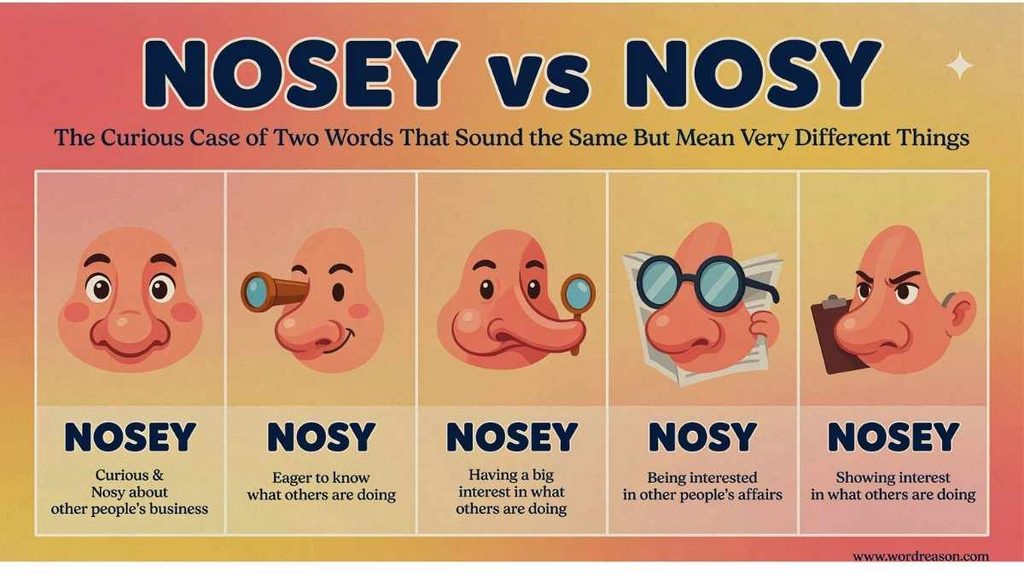
The history behind nosy explains why the word has such a strong connection with curiosity.
The word comes from nose, with the suffix y.
Historical evidence shows that nosy/nosey was first used in a physical sense connected with having a prominent nose. The modern meaning involving excessive curiosity appeared later.
The Online Etymology Dictionary dates the physical sense to the early 17th century and records the modern inquisitive sense from the 19th century.
Where Does the Word Come From?
The connection begins with the literal nose.
English has long used the nose in figurative expressions involving attention or interference.
Consider
- Stick your nose into something.
- Put your nose in someone’s business.
- Under your nose.
- Turn up your nose.
These expressions helped establish the nose as a useful metaphor for getting involved in matters that may not concern you.
The adjective nosy fits naturally into this pattern.
How the Meaning Developed
The early physical meaning of nosy/nosey referred to having a prominent nose.
Over time, the word developed its modern figurative sense: someone who is overly interested in other people’s affairs.
The modern meaning is recorded from the late 19th century.
A related expression is nosy parker, a British informal term for an inquisitive or meddlesome person. Oxford describes it as an expression that is becoming old-fashioned.
The history is useful because it explains why the word feels connected to the idea of someone “sticking their nose” into another person’s business.
Learn the difference between confusing more English words
YNS Meaning What YNS Means in Texting and Slang
American English vs British English
Regional usage can make the nosy vs nosey question seem more complicated than it really is.
Neither spelling belongs exclusively to one country.
However, the frequency and familiarity of each form can vary.
Nosy in American English
In American English, nosy is the natural default for many writers.
Examples include
- My nosy neighbor knows everyone’s business.
- Don’t be nosy.
- He asked a nosy question.
- She can be incredibly nosy.
- I wasn’t trying to be nosy.
If your content targets US readers, nosy American English is generally the spelling to choose.
Nosey in British English
Nosey is well established in British English.
For example
- Don’t be so nosey.
- She’s always been a little nosey.
- The neighbors were rather nosey.
- He asked a nosey question.
However, British writers can also use nosy.
Therefore, it would be inaccurate to say that British English uses only nosey.
Which Spelling Should You Use?
Use this practical guide:
| Audience | Good default |
|---|---|
| American readers | Nosy |
| British readers | Nosey or nosy |
| International readers | Either |
| Formal US writing | Avoid the word if a more precise term works |
| Casual writing | Either |
| US-focused SEO content | Nosy |
When you’re uncertain, nosy is the safest choice for a US audience.
Nosy vs Nosey in Different Contexts
Spelling is only half the story. The other half is knowing when the word fits.
Everyday Conversations
In everyday speech, nosy is common and informal.
Examples
- My sister is nosy about everything.
- Don’t be nosy. You’ll find out tomorrow.
- Our nosy neighbor asked who was visiting.
- I wasn’t trying to be nosy.
- Why are you being so nosy?
The expression nosy neighbors is especially common because neighbors often see or hear things happening around them.
Workplace Communication
In the workplace, nosy can sound too personal or judgmental.
For example:
Mark is nosy about everyone’s salary.
That sentence is understandable, but it may sound blunt.
A more neutral version would be
Mark often asks questions about information that employees prefer to keep private.
The second sentence focuses on the behavior rather than labeling the person.
Still, nosy can work in casual workplace conversation when the relationship and tone make it appropriate.
Academic and Formal Writing
The word nosy is informal.
As a result, academic and professional writers may prefer more precise alternatives.
Consider
- intrusive
- prying
- overly curious
- inquisitive
- meddlesome
For example
Informal
The journalist was being nosy.
More formal
The journalist asked intrusive questions about the person’s private life.
The second sentence is more suitable for a formal report.
Social Media and Texting
Social media and text messages often use nosy in a playful way.
Examples include
- Not to be nosy, but are you two dating?
- Okay, I’m being nosy, but what happened?
- My nosy friends already figured it out.
The phrase not to be nosy is especially useful because it signals that the speaker realizes the question might be personal.
Common Grammar Patterns With Nosy
Knowing the nosy usage patterns can help you avoid awkward sentences.
Nosy as an Adjective
Nosy is an adjective.
It can describe people, questions, behavior, and similar things.
Examples
She is nosy.
He asked a nosy question.
My nosy neighbor called again.
Their nosy behavior annoyed everyone.
The adjective can appear before a noun or after a linking verb such as is, was, or seems.
Comparative and Superlative Forms
The common comparative and superlative forms are
- nosy
- nosier
- nosiest
Examples
My brother is nosier than my sister.
That was the nosiest question of the evening.
The noun form is nosiness.
For example
Her nosiness became difficult to tolerate.
Common Phrases With Nosy
Common expressions include
- nosy neighbor
- nosy neighbors
- nosy person
- nosy people
- nosy questions
- nosy behavior
- being nosy
- too nosy
- don’t be nosy
- stop being nosy
You can also encounter the same phrases with nosey.
For example
She has a very nosey neighbor.
The meaning remains the same.
Nosy vs Noisy Don’t Mix Them Up
Here’s where spelling confusion can create a completely different meaning.
Nosy and noisy are not variants of the same word.
They mean completely different things.
Nosy means excessively interested in other people’s private affairs.
Noisy means making or producing a lot of sound.
Compare these sentences
My nosy neighbor asks too many personal questions.
The neighbor is overly curious.
My noisy neighbor plays loud music every night.
The neighbor makes too much sound.
Nosy vs Noisy Examples
| Word | Meaning | Example |
|---|---|---|
| Nosy | Too interested in private matters | She’s nosy about everyone’s relationships. |
| Noisy | Producing a lot of sound | The restaurant was noisy. |
A useful memory trick is
Nosy → nose → sticking your nose into someone’s business.
Noisy → noise → sound.
The words also have different origins. Nosy comes from nose + -y, while noisy comes from noise + y.
Common Mistakes With Nosy and Nosey
Even though both spellings are accepted, several mistakes appear regularly.
Treating Nosey as Incorrect
One common assumption is that nosey must be wrong because nosy looks more familiar.
That’s not accurate.
Dictionaries recognize nosey as an established variant.
If your style guide or audience prefers nosy, use it. However, don’t automatically label nosey a spelling error.
Assuming the Two Spellings Have Different Meanings
There isn’t a hidden meaning difference between the two forms in ordinary modern English.
Both describe excessive interest in someone else’s affairs.
Confusing Nosy With Noisy
This mistake can change the entire sentence.
He’s nosy.
He asks too many personal questions.
He’s noisy.
He makes too much sound.
Always check the meaning before choosing the spelling.
Using Nosy in the Wrong Tone
Although nosy is a common word, it can sound insulting.
If you want to set a boundary without sounding confrontational, you could say:
I’d rather keep that private.
Instead of
You’re being nosy.
The best word depends on your relationship with the person and the sensitivity of the subject.
Switching Between Spellings Without a Reason
If you choose nosy at the beginning of an article and switch to nosey later, readers may assume the difference is meaningful.
Unless you’re discussing the spelling variants themselves, consistency usually produces cleaner writing.
Nosy vs Nosey Example Sentences
Examples make the spelling distinction much easier to remember.
1.Examples With Nosy
- My nosy neighbor asked where I was going.
- Don’t be nosy about her personal life.
- He asked a nosy question about my salary.
- I wasn’t trying to be nosy.
- The children were nosy about the wrapped gift.
- His nosy questions made everyone uncomfortable.
- That reporter was criticized for being too nosy.
2.Examples With Nosey
- My nosey neighbor wanted to know who had visited.
- Don’t be nosey about his relationship.
- She can be a little nosey sometimes.
- He asked a nosey question about their plans.
- The children were nosey about the surprise.
The important thing to notice is that changing nosy to nosey doesn’t change the basic meaning.
Side by Side Examples
| Nosy | Nosey |
|---|---|
| She is nosy. | She is nosey. |
| Don’t be nosy. | Don’t be nosey. |
| He asked a nosy question. | He asked a nosey question. |
| My nosy neighbor called again. | My nosey neighbor called again. |
Synonyms for Nosy
Sometimes nosy isn’t the best word for your sentence.
Depending on your intended tone, you can choose another word.
Useful alternatives include
- prying
- intrusive
- inquisitive
- curious
- meddlesome
- interfering
- overly curious
However, these words aren’t exact replacements in every context.
Nosy vs Inquisitive
Inquisitive often has a positive or neutral meaning.
The inquisitive student asked several thoughtful questions.
That sounds complimentary.
By contrast
The nosy neighbor asked several personal questions.
That sounds critical.
Nosy vs Prying
Prying often sounds stronger than nosy.
Compare
She was curious about the new project.
This is neutral.
She was prying into his personal life.
This suggests deliberate intrusion.
Therefore, consider the emotional strength of each word before replacing nosy with a synonym.
How to Choose Between Nosy and Nosey
The simplest way to choose is to consider your audience.
For US English
Use nosy as your default.
For example
The nosy neighbor kept asking questions.
This is natural for American readers.
For UK English
Both forms are established.
Nosey may feel especially familiar to British readers, while nosy is also used and understood.
For SEO and Online Content
If you’re writing an article targeting searches such as nosey vs nosy, nosy vs nosey, or nosey vs nosy, don’t repeat the exact keyword in every paragraph.
A stronger approach is to answer the user’s search intent naturally.
Use related phrases where they genuinely fit, including:
- nosy spelling
- nosey spelling
- correct spelling of nosy
- correct spelling of nosey
- nosy meaning
- nosey meaning
- nosy definition
- nosey definition
- nosy pronunciation
- nosey pronunciation
- nosy American English
- nosey British English
- nosy vs noisy
- nosy neighbors
- nosy person
The goal is simple: answer the reader’s question thoroughly instead of stuffing keywords into every sentence.
A Practical Case Study Which Spelling Should You Choose?
Consider three writers working for three different audiences.
1. Case Study 1 An American Grammar Website
A grammar website targets readers in the United States.
The writer chooses
Don’t be nosy about your coworker’s private life.
That’s a sensible choice because nosy is the familiar default in American English.
2. Case Study 2 A British Lifestyle Magazine
A British magazine chooses
Her nosey neighbors wanted to know everything about the new family.
That spelling works naturally in British English.
3. Case Study 3 A Global English Website
A global website wants readers from different English-speaking regions to understand the article.
The writer can state
Nosy is the primary spelling used in this guide. Nosey is also an accepted variant.
That brief explanation removes confusion without forcing both forms into every sentence.
Here’s a trusted source for clear more words Comparison
Nosy vs Nosey Quick Reference Table
| Question | Answer |
|---|---|
| Is it nosy or nosey? | Both are correct. |
| Which is correct, nosy or nosey? | Both are accepted spellings. |
| Is nosy a word? | Yes. |
| Is nosey a word? | Yes. |
| What does nosy mean? | Too interested in other people’s affairs. |
| What does nosey mean? | Essentially the same as nosy. |
| Is nosy the standard spelling? | It is a common standard form, especially in US English. |
| Is nosey an accepted spelling? | Yes. |
| Is nosy used in British English? | Yes. |
| Is nosey used in American English? | Yes, as an accepted variant. |
| Is nosy the same as noisy? | No. |
| What is another word for nosy? | Prying, intrusive, inquisitive, or overly curious, depending on context. |
Practice Session Nosy vs Nosey?
1.Choose the Correct Spelling
- My ______ neighbor always asks about my personal life.
(nosy / nosey) - Don’t be so ______. That’s private information.
(nosy / nosey) - She became ______ when she heard her coworkers talking.
(nosy / nosey) - The ______ reporter kept asking personal questions.
(nosy / nosey) - His ______ questions made everyone uncomfortable.
(nosy / nosey)
2.Choose Nosy or Noisy
- The classroom became very ______ during lunch.
(nosy / noisy) - My ______ neighbor wanted to know where I was going.
(nosy / noisy) - The children were too ______ to hear the teacher.
(nosy / noisy) - She didn’t mean to be ______ she was simply curious.
(nosy / noisy) - The construction work outside was extremely ______.
(nosy / noisy)
Complete the Sentences
Fill in each blank with nosy, nosey, or noisy.
- Why are you being so ______ about my plans?
- The party next door was incredibly ______.
- He asked a few ______ questions about her salary.
- My ______ neighbor watches everyone coming and going.
- The office became ______ after the meeting ended.
- She apologized for being ______ and asking about his relationship.
- That ______ reporter wouldn’t stop asking personal questions.
- The street was too ______ for us to have a conversation.
- Don’t be ______. Let people keep some things private.
- Her ______ behavior annoyed the entire family.
Challenge Questions
- Which word means overly curious about another person’s private affairs?
(nosy / noisy) - Which word means making a lot of sound?
(nosy / noisy) - Is nosey an accepted spelling?
(Yes / No) - Which spelling is generally more common in American English?
(nosy / nosey) - Do nosy and nosey usually have different meanings?
(Yes / No)
Answers
- nosy / nosey
- nosy / nosey
- nosy / nosey
- nosy / nosey
- nosy / nosey
- noisy
- nosy / nosey
- noisy
- nosy / nosey
- noisy
- nosy / nosey
- noisy
- nosy / nosey
- nosy / nosey
- noisy
- nosy / nosey
- nosy / nosey
- noisy
- nosy / nosey
- nosy / nosey
- nosy
- noisy
- Yes
- nosy
- No
Frequently Asked Questions About Nosy and Nosey
What is being nosy?
Being nosy means showing too much interest in other people’s private lives or business.
How do you spell nosey neighbor?
Both nosey neighbor and nosy neighbor are correct. Nosy neighbor is more common in American English.
Do Americans use the word “nosy”?
Yes. Nosy is widely used in American English and is the more common spelling.
Is nosy a real word?
Yes. Nosy is a standard English adjective meaning overly curious about other people’s affairs.
Which is correct, nosy vs nosey?
Both are correct. Nosy is the more common spelling, while nosey is an accepted variant.
What’s a nicer word for nosy?
Curious or inquisitive can sound softer than nosy, depending on the context.
What do Mexicans call nosy people?
In Mexican Spanish, metiche commonly describes a nosy or meddlesome person.
How do you say nosy in a professional way?
Use phrases such as overly curious, asking intrusive questions, or overly interested in private matters.
What is a nickname for a nosey person?
Nosy parker and busybody are common informal terms for a nosy person.
How do I shut down a nosy person?
Politely set a boundary by saying, “I’d rather keep that private.”
What do you call a very nosy person?
You can call them prying, intrusive, meddlesome, or excessively curious.
How do you say nosy?
Nosy has two syllables and rhymes closely with words such as cozy and rosy.
How can you spot a nosy person?
A nosy person often asks unwanted personal questions or repeatedly tries to learn private information.
Is being nosy disrespectful?
It can be, especially when someone ignores personal boundaries or asks intrusive questions.
What is the psychology of nosy people?
Nosy behavior can come from curiosity, boredom, insecurity, or a desire for social information. The reason varies by person.
Is nosey British English?
Nosey is well established in British English, although nosy is also used.
Is nosy the same as noisy?
No. Nosy means overly curious, while noisy means making a lot of sound.
What is another word for nosy?
Common alternatives include prying, intrusive, meddlesome, inquisitive, and overly curious.
Are nosy vs nosey the same?
Yes. Nosy and nosey generally have the same meaning and pronunciation.
What is the best spelling for American English?
For American English, nosy is usually the preferred and more familiar spelling.
What does a nosy neighbor do?
A nosy neighbor may ask personal questions, gossip, or take too much interest in other people’s business.
Is “nosy” rude?
It can sound rude or critical because it often suggests that someone has crossed a privacy boundary.
Final Thoughts Nosey vs Nosy?
The nosey vs nosy debate is much less complicated than it looks. Both nosy and nosey are accepted spellings, and they generally have the same meaning. The main difference is spelling preference, not grammar or meaning. Nosy is the more common choice, especially in American English, while nosey is also widely recognized.j
just remember: nosy means too interested in someone else’s business, while noisy means full of sound. One asks too many questions; the other makes too much noise. So, choose nosy for most US writing, and you’ll have one less spelling mystery to worry about. Your grammar checker can finally relax!

Bella AJS
Bella AJS is an experienced blogger and passionate language enthusiast at WordReason. She specializes in English grammar, word meanings, spelling, and commonly confused words. With a clear and practical writing style, Bella helps readers understand tricky language rules without the textbook headache. Her goal is simple: make English easier, clearer, and more enjoyable one word at a time.