

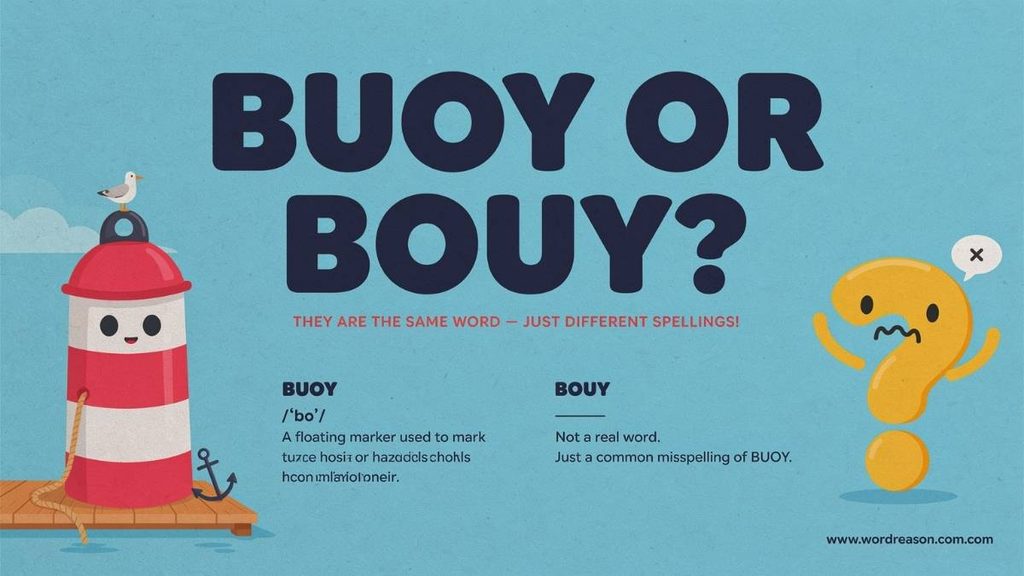
If you are stuck between buoy or bouy, the confusion is understandable. Its unusual letter order does not make the spelling easy to remember, while its pronunciation can make the word even more puzzling. However, the answer is simple buoy is the correct spelling, and bouy is a common spelling mistake. A buoy is a floating object used to guide boats, mark hazards, or identify locations in water. Interestingly, buoy has different accepted pronunciations in American English, while British English commonly uses a one-syllable pronunciation.
Buoy or Bouy Quick Answer
If you are wondering, is it buoy or bouy? the answer is simple: use buoy.
The buoy correct spelling is B-U-O-Y.
Bouy is the common spelling mistake.
| Form | Standard English spelling | Meaning |
|---|---|---|
| Buoy | Yes | A floating marker or device; also a verb |
| Bouy | No | Common misspelling of buoy |
For example, you would write:
The boat passed the red buoy.
You would not write
The boat passed the red bouy.
The second sentence contains a bouy spelling mistake. Although the incorrect form may look reasonable, standard English uses buoy.
This is one of those cases where memorizing the correct word works better than trying to spell it from sound
Learn the difference between confusing more English words
Unformal or Informal Which Spelling Is Correct?.
What Is the Difference?
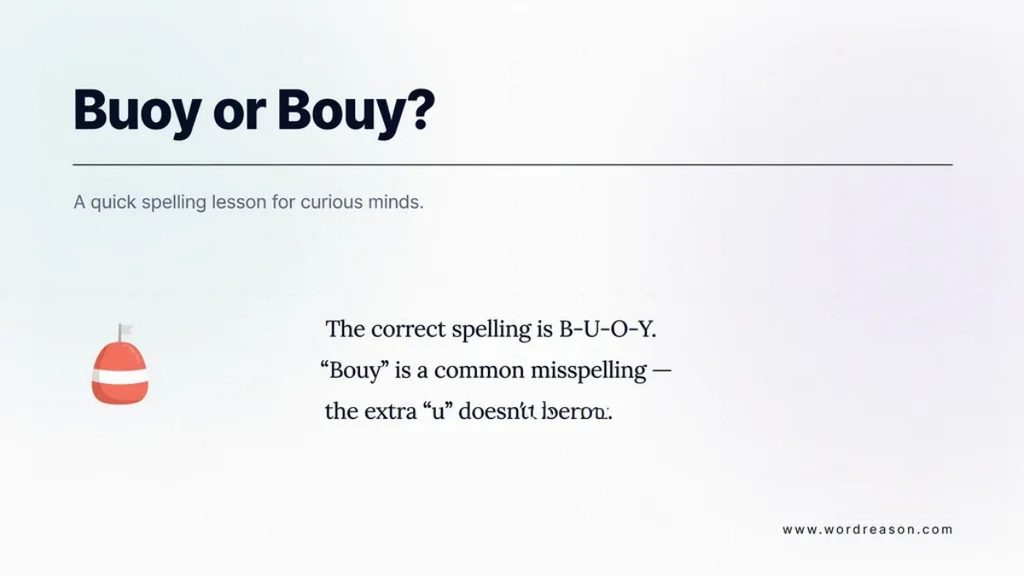
The difference between buoy vs bouy comes down to standard spelling.
Buoy is a real English word. It functions as both a noun and a verb. As a noun, it refers to a floating object used in water. As a verb, it can describe keeping something afloat or giving support and encouragement.
Bouy, however, is not the standard spelling of that word.
That distinction matters because English sometimes allows genuine spelling variations between different varieties of the language. Buoy is not one of those cases. American English and British English both use buoy.
So, if you are asking, is bouy correct? the answer is no when you mean the standard English word.
If you are asking, is buoy correct? the answer is yes.
Learn the difference between confusing more English words
Excel vs Accel which is correct spelling?
What Does Buoy Mean?
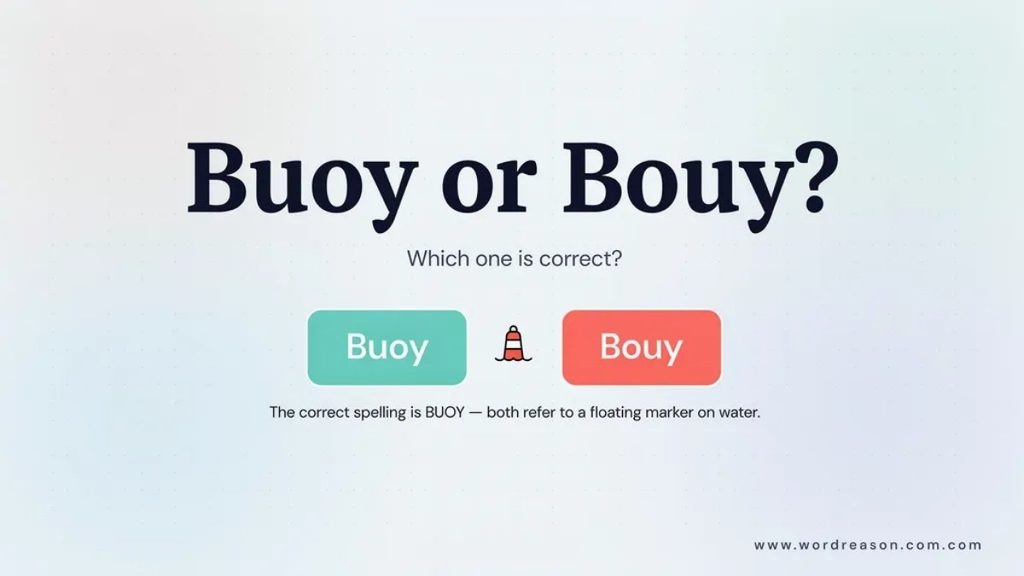
The basic buoy meaning is a floating object placed in water for a particular purpose.
According to Cambridge, a buoy is a floating object on the sea that can direct ships and warn them about possible danger. Oxford similarly defines it as an object that floats on the sea or a river to indicate places that are safe or dangerous for boats.
In everyday language, you can think of a buoy as a marker in the water.
A buoy might tell a boat where to go. It might warn a sailor about a dangerous area. It might mark a channel or provide a place where a boat can attach.
For example
The red buoy marked the edge of the channel.
The boat slowed down as it approached the navigation buoy.
Swimmers stayed inside the area marked by the buoys.
In each example, buoy refers to a physical object floating in water.
Learn the difference between confusing more English words
Bellies or Bellys Which Spelling Is Correct?
What Is a Buoy?
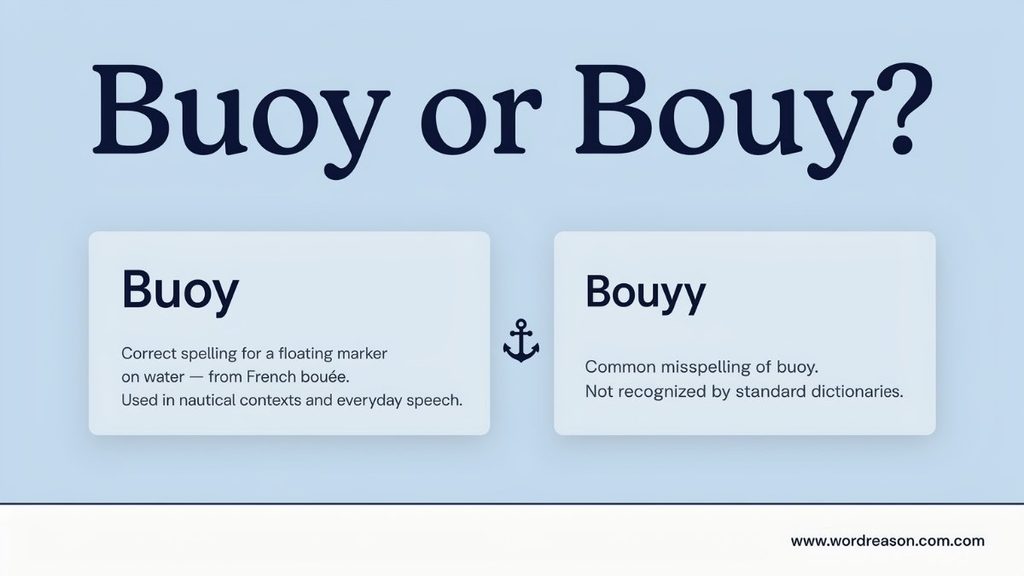
A buoy is usually an anchored or otherwise positioned floating device that serves as a marker, warning sign, navigation aid, or mooring point.
The exact purpose depends on the type of buoy and where it is placed.
For ships and boats, buoys can provide valuable information without requiring a person to stand nearby and point out the route. They can mark channels, hazards, boundaries, or other important locations.
Some buoys also collect environmental information. Ocean and weather monitoring systems can use buoys to gather information about conditions such as waves, wind, temperature, and other measurements.
Therefore, a buoy is much more than a colorful object bobbing around on the water. It can be an important part of marine navigation and ocean observation.
Learn the difference between confusing more English words
Opening or Openning which Spelling is correct?
Is Bouy a Word?
If you are asking, is bouy a word? there is an important distinction to make.
Bouy is not the standard spelling of the English word buoy.
The spelling appears because people often hear the word and try to reconstruct it from its pronunciation. Since the word has unusual spelling, the letters can easily get rearranged.
However, frequent use does not make the spelling standard.
For normal English writing, the correct form is buoy.
An unusual spelling could still appear as part of a brand name, username, surname, title, or other proper name. In that situation, the spelling belongs to that particular name. It does not change the standard English spelling of the common word.
Learn the difference between confusing more English words
Many or Meny Which Spelling Is Correct?
How to Spell Buoy
If you are wondering how to spell buoy, remember these four letters
B-U-O-Y
The most common error switches the middle letters and produces
B-O-U-Y
That gives you bouy.
A simple way to remember the correct order is to divide the word into two parts
BU + OY = BUOY
The first part is BU. The second part is OY.
Once you remember that small pattern, the spelling becomes much easier.
So, how do you spell buoy?
You spell it B-U-O-Y.
The correct English word is buoy.
Learn the difference between confusing more English words
Bareable or Bearable Which Spelling Is Correct?
Why Do People Spell this words?
The question why do people spell buoy as bouy? has a lot to do with the relationship between English spelling and pronunciation.
English does not always spell words exactly as they sound. Buoy is a good example.
When someone hears buoy, the sound may not give them enough information to reconstruct the letters. Depending on the speaker, the word can sound like boy or like a two-syllable form similar to boo-ee.
That creates a problem for someone who has learned the word mainly through listening.
The writer knows the sound but does not remember the written pattern. The brain then searches for a familiar arrangement of letters. Because ou is a common letter combination in English, bouy can look perfectly reasonable at first glance.
Unfortunately, reasonable-looking spelling is not always correct spelling.
The established form is buoy.
Learn the difference between confusing more English words
Barrel or Barrell which is the Correct Spelling?
Buoy Spelling Confusion Sound vs Spelling
The buoy spelling confusion becomes easier to understand when you separate pronunciation from spelling.
English contains many words whose written forms do not directly reveal their pronunciation. Buoy takes this a step further because different English varieties use different pronunciations.
Cambridge lists /bɔɪ/ in UK English and lists both /bɔɪ/ and /ˈbuː.i/ in US English. Oxford also records both pronunciations in American English.
Therefore, the spelling does not need to change simply because the pronunciation changes.
The same written word remains buoy.
This is an important point because some learners assume that bouy might be an American or British spelling. It is not. The spelling stays the same across standard American and British English.
Learn the difference between confusing more English words
Speach or Speech Which Is the Correct Spelling?
Buoy Pronunciation
The buoy pronunciation is one of the main reasons the word causes spelling problems.
In one common pronunciation, buoy sounds like boy. In another accepted American pronunciation, it has two syllables and sounds roughly like boo-ee.
Cambridge lists the UK pronunciation as /bɔɪ/ and gives both /bɔɪ/ and /ˈbuː.i/ for US English.
That means you may hear different speakers pronounce the same word differently.
This also explains why the phrase buoy pronunciation can produce different answers depending on the dictionary or speaker.
Bouy Pronunciation in American English
American English recognizes two pronunciations of buoy.
One pronunciation has one syllable and sounds like boy.
Another has two syllables and is represented by Cambridge as /ˈbuː.i/. Oxford also records both forms in its American English dictionary.
Neither pronunciation changes the spelling.
The word remains buoy.
Buoy Pronunciation in British English
British English commonly uses the one-syllable pronunciation /bɔɪ/, which sounds like boy. Cambridge lists this as the UK pronunciation.
Again, the spelling does not change.
So, the buoy vs bouy pronunciation question should not lead you to create a second spelling. Bouy is not the British form of buoy.
Learn the difference between confusing more English words
Studder or Stutter Which Spelling Is Correct?
Pronunciation
There is no separate standard bouy pronunciation to memorize.
If someone writes bouy but means the floating marker, they normally intend the word buoy.
The correct approach is to correct the spelling rather than treat bouy as another English word.
This is especially important in formal writing. A reader may understand what you mean, but a spelling error can still make the writing look careless.
Learn the difference between confusing more English words
Happened or Happend which spelling is correct?
Buoy as a Noun
As a noun, buoy refers to the physical floating object.
For example
The sailor noticed a buoy near the harbor.
The buoy marked the entrance to the channel.
Several buoys warned boats about the shallow water.
Here, the word describes something you can physically see in the water.
A buoy can have different designs and purposes. Some mark navigation routes, some warn about hazards, and others provide mooring points.
The key idea remains the same: it is a floating marker or device used in water.
Learn the difference between confusing more English words
Monkeys or Monkies Which Spelling Is Correct?
Buoy as a Verb
Buoy also works as a verb, and this is where the word moves beyond maritime vocabulary.
Cambridge gives three important verb meanings. Buoy can mean to prevent someone or something from sinking, to make someone feel happier or more confident, and to support something so that it becomes more successful.
For example
The life jacket buoyed her up in the water.
The good news buoyed his spirits.
Strong sales buoyed the company.
The first example uses the physical sense. The second uses the emotional sense. The third uses the figurative sense of support.
The meanings may look different, but they share the same basic idea of support.
Buoy Up Meaning
The phrase buoy up means to support, encourage, or make someone feel happier or more confident.
For example
The team was buoyed up by its recent victory.
Here, the victory gave the team greater confidence.
The phrase can also describe something that receives support:
Strong demand buoyed up the market.
Oxford gives examples of buoy used for keeping something afloat, making someone feel cheerful or confident, and helping maintain prices at a high or acceptable level.
Therefore, you can encounter buoy in conversations about emotions, business, economics, and success as well as in discussions about water.
Buoy Origin
The buoy origin is older and more complicated than its modern spelling suggests.
Oxford traces the noun to Middle English and says it probably came from Middle Dutch forms such as boye and boeie, from a Germanic base associated with the meaning “signal.” Oxford also notes that the verb has a different route, connecting it with Spanish boyar, meaning to float, from boya, meaning buoy.
This history helps explain why the modern word does not look completely predictable from its pronunciation.
English has borrowed words from many languages throughout its history. As those words entered English, their forms and pronunciations changed over time.
So, the unusual spelling of buoy is not a modern mistake. The word has a long linguistic history.
American English vs British English Buoy or Bouy
One common question is whether buoy and bouy represent different varieties of English.
They do not.
The standard spelling is buoy in both American English and British English.
The main difference appears in pronunciation.
| Feature | American English | British English |
|---|---|---|
| Standard spelling | Buoy | Buoy |
| Standard alternative | None | None |
| Common pronunciation | “boy” or two-syllable form | “boy” |
| Noun use | Yes | Yes |
| Verb use | Yes | Yes |
| Plural | Buoys | Buoys |
Therefore, if someone tells you that bouy is the British spelling, that information is incorrect.
British English does not replace buoy with bouy.
Common Buoy Spelling Mistakes
The biggest spelling mistake is simply writing bouy instead of buoy.
For example
Incorrect The ship passed the bouy.
Correct The ship passed the buoy.
Another common problem occurs when writers assume that pronunciation should determine spelling.
That approach does not work well with buoy because the pronunciation can vary.
A third mistake involves the plural.
The plural is buoys, not bouys.
Correct
The buoys marked the safe route.
Incorrect
The bouys marked the safe route.
Once you remember the base spelling, the plural becomes straightforward.
Common Uses of Buoy
Buoy appears in several areas of English.
1.In maritime vocabulary, it commonly describes floating markers used by boats and ships.
2.In navigation vocabulary, it can refer to an object that identifies a channel, hazard, boundary, or safe route.
3.In safety contexts, a buoy can mark an area where people should swim or stay away.
4.In environmental science, buoys can collect information about ocean and weather conditions.
5.In figurative English, the verb buoy can mean to encourage or support.
6.This range explains why buoy is not limited to sailors or maritime professionals.
Types of Buoys
A navigation buoy helps guide vessels through a waterway. It can identify a channel or indicate where boats should travel.
A mooring buoy provides a point where a boat can be secured. Instead of dropping an anchor, a vessel can attach to the designated mooring system.
A weather buoy supports ocean and weather observation. Depending on the system, it can collect information about waves, wind, temperature, atmospheric conditions, and other environmental factors.
A marker buoy can identify a particular area, boundary, hazard, or location.
Although these types serve different purposes, they all fit the basic buoy definition: a floating object or device used for a specific purpose in water.
Buoy vs Boy
Buoy and boy can sound identical in common pronunciation, but their meanings are completely different.
IT refers to a floating marker or device. Boy normally refers to a male child or young male person.
Consider these sentences
The boat passed the buoy.
The boy watched the boat.
The words sound alike in many varieties of English, but the context makes their meanings clear.
This is another reason spelling matters. When two words sound alike, the written form helps readers understand which word you mean.
Buoy vs Buoyant
Buoy and buoyant are related words, but they have different grammatical roles.
IT can be a noun or a verb.
Buoyant is an adjective.
For example
The buoy floated near the boat.
The material is buoyant.
Buoyant can describe something that floats easily. It can also describe a cheerful, confident, or optimistic mood.
For example
She remained buoyant despite the difficult circumstances.
The words are connected through the idea of floating and support, but they do not have the same grammatical function.
Buoy vs Beacon
Buoy and beacon can both relate to navigation, but they describe different things.
A buoy is generally a floating marker in water.
A beacon is a signal or marker that helps people identify a location, direction, danger, or other point of interest. A beacon can use light or another visible signal.
Therefore, a buoy may serve as a navigational aid, while a beacon is a broader type of signaling device.
The two words can appear in similar discussions, but they are not interchangeable.
What Is the Plural of Buoy?
The plural of buoy is buoys.
That means
One buoy.
Two buoys.
Several buoys.
The word simply takes the normal plural ending s.
There is no change to the internal spelling.
The correct forms are
Buoy
Buoys
The incorrect forms are
Bouy
Bouys
This small detail causes fewer problems once the correct base spelling becomes familiar.
Buoy in Real Sentences
The best way to understand buoy is to see how it behaves in real sentences.
The fishing boat passed a yellow buoy near the harbor.
The navigation buoy marked the entrance to the channel.
The sailor attached the boat to a mooring buoy.
The warning buoy showed that the area was unsafe for swimmers.
The encouraging response buoyed her spirits.
The strong sales figures buoyed investor confidence.
The first four examples use buoy as a noun. The final two use buoy as a verb.
Notice the transition from physical support to figurative support. That connection is central to understanding the word.
Why Buoy Is Misspelled as Bouy
The common misspelling bouy makes sense when you consider how people learn words.
A person may hear buoy several times without seeing it written. Later, when that person needs to write it, the brain tries to recreate the spelling.
Because English contains many words with ou, the sequence bouy may seem familiar.
However, English spelling often preserves historical patterns that pronunciation no longer reveals clearly.
That is exactly what happens here.
Instead of trying to invent the spelling every time, remember the established form
Buoy.
The correct spelling has U before O.
Buoy Spelling A Simple Memory Method
A simple memory method is to remember the word as
BU + OY
That gives
BUOY
Another useful association is to picture a buoy floating on water while mentally connecting the image with the unusual four-letter spelling.
The goal is not to create a complicated spelling rule. The goal is to make the correct pattern familiar.
After you have seen and written buoy several times, the word stops looking strange.
Buoy or Bouy Quick Comparison
| Question | Correct answer |
|---|---|
| Is it buoy or bouy? | Buoy |
| What is the buoy correct spelling? | B-U-O-Y |
| Is bouy correct? | No |
| Is buoy correct? | Yes |
| Is bouy a standard English word? | No |
| What is a buoy? | A floating object or device used in water |
| What does buoy mean? | It can mean a floating marker, or as a verb, to support, encourage, or keep afloat |
| How do you spell buoy? | B-U-O-Y |
| What is the plural of buoy? | Buoys |
| Is buoy spelled differently in British English? | No |
| Is buoy spelled differently in American English? | No |
| Can buoy be a verb? | Yes |
| Can buoy describe emotions? | Yes |
| Is bouy a common misspelling? | Yes |
Practice Session Buoy or Bouy?
Test your understanding of the correct plural spelling of monkey. Complete each sentence with the correct word or form.
- The sailor spotted a red ___ near the harbor.
- The ___ marked the shallow area of the water.
- Several ___ guided the boats through the channel.
- I always forget how to spell ___.
- The ship passed safely between the ___.
- The floating ___ warned sailors about the rocks.
- The correct spelling is ___, not bouy.
- A ___ can help boats navigate safely.
- The crew repaired the damaged ___.
- The yellow ___ was easy to see from the shore.
- The captain followed the ___ along the marked route.
- The storm moved the ___ away from its usual position.
- The ___ indicated a restricted area.
- Many students make the spelling mistake ___.
- The boat stopped beside the ___.
- The ___ was anchored near the entrance to the harbor.
- Can you spell ___ correctly?
- The navigation ___ helped the crew stay on course.
- The red ___ marked a dangerous section of water.
- Several ___ floated near the coastline.
- The word ___ contains the letters U-O-Y.
- The damaged ___ needed to be replaced.
- A ___ can serve as a warning marker.
- The sailor checked the position of each ___.
- Never write ___ when you mean the floating marker.
Answer Key
- buoy
- buoy
- buoys
- buoy
- buoys
- buoy
- buoy
- buoy
- buoy
- buoy
- buoy
- buoy
- buoy
- bouy
- buoy
- buoy
- buoy
- buoy
- buoy
- buoys
- buoy
- buoy
- buoy
- buoy
- bouy
FAQs
What is the correct spelling buoy or bouy?
Buoy is the correct spelling. Bouy is a common misspelling.
Is bouy a word?
No. Bouy is not the standard spelling of the word buoy.
How do you spell buoy?
Buoy is spelled B-U-O-Y.
How is buoy pronounced?
Buoy is commonly pronounced like boy in British English. American English also uses a two-syllable pronunciation.
What does buoy mean?
A buoy is a floating object used to mark locations, guide boats, or warn of danger in water.
What is the plural of buoy?
The plural of buoy is buoys.
Is it boy or buoy?
They are different words. Boy refers to a male child, while buoy refers to a floating marker or device used in water.
Why do people spell buoy as bouy?
The unusual letter order in buoy makes it easy to misspell as bouy, especially when spelling from memory.
Can buoy be used as a verb?
Yes. Buoy can mean to support, encourage, or make someone feel happier or more confident.
What is the difference between buoy and buoyancy?
Buoy is a floating object or a verb. Buoyancy refers to the ability to float or stay supported in a fluid.
AEO Questions
Is buoy the correct spelling?
Yes. Buoy is the standard English spelling; bouy is incorrect.
What is a buoy?
A buoy is a floating marker used in water to guide boats, mark hazards, or identify locations.
How do you remember the spelling of buoy?
Remember the letter order B-U-O-Y. The U comes before the O.
What does buoy up mean?
Buoy up means to support, encourage, or make someone feel more positive.
How is buoyancy pronounced?
Buoyancy is pronounced with three syllables, with the first syllable sounding like the common pronunciation of buoy.
conclusion
When it comes to buoy or bouy, the mystery is finally floating away. Buoy is the correct spelling, while bouy is simply a common spelling mistake. The tricky U O Y order may look unusual, but it becomes much easier once you remember it. A buoy can mark hazards, guide boats, or identify locations in the water, and it can also work as a verb meaning to support or encourage. Its pronunciation may add another splash of confusion, especially because American and British English can differ. So, before you let that spelling mistake drift into your writing, remember B U O Y. One small spelling check can keep your sentence safely on course.

Bella AJS
Bella AJS is an experienced blogger and passionate language enthusiast at WordReason. She specializes in English grammar, word meanings, spelling, and commonly confused words. With a clear and practical writing style, Bella helps readers understand tricky language rules without the textbook headache. Her goal is simple: make English easier, clearer, and more enjoyable one word at a time.