The confusion between happened or happend is a common spelling mistake, especially when you’re typing quickly or relying on how the word sounds. The good news is that the correct spelling is simple happened. The spelling happend is incorrect in standard English. In this guide, you’ll learn what happened means, why it has two p’s, how to spell and pronounce it correctly, and how to use it in sentences. You’ll also discover easy ways to avoid this surprisingly stubborn spelling mistake for good.
Happened or Happend Which Spelling Is Correct?
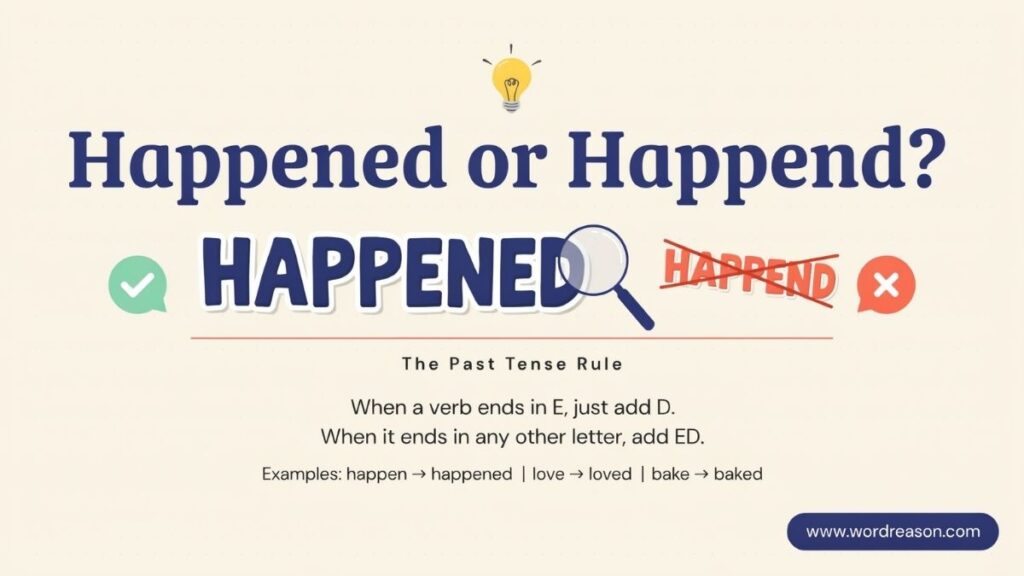
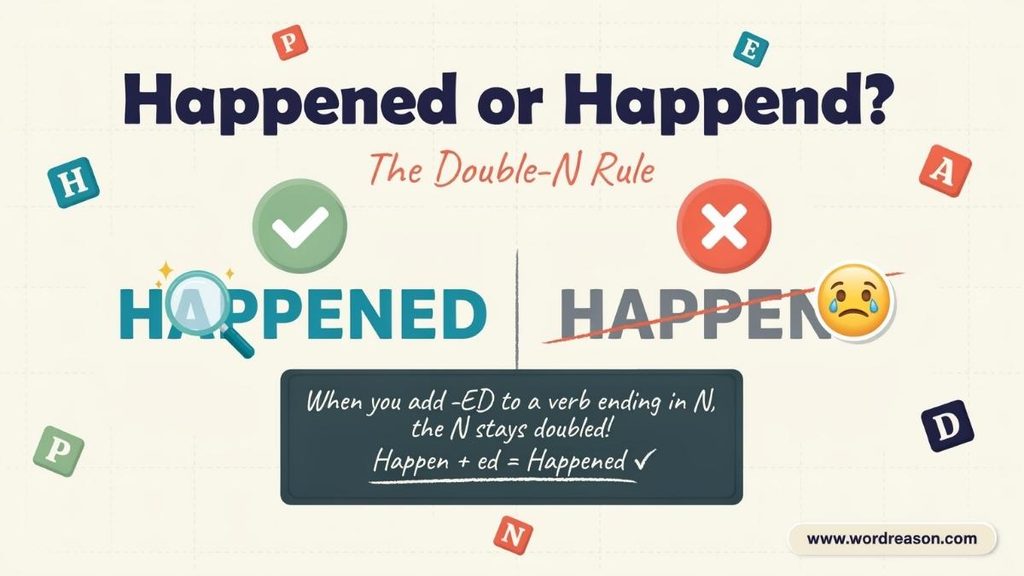
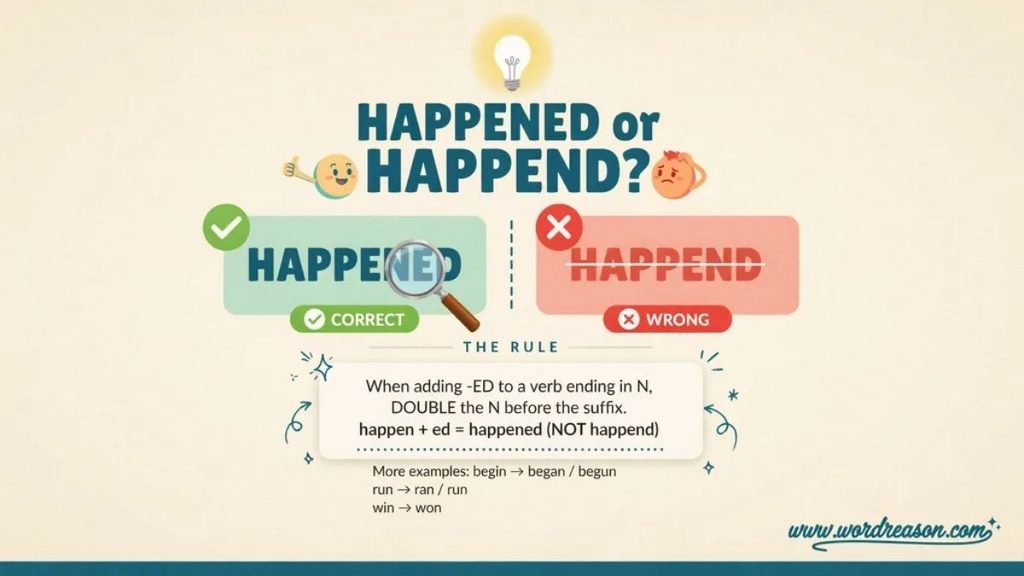
Happened is the correct spelling. Happend is incorrect in standard English.
The word comes from the verb happen, which means to take place or occur. When you use this regular verb in the simple past tense, you add the ending ed
happen + ed = happened
That gives you the standard spelling
happened — correct
happend — incorrect
The mistake usually occurs because the second e isn’t strongly heard when you pronounce the word. When people write from sound alone, they may leave that letter out.
Consider these examples
“What happened after the meeting?”
“The accident happened early in the morning.”
“Something unexpected happened yesterday.”
“I don’t know what happened.”
In every example, happened needs the e before the final d.
Learn the difference between confusing more English words
Time Off vs Time-Off Understanding the Hyphen Rule
Quick Comparison
| Word | Correct? | Meaning or Role | Example |
|---|---|---|---|
| happened | Yes | Past tense and past participle of happen | “It happened yesterday.” |
| happend | No | Common misspelling | “It happend yesterday.” |
So, if you’re asking happened or happend which is correct, the answer is clear: happened.
There’s no standard English situation in which happend replaces happened.
Learn the difference between confusing more English words
Patients vs Patient Meaning Difference and Correct Usage
What Does it Mean?
Happened is the past form of happen. It tells you that something took place or occurred in the past.
The verb happen has a broad meaning. You can use it for ordinary events, unexpected situations, accidents, changes, or things that occur without someone deliberately planning them.
For example
“The meeting happened on Monday.”
“What happened to your phone?”
“A strange thing happened at school.”
“The problem happened because of a software error.”
In simple terms, happened often answers the question:
What took place?
Happened Meaning in Different Contexts
The exact meaning can depend on the situation.
1.When an event took place
“The concert happened last Saturday.”
2. When something unexpected occurred
“A strange thing happened during the trip.”
3. When asking what occurred to someone or something
“What happened to your car?”
When describing a situation that developed
“Several changes happened after the new policy.”
Because the word covers many types of events, happened appears frequently in everyday English.
Learn the difference between confusing more English words
Nosey vs Nosy Which Spelling Is Correct?
Is Happened the Past Tense of Happen?
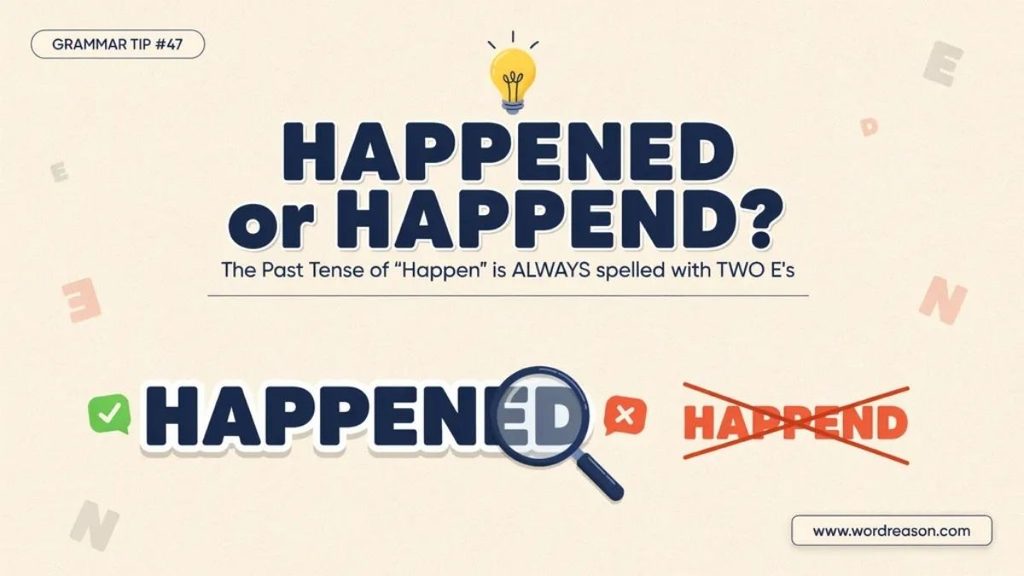
Yes Happened is the simple past form of happen.
It also serves as the past participle. Since happen is a regular verb, the simple past and past participle have the same spelling.
| Verb Form | Word | Example |
|---|---|---|
| Base form | happen | “Things happen.” |
| Third-person singular | happens | “It happens often.” |
| Present participle | happening | “It is happening now.” |
| Simple past | happened | “It happened yesterday.” |
| Past participle | happened | “It has happened before.” |
This distinction matters because happened doesn’t describe a current action by itself.
Compare these sentences
- It happens every Friday — present or habitual
- It happened last Friday— past
- It is happening now — currently in progress
The correct form depends on when the event takes place.
Learn the difference between confusing more English words
in vs On the Same Day no confusion grammar guide
Why Is “Happened” Spelled With Two P’s?
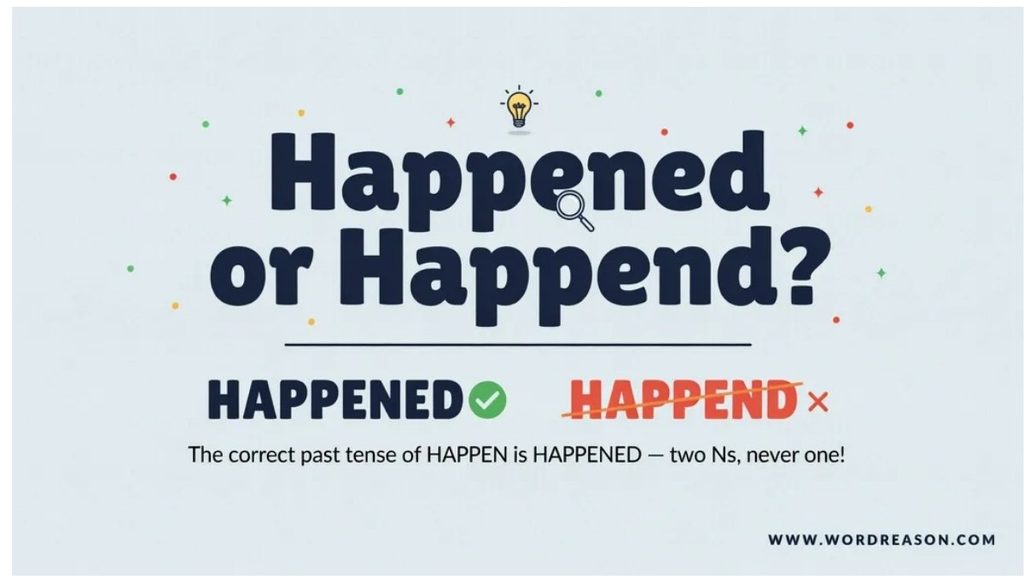
The middle of happened causes another common spelling mistake. Some writers accidentally write hapened because they aren’t sure whether the word needs one or two p’s.
The correct spelling is
h-a-p-p-e-n-e-d
The double p comes from the base word happen. When you add -ed, you don’t remove either of those letters.
Think of the formation like this
HAPPEN → HAPPENED
The base word stays intact while the past-tense ending is added.
This gives you another useful memory trick
HAPPEN + ED = HAPPENED
The word contains both the double p and the e before the final d.
learn the difference between confusing more English words
She or Her the Correct Way to Answer the Phone
How to Pronounce Happened correctly
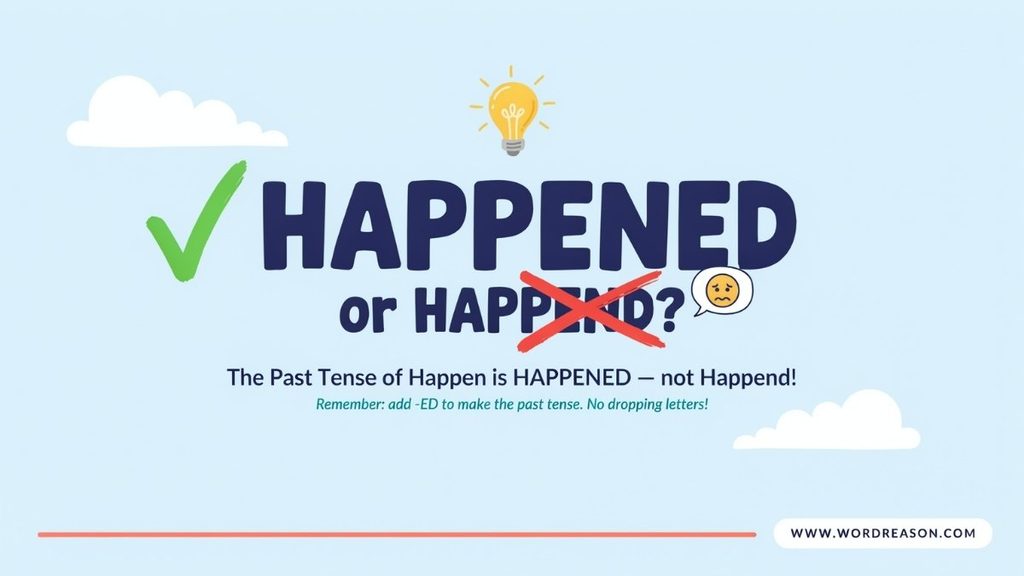
If you’re wondering how to spell happened, the correct spelling is
H-A-P-P-E-N-E-D
Three details deserve special attention
- It begins with happ-.
- It contains two p’s.
- It contains an e immediately before the final d.
The most common incorrect form is
happend — incorrect
The correct form is
happened — correct
Instead of memorizing the entire word letter by letter, start with the base verb
happen
Then add the past-tense ending
happen + ed
The result is
happened
This approach is especially useful when you’re writing quickly.
Learn the difference between confusing more English words
Bougie vs Boujee which one is correct?
How to Pronounce Happened
In standard American English, happened has two syllables. The ed ending doesn’t form a separate third syllable.
The spelling can therefore look slightly different from the way the word sounds in normal conversation. That difference partly explains why people sometimes write happend.
The correct pronunciation is represented as /ˈhæpənd/ in American English.
The first syllable receives the main stress, while the ending is pronounced more lightly.
This is an important spelling lesson English doesn’t always pronounce every written letter as clearly as you might expect. You may not hear the second e distinctly, but you still need it when writing happened.
Learn the difference between confusing more English words
Memento or Momento which is the Correct Spelling?
Happened or Happend How to Use Happened in a Sentence
Once the spelling is clear, the next step is knowing how to use happened naturally.
The word generally describes something that occurred in the past. It can appear in short statements, questions, explanations, and longer sentences.
Simple Past Statements
A basic sentence can follow this pattern
Subject + happened + additional information
Examples
The accident happened yesterday.
The meeting happened at noon.
Something unusual happened last night.
The change happened very quickly.
You can also use happened in a very short sentence:
“It happened.”
That sentence is grammatically complete, although the listener may need additional context to understand what “it” refers to.
Questions With Happened
One of the most common questions in English is
“What happened?”
You can expand it in several ways
- What happened at school?
- What happened to your car?
- What happened after the game?
- Do you know what happened?
- What happened during the meeting?
Learn the difference between confusing more English words
Unformal or Informal Which Spelling Is Correct?
Did Happen or Did Happened?
This is another common grammar trap.
The correct form is
did happen
The incorrect form is
did happened
Why? Because did already marks the past tense. After did, English normally uses the base form of the main verb.
Compare
- What did happen? — correct
- What did happened? — incorrect
The same principle applies to many other verbs
- Did you go?” not “Did you went?
- Did she call?” not “Did she called?
- Did they arrive?” not “Did they arrived?
- Did it happen?” not “Did it happened?
However, did happen can add emphasis.
“Something unusual did happen that night.”
Here, did emphasizes that the event really occurred.
Learn the difference between confusing more English words
Optimize or Optimise which spelling is correct?
Has Happened or Had Happened?
The word happened also appears with helping verbs such as has, have, and had.
The choice depends on the relationship between the event and the present or another past event.
Has Happened
Use has happened when a past event has a connection to the present.
“Something strange has happened.”
The speaker is focusing on the current situation or result.
Had Happened
Use had happened when one past event occurred before another past event.
“The problem had happened before we arrived.”
The sequence is
The problem happened → We arrived
The past perfect makes that order clear.
Quick Comparison
| Form | Typical Use | Example |
|---|---|---|
| happened | Simple past | “It happened yesterday.” |
| has happened | Past event connected to the present | “Something has happened.” |
| had happened | Earlier event before another past event | “It had happened before we arrived.” |
Understanding this difference helps you avoid using happened incorrectly when the sentence needs a helping verb.
Happened vs Happening
IT share the same base verb, but they describe different time relationships.
Happened generally refers to a completed event.
Happening usually refers to something occurring now or continuing over a period.
Compare
“The accident happened yesterday.”
The event occurred in the past.
“The accident is happening now.”
The event is currently taking place.
| Word | Function | Example |
|---|---|---|
| happen | Base form | “Things happen.” |
| happens | Present-tense form | “It happens often.” |
| happened | Past form | “It happened yesterday.” |
| happening | Present participle | “It is happening now.” |
The important point is simple: choose the verb form according to the time and structure of your sentence.
Happened vs Similar Words
English has several words that can replace happened in particular contexts. However, they don’t always carry exactly the same tone or meaning.
Happened vs Occurred
Occurred often sounds more formal than happened.
Compare
“The error happened during testing.”
“The error occurred during testing.”
Both can work, although occurred often fits technical, academic, or formal writing better.
Happened vs Took Place
Took place commonly describes an event, ceremony, meeting, or organized activity.
“The ceremony took place on Saturday.”
This can sound more precise than saying
“The ceremony happened on Saturday.”
Happened vs Arose
Arose works particularly well for problems, situations, opportunities, or needs that developed.
For example
“A problem arose during the project.”
Although “a problem happened” is understandable, arose communicates the idea more naturally in many formal contexts.
The key lesson is that a synonym should match the situation. A more complicated word isn’t automatically a better word.
Common Expressions With Happened
Some phrases containing happened appear so often that they are worth learning as complete patterns.
“What Happened?”
This asks someone to explain a past event.
“You look upset. What happened?”
What Happened To…?
This asks what occurred to a person, object, or situation.
“What happened to your old laptop?”
It Happened Again
This means something similar occurred another time.
“The printer stopped working again. It happened again this morning.”
It Just Happened
This often emphasizes that something occurred very recently.
“The accident just happened.”
It Happened by Accident
This means the event wasn’t intentional.
“The mistake happened by accident.”
As It Happened
This expression can introduce information that turns out to be relevant.
“As it happened, we already had the information.”
These expressions show why happened is such a useful verb in everyday English.
Real Life Examples of Happened
The best way to understand a grammar point is to see how people actually use it.
Everyday Conversation
What happened last night?
I missed the bus, and something unexpected happened afterward.
Nothing happened while you were gone.
I don’t know exactly what happened.
It all happened so quickly.
School and Academic Writing
You can use happened in school writing when the context calls for ordinary language
“The change happened after the temperature increased.”
However, academic writing often favors a more precise verb
“The reaction occurred after the temperature increased.”
The second sentence tells the reader exactly what took place without relying on the broad verb happened.
Workplace Communication
The system error happened during the update.
The meeting happened as scheduled.
A technical problem happened shortly after installation.
In a formal report, you might choose occurred or another specific verb when it improves precision.
Text Messages and Online Conversations
The word appears naturally in casual digital communication:
What happened?
Wait, what happened?
I can’t believe that happened.
How did that happen?
That happened so fast.
The informal setting doesn’t change the spelling. Even in a quick text, the standard form remains happened.
Common Mistakes People Make With Happened
Spelling mistakes involving happened usually come from a small number of patterns.
Writing “Happend” Instead of “Happened”
This is the most common mistake.
“What happend?” — incorrect
“What happened?” — correct
The incorrect version leaves out the e before the final d.
Writing Hapened
Some writers use only one p
“It hapened yesterday.” — incorrect
The base word is happen, so the double p stays when you add -ed.
Writing Happenned
Another error adds an unnecessary n
“It happenned suddenly.” — incorrect
The correct spelling contains only one n before the final e
happened
Writing Did Happened
This mistake involves grammar rather than spelling alone.
“What did happened?” — incorrect
“What did happen?” — correct
After did, use happen, not happened.
Why Is Happend So Easy to Miss?
There’s a good reason this mistake can slip through proofreading.
When you read quickly, your brain doesn’t necessarily examine every letter separately. Familiar words often get recognized as complete patterns. If one letter is missing, the surrounding letters and context may still make the word understandable.
Pronunciation adds another layer of confusion. The e in happened isn’t strongly pronounced as an independent vowel sound. Consequently, someone may type the word according to how it sounds.
That makes happened a classic example of why spelling and pronunciation don’t always line up perfectly.
A useful proofreading technique is to check the ending
happen + ed → happened
Rather than relying entirely on pronunciation, compare the word with its base form.
How to Remember the Correct Spelling of Happened
The easiest memory trick is to avoid memorizing the past tense as a completely separate word.
Start with
happen
Then add
ed
The result is
happened
The Three Step Memory Method
- Step 1 find the base verb
happen
2. Step 2 Add the past-tense ending
happen + ed
3. Step 3 Check the finished word
happened
This method also reminds you to retain the double p.
A Quick Visual Reminder
HAPPEN → HAPPENED
If you type happend, compare it with the base word. You’ll immediately notice that the e before d has disappeared.
That’s often all the reminder you need.
When to Use Happened in Formal Writing
There’s nothing grammatically informal about happened. It’s a standard English verb that can appear in professional and academic writing.
For example
“The incident happened during the final stage of testing.”
The sentence is correct.
However, formal writing often benefits from specificity. Depending on the context, words such as occurred, developed, resulted, or took place may provide more precise information.
Compare
“A problem happened during the procedure.”
with:
“A problem occurred during the procedure.”
The second sentence may fit a technical report more naturally.
Still, replacing every occurrence of happened with a formal synonym can make writing stiff. The best word is the one that expresses the intended meaning clearly.
When Happend Should Be Avoided
If you’re using the past form of happen, don’t use happend.
Correct the spelling in
School assignments
Essays
Resumes
Cover letters
Business emails
Reports
Blog posts
Articles
Presentations
Professional documents
Standard social media posts
A typo may seem minor, but repeated spelling errors can make otherwise strong writing look careless.
A Practical Case Study Correcting Happend
Consider this sentence
“I don’t know what happend during the meeting.”
The meaning is perfectly clear. Yet the spelling is incorrect.
Original
I don’t know what happend during the meeting.
Corrected
I don’t know what happened during the meeting.
Why Is the Correction Necessary?
The base verb is happen.
Add -ed
happen + ed = happened
The sentence therefore needs happened, not happend.
This example highlights an important proofreading lesson: a sentence can be easy to understand and still contain a spelling error.
Happened or Happend Correct and Incorrect Examples
| Incorrect | Correct | Why? |
|---|---|---|
| What happend? | What happened? | The e before d is required. |
| It happend yesterday. | It happened yesterday. | Happened is the past form of happen. |
| Something strange happend. | Something strange happened. | The standard spelling contains -ened. |
| I don’t know what happend. | I don’t know what happened. | Happend is a misspelling. |
| It hapened suddenly. | It happened suddenly. | The base verb contains two p’s. |
| What did happened? | What did happen? | Did takes the base verb. |
The last example is particularly useful because it demonstrates the difference between a spelling error and a verb-form error.
Happened vs Happend: The Simple Rule
When you’re unsure about the spelling, remember one formula
HAPPEN + ED = HAPPENED
That rule handles the spelling question in seconds.
If you catch yourself writing happend, return to the base form
happen
Then add -ed
happened
The spelling contains
Two p’s
One n
An e before the final d
Once that pattern becomes familiar, happend becomes much easier to spot.
Practice Session
Test your understanding of happen and happened. Fill in each blank with the correct word.
Fill in the Blanks
- What _______ at the meeting yesterday?
- Something strange _______ on my way home.
- Accidents can _______ when people aren’t careful.
- Did anything _______ after I left?
- I don’t know what _______ last night.
- These mistakes often _______ when you type too quickly.
- The accident _______ early in the morning.
- What has _______ to your phone?
- Unexpected things can _______ sometimes.
- She explained what _______ during the class.
- Nothing unusual _______ at work today.
- Did something _______ while I was away?
- The problem _______ because of a technical error.
- Mistakes _______ when you aren’t paying attention.
- I happened to _______ there when it occurred.
- The event _______ two days ago.
- What _______ after the power went out?
- It can _______ to anyone.
- Several changes have _______ since last month.
- He told us exactly what _______.
- Don’t worry. These things _______ sometimes.
- The meeting _______ as planned.
- Did anything unusual _______ during the trip?
- She couldn’t believe what had _______.
- I don’t know why it _______ so suddenly.
Answer Key
- happened
- happened
- happen
- happen
- happened
- happen
- happened
- happened
- happen
- happened
- happened
- happen
- happened
- happen
- be
- happened
- happened
- happen
- happened
- happened
- happen
- happened
- happen
- happened
- happened
Here’s a trusted source for clear more words Comparison
Frequently Asked Questions About Happened or Happend
Is it spelled happend or happened?
Happened is correct. Happend is a common misspelling.
What is the past tense of happen?
The past tense of happen is happened.
What does happened mean?
Happened means that something took place or occurred in the past.
Is happend a word?
No. Happend is an incorrect spelling of happened.
Why is happened not spelled happenned?
Because happen + ed = happened. The correct spelling has two p’s and one n.
Why does happened have two p’s?
The base word happen has two p’s, which remain when -ed is added: happen → happened.
What does What happened? mean?
“What happened?” asks about something that took place in the past.
When should you use happen and happened?
Use happen for the base or present form and happened for a past event.
Is What happened? grammatically correct?
Yes. “What happened?” is grammatically correct.
Is What has happened? correct?
Yes. “What has happened?” is correct and uses the present perfect tense.
Is Did something happen? correct?
Yes. After did, use the base verb: “Did something happen?”
Is it I happen to have or I happened to have?
Both can be correct. Happen usually refers to the present, while happened refers to the past.
What is another word for happened?
Depending on the context, you can use occurred or took place.
How can you remember the spelling of happened?
Remember HAPPEN + ED = HAPPENED.
conclusion
When it comes to happened or happend, there’s no need to let one missing letter cause a grammar headache. Happened is the correct spelling, while happend is simply a common spelling mistake. Remember the easy formula HAPPEN + ED = HAPPENED. Keep the two p’s, one n, and the final -ed, and you’re all set. Whether you’re writing an email, school assignment, text message, or professional report, choosing happened keeps your writing clear and correct. Once this simple spelling pattern sticks in your mind, happend can finally retire from your vocabulary.

Bella AJS
Bella AJS is an experienced blogger and passionate language enthusiast at WordReason. She specializes in English grammar, word meanings, spelling, and commonly confused words. With a clear and practical writing style, Bella helps readers understand tricky language rules without the textbook headache. Her goal is simple: make English easier, clearer, and more enjoyable one word at a time.