
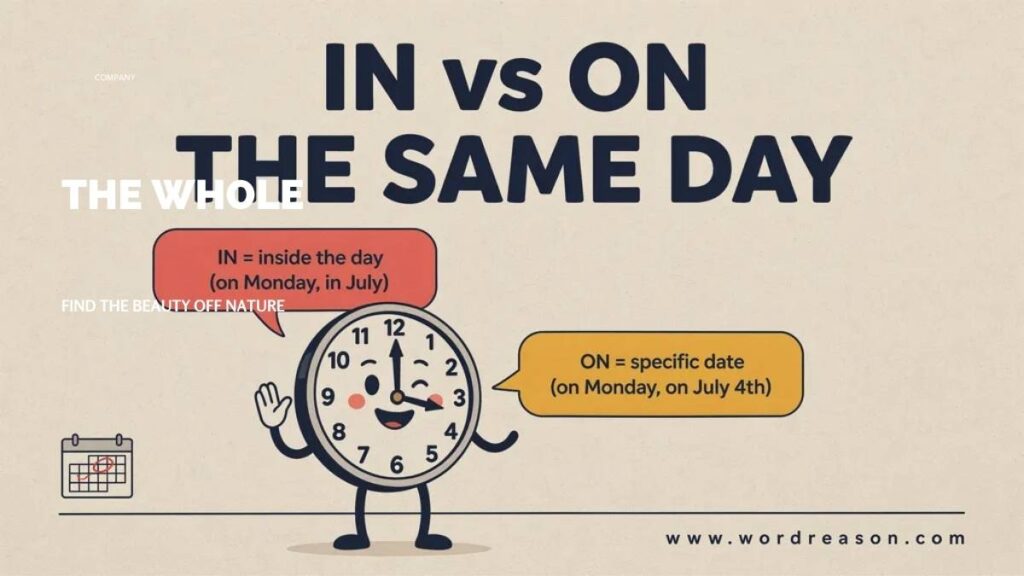
In vs On the Same Day,english prepositions can make even simple time expressions surprisingly confusing. One small word can change how natural your sentence sounds, leaving you second-guessing what seemed like an easy grammar choice. The good news? You don’t need to memorize a mountain of rules. Once you understand how in and on work with days, dates, and time periods, the difference becomes much clearer. In most cases, “on the same day” is the natural choice. However, “in the same day” can also work in certain contexts. Let’s clear it up.
Quick Answer in vs On the Same Day?
On the same day is the standard and natural expression when two or more events happen on one particular calendar day.
The two events happened on the same day.
By comparison, in the same day is less common. It can work when you’re focusing on what happens or gets completed during a one day period.
She completed several tasks in the same day.
Even in that situation, in one day or within the same day may sound smoother depending on the sentence.
Here’s the basic difference
| Expression | Main meaning | Example |
|---|---|---|
| On the same day | A shared calendar date | We arrived on the same day. |
| In the same day | Activity within a day’s period | He completed several tasks in the same day. |
| In one day | Duration of one day | She finished the project in one day. |
| Within the same day | A limit ending that day | Please respond within the same day. |
| At the same time | The same moment | They arrived at the same time. |
The key in vs on the same day is to look at the meaning of the time expression, not just the word that follows the preposition.
Learn the difference between confusing more English words
Girlie vs Girly Which Word Is Correct?
In vs On the Same Day The Basic Difference
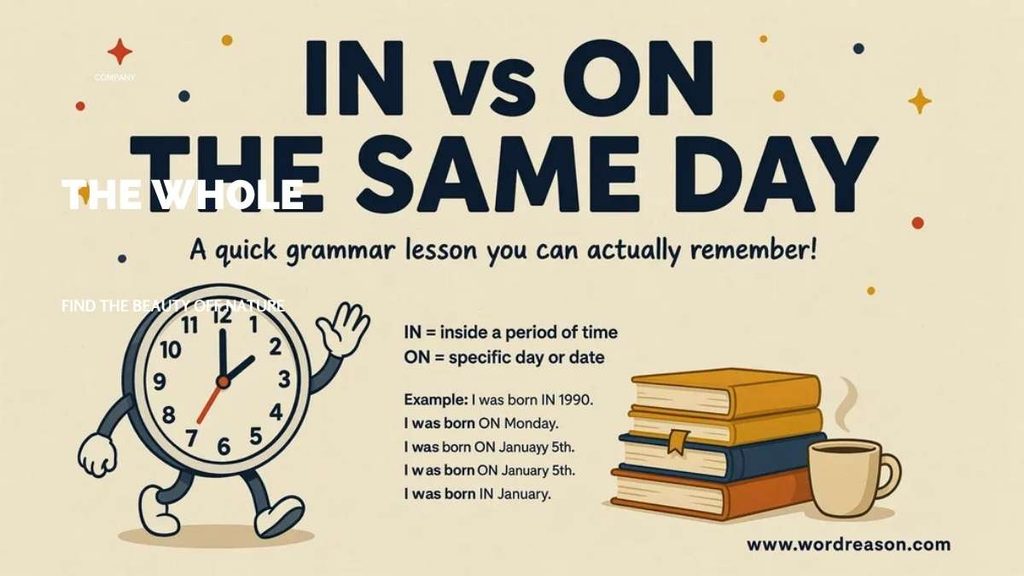
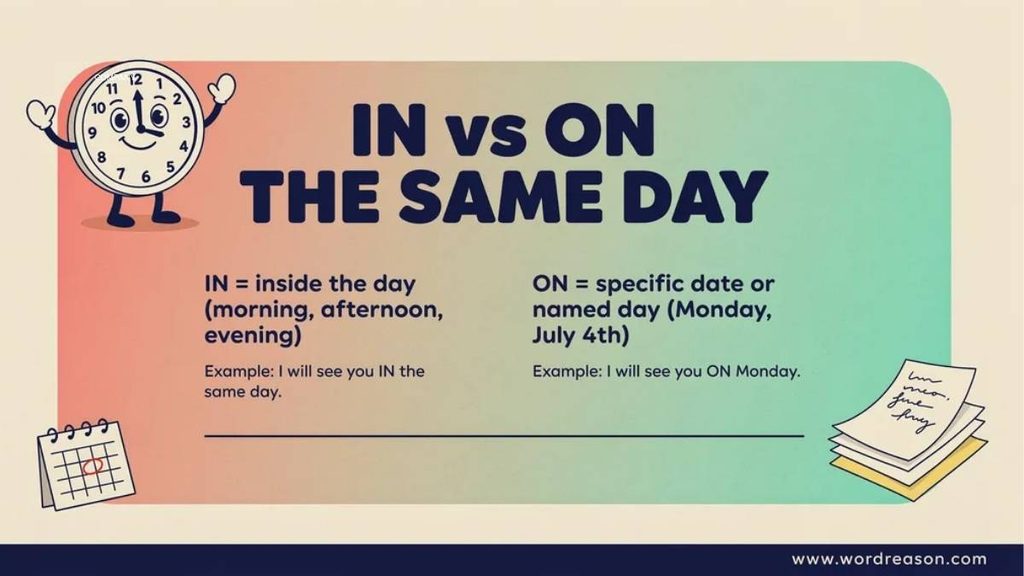
The main difference between in vs and on the same day comes from how you use the word day.
When day refers to a particular point on the calendar, English normally uses on.
The two concerts happened on the same day.
Here, the speaker is telling you that both concerts took place on one shared calendar date.
When day represents a period during which something happens, in can sometimes appear.
She visited three museums in the same day.
The second sentence focuses more on the amount of activity packed into one day.
However, there’s an important point here. Although in the same day can be understood in this type of context, many speakers would prefer in one day or during the same day.
For example
She visited three museums in one day.
This sounds more natural when the speaker wants to emphasize the amount of activity completed during a single day.
Learn the difference between confusing more English words
Masonary vs Masonry Which Spelling Is Correct?
A simple way to remember the difference
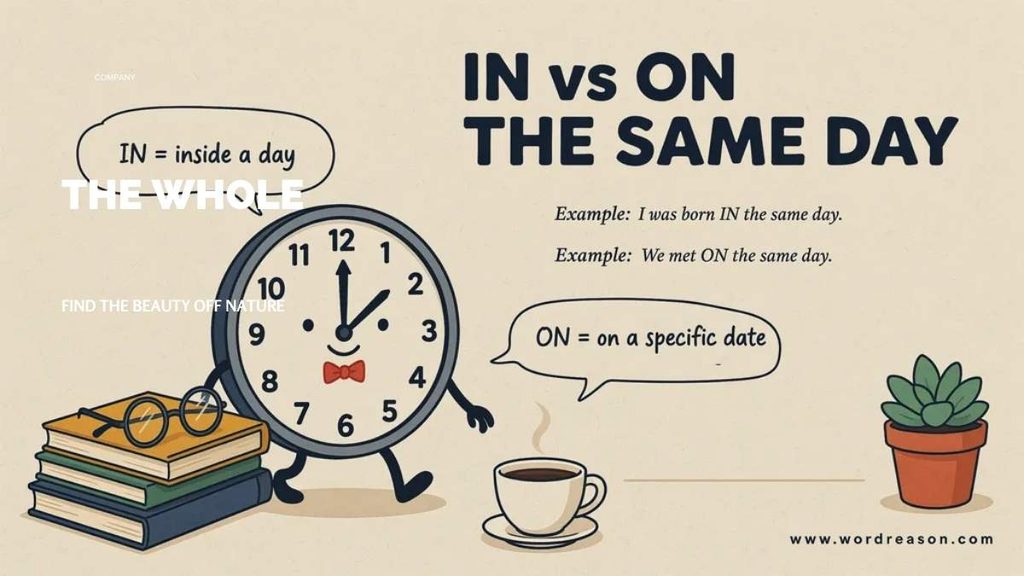
Specific day or date → ON
Period or duration → IN
This isn’t a rule that explains every English time expression. Still, it works very well for this particular grammar question.
What Does “On the Same Day” Mean?
On the Same Day Meaning
The on the same day meaning is simple: two or more events happen on one particular calendar day.
The phrase often connects one event with another event.
For example
- Sarah started her new job on the same day I moved.
- The two teams played on the same day.
- The package arrived on the same day it was shipped.
- Both applications were submitted on the same day.
In each example, the important detail is the calendar date.
The events don’t need to happen at the same hour. One could happen in the morning while another happens in the evening. As long as they happen on the same calendar date, on the same day works.
When to Use On the Same Day
Use on the same day when
- Two events share a calendar date.
- You refer to a particular day mentioned earlier.
- You compare the dates of two events.
- You discuss appointments, meetings, exams, or deadlines.
- You describe events that happened on one specific day.
- You connect two events using on the same day as.
For example
The interview and final exam were scheduled on the same day.
The sentence tells you that both events fall on one calendar date. It doesn’t tell you whether they happen at the same time.
On the Same Day Sentences
Here are some natural same day sentences
- The two packages arrived on the same day.
- We booked our flights on the same day.
- They announced the winners on the same day.
- The school held two exams on the same day.
- My sister graduated on the same day I started college.
- The storm reached the city on the same day the festival began.
- Both companies released their reports on the same day.
This phrase works naturally in everyday English, professional writing, academic writing, and casual conversation.
Learn the difference between confusing more English words
Time Off vs Time-Off Understanding the Hyphen Rule
Why Do We Say “On the Same Day”?
The answer becomes clearer when you look at the broader system of English prepositions of time.
English commonly uses at for precise times, on for days and dates, and in for months, years, seasons, and broader periods.
For example
| Preposition | Used with | Example |
|---|---|---|
| At | Exact time | at 8:00 |
| At | Specific point in time | at noon |
| On | Day | on Monday |
| On | Date | on July 10 |
| On | Particular day | on my birthday |
| In | Month | in July |
| In | Year | in 2026 |
| In | Season | in summer |
That gives us familiar expressions such as
- on Monday
- on Friday
- on July 10
- on my birthday
- on the same day
This pattern explains why on the same day sounds natural to English speakers.
Learn the difference between confusing more English words
Patients vs Patient Meaning Difference and Correct Usage
What Does “In the Same Day” Mean?
The in the same day meaning is slightly different because the phrase can treat day as a period of time rather than simply a calendar date.
For example
He visited three cities in the same day.
The speaker is highlighting the amount of activity that happened during one day.
Another example is
She attended her meetings in the same day.
Again, the focus falls on how much happened during that period.
However, in the same day is not usually the first choice when you simply want to say that two events happened on one calendar date.
In that situation, use
Both meetings happened on the same day.
When to Use In the Same Day
The use of in the same day can make sense when you’re describing several activities that happen during one day’s time.
For example
- He visited three cities in the same day.
- She handled several meetings in the same day.
- They completed multiple tasks in the same day.
Still, you should check whether another expression sounds more natural.
Often, these versions are better
- He visited three cities in one day.
- She handled several meetings in one day.
- They completed multiple tasks within the same day.
The exact choice depends on the context of the sentence.
Learn the difference between confusing more English words
YNS Meaning What YNS Means in Texting and Slang
Why “In the Same Day” Often Sounds Unnatural
Many English learners use in because English uses in with several time expressions
- in one day
- in three days
- in a week
- in a month
- in 24 hours
That pattern can make in the same day seem like the obvious choice.
But English treats a specific day differently.
Compare
The meeting happened on Monday.
Not
The meeting happened in Monday.
Likewise
The two events happened on the same day.
Not
The two events happened in the same day.
The issue isn’t that in the same day is impossible in every context. It’s that learners often use it when they really mean on the same calendar date.
That’s when on is the better choice.
Learn the difference between confusing more English words
Nosey vs Nosy Which Spelling Is Correct?
In vs On the Same Day Side by Side Comparison
| Feature | On the same day | In the same day |
|---|---|---|
| Main focus | Calendar date | Time period |
| Commonness | Very common | Less common |
| Typical use | Events sharing a date | Activities within one day |
| Everyday English | Very natural | Context-dependent |
| Professional writing | Natural | Use carefully |
| Best choice for a shared date | Yes | No |
| Common alternative | On that day | In one day |
Consider these examples
The two meetings took place on the same day.
The focus is the shared date.
She attended five meetings in the same day.
The focus is the amount of activity during one day.
That is the key difference between in vs on the same day.
The Grammar Behind “In” vs “On”
Preposition With Day
The correct preposition for same day depends on the meaning of the expression.
When you identify a specific day or date, use on
- on Monday
- on Friday
- on July 10
- on Christmas Day
- on my birthday
- on the same day
When you describe a period or duration, in may be appropriate
- in one day
- in three days
- in 24 hours
- in a week
This distinction is one of the most useful grammar rules for time.
The Calendar Test
Here’s a simple trick.
Imagine looking at a calendar.
If you can point to one particular date and say, “That’s when it happened,” on is usually the right choice.
The interview was on the same day as the exam.
Now imagine that you’re measuring how much time someone had to finish something.
She completed the work in one day.
The first sentence identifies a calendar day.
The second describes a time span.
Quick Rule to Remember
Specific day = ON
Duration = IN
Time limit = WITHIN
Exact moment = AT
Examples
- on the same day → shared calendar date
- in one day → duration
- within the same day → deadline or time limit
- at the same time → exact or overlapping moment
This simple pattern makes same day English grammar much easier to understand.
On the Same Day vs At the Same Time
These phrases describe different parts of timing.
On the same day tells you that events happened on the same calendar date.
At the same time tells you that events happened at the same moment or nearly the same moment.
Compare
Maria arrived on the same day as John.
This only tells you that they shared a date.
Now
Maria arrived at the same time as John.
This tells you that they arrived together or at matching times.
You can also combine both ideas
Maria and John arrived on the same day at the same time.
Now the sentence gives information about both the date and the time.
“On the Same Day As” Explained
The expression on the same day as is especially useful when comparing two events.
The basic structure is
on the same day as + event
Examples
- The wedding took place on the same day as the graduation.
- She started her job on the same day as her friend.
- The company announced the change on the same day as the annual meeting.
- The package arrived on the same day as the replacement order.
This construction clearly shows that two events share a calendar date.
“On the Same Day” vs “That Same Day”
These expressions are close, but they don’t always do the same job.
On the same day commonly connects two events
The interview took place on the same day as the exam.
That same day usually refers back to a day already mentioned
She had her interview on Monday. That same day, she received an offer.
You can also use on that day
The contract was signed on Monday. On that day, both sides agreed to the final terms.
These small differences can make your writing more precise.
Can You Say “The Same Day” Without “On”?
Yes. English sometimes uses the same day as a time expression without a preposition.
For example
She left the same day.
You may also see
He called the same day I arrived.
These constructions can sound natural, especially in everyday English.
That doesn’t make on the same day incorrect.
Compare
She left on the same day.
She left the same day.
Both can work, although the first makes the day relationship more explicit.
In the Same Day vs In One Day
This is one of the most important comparisons because in one day is much more common when you’re talking about duration.
Consider
She finished the project in one day.
The sentence tells you how long the project took.
Now compare
She finished the project on the same day.
This usually connects the completion to another known day.
For example
She started the project on Monday and finished it on the same day.
Here, on the same day means Monday.
But
She finished the project in one day.
Here, the focus is the duration.
Quick comparison
| Sentence | Main focus |
|---|---|
| She finished it on the same day. | Which day? |
| She finished it in one day. | How long? |
| She finished it within the same day. | By when? |
| She worked during the day. | When during the day? |
Within the Same Day vs On the Same Day
Within the same day can be useful when the sentence emphasizes a deadline or time limit.
For example
Please send your response within the same day.
The focus is on completing the action before that day ends.
Now compare
The customer contacted us and received a response on the same day.
This focuses on the shared calendar date.
Another example
The issue was resolved within the same day.
The meaning centers on the amount of time needed to resolve it.
Choosing between these expressions helps you make your writing more precise.
Common Mistakes With “In the Same Day” and “On the Same Day”
1. Mistake 1 Using “In” for a Specific Date
The conference happened in the same day as the ceremony. incorrect
The conference happened on the same day as the ceremony. correct
The sentence compares two events by calendar date, so on is the natural choice.
2. Mistake 2 Confusing Date With Duration
Consider
She completed the project in one day.
This tells you how long the work took.
Now
She completed the project on the same day.
This connects the completion to a particular day.
The two sentences may describe the same event, but they emphasize different information.
3. Mistake 3 Using “At the Same Day”
The two events happened at the same day. incorrect
The two events happened on the same day. correct
Remember
on the same day
at the same time
English uses different prepositions because the expressions refer to different types of time references.
4. Mistake 4 Assuming “In the Same Day” Is Always Wrong
That would be too broad.
In the same day can make sense when the sentence emphasizes several activities occurring during one day.
For example
He visited three cities in the same day.
However, in one day may sound more natural:
He visited three cities in one day.
The goal isn’t to memorize “in is wrong.” The goal is to choose the expression that matches your intended meaning.
Real Life Use of “On the Same Day”
Professional Emails
The phrase works especially well in workplace communication because it makes dates easy to understand.
Examples
The invoice and payment confirmation were sent on the same day.
Both meetings are scheduled on the same day.
The documents should arrive on the same day as the signed contract.
These sentences sound clear without becoming unnecessarily formal.
Academic Writing
Academic writing often requires precise information about timing.
Examples
Both experiments were conducted on the same day.
The two surveys were distributed on the same day.
The samples were collected on the same day to reduce timing differences.
When the exact calendar date matters, on provides a clear reference.
Everyday Conversation
You’ll also hear the phrase in ordinary conversations
We bought the tickets on the same day.
My parents arrived on the same day.
I had my appointment on the same day as my brother.
There’s nothing formal about the phrase. It’s simply common spoken and written English.
Case Study How One Preposition Changes the Focus
Imagine a chef who prepares breakfast, lunch, and dinner during one busy day.
1. Version A
The chef prepared all three meals on the same day.
This is grammatically natural. It tells you that all three meals were prepared on one calendar day.
2. Version B
The chef prepared all three meals in the same day.
The meaning can be understood, but the sentence sounds less natural to many English speakers. It places more emphasis on the day’s time period.
3. Version C
The chef prepared all three meals in one day.
This is more natural when the point is that the chef completed all the work during a single day.
4. Version D
The chef prepared all three meals on the same day as the event.
Now the sentence clearly connects the meals with another event through a shared calendar date.
Takeaway
A tiny preposition can change the focus of a sentence.
On usually points to a calendar day.
In can frame the day as a period of time.
That distinction helps explain why in the same day vs. on the same day causes so much confusion.
Better Alternatives to “In the Same Day”
Sometimes the best solution is simply to choose a more natural expression.
Depending on your meaning, you can use
- on the same day — for a shared calendar date
- in one day — for duration
- within the same day — for a time limit
- during the same day — for activity occurring during that day
- during the day — for an unspecified time during daytime
- within 24 hours — for a precise one-day period
- in a single day — for emphasis on completing something within one day
For example
We completed everything in the same day. incorrect
Depending on what you mean, you could write
We completed everything in one day. correct
or
We completed everything within the same day. correct
or
We completed everything on the same day. correct
Context decides which option fits best.
A Practical Guide to English Time Expressions
Understanding the larger system of time expressions in English can make this grammar point much easier.
| Meaning | Expression | Example |
|---|---|---|
| Specific weekday | on | on Friday |
| Specific date | on | on July 10 |
| Shared calendar date | on | on the same day |
| Month | in | in July |
| Year | in | in 2026 |
| Season | in | in winter |
| Duration | in | in three hours |
| Completion period | in | in one day |
| Time limit | within | within 24 hours |
| Exact time | at | at 6 p.m. |
| Exact moment | at | at midnight |
Of course. I’ve polished the practice section, made the wording smoother and easier to read, and removed all italic formatting.
Here’s a trusted source for clear more words Comparison:
Practice Session In vs On the Same Day
Test your understanding of “in the same day” vs “on the same day” with these simple exercises. The questions also cover other common time prepositions, so you can build a stronger understanding of English time expressions.
Quick Practice Rule
Keep these three basic rules in mind
- On → specific days and dates
Example: on Monday, on Friday, on July 10, on the same day - In → longer periods or a period of time
Example: in July, in 2026, in the same week, in one day - At → exact times
Example: at noon, at midnight, at 5 p.m.
Choose the Correct Answer
Choose the correct option to complete each sentence.
1. We had two meetings ___ the same day.
a) in
b) on
2. She finished the project ___ one day.
a) in
b) on
3. I’ll see you ___ Monday.
a) in
b) on
4. The two events happened ___ the same date.
a) in
b) on
5. We completed both tasks ___ the same week.
a) in
b) on
6. The meeting starts ___ noon.
a) in
b) at
7. He arrived ___ Friday.
a) in
b) on
8. They moved to the city ___ 2025.
a) on
b) in
9. She called me ___ the same day.
a) in
b) on
10. I finished the book ___ a day.
a) in
b) on
Correct the Mistakes
Rewrite each sentence using the correct time expression.
11. We met in Monday.
12. The package arrived in the same day.
13. I’ll call you on tomorrow.
14. She visited us in Friday.
15. The test is at Tuesday.
Fill in the Blanks
Complete each sentence with the correct word or phrase.
16. We met ___ the same day.
17. The conference starts ___ Monday.
18. I finished the task ___ one day.
19. The store opened ___ July.
20. The train arrives ___ noon.
21. She called me ___ yesterday.
22. We’ll meet ___ Friday.
23. He completed the work ___ the same week.
24. I’ll send the report ___ tomorrow.
25. Both events happened ___ the same date.
Answer Key
1. on
2. in
3. on
4. on
5. in
6. at
7. on
8. in
9. on
10. in
11. We met on Monday.
12. The package arrived on the same day.
13. I’ll call you tomorrow.
14. She visited us on Friday.
15. The test is on Tuesday.
16. on
17. on
18. in
19. in
20. at
21. yesterday
22. on
23. in
24. tomorrow
25. on
Easy Memory Trick
Use this simple pattern in vs on the same day
Specific day or date → ON
Longer time period → IN
Exact time → AT
For example
- on Monday
- in July
- at noon
FAQs In vs On the Same Day
Which is correct, “in the day” or “on the day”?
Both can be correct, but they have different meanings. “On the day” refers to a specific day, while “in the day” usually means during daytime.
Is it “on” or “in” the same day?
“On the same day” is the standard choice when you mean the same calendar date.
Which is correct: “on this day” or “in this day”?
“On this day” is correct when referring to a specific day.
What is another way to say “the same day”?
You can say “that day,” “on the same date,” “within the same day,” or “in one day,” depending on the meaning.
Do we say “in Monday” or “on Monday”?
Use “on Monday.” We use on with specific days of the week.
What does “in the day” mean?
“In the day” usually means during daylight hours. “During the day” often sounds more natural in everyday English.
What is the correct preposition for days?
Use “on” with specific days and dates, such as on Monday, on Friday, and on July 10.
Do you say “in Tuesday” or “on Tuesday”?
Use “on Tuesday.” “In Tuesday” is incorrect when referring to the day itself.
Is it “in the same week” or “on the same week”?
Use “in the same week.” We normally use in with weeks when talking about a time period.
Why do we say “on Monday”?
English uses on with specific calendar days. For example, on Monday and on Sunday.
Which is correct: “on that day” or “at that day”?
“On that day” is correct. “At that day” is not standard English.
Is “on today” grammatically correct?
No Simply say “today.”
- Correct: I’ll see you today.
- Incorrect: I’ll see you on today.
Is it “on Sunday” or “in Sunday”?
Use “on Sunday.” We use on with days of the week.
Is it “on Friday” or “in Friday”?
“On Friday” is correct. “In Friday” is incorrect.
Is it “in” or “on Saturday”?
Use “on Saturday.”
Do you say “on this day” or “in this day”?
Say “on this day.” It refers to a particular calendar day.
Is “on yesterday” grammatically correct?
No. Use “yesterday” without a preposition.
Is “on tomorrow” grammatically correct?
No. Say “tomorrow” without on.
Should I say “see you on Monday” or “see you in Monday”?
Say “See you on Monday.” On is the correct preposition for a specific weekday.
Do you say “on” or “in” for a date?
Use “on” for a specific date.
- on July 10
- on December 25
- on March 5
Do we say “on Tuesday” or “in Tuesday”?
We say “on Tuesday.” Use on with specific days of the week.
AEO Quick Answers
Is it “in the same day” or “on the same day”?
“On the same day” is the standard phrase for events happening on the same calendar date.
What preposition do you use with a specific day?
Use “on.” For example, on Monday, on Friday, and on July 10.
Can you use “in” with a day?
Yes, but the meaning can change. “In one day” usually refers to a duration, while “on a day” refers to a specific day.
Is “at the same day” correct?
No. Say “on the same day.” Use at for specific times, such as at noon or at 5 p.m.
What is the difference between “in a day” and “on a day”?
“In a day” usually describes how long something takes. “On a day” refers to a particular day.
What is the difference between “on the same day” and “within the same day”?
“On the same day” focuses on the shared calendar date. “Within the same day” emphasizes that something happens before the day ends.
Is “on the same date” correct?
Yes. “On the same date” is a natural alternative when you want to emphasize the calendar date.
Can you say “the same day” without “on”?
Yes. For example: “She left the same day.” The phrase can work as a time expression without on.
What is the easiest rule for “in” vs “on” with time?
Use on for specific days and dates, in for longer periods, and at for exact times.
| Time | Correct preposition | Example |
|---|---|---|
| Specific day | on | on Monday |
| Specific date | on | on July 10 |
| Same day | on | on the same day |
| Week | in | in the same week |
| Month | in | in July |
| Year | in | in 2026 |
| Exact time | at | at 5 p.m. |
What should you remember about “in vs on the same day”?
Use “on the same day” when two events happen on the same calendar date. Use “in one day” or “within the same day” when you want to emphasize a time period or deadline.
Conclusion
The “in vs on the same day” confusion may look like a tiny grammar problem, but that little preposition can make a sentence sound either natural or awkward. The good news is that you don’t need a grammar detective’s magnifying glass to get it right.When you’re talking about two events happening on the same calendar date, use “on the same day.” For example, “They arrived on the same day.” When you’re talking about completing something within a one day period, phrases such as “in one day” or “within the same day” may fit better.
So, when in doubt, check what you mean first. Specific day or date? Use “on.” Time period or duration? “In” may be the better choice. Once this simple distinction clicks, this common grammar confusion becomes much easier to handle and one less preposition will keep you awake at night.

Bella AJS
Bella AJS is an experienced blogger and passionate language enthusiast at WordReason. She specializes in English grammar, word meanings, spelling, and commonly confused words. With a clear and practical writing style, Bella helps readers understand tricky language rules without the textbook headache. Her goal is simple: make English easier, clearer, and more enjoyable one word at a time.