A simple phone call can feel like a surprise grammar quiz! Both phrases She or Her” identify the same person, but they don’t follow the same traditional grammar rule. “This is she” has long been considered the grammatically correct form because she acts as a subject complement after the linking verb is. Yet “This is her” sounds completely natural in everyday English and appears frequently in modern conversation. So, which is correct this is she or her? Let’s settle the confusion with clear rules and examples.
Quick Answer
“This is she” is the traditional grammatically preferred form when someone asks to speak with a woman on the phone. The word she functions as a subject complement after the linking verb is.
“This is her” is also widely used in modern spoken English. It commonly appears in casual conversations because many speakers find the phrase more natural and relaxed.
If you want a professional response that avoids the pronoun question altogether, use
- “Yes, this is bella.”
- “Yes, bella speaking.”
- “Speaking.”
- “Yes, this is bella speaking.”
So, if you’re asking which is correct, this is she or this is her, traditional grammar favors “This is she.” Modern spoken English, however, frequently uses This is her.
Learn the difference between confusing more English words
Girlie vs Girly Which Word Is Correct?
Why this Is Confuse So Many People
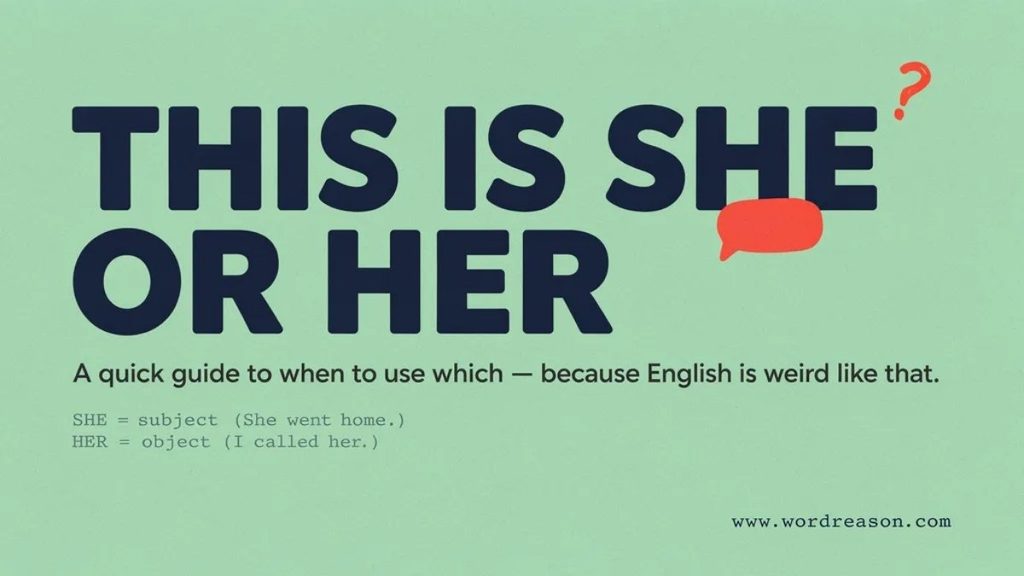
The confusion comes from two words that refer to the same person but have different grammatical forms she and her.
English personal pronouns change form depending on how they function in a sentence. This difference is called pronoun case.
| Subject Pronoun | Object Pronoun |
|---|---|
| I | me |
| you | you |
| he | him |
| she | her |
| we | us |
| they | them |
A subject pronoun normally performs an action
She called me.
An object pronoun normally receives an action
I called her.
That simple distinction explains much of the debate surrounding this is she or this is her grammar.
The Hidden Grammar Behind “This Is She”
The phrase contains a linking verb is.
A linking verb doesn’t normally show an action. Instead, it connects the subject with information that identifies or describes it.
Consider
Bella is a teacher.
Sarah is the subject, while teacher identifies bella.
Now consider
This is Bella.
Here, this is the subject, while Bella identifies the person represented by “this.”
If you replace the name with a traditional subject pronoun, you get
This is she.
That’s the basic grammatical reasoning behind the traditional form.
Why “This Is Her” Sounds Natural
Although traditional grammar prefers she in this construction, modern spoken English often uses her.
For many speakers, “This is her” feels less formal and more natural. You can hear the same general pattern in other expressions involving forms of be.
For example
- This is him.
- It is me.
- That was her.
Traditional grammar may prefer he, I, and she in comparable subject-complement constructions. Modern conversation frequently chooses the object forms instead.
Why It Actually Matters
This distinction matters when you’re trying to write formal English, teach grammar, or understand why one form receives traditional grammatical approval.
If you’re answering a grammar exercise, “This is she” is the safer answer.
If you’re talking to a friend, however, “This is her” is common and easily understood.
The key is to distinguish grammatical tradition from everyday usage.
Learn the difference between confusing more English words
Masonary vs Masonry Which Spelling Is Correct?
Why “This Is She” Is Traditionally Grammatically Correct
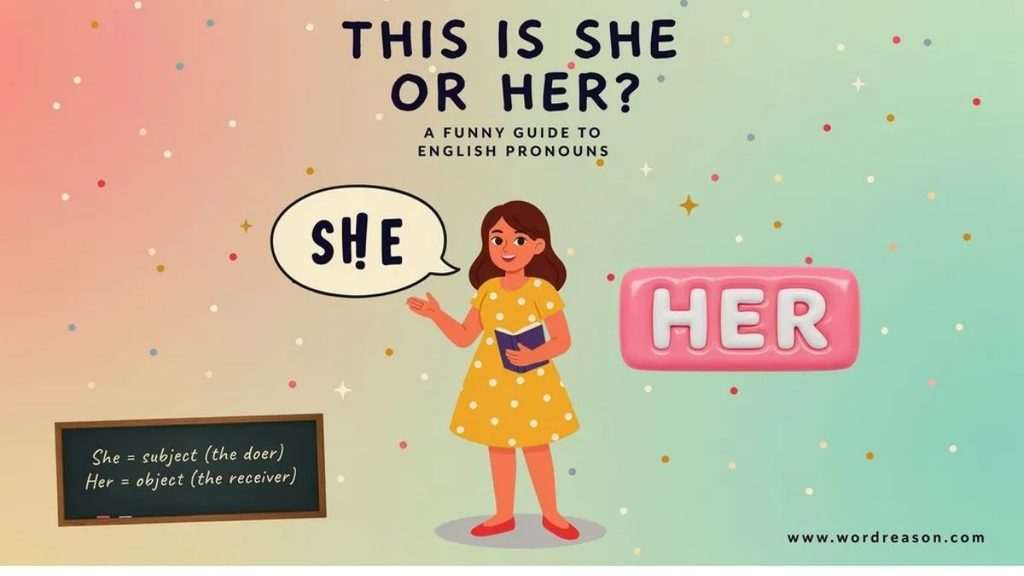
The answer becomes much clearer once you understand the role of the verb is.
The verb is belongs to the verb to be and often works as a linking verb. It connects a subject with a word or phrase that identifies or describes that subject.
Consider this sentence
Bella is a doctor.
Bella is the subject. Doctor tells us what Maria is.
Now change the structure
This is Bella.
This is the subject. Bella identifies the person.
Replace Bella with a pronoun
This is she.
That’s why traditional grammar considers “This is she” correct.
The Subject Complement Rule
Traditional English grammar generally uses a subject pronoun after a linking verb when that pronoun functions as the subject complement.
This produces forms such as
- This is she.
- This is he.
- It is I.
- That was she.
The forms may sound formal today, but they follow the traditional grammatical pattern.
Subject Pronouns vs Object Pronouns
The difference becomes easier to see when you compare ordinary sentences.
| Subject Pronoun | Example | Object Pronoun | Example |
|---|---|---|---|
| she | She called me. | her | I called her. |
| he | He answered. | him | I called him. |
| I | I called yesterday. | me | She called me. |
| they | They arrived. | them | We invited them. |
The traditional analysis of “This is she” treats she as a complement that identifies the subject.
That’s why she, rather than her, is preferred by traditional grammar.
Why Is “This Is She” So Formal?
There’s an important difference between being grammatically traditional and sounding natural in everyday conversation.
“This is she” follows the older grammatical pattern, but many speakers rarely use that pattern in casual speech.
As a result, the sentence can sound polished, formal, old-fashioned, or even slightly stiff depending on the situation.
For example
Caller: May I speak with Jennifer?
Jennifer: This is she.
The sentence is perfectly understandable and traditionally grammatical.
Now compare it with
Caller: May I speak with Jennifer?
Jennifer: Yes, this is Jennifer speaking.
The second response sounds more natural to many modern speakers while remaining professional.
Learn the difference between confusing more English words
Time Off vs Time-Off Understanding the Hyphen Rule
Why Most People Say “This Is Her” Anyway
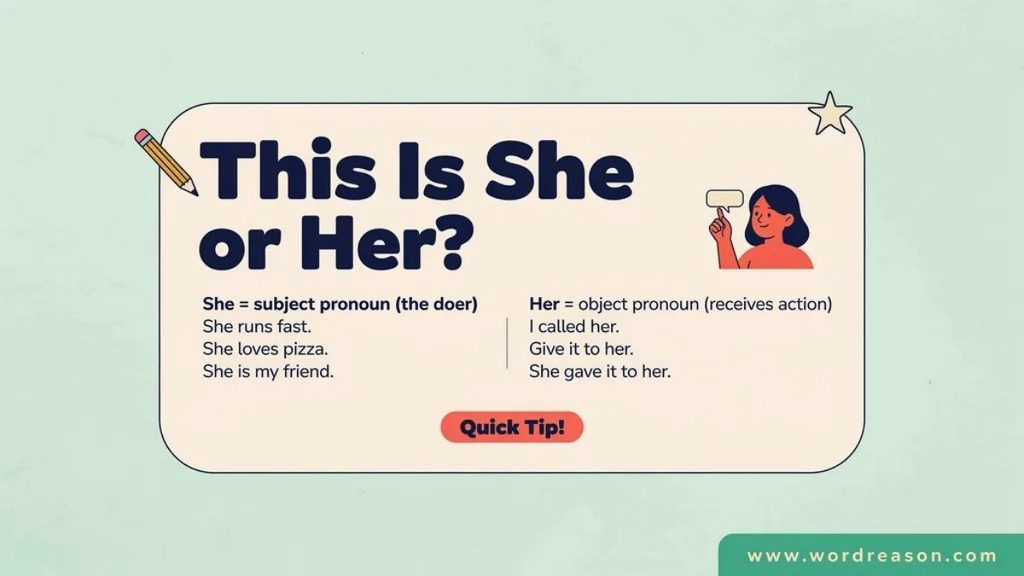
English changes through everyday use. People don’t always speak according to the rules found in traditional grammar books.
That’s especially true in informal conversation.
Spoken English Favors Natural Rhythm
Phone conversations happen quickly. When someone asks
“Can I speak with Bella?”
Bella isn’t usually thinking
“Which pronoun case should I use after this linking verb?”
She simply responds.
“This is her.”
For many speakers, that response feels comfortable and natural.
Modern Usage Doesn’t Always Follow Traditional Rules
The popularity of “this is her” doesn’t mean that traditional grammar suddenly became meaningless.
Instead, it shows how English has evolved.
Language users often prefer forms that feel natural in conversation. Over time, those patterns can become widespread.
This is why it’s useful to separate two questions
- What does traditional grammar recommend?
- What do people commonly say in modern English?
Is “This Is Her” Grammatically Correct?
The safest explanation is not simply yes or no.
According to traditional prescriptive grammar, “This is she” is the preferred construction.
In modern spoken English, “This is her” is a common and established conversational form.
Therefore, saying that “this is her” is never acceptable would give English learners an incomplete picture of how people actually speak.
Learn the difference between confusing more English words
Patients vs Patient Meaning Difference and Correct Usage
This Is She or Her Key Differences
| Feature | This is she | This is her |
|---|---|---|
| Traditional grammar | Preferred | Not traditionally preferred |
| Modern spoken English | Less common | Very common |
| Formality | Formal or traditional | Casual to neutral |
| Phone conversations | Correct | Common |
| Professional settings | Acceptable | More conversational |
| Grammatical analysis | Subject complement | Object-form pronoun in modern usage |
| Naturalness | May sound formal | Often sounds natural |
The important lesson is that “this is she vs her” isn’t simply a battle between right and wrong.
The traditional form follows a grammatical rule. The conversational form reflects widespread modern usage.
When Answering the Phone
Phone conversations are where this question comes up most often.
Imagine someone calls your home and asks
“May I speak with Bella?”
If Bella answers
“This is she.”
she has used the traditional form.
If she says
“This is her.”
she has used the conversational form that many speakers naturally use.
Both responses identify the same person. The main difference is style and grammatical tradition.
Formal Phone Conversations
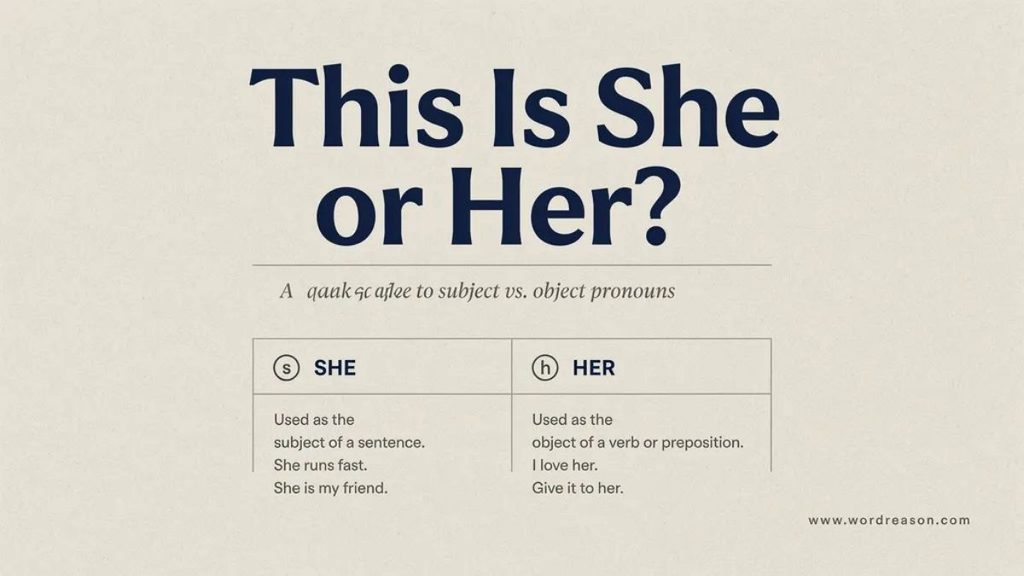
When you’re handling a professional call, clarity and confidence matter.
Good choices include
- “Yes, this is Bella.”
- “Yes, Bella speaking.”
- “This is Bella speaking.”
- “Yes, speaking.”
- “This is she.”
For example
Caller: May I speak with Ms. Carter?
Ms. Carter: Yes, this is Bella speaking.
This response sounds professional without feeling overly formal.
Casual Phone Conversations
Casual calls give you more freedom.
You might say
- “Yep, this is her.”
- “Yeah, speaking.”
- “That’s me.”
- “Yes, this is Bella.”
For example
Friend: Is that Bella?
Bella: Yep, that’s me.
There’s no need to make a relaxed conversation sound like a grammar exam.
Better Alternatives to “This Is She” or “This Is Her”
Sometimes the best answer isn’t choosing between the two forms. You can simply use a phrase that sounds natural and avoids the pronoun issue.
“Speaking”
“Speaking” is short, clear, and useful when someone asks for you directly.
Caller: May I speak with Bella?
Bella: Speaking.
This works particularly well in professional phone conversations.
“Yes, This Is [bella]”
This is one of the safest choices in almost any situation.
“Yes, this is Bella.”
It identifies you immediately and avoids the she vs. her question.
“This Is [Bella] Speaking”
This phrase works especially well in business calls.
“Hello, this is Bella speaking.”
It sounds polite, professional, and natural.
“Yes, That’s Me”
Use this when someone asks whether they’ve reached the right person.
Caller: Am I speaking with Daniel?
Daniel: Yes, that’s me.
This response feels friendly and natural.
Common Mistakes With “This Is She” and “This Is Her”
Pronoun questions often lead people into one of two extremes: overcorrecting or ignoring context.
1. Mistake Assuming the Most Common Form Must Be the Traditional Correct Form
Because “this is her” is common, some speakers assume “this is she” must be incorrect.
That’s not true.
Traditional grammar prefers “this is she” because the pronoun functions as a subject complement after the linking verb is.
2. Mistake Assuming “This Is Her” Is Always Wrong
The opposite claim is also too strong.
Modern speakers regularly use “this is her” in everyday conversation.
Calling it an impossible English construction doesn’t accurately describe modern spoken English.
3. Mistake Using Formal Language in Every Conversation
You don’t need to sound like you’re reading from a legal document every time the phone rings.
If a friend asks
“Is that Rachel?”
You can simply say
“Yes, that’s me.”
Natural communication often matters more than using the most formal grammatical construction available.
4. Mistake Overthinking the Response
The goal of a phone call is communication.
If you’re stuck between “this is she” and “this is her,” use your name:
“Yes, this is Rachel.”
Problem solved.
Learn the difference between confusing more English words
Nosey vs Nosy Which Spelling Is Correct?
“This Is She” or “This Is Her” in Professional English
Professional communication deserves a little extra care because your choice of words can affect how polished your speech sounds.
For business calls, the strongest option is often a clear name based response.
Best Professional Options
- “Yes, this is Sarah.”
- “Yes, Sarah speaking.”
- “This is Sarah speaking.”
- “Yes, you’ve reached Sarah.”
- “Speaking.”
You can also use “This is she” if you prefer traditional formal grammar.
For example:
Caller: May I speak with Ms. Adams?
Ms. Adams: Yes, this is she.
That response is grammatically traditional and completely clear.
However, many speakers would choose:
“Yes, this is Ms. Adams speaking.”
The second version often sounds more natural in contemporary professional English.
This Is She vs Her vs This Is Me
The phrase “this is me” creates another interesting pronoun question.
Consider
“Which person in the photo is you?”
A natural response is
“This is me.”
Modern English doesn’t normally require
“This is I.”
That would sound unusually formal in most situations.
This example shows that modern English doesn’t always preserve the older pronoun pattern after forms of be.
The same issue appears in
- This is she / This is her
- This is he / This is him
- It is I / It is me
Traditional grammar and modern speech don’t always choose the same pronoun form.
in vs On the Same Day no confusion grammar guide
“This Is He” or “This Is Him”?
The masculine version follows the same grammatical pattern.
Traditional grammar favors
“This is he.”
Modern conversational English commonly uses
“This is him.”
For example
Caller: May I speak with John?
John: This is he.
This follows the traditional subject-complement rule.
In everyday conversation, you may hear
John: This is him.
The same distinction between subject pronouns and object pronouns explains the difference.
When Should You Use “This Is She”?
Use “this is she” when you want to follow the traditional grammatical pattern, especially in formal or careful English.
It can work well in
- Professional phone calls
- Formal conversations
- Grammar lessons
- Grammar exercises
- Formal writing
- Situations where traditional grammar matters
For example
Caller: May I speak with Ms. Carter?
Answer: This is she.
It’s short, clear, and grammatically traditional.
When Should You Use “This Is Her”?
Use “this is her” when you’re speaking casually or following common modern conversational patterns.
It works especially well in
- Conversations with friends
- Informal phone calls
- Family conversations
- Relaxed everyday speech
- Situations where natural conversation matters more than formal grammar
For example
Caller: Is Jessica there?
Jessica: This is her.
Many speakers find this response perfectly natural.
Case Study Three Real Life Phone Situations
Real conversations make the distinction much easier to understand.
1. Scenario A Job Related Call
Imagine you’re waiting for a recruiter to call.
Recruiter: May I speak with Olivia?
Olivia: Yes, this is Olivia speaking.
This is a strong professional response.
It confirms Olivia’s identity and keeps the conversation moving.
A traditional alternative would be
“This is she.”
That is also acceptable according to traditional grammar.
2. Scenario A Friend Calls
Now imagine your best friend calls and asks
Friend: Is that Megan?
Megan: Yep, that’s me.
This sounds relaxed and natural.
You could also hear:
“Yep, this is her.”
There’s no need for a formal response when you’re talking to a friend.
3. Scenario An Unknown Business Caller
Suppose a business representative calls and asks
Caller: May I speak with Daniel?
Daniel: Yes, this is Daniel.
This answer immediately confirms his identity.
It also avoids the entire this is she or this is her question.
A Simple Rule for Choosing the Right Phrase
If you want a quick rule that works in real life, remember these three points.
For Traditional Grammar: Choose “This Is She”
This is she follows the traditional grammatical pattern for a subject complement after a linking verb.
For Everyday Conversation: “This Is Her” Is Common
This is her appears frequently in modern spoken English and often sounds natural in casual settings.
When You’re Unsure Use Your Name
The easiest option is:
“Yes, this is [name].”
It works in professional and casual settings. It also eliminates the pronoun debate.
Quick Decision Guide This Is She or Her?
| Situation | Best choice |
|---|---|
| Formal grammar exercise | This is she. |
| Formal phone call | This is she. |
| Professional phone call | This is [name] speaking. |
| Casual phone call | This is her. |
| Friend asks if it’s you | Yes, that’s me. |
| Someone asks directly for you | Speaking. |
| Unknown caller | Yes, this is [name]. |
| Formal writing | This is she. |
| Everyday conversation | This is her. |
Why Context Matters More Than a Single “Correct” Answer
English grammar isn’t always a neat collection of rules where every situation has only one acceptable sentence.
Some constructions have a clear standard form. Others sit between traditional grammar and modern usage.
“This is she” follows the traditional grammatical rule. The pronoun she functions as a subject complement after the linking verb is.
“This is her” reflects common modern spoken usage.
Understanding both forms gives you a more accurate picture of English.
Think of it like clothing. A suit and jeans can both be appropriate, but you wouldn’t normally wear the same outfit to a job interview and a backyard barbecue.
Language works in much the same way.
The words you choose should fit the situation.
Here’s a trusted source for clear more words Comparison:
Practice Session This Is She or Her?
Quick Practice
Before you begin, remember this simple rule
- She = subject pronoun
- Her = object pronoun or possessive determiner
- “This is she” = traditional/formal grammar
- “This is her” = common in modern spoken English
- “This is [bella] speaking” = clear and professional
Fill in the Blanks
Choose the best word or phrase to complete each sentence.
- “May I speak with Sarah?” — “This is ______.”
- “Is Emma available?” — “Yes, this is ______.”
- ______ called me yesterday.
- I spoke with ______ this morning.
- “May I speak with Lisa?” — “Yes, this is Lisa ______.”
- ______ is my sister.
- I called ______ after work.
- “Is Anna there?” — “Yes, this is ______.”
- ______ answered the phone.
- I sent the message to ______.
- “May I speak with Jessica?” — “Speaking. This is ______.”
- ______ works at the front desk.
- The manager asked to speak with ______.
- “Is Maria on the line?” — “Yes, this is ______.”
- ______ is my best friend.
- I met ______ at the office.
- “May I speak with Emily?” — “Yes, this is Emily ______.”
- ______ called the customer back.
- The customer spoke to ______.
- “Is this Olivia?” — “Yes, this is ______.”
- ______ answered the business call.
- I gave the documents to ______.
- “May I speak with Rachel?” — “Yes, this is ______ speaking.”
- ______ is waiting for your call.
- “Is Jennifer available?” — “Yes, this is ______.”
Answer Key
- she
- her
- She
- her
- speaking
- She
- her
- her
- She
- her
- me
- She
- her
- her
- She
- her
- speaking
- She
- her
- me
- She
- her
- speaking
- She
- her
Challenge
Now try creating your own three phone responses:
- Traditional: “This is ______.”
- Conversational: “This is ______.”
- Professional: “Yes, this is ______ speaking.”
Frequently Asked Questions
Is “This Is She” grammatically correct?
Yes. “This is she” is the traditional grammatically correct form because she acts as a subject complement after the linking verb is.
Is “This Is Her” correct?
Yes. “This is her” is very common in modern spoken English, especially in casual conversations. Traditional grammar prefers “this is she.”
Which is correct: “This Is She” or “This Is Her”?
Both are used. “This is she” is more traditional and formal, while “this is her” sounds more natural in everyday speech.
Why do people say “This Is She” on the phone?
They say “this is she” because traditional grammar uses the subject pronoun she after the linking verb is.
What does “This Is She” mean?
“This is she” means “I am the woman you asked to speak with.”
What does “This Is Her” mean?
“This is her” can also mean “I am the woman you asked for.” It’s a common conversational expression.
Is “It Is She” or “It Is Her” correct?
Traditional grammar favors “it is she,” while “it is her” is more common in everyday speech.
Should I say “This Is She” or “This Is Her” when answering the phone?
For formal situations, “this is she” is the traditional choice. In casual conversation, “this is her” is perfectly natural.
What is the best professional way to answer the phone?
A clear option is “Yes, this is [name] speaking.” It sounds professional and avoids the she-versus-her confusion.
Is “This Is He” or “This Is Him” correct?
“This is he” is the traditional form, while “this is him” is common in modern spoken English.
What is the difference between “She” and “Her”?
She is a subject pronoun, while her is usually an object pronoun or possessive determiner.
- She called me.
- I called her.
- That is her phone.
Is “This Is Me” grammatically correct?
Yes. “This is me” is standard and very common, especially in everyday English.
Here’s a more polished version with a smoother flow, stronger closing, and a light humorous touch while keeping the explanation clear and professional:
Final Takeaway This Is She or Her?
The “this is she or her” confusion may turn a simple phone call into a mini grammar exam, but the rule is easier than it seems. “This is she” is the traditional and more formal choice because she functions as a subject complement after the linking verb is. Meanwhile, “this is her” is extremely common in modern spoken English and sounds natural in casual conversation.
So, which one should you use? Choose “This is she” for traditional or formal English. Use “This is her” in relaxed conversation. If you’d rather skip the grammar debate altogether, say “Yes, this is [Bella] speaking.” It’s clear, professional, and leaves no room for a pronoun showdown!

Bella AJS
Bella AJS is an experienced blogger and passionate language enthusiast at WordReason. She specializes in English grammar, word meanings, spelling, and commonly confused words. With a clear and practical writing style, Bella helps readers understand tricky language rules without the textbook headache. Her goal is simple: make English easier, clearer, and more enjoyable one word at a time.