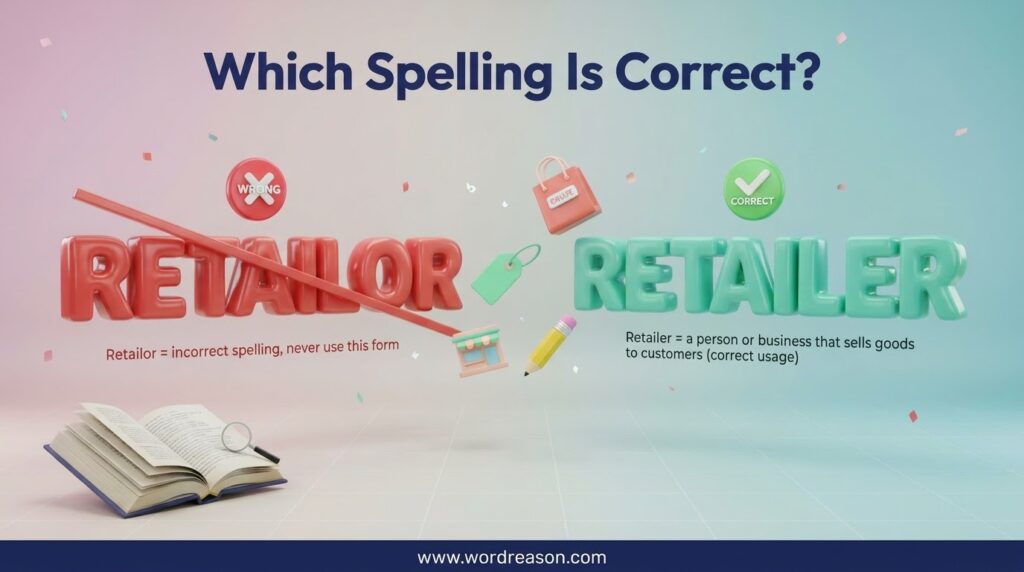
One tiny spelling mistake can turn a perfectly professional sentence into a grammar puzzle! If you have ever hesitated between retailor or retailer, you are certainly not alone. These two spellings look almost identical, but only one is correct in modern English. Retailer refers to a person or business that sells products directly to customers, while retailor is a common spelling mistake. So, before one misplaced letter sneaks into your business report or website content, let us clear up the confusion. Explore the correct spelling, meaning, pronunciation, practical examples, and simple memory tricks to master retailer with confidence.
Retailor or Retailer Quick Answer
Retailer is the correct spelling in both American and British English. It describes a person, shop, company, or business that sells goods directly to the public.
Retailor is not the standard spelling of this word. You should avoid using it in formal writing, business documents, school assignments, and everyday communication.
For example
Correct: The retailer sells clothing, shoes, and accessories.
Incorrect: The retailor sells clothing, shoes, and accessories.
The easiest way to remember the correct form is to connect retailer with retail. Add the suffix -er to retail, and you get retailer.
Learn the difference between confusing more English words
Programming or Programing Which Spelling Is Correct?
What Does Retailer Mean?
A retailer is a person or business that sells products directly to individual customers. These customers usually purchase goods for personal or household use rather than for resale.
Retailers operate in different parts of the economy. They include small neighborhood shops, supermarkets, clothing stores, electronics businesses, online shopping platforms, and large department stores.
For example, when you visit a grocery store and purchase milk, bread, or fruit, you buy those products from a retailer. Similarly, when you order a laptop from an online store, that business may act as the retailer.
The main purpose of a retailer is to make products available to customers in convenient quantities and locations.
Retailer Meaning in Business and Commerce
In business terminology, a retailer is an important part of the supply chain. A supply chain describes the process through which products move from manufacturers to customers.
A manufacturer produces goods. A wholesaler may purchase those goods in large quantities and distribute them to retailers. The retailer then sells individual products or smaller quantities to the final consumer.
For example, a company manufactures shoes and sends them to a distributor. A footwear shop purchases several pairs from that distributor and displays them for customers. The footwear shop acts as the retailer because it sells the shoes directly to the public.
However, not every retailer follows this exact process. Some retailers purchase products directly from manufacturers, while others operate through online marketplaces or specialized distribution networks.
Retailer as a Person or Business
The word retailer can describe an individual who sells goods or an entire business that provides products to customers.
For instance, a person who owns a small clothing shop may be called a retailer. A large supermarket chain can also be described as a retailer.
The word does not refer to only one type of business. It covers many industries, including food, fashion, technology, furniture, cosmetics, books, and household products.
Learn the difference between confusing more English words
Bellow or Below Which spelling Is Correct?
Is Retailor a Real Word?
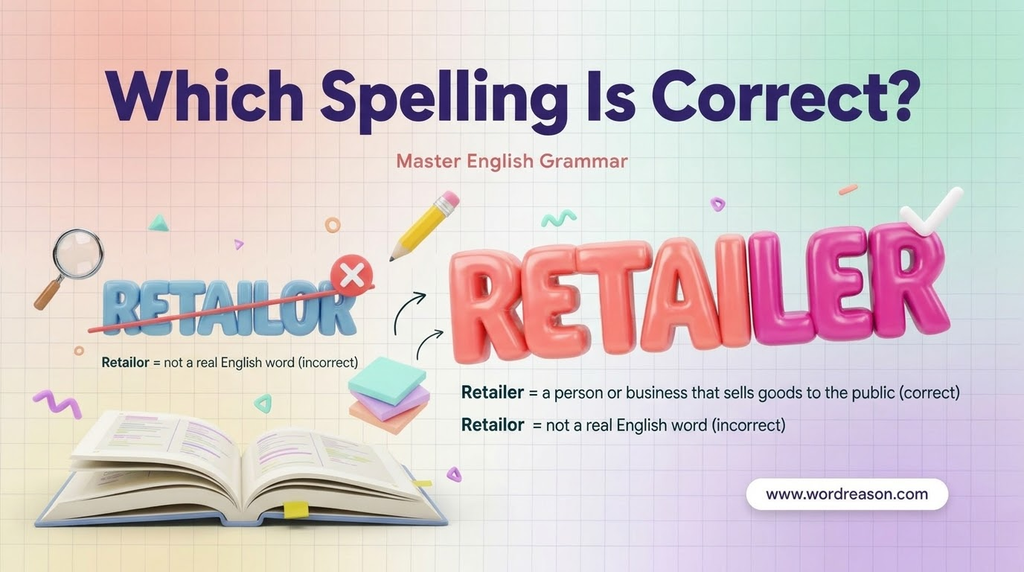
Retailor is not the standard modern English spelling for a person or business that sells goods directly to consumers. If you want to describe such a business, use retailer.
You may occasionally encounter retailor in online searches, informal writing, or spelling discussions. However, its appearance does not make it an accepted alternative to retailer.
There is also a historical detail worth understanding. Older English records contain the form retaillour, which was used for a retail merchant or dealer. That historical spelling does not make retailor the correct modern form.
In present-day American and British English, retailer remains the accepted spelling.
Why Is Retailor Incorrect?
The mistake usually happens because English contains many words that end in -or. Words such as actor, director, and inventor may encourage writers to assume that retailer should follow the same pattern.
However, English suffixes do not work through one universal spelling rule. Some words use -er, while others use -or. The correct form often depends on the history and established spelling of the individual word.
Retailer follows the pattern retail + er. Changing the ending to -or creates a nonstandard spelling.
Can Retailor Be Used in Formal Writing?
No. You should use retailer in formal and professional writing.
Using retailor in a business report, website article, academic assignment, or company description may look like a spelling error. It can also distract readers from the information you want to communicate.
For clear and professional writing, choose retailer every time you mean a business or person that sells goods directly to customers.
Learn the difference between confusing more English words
Customize or Customise Which Spelling Is Correct?
Retailor vs Retailer What Is the Difference?
The main difference is spelling and standard usage. Retailer is the accepted English word, while retailor is an incorrect modern spelling for the same intended meaning.
Both forms may look reasonable at first glance. However, English spelling depends on established word forms rather than appearance alone.
Retailer comes from the word retail with the suffix -er. The suffix identifies a person or thing associated with an action or activity.
Consider the following examples:
| Base word | Correct related word | Example |
|---|---|---|
| Teach | Teacher | The teacher explains the lesson. |
| Work | Worker | The worker repairs the equipment. |
| Drive | Driver | The driver follows the road signs. |
| Retail | Retailer | The retailer sells products to customers. |
Retailor or Retailer these examples show how the suffix -er appears in words that describe people connected with particular activities.
Retailor does not follow the established spelling of retailer. Therefore, it should not replace the correct form.
Learn the difference between confusing more English words
Adress or Address Which Spelling Is Correct?
Why Do People Confuse Retailor or Retailer?
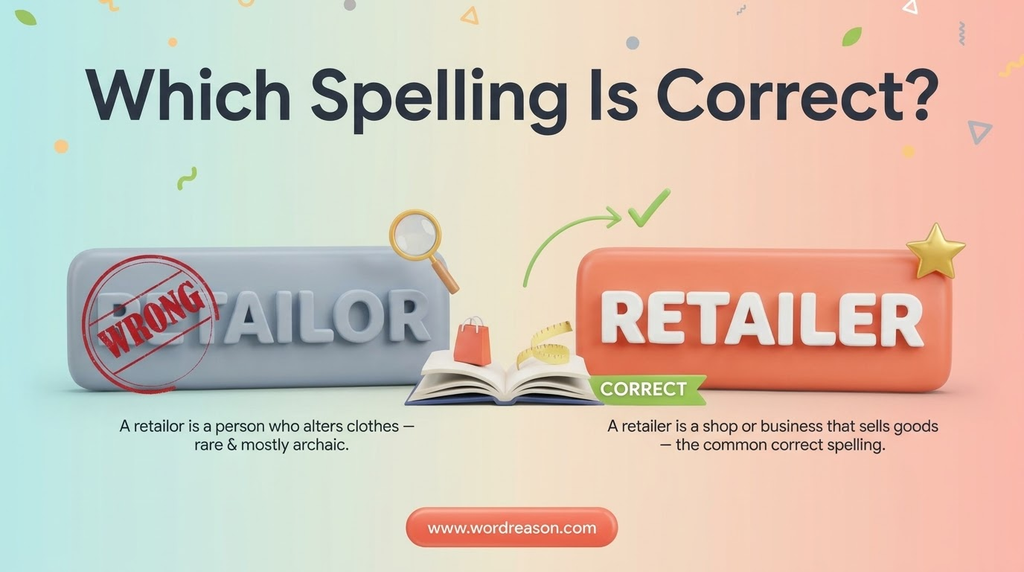
The confusion between retailor and retailer is understandable. The words differ by only one vowel, and both endings appear in English vocabulary. Several factors can make the incorrect version seem convincing.
Confusion Between Er and Or
English uses both -er and -or to form nouns that describe people or things associated with an activity.
For example, teacher ends in -er, while actor ends in -or. Because both endings are common, writers sometimes apply the wrong one to an unfamiliar word.
However, you cannot freely exchange these suffixes. Their spelling depends on established word usage.
Retailer is the recognized form because it developed from retail with the suffix -er. The spelling retailor does not follow that accepted form.
Pronunciation Can Cause Confusion
The pronunciation of retailer may also contribute to spelling mistakes. In American English, retailer is commonly pronounced as REE-tay-ler.
The final sound does not always make the written ending obvious to someone who has only heard the word. As a result, a writer may choose -or instead of -er.
Pronunciation can help you recognize a word, but it does not always reveal its exact spelling. Checking the standard written form is the safest approach.
Typing Errors and Autocorrect
Fast typing can create spelling mistakes, especially when two forms look similar. A person may type retailor without noticing the incorrect ending.
Autocorrect does not always catch every mistake. Some spelling tools focus on familiar words, while others may miss unusual errors depending on the context.
For this reason, proofread important writing instead of depending entirely on automatic corrections.
Incorrect Spelling Patterns
People sometimes assume that a word should use -or because another word with a similar meaning or function has that ending.
For example, actor and director are correct words, but their spelling does not determine the spelling of retailer. English vocabulary contains many historical spelling patterns that you must learn individually.
The best approach is to remember retailer as one complete word rather than trying to guess its ending.
Learn the difference between confusing more English words
Cocoon vs Cacoon Which Spelling Is Correct?
Origin and Etymology of Retailer
Understanding the origin of a word can make its spelling easier to remember. The word retailer developed from the older word retail, which has roots in French.
The English word retail appeared in the early fifteenth century. It came through Old French from the verb retaillier, which carried meanings connected with cutting back, cutting off, trimming, or reducing.
Over time, the word retail developed its commercial meaning. It came to describe the sale of goods in smaller quantities rather than large wholesale amounts.
The noun retailer appeared later as a term for a person who sold goods in small quantities. Historical records include an older form, retaillour, from the fifteenth century.
Modern English eventually settled on retailer as the standard spelling.
How Retailer Became an English Word
The development of retailer follows a familiar pattern in English word formation. The base word retail describes a type of commercial activity, while the suffix -er identifies someone who performs or participates in that activity.
The result is retailer, meaning a person or business involved in retail sales.
This formation is similar to other familiar words. A person who teaches is a teacher, and a person who drives is a driver. In the same way, a person or business that sells goods through retail trade is a retailer.
The historical background also explains why retailer has its particular spelling. Its accepted form developed through established language use rather than a modern guess about which suffix looks better.
Learn the difference between confusing more English words
Annual vs Anual Which Spelling Is Correct?
Retailer vs Wholesaler What Is the Difference?
Retailer and wholesaler are related business terms, but they describe different roles in the supply chain.
A retailer generally sells products directly to individual customers. A wholesaler usually sells products in large quantities to retailers or other businesses.
For example, imagine a company that manufactures notebooks. A wholesaler may purchase thousands of notebooks from the manufacturer and distribute them to several stationery shops. Those shops then sell individual notebooks to students and other customers.
In this example, the wholesaler handles bulk distribution, while the stationery shops act as retailers.
| Feature | Retailer | Wholesaler |
|---|---|---|
| Main customer | Individual consumers | Retailers and other businesses |
| Typical quantity | Small quantities or individual items | Large quantities |
| Main role | Sells products to the public | Distributes products in bulk |
| Selling method | Physical stores or online shops | Business-to-business transactions |
| Example | A grocery store | A bulk food supplier |
| Main focus | Serving end consumers | Supplying businesses |
How Retailers and Wholesalers Work Together
Retailers and wholesalers often work together to move products through the supply chain.
A manufacturer may not want to sell individual products to thousands of customers. Instead, it can sell large quantities to a wholesaler. The wholesaler distributes those products to retailers, which then make them available to the public.
However, some businesses skip the wholesale stage. A retailer may purchase products directly from a manufacturer and sell them to customers.
Online businesses can also use different arrangements. Some operate as direct retailers, while others provide a marketplace where independent sellers offer their products.
The important distinction is the customer each business serves. Retailers generally sell to the public, while wholesalers generally supply other businesses.
Learn the difference between confusing more English words
Fryed or Fried Which Spelling Is Correct?
Which Spelling Should You Use? American vs British English
Some English words have different spellings in American and British English. For example, American English uses color, while British English commonly uses colour.
However, retailer does not have a different standard spelling in these varieties of English.
Both American and British English use retailer when referring to a person or business that sells goods directly to consumers.
| English variety | Correct spelling | Incorrect spelling |
|---|---|---|
| American English | Retailer | Retailor |
| British English | Retailer | Retailor |
| Canadian English | Retailer | Retailor |
| Australian English | Retailer | Retailor |
You can use retailer in professional documents, educational writing, business communication, and everyday conversation regardless of whether you follow American or British English.
Retailer in American English
In American English, retailer is the standard spelling. You may see it in business reports, online shopping descriptions, company websites, and financial discussions.
For example
The retailer introduced a new delivery service for its customers.
The sentence uses the accepted spelling and clearly describes the business.
Retailer in British English
British English also uses retailer. The spelling does not change to retailor, and there is no need to replace the final -er with -or.
For example
The retailer operates several stores across the city.
The spelling remains the same even though the sentence follows British English usage.
Retailer in Professional and Academic Writing
Use retailer in professional emails, reports, research papers, presentations, and business plans.
Correct spelling helps readers understand your message without unnecessary distractions. It also makes your writing look more careful and reliable.
If you are writing about retail companies, consumer markets, or product distribution, retailer is the appropriate term.
Learn the difference between confusing more English words
Grayscale vs Greyscale Which Spelling Is Correct?
How to Pronounce Retailer Correctly
The word retailer is commonly pronounced as REE-tay-ler in American English.
Its pronunciation can be represented using the International Phonetic Alphabet as /ˈriːteɪlər/.
The word contains three main sound parts
REE represents the opening sound.
TAY represents the middle sound.
LER represents the final sound.
Say the word slowly as REE-tay-ler. Then repeat it at a natural speaking speed.
Remember that pronunciation and spelling are different. Even if the final sound seems unclear, the correct written form remains retailer.
Learn the difference between confusing more English words
Onsite vs On-Site which spelling is correct?
Retailer in Everyday Sentences and Examples
Seeing a word in context is one of the easiest ways to understand its meaning. Retailer appears in everyday conversations, business writing, online shopping, and discussions about the economy.
The following examples show how to use it naturally.
Business Examples
The retailer opened a new store near the shopping center.
A local retailer offers affordable clothing for families.
The company became a leading retailer of electronic products.
Every retailer must understand the needs of its customers.
The retailer increased its product selection before the holiday season.
Online Shopping Examples
The online retailer offers free shipping on selected orders.
Customers can compare prices before choosing a retailer.
The retailer provides several payment options during checkout.
An online retailer may sell products through its own website.
The retailer delivered my order earlier than expected.
Everyday Conversation Examples
I usually buy groceries from a nearby retailer.
That retailer sells high-quality furniture.
We found a reliable retailer for our new appliances.
The retailer gave us a discount on the final purchase.
She contacted the retailer about a damaged product.
Academic and Professional Examples
Retailers play an important role in the distribution of consumer goods.
The study examines the relationship between retailers and customer satisfaction.
Online retailers have changed the way consumers purchase products.
Small retailers often compete with larger businesses through customer service and specialized products.
The report compares the sales performance of several retailers.
Learn the difference between confusing more English words
Grammar or Grammer Which Spelling Is Correct?
Common Spelling Mistakes Involving Retailer
Retailer is a straightforward word once you learn its correct form. Still, several mistakes can appear in writing, especially when people type quickly or rely on pronunciation.
Writing Retailor Instead of Retailer
This is the most common mistake in the comparison.
Incorrect: The retailor sells household products.
Correct: The retailer sells household products.
Always use retailer when describing a person or business that sells products to consumers.
Assuming Retailor Is a British Variation
Some English words change spelling between American and British English. However, retailer is not one of them.
Both varieties use the same spelling. Therefore, changing retailer to retailor does not make your writing more British.
Confusing Retailer With Wholesaler
A retailer and a wholesaler both participate in product distribution, but they do not usually serve the same customers.
A retailer sells goods to the public. A wholesaler generally supplies products in bulk to businesses.
Choosing the right word depends on the role you want to describe.
Using the Wrong Spelling in Business Documents
A spelling mistake in a business proposal, product description, or company profile can make the document look less professional.
For example, a website that describes a company as a trusted retailor should use retailer instead.
Proofreading business content can help you catch these small but noticeable errors.
Retailer and Other Related Words
Several words are connected with retail business. Although they share similar meanings, they do not always describe exactly the same role.
Understanding these differences can help you choose the most accurate word.
Retail vs Retailer
Retail refers to the activity or process of selling goods directly to consumers. Retailer refers to the person or business that performs that activity.
For example
Retail: The company operates in the retail industry.
Retailer: The company is a major retailer of household products.
The first sentence describes a business sector. The second identifies a type of business.
Retailer vs Merchant
A merchant is a person or business involved in buying and selling goods. The term can cover a wider range of commercial activities.
A retailer specifically sells goods to the public. Therefore, a retailer can be a merchant, but the two terms are not always interchangeable.
For example, a business that sells products in bulk to other companies may be described as a merchant without being a retailer.
Retailer vs Vendor
A vendor is a person or business that sells goods or services. The term often appears in markets, events, commercial agreements, and business transactions.
A retailer usually refers to a business that sells products to consumers through a store, website, or another retail channel.
For example, a food stall at a public event may be called a vendor. A supermarket selling groceries to customers is a retailer.
Retailer vs Seller
Seller is a broad term for anyone who sells something. It can describe an individual, a company, or a business operating in different types of markets.
Retailer is more specific because it identifies a person or business involved in selling goods directly to consumers.
Every retailer is a seller, but not every seller is a retailer.
Easy Memory Trick: How to Remember Retailer
If you often confuse retailor and retailer, use a simple spelling trick.
Start with the word retail. Then add the letter combination -er.
Retail + er = Retailer.
You can also connect retailer with familiar words such as teacher, worker, and driver. Each word uses -er to identify someone associated with an activity.
Another helpful method is to remember the phrase retail seller. A retailer sells products to customers, and the correct word ends in -er.
Repeat this sentence a few times:
A retailer sells products directly to customers.
The more often you see and use the correct spelling, the easier it becomes to remember.
Retailer Spelling and Usage Frequency
Retailer is the established spelling used in modern English dictionaries, business communication, and general writing.
Retailor sometimes appears as a typing error or an incorrect spelling choice. However, its appearance in a search result or informal online post does not establish it as a standard alternative.
When checking spelling, rely on reputable dictionaries and established English usage rather than the number of times a form appears online.
Search frequency can show what people type into search engines, but it cannot determine which spelling is correct. People frequently search for misspelled words because they want to confirm the right form.
For accurate writing, retailer is the form you should use.
Fill in the Blanks
Complete each sentence with the correct word or phrase.
- The correct spelling is __________.
- A __________ sells products directly to customers.
- Retailer comes from the word __________.
- The incorrect spelling is __________.
- A grocery store is an example of a __________.
- A retailer sells goods to the final __________.
- The plural of retailer is __________.
- A wholesaler usually sells products in __________ quantities.
- A retailer can operate through a physical store or an __________ shop.
- Retail refers to the process of selling goods to __________.
- A person who owns a small shop may be called a __________.
- Both American and British English use the spelling __________.
- The suffix used in retailer is __________.
- A supermarket is a type of __________.
- Retailers play an important role in the supply __________.
- A retailer may sell clothing, groceries, and __________.
- A business that sells products online is an online __________.
- A wholesaler generally supplies products to __________.
- Retailer is a __________.
- Retailor is a __________ spelling.
- A shopkeeper is often a type of __________.
- Retailers sell products directly to __________.
- The noun retail describes the sale of goods to the __________.
- A retail outlet is another name for a retail __________.
- The correct formula is retail + er = __________.
Answer Session
- Retailer
- Retailer
- Retail
- Retailor
- Retailer
- Consumer
- Retailers
- Large or bulk
- Online
- Consumers
- Shopkeeper
- Retailer
- -er
- Retail business
- Chain
- Electronics
- Retailer
- Retailers
- Noun
- Incorrect or nonstandard
- Retailer
- Customers
- Public
- Store
- Retailer
Here’s a trusted source for clear word meanings:
FAQs
What does retailor mean?
Retailor is an incorrect spelling of retailer.
How do you spell the word retailer?
The correct spelling is R-E-T-A-I-L-E-R.
What are two types of retailers?
Store-based retailers and non-store retailers.
What is a fancy word for “retail store”?
Retail outlet or retail establishment.
What is another word for “retailer”?
Merchant, seller, vendor, or shopkeeper.
What is a retailer in simple words?
A retailer is a person or business that sells products directly to customers.
What is the difference between retail and retailer?
Retail means selling goods to consumers. A retailer is the person or business that sells them.
What is the noun form of “retail”?
Retail is already a noun. Retailer is a related noun.
Can you use the word “retailer” in a sentence?
The retailer offers affordable products to customers.
AEO
Is retailer the correct spelling?
Yes, retailer is the correct spelling.
What does a retailer sell?
A retailer sells products such as food, clothing, electronics, and furniture.
Who is called a retailer?
A person or business that sells products directly to consumers.
Is an online shop a retailer?
Yes, an online shop is a retailer when it sells products directly to customers.
What is the main purpose of a retailer?
To make products available to consumers.
What is the plural of retailer?
The plural is retailers.
What is the difference between a retailer and a merchant?
A retailer sells to consumers, while a merchant is a broader term for someone involved in trade.
Is a supermarket a retailer?
Yes, a supermarket is a retail business.
What is the opposite of a retailer?
A wholesaler is commonly contrasted with a retailer.
conclusion
English spelling can sometimes be a tricky little puzzle, but this one is easier than it looks. Between retailor and retailer, only one spelling gets the job right: retailer. It is the correct standard English word for a person or business that sells products directly to customers. Whether you are shopping at a local store, browsing an online marketplace, or buying groceries from a supermarket, you are dealing with a retailer.
The easiest way to remember it is simple: retail + er = retailer. Think of familiar words like teacher, worker, and driver. They follow the same -er pattern, making the correct spelling easier to recognize. Although retailor might look convincing at first glance, that extra o only adds confusion, not correctness. And no, actor and director cannot come to its rescue!
Now that you know the difference, you can leave this spelling mistake behind with confidence. Use retailer in your school assignments, business reports, website content, and everyday conversations. Remember, even the smallest spelling choices can make a big difference in clear and professional writing. So, keep your spelling sharp, your message clear, and your extra letters where they belong. After all, a good retailer knows how to sell products, but a good writer knows how to sell an idea with the right words!

Bella AJS
Bella AJS is an experienced blogger and passionate language enthusiast at WordReason. She specializes in English grammar, word meanings, spelling, and commonly confused words. With a clear and practical writing style, Bella helps readers understand tricky language rules without the textbook headache. Her goal is simple: make English easier, clearer, and more enjoyable one word at a time.