
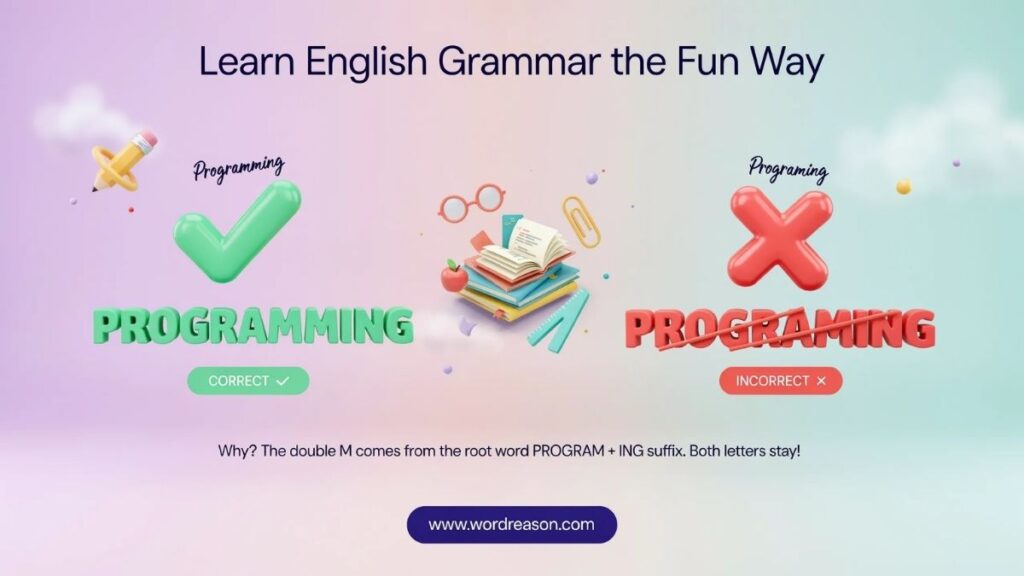
Programming or Programing one letter might seem like a tiny detail, but it can make your spelling look a little less professional. If you have ever paused while typing this word, you are not alone. Is one M enough, or does programming need two? English spelling loves to keep you guessing! However, there is a clear answer. Programming is the standard and widely preferred spelling, while programing is a less common alternative. In this guide, you will discover the difference, understand the spelling rules, explore practical examples, and avoid common mistakes. Let us put this double M mystery to rest!
Quick Answer Programming or Programing?
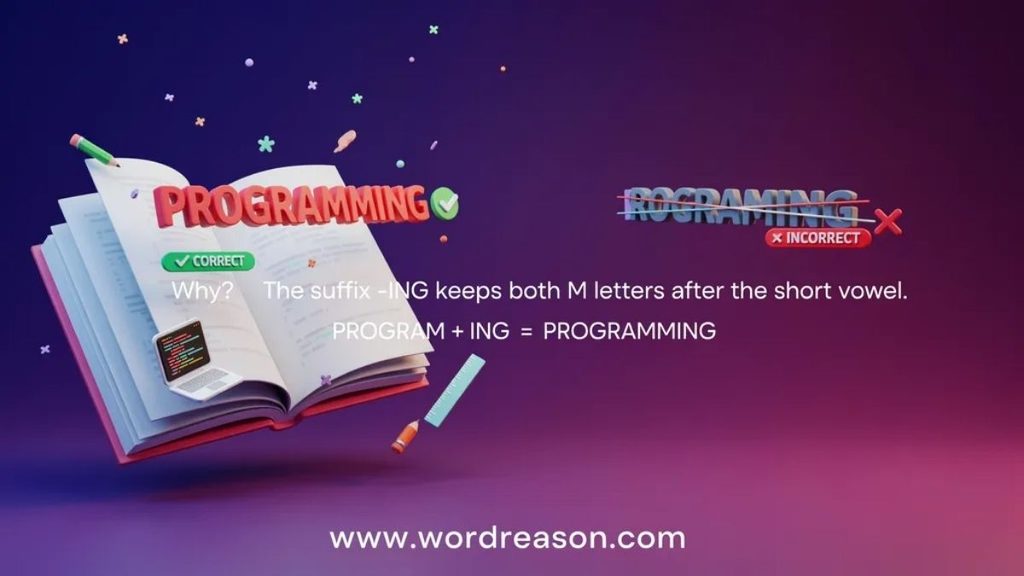
Programming, with two M letters, is the standard and preferred spelling in modern English. It commonly refers to writing computer instructions, developing software, and arranging scheduled content for television or radio.
Programing, with one M, is also recognized as an alternative spelling in some dictionaries. However, it appears much less frequently in everyday and technical writing.
Consider these examples:
| Spelling | Status | Example |
|---|---|---|
| Programming | Standard and preferred | She is learning computer programming. |
| Programing | Less common alternative | She is learning computer programing. |
For everyday communication, academic assignments, professional documents, and technical articles, choose programming. It is the more familiar spelling and the safest option for most readers.
Which One Is Correct?
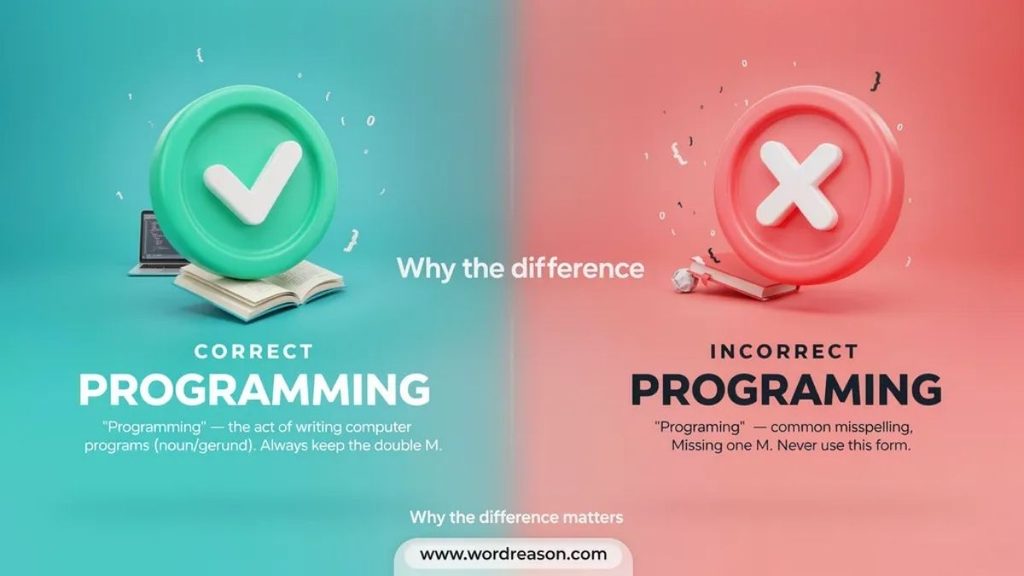
The main difference between programming and programing is their spelling, not their meaning. Both forms can describe the process of creating, writing, or arranging programs. Nevertheless, programming is considerably more common.
The double-M spelling dominates modern technical vocabulary. You will encounter it in computer science textbooks, software development courses, programming tutorials, job descriptions, and technical documentation.
For example, computer programming, programming languages, programming skills, and programming tools all commonly use the double-M form.
The single-M version also appears in dictionary entries, but its limited use makes it less suitable for general professional writing.
Difference Between Programming and Programing
Understanding their similarities and differences helps you avoid unnecessary spelling confusion.
| Feature | Programming | Programing |
|---|---|---|
| Number of M letters | Two | One |
| Meaning | Writing or arranging programs | Same general meaning |
| Dictionary recognition | Recognized | Recognized as a variant in some dictionaries |
| Common usage | Very common | Much less common |
| Computer science | Preferred | Less preferred |
| Academic writing | Recommended | Generally avoid |
| Professional writing | Preferred | Less familiar |
The important point is that these spellings do not describe two different computer-related activities. Instead, they represent alternative written forms of the same word.
Dictionary.com recognizes programing as an alternative form of programming. Collins also records programing as a variant in its American English entry. Therefore, calling the single-M spelling universally incorrect would be misleading. Dictionary.com+1
However, dictionary recognition does not mean that both spellings have equal standing in everyday English.
Learn the difference between confusing more English words
Forest or Forrest Which Spelling Is Correct?
Why Is Programming Spelled With Two M Letters?
The easiest way to understand programming is to start with its root word: program.
A program can refer to a set of instructions that tells a computer what to do. It can also describe a planned series of activities, events, or broadcasts.
When you add the suffix -ing to program, you get programming as the established standard spelling.
However, the spelling variation deserves attention because English consonant-doubling rules do not always produce the forms that writers expect.
The Root Word Program
Program is the original word from which programming develops. It functions as both a noun and a verb.
As a noun, program can describe computer software or an organized plan of activities. As a verb, it means to create computer instructions or arrange something according to a particular plan.
Consider these examples:
| Word form | Example sentence |
|---|---|
| Program as a noun | I installed a new computer program. |
| Program as a verb | I need to program the device. |
| Programming | She enjoys programming in Python. |
| Programmed | The technician programmed the machine. |
| Programmer | The programmer developed a new application. |
The root word helps explain the relationship between all these forms.
Program also appears in other related words, including programmable and programmatic. Each word has its own grammatical function and meaning.
The English Consonant Doubling Rule
English sometimes doubles a final consonant when a writer adds a suffix such as ing or ed. This process is called consonant doubling.
A common example involves short words that end in a consonant-vowel-consonant pattern. When the suffix begins with a vowel, the final consonant usually doubles.
For example
| Original word | With -ing | With -ed |
|---|---|---|
| Run | Running | Ran |
| Sit | Sitting | Sat |
| Plan | Planning | Planned |
| Stop | Stopping | Stopped |
| Drop | Dropping | Dropped |
| Swim | Swimming | Swam |
Longer words can follow a similar pattern when the final syllable carries the main stress.
For example
| Original word | With -ing |
|---|---|
| Begin | Beginning |
| Admit | Admitting |
| Prefer | Preferring |
| Occur | Occurring |
By contrast, words that do not place the main stress on the final syllable generally do not double their final consonant under this pattern.
For example
| Original word | With -ing |
|---|---|
| Open | Opening |
| Visit | Visiting |
| Offer | Offering |
| Listen | Listening |
However, program is an important case because it does not fit the usual stressed-final-syllable explanation. The main stress falls on the first syllable. Both programing and programming are recognized forms, although modern usage strongly favors programming.
Therefore, it is better to learn programming as the established spelling rather than assume that a simple consonant-doubling rule explains every detail.
Adding the ING Suffix
The suffix -ing commonly forms a present participle or gerund from a verb.
A present participle usually describes an ongoing action, while a gerund functions as a noun.
For example, consider the following sentences
| Sentence | Grammatical function |
|---|---|
| She is programming a computer. | Present participle |
| Programming requires patience. | Gerund |
| They enjoy programming games. | Gerund |
| He is programming a new application. | Present participle |
In standard modern writing, the familiar form is programming.
The same word formation process appears in many other English words. Nevertheless, the accepted spelling of an individual word sometimes depends on established usage and dictionary recognition.
The practical pattern to remember is
| Root word | Related form |
|---|---|
| Program | Programming |
| Program | Programmed |
| Program | Programmer |
These are the standard forms you should use in most writing.
Learn the difference between confusing more English words
Fiend or Feen Which Spelling Is Correct?
What Does Programming Mean?
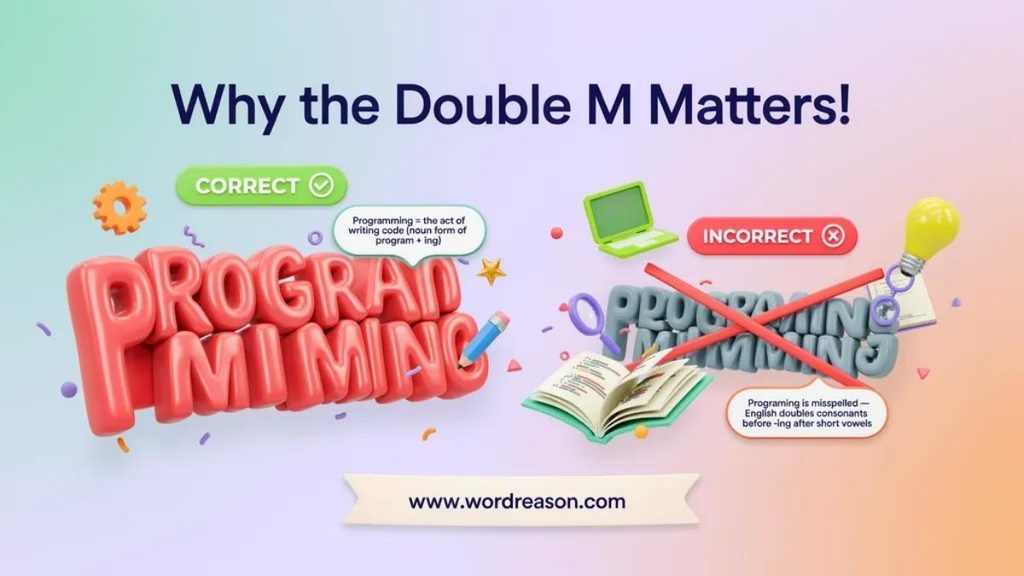
Programming has several meanings depending on the context. Most people associate it with computers and software development. However, the word also describes the process of planning and scheduling content for television, radio, and other entertainment platforms.
Understanding these meanings helps you recognize the word in different situations.
Programming in Computer Science
In computer science, programming means creating instructions that tell a computer or digital device how to perform specific tasks.
These instructions usually take the form of source code written in a programming language. A computer processes the instructions, either directly or after translation into an executable form, to perform the required operations.
Programming involves much more than typing code. It also requires planning solutions, organizing instructions, testing software, identifying errors, and improving applications.
For example, programmers use their skills to develop websites, create mobile applications, build video games, manage databases, and automate repetitive tasks.
Common programming languages include
| Programming language | Common application |
|---|---|
| Python | Automation, artificial intelligence, and data analysis |
| JavaScript | Interactive websites and web applications |
| Java | Enterprise software and Android development |
| C++ | Game development and performance-intensive software |
| C | Operating systems and embedded systems |
| PHP | Server-side web development |
| Swift | Apple application development |
| SQL | Managing and querying relational databases |
These languages have different purposes, but they all support computer programming.
Consider the following examples
| Context | Example sentence |
|---|---|
| Education | My brother is studying computer programming. |
| Career | She wants to become a professional programmer. |
| Technology | Python is a popular language for programming applications. |
| Workplace | The company hired a programmer to develop its software. |
| Personal interest | Programming has become one of his favorite hobbies. |
In each example, programming refers to the activity of creating or developing computer instructions.
Programming in Everyday English
Programming is not limited to computer science. It also describes the process of selecting, organizing, and scheduling content for radio, television, and other media platforms.
For example, a television network might change its programming to attract more viewers during the evening. Similarly, a radio station might organize its weekend programming around music shows, interviews, and news broadcasts.
Consider these examples
| Context | Example sentence |
|---|---|
| Television | The network announced its new programming schedule. |
| Radio | The station changed its morning programming. |
| Entertainment | The festival programming includes films and musical performances. |
| Streaming | The platform offers original programming throughout the year. |
The meaning changes according to the subject, but the spelling remains programming.
Learn the difference between confusing more English words
Enquiries or Inquiries Which Spelling Is Correct?
Is Programing a Word?

Yes. Programing is a recognized spelling variant of programming in some dictionaries. It can describe the same activity, whether that involves writing computer instructions or arranging a program.
This distinction matters because people sometimes assume that every alternative spelling represents a grammatical mistake. However, English contains many words with recognized spelling variations.
Dictionary.com lists programing as an alternative form of programming. Collins also includes it in its American English dictionary entry. Dictionary.com+1
Therefore, the single M spelling is not simply an invented word or an automatic typing error.
Nevertheless, its acceptance does not make it equally common or equally suitable for every writing situation.
Is Programing an Accepted Alternative Spelling?
Yes. Some established dictionaries recognize programing as an alternative spelling.
This means that the word has dictionary support even though most modern writers prefer programming.
Consider three important points.
First, dictionary recognition establishes that a spelling variation exists. Second, common usage helps determine which version readers expect to see. Finally, editorial conventions help writers choose the most appropriate form for a particular publication.
For example, a technical writer preparing software documentation would normally choose programming. A blogger writing about computer science should make the same choice.
The following comparison makes the distinction clearer:
| Consideration | Programming | Programing |
|---|---|---|
| Dictionary recognition | Yes | Yes, as a variant in some dictionaries |
| General familiarity | High | Lower |
| Technical usage | Established | Uncommon |
| Recommended for most readers | Yes | No |
In other words, a spelling can be recognized without becoming the preferred choice.
Why Is Programing Less Common?
Programming has become the established form in modern technology-related writing. Readers regularly encounter it in programming courses, software development guides, computer science textbooks, and technical publications.
Consequently, the double M spelling feels familiar across different writing situations.
The single-M version receives less attention. As a result, readers may assume that it contains a typing mistake even when the writer intends to use an accepted alternative.
Consistency also matters. Writers who use programming throughout an article make the text easier to recognize, read, and edit.
For example, consider these common expressions
| Preferred expression | Less common variation |
|---|---|
| Computer programming | Computer programing |
| Programming languages | Programing languages |
| Programming skills | Programing skills |
| Programming courses | Programing courses |
| Software programming | Software programing |
The double-M versions are the familiar choices for modern professional communication.
Learn the difference between confusing more English words
Creator vs Creater Which Spelling Is Correct?
Examples in Sentences
Sentence examples make spelling differences easier to understand. They also show how programming works in different contexts without changing its spelling.
| Context | Example sentence |
|---|---|
| Education | My sister is learning computer programming at college. |
| Workplace | The company needs an experienced programming specialist. |
| Technology | JavaScript is widely used for web programming. |
| Career | She wants to pursue a career in software programming. |
| Personal interest | He enjoys programming in his free time. |
| Web development | Learning programming can help you build interactive websites. |
| Broadcasting | The television network updated its weekend programming. |
| Automation | Programming the machine will reduce manual work. |
| Academic writing | The research examines programming methods in artificial intelligence. |
| Social media | I am learning programming this summer. |
These examples demonstrate that programming works naturally in professional, academic, and informal communication.
Computer Programming Examples
Computer-related writing provides some of the clearest examples of the preferred spelling.
My brother wants to improve his computer programming skills.
The students completed a programming project using Python.
She is interested in programming languages and software development.
The company offers advanced programming courses for beginners.
Good programming habits make software easier to understand and maintain.
Workplace and Professional Writing Examples
Professional communication also benefits from consistent spelling.
Our team is looking for a programmer with strong programming experience.
The company offers programming training to new employees.
She manages the programming department at a software development firm.
The new employee will work on programming and application development.
Academic Writing Examples
In academic writing, programming usually refers to a field of study, a technical process, or a practical skill.
Computer programming introduces students to logical problem-solving.
The research examines programming methods used in artificial intelligence.
Students must complete a programming assignment before the final examination.
The course covers programming languages and software development principles.
Everyday Conversation and Social Media Examples
People also use programming in informal conversations.
I am learning programming this year.
Programming looks difficult, but I am enjoying it.
Does anyone know a good programming course?
I spent the weekend programming a small game.
Whether you write a casual message or a formal report, programming remains the familiar spelling.
Learn the difference between confusing more English words
Emphasise or Emphasize which spelling is correct?
American vs British English Which Spelling Is Preferred?
American and British English sometimes use different spellings for the same word. For example, Americans generally write color, while British writers commonly use colour.
The word program follows a similar regional pattern. American English normally uses program for software, television broadcasts, and organized activities. British English often uses programme for television shows, educational courses, and planned activities.
However, computer-related vocabulary follows a different convention.
Both American and British English commonly use programming when discussing computer science and software development.
| Meaning or context | American English | British English |
|---|---|---|
| Computer software | Program | Program |
| Writing computer code | Programming | Programming |
| Past tense in computing | Programmed | Programmed |
| Person who writes code | Programmer | Programmer |
| Television broadcast | Program | Programme |
| Television scheduling | Programming | Programming |
| Educational course | Program | Programme |
For example, an American writer might say
She enrolled in a computer program.
A British writer might say
She enrolled in a computer programme.
However, both writers would normally say
She is studying computer programming.
The distinction concerns the base word program or programme, not a requirement to change programming into programing.
American English Spelling of Programming
American English uses programming as the preferred spelling when discussing computer coding, software development, and broadcast scheduling.
It also uses program as the standard base form.
For example
The company developed a new computer program.
He is learning programming to improve his technical skills.
The technician programmed the device.
These forms follow familiar American English usage.
British English Spelling of Programming
British English also uses programming for computer-related activities.
However, programme remains common in contexts involving television broadcasts, educational courses, and organized activities.
For example
She enjoys computer programming.
The television programme begins at eight.
He enrolled in a university programme.
Notice that the computing term remains programming. The difference between program and programme depends on the meaning and regional convention.
Learn the difference between confusing more English words
Totaling or Totalling? which spelling is correct?
Common Spelling Mistakes Related to Programming
Even familiar words can cause confusion when writers add suffixes or create related forms. Programming is no exception.
The following mistakes commonly occur when people try to spell words from the same word family.
Writing Programing Instead of Programming
Programing is a recognized alternative, but programming is the preferred form in standard modern writing.
For professional and academic content, use the familiar double M spelling.
| Less preferred | Preferred |
|---|---|
| I am learning computer programing. | I am learning computer programming. |
| She teaches software programing. | She teaches software programming. |
| He enjoys programing games. | He enjoys programming games. |
Writing Programed Instead of Programmed
The past-tense forms also have spelling variations.
Programed is recognized as an alternative, but programmed is the familiar and widely preferred spelling.
For example
The developer programmed the application.
The technician programmed the security system.
The computer was programmed to recognize specific commands.
For consistency, use programmed in most professional and technical writing.
Confusing Program With Programme
This mistake usually involves regional English conventions.
American English normally uses program for software and organized activities. British English commonly uses programme for television broadcasts, educational courses, and planned activities.
However, computer-related writing generally uses program in both varieties.
For example, an American student might enroll in a computer program, while a British student might enroll in a computer programme.
Both would study computer programming.
Spelling Programmer With One M
A programmer is someone who writes, tests, and maintains computer programs.
The standard spelling is programmer, with two M letters.
The word programer also appears as a less common alternative in some dictionary references. Nevertheless, programmer is the preferred form in modern professional writing.
For example
The programmer fixed the software error.
Our company hired an experienced programmer.
The programmer developed a new mobile application.
Mixing Up Programming and Programmatic
These words share the same root, but they have different grammatical functions.
Programming refers to the process of creating or arranging programs.
Programmatic is an adjective that describes something related to a program, plan, or organized approach.
For example
Programming requires logical thinking.
The organization introduced a programmatic approach to employee training.
Although these words look similar, they are not interchangeable.
Learn the difference between confusing more English words
Tying or Tieing Which Spelling Is Correct?
Programming, Programmed and Programmer
Learning related word forms makes it easier to avoid spelling mistakes. It also helps you understand how the root word program changes when you use different grammatical forms.
| Word | Part of speech | Meaning | Example |
|---|---|---|---|
| Program | Noun or verb | Software or the act of creating instructions | I will program the device. |
| Programs | Noun or verb | Multiple programs or an action performed by someone | She programs computers. |
| Programming | Noun or verb form | The process of creating programs | Programming takes practice. |
| Programmed | Past tense or past participle | Created or entered instructions | He programmed the machine. |
| Programmer | Noun | A person who writes computer programs | The programmer tested the application. |
| Programmable | Adjective | Capable of receiving instructions | This is a programmable device. |
| Programmatic | Adjective | Related to a program or organized plan | The company introduced a programmatic strategy. |
Program
Program is the basic form of the word. It functions as both a noun and a verb.
As a noun, it describes software or an organized series of activities.
As a verb, it describes the act of writing computer instructions or arranging something according to a plan.
Example: The developer will program the new application.
Programming
Programming can function as a noun, gerund, or present participle.
1.Example Programming is an important computer science skill.
2.Example She is programming a new application.
3.Example They enjoy programming games.
Programmed
Programmed is the past-tense and past-participle form of program.
1.Example I programmed the computer yesterday.
2.Example The machine was programmed to stop automatically.
3.Example They have programmed the system to detect errors.
Programmer
A programmer is someone who creates computer programs by writing and maintaining code.
Example The programmer developed a mobile application.
Example Our company hired an experienced programmer.
Programmable
Programmable describes a machine or device that can receive instructions.
Example The programmable thermostat adjusts the temperature automatically.
Example This programmable robot can follow different commands.
Programmatic
Programmatic describes something connected with a structured program, plan, or organized approach.
Example The organization introduced a programmatic approach to improving education.
Example The research examines programmatic changes in public policy.
Learn the difference between confusing more English words
Reinforce vs Reenforce Which spelling Is Correct?
Which Spelling Should You Use in Formal and Technical Writing?
When preparing a school assignment, professional email, technical report, resume, or online article, choose programming.
Although programing has dictionary recognition, the double M spelling is more familiar and widely established. It also reduces the possibility that readers will mistake your spelling for an accidental omission.
| Writing situation | Recommended spelling |
|---|---|
| Academic assignments | Programming |
| Computer science textbooks | Programming |
| Software documentation | Programming |
| Job applications | Programming |
| Professional emails | Programming |
| Technology blogs | Programming |
| Programming tutorials | Programming |
| Social media posts | Programming |
Learn the difference between confusing more English words
Discard vs Disgard Which Spelling Is Correct?
What About AP Style?
The Associated Press Stylebook is a widely used reference for journalists, editors, and professional writers.
AP uses Merriam-Webster as its primary spelling reference for matters that its own guidance does not specifically address. Therefore, writers following AP style should consult the current dictionary entry rather than assume that AP has a separate rule requiring one particular form.
For practical purposes, programming is the recommended choice for general professional communication and technology-related articles.
A Practical Editing Example
Imagine that you are preparing a resume for a software development position.
Your original sentence reads
Experienced in computer programing, application development, and software testing.
The meaning is clear, but the single-M spelling may look like a typing mistake to a recruiter.
A more polished version reads
Experienced in computer programming, application development, and software testing.
The revised sentence uses the familiar spelling and maintains consistency with common technology terminology.
The same principle applies to academic papers, website articles, product descriptions, and technical documentation.
Learn the difference between confusing more English words
Thiefs or Thieves Which Spelling Is Correct?
Fill in the Blanks
- The correct and standard spelling is __________.
- Programming contains __________ Ms.
- Programing contains __________ M.
- The word programming comes from the root word __________.
- Programming is commonly used in __________ science.
- Python is a popular __________ language.
- Writing instructions for computers is called __________.
- The spelling programing is considered an alternative __________.
- Both American and British English use __________ for computer software.
- British English often uses __________ for television schedules.
- The suffix added to program is __________.
- A person who writes computer programs is called a __________.
- The past tense of program is __________.
- Programming involves writing, testing, and __________ code.
- JavaScript is a popular __________ language.
- The word program can function as a noun and a __________.
- The preferred spelling has a double __________.
- Programing is less __________ than programming.
- Computer programming helps create software and __________.
- A set of instructions that tells a computer what to do is called a __________.
- The word programming can also refer to arranging television or radio __________.
- Programming and coding have closely related __________.
- The correct spelling in professional writing is usually __________.
- The Greek word programma is associated with a written public __________.
- Assembly and C++ are sometimes considered challenging programming __________.
Answer Session
- Programming
- Two
- One
- Program
- Computer
- Programming
- Programming
- Spelling
- Program
- Programme
- -ing
- Programmer
- Programmed
- Debugging
- Programming
- Verb
- M
- Common
- Applications
- Program
- Content
- Meanings
- Programming
- Notice
- Languages
Here’s a trusted source for clear word meanings:
Frequently asked questions
Does programing have one M or two?
Programing has one M, while programming has two.
Is programming spelled correctly?
Yes. Programming is the standard and preferred spelling.
What do you mean by programing?
Programing is an alternative spelling of programming, meaning writing or arranging programs.
Is Python coding or programming?
Python is a programming language used for coding and software development.
How do I spell programming?
P-R-O-G-R-A-M-M-I-N-G.
What are the big three coding languages?
Python, JavaScript, and Java are three widely used programming languages.
Which is correct, programming or programing?
Programming is the preferred spelling, although programing is a recognized alternative.
What is the etymology of the word programming?
Programming comes from program, which traces back to the Greek word programma.
How is program spelled in American English?
Americans spell it program, with one M.
What language did Elon Musk code in?
Elon Musk has discussed using BASIC and C++ in his early programming experiences.
How do you write I love you in coding?
In Python, write print("I love you").
What is the hardest coding language ever?
Assembly, C++, and Haskell are often considered challenging programming languages.
conclusion
The programming or programing confusion may look like a tiny spelling puzzle, but now you know which side of the M mystery wins. Programming, with two Ms, is the standard and widely preferred spelling in modern English, especially in computer science and technical writing. Although programing with one M is recognized as an alternative, it is far less common. So, before you let that missing M sneak into your writing, remember the correct form: programming. Whether you are writing about Python, developing software, or discussing technology, use the double-M spelling to keep your writing clear, accurate, and professional. One extra M, one less grammar headache!

Bella AJS
Bella AJS is an experienced blogger and passionate language enthusiast at WordReason. She specializes in English grammar, word meanings, spelling, and commonly confused words. With a clear and practical writing style, Bella helps readers understand tricky language rules without the textbook headache. Her goal is simple: make English easier, clearer, and more enjoyable one word at a time.