
One tiny spelling mistake can leave even confident writers second guessing themselves. Is it tying or tieing? At first glance, adding ing to tie seems simple enough, but English spelling has other plans! The difference comes down to a small but important spelling rule that many people overlook. Whether you’re tying your shoelaces, securing a package, connecting ideas, or tying the knot, using the correct form keeps your writing polished and professional. So, which spelling should you choose, and why does the other one cause so much confusion? Let’s untangle the rule with clear explanations and practical examples.
Tying or Tieing Which Spelling Is Correct?
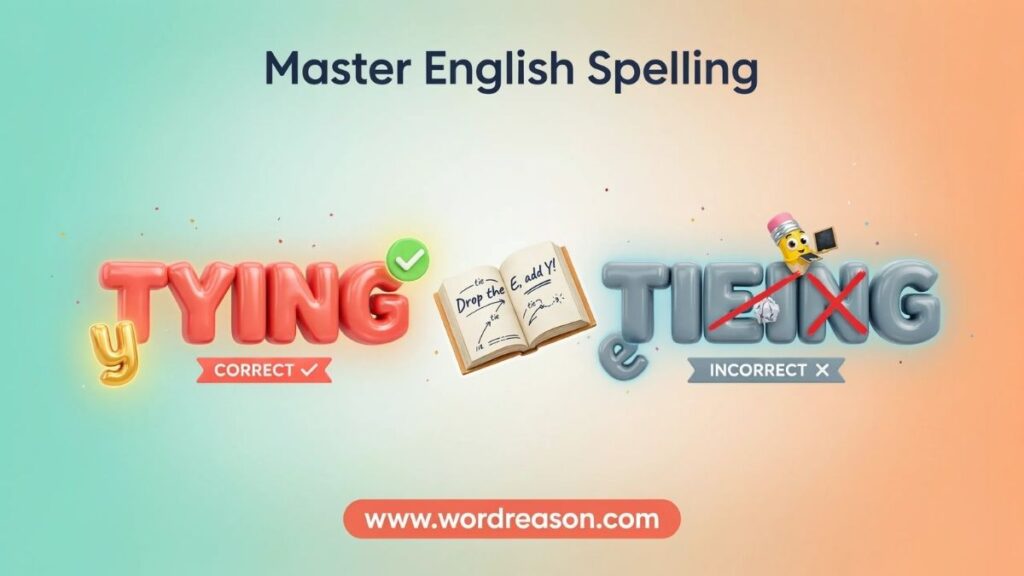
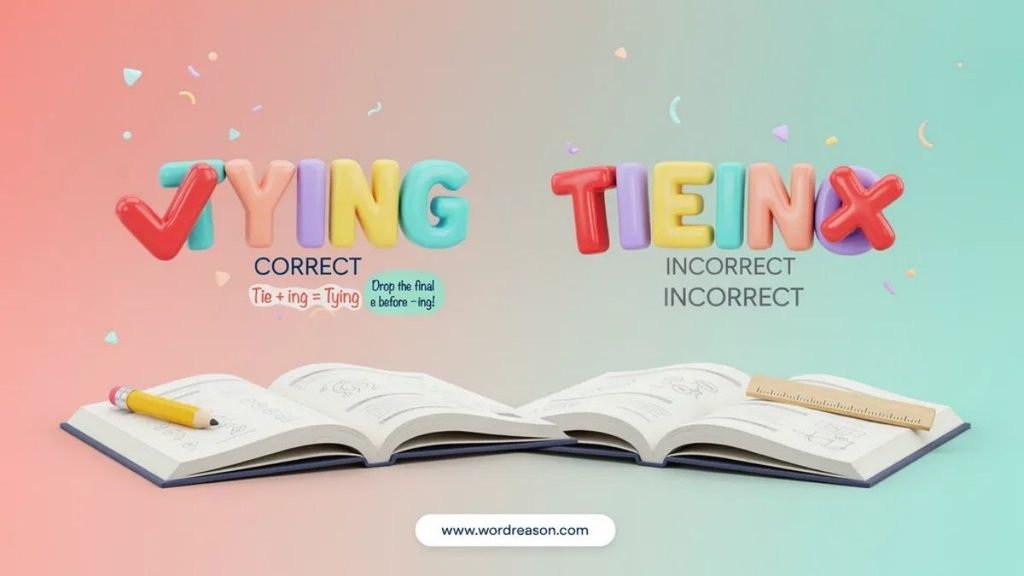
The correct spelling is tying. You should use this form whenever you want to describe fastening something with a knot, connecting two objects, or making two competitors reach the same score.
Although tieing may look logical, it is not the accepted spelling in modern standard English. The confusion happens because the base verb tie ends in a silent e. Many English verbs drop their final e before adding -ing, such as make becoming making and write becoming writing. However, verbs ending in -ie follow a different pattern.
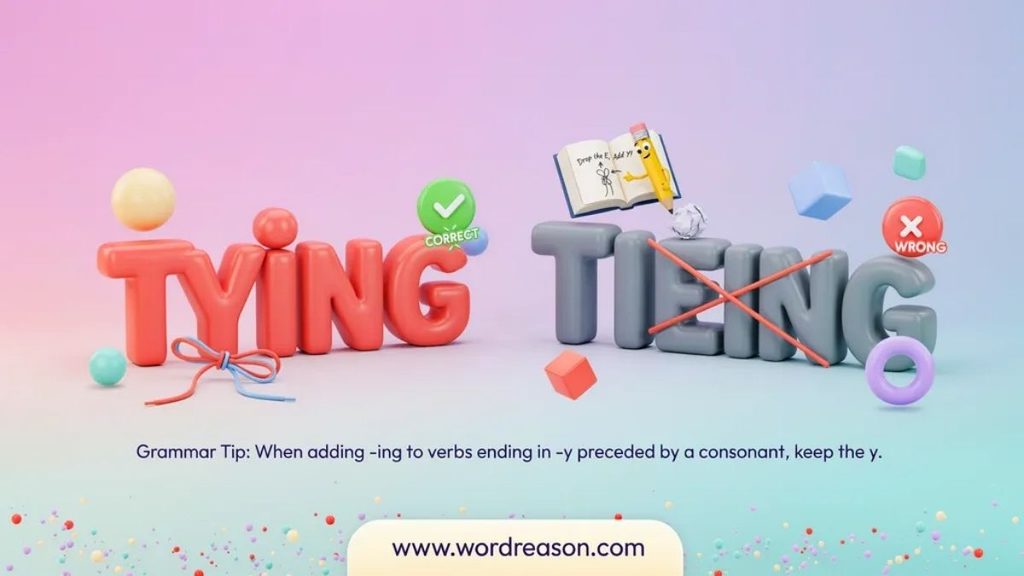
For these verbs, you replace the final -ie with -y before adding -ing. As a result, tie becomes tying, not tieing.
| Word | Correct form | Incorrect form |
|---|---|---|
| Tie | Tying | Tieing |
| Die | Dying | Dieing |
| Lie | Lying | Lieing |
| Vie | Vying | Vieing |
This pattern applies to common English verbs, so learning it can help you avoid several spelling mistakes at once.
Learn the difference between confusing more English words
Label or Lable which Spelling is correct?
What Does Tying Mean?
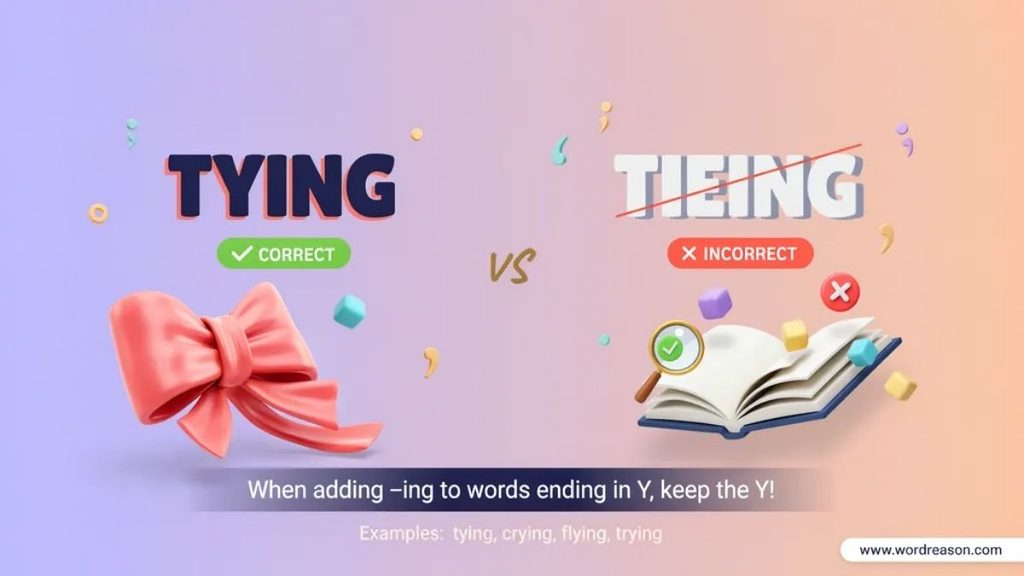
Tying is the present participle and gerund form of the verb tie. It describes the action of fastening, securing, joining, or connecting something. The exact meaning depends on the sentence and situation.
For example, you might use tying when fastening your shoelaces, securing a package with string, or connecting two pieces of rope. The word also appears in sports, relationships, and everyday expressions.
Tying as Fastening or Securing Something
The most common meaning of tying involves using a knot, string, rope, ribbon, or another material to hold something in place.
For example, you might be tying your shoes before leaving home or tying a ribbon around a gift box. In both situations, the word describes an action that helps secure something.
| Sentence | Meaning |
|---|---|
| She is tying her shoelaces. | She is fastening her shoes. |
| He is tying a ribbon around the package. | He is securing the package with a ribbon. |
| I spent the morning tying the ropes together. | I connected the ropes using knots. |
| The nurse is tying a bandage around his arm. | The nurse is securing the bandage. |
| They are tying the branches into bundles. | They are fastening the branches together. |
Tying in Sports and Competitions
In sports, tying can mean bringing the scores of two competing teams or players to the same level.
For instance, if one team trails by two points and then scores twice, it may be tying the game. The word describes the moment when both sides have an equal score.
| Sentence | Meaning |
|---|---|
| The player is tying the game with a late goal. | The player is making the score equal. |
| Our team is tying the match in the final minutes. | Our team is bringing the scores level. |
| She scored again, tying the game at three. | Her score made the total three for each side. |
| The runner is tying the record set last year. | The runner is matching the existing record. |
You may also see tying for first place in competition results. This means two or more participants share the same position because they have achieved equal scores or results.
Tying the Knot
The expression tying the knot means getting married. It is an informal and familiar phrase that people often use when talking about weddings and marriage plans.
For example
They are tying the knot next summer.
In this sentence, tying does not describe fastening an actual rope or string. Instead, it forms part of an idiom that refers to marriage.
Tying Things Together Figuratively
The word tying can also describe connecting ideas, events, or pieces of information. In this sense, it does not involve a physical knot.
For example, a writer might be tying several ideas together to create a clear argument. A detective might be tying different clues together to understand a case.
The expression tying up loose ends has a related meaning. It refers to finishing unfinished tasks, resolving small problems, or completing the remaining details of a project.
Learn the difference between confusing more English words
Salvadoran or Salvadorian Which Spelling Is Correct?
Why Is Tying Spelled Without an E?
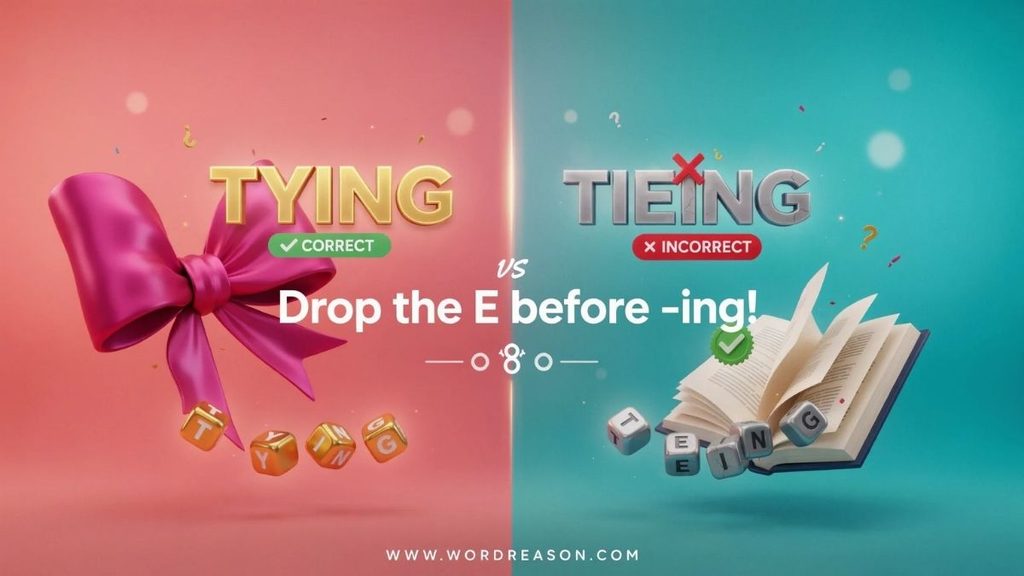
The spelling tying follows a specific English spelling rule for verbs that end in -ie. When you add the suffix -ing to one of these verbs, you change ie to y.
This rule explains why tie becomes tying rather than tieing.
The ie to y Spelling Rule
The rule is straightforward. If a verb ends in -ie, replace those two letters with y before adding ing.
The word formation process looks like this
| Base verb | Remove -ie | Add -y and -ing | Correct spelling |
|---|---|---|---|
| Tie | T- | T + ying | Tying |
| Die | D- | D + ying | Dying |
| Lie | L- | L + ying | Lying |
| Vie | V- | V + ying | Vying |
This spelling pattern keeps the pronunciation clear and prevents an awkward combination of letters.
How the Rule Differs From the Silent E Rule
Many verbs that end in a silent e drop that letter before they take the ing suffix. For example, make becomes making, write becomes writing, and dance becomes dancing.
However, verbs ending in ie do not follow that exact pattern. They change the ending to y instead.
Compare these examples
| Base verb | Correct -ing form | Spelling pattern |
|---|---|---|
| Make | Making | Drop final e |
| Write | Writing | Drop final e |
| Dance | Dancing | Drop final e |
| Tie | Tying | Change -ie to -y |
| Die | Dying | Change -ie to -y |
| Lie | Lying | Change -ie to -y |
| See | Seeing | Keep the final e |
| Agree | Agreeing | Keep the final e |
| Dye | Dyeing | Keep the final e |
The last three examples are especially useful because they show that not every verb ending in e drops that letter. Words ending in ee, ye, and oe generally keep the e when they take ing. Grammatik – Cambridge Dictionary+1
Why Does the Y Replace the IE?
The change helps preserve the familiar sound of the original word. The base verb tie has a long i sound. Writing tying keeps that sound clear while following the established spelling convention.
The same pattern appears in dying, lying, and vying. Once you recognize the pattern, you can apply it without having to memorize each word separately.
Learn the difference between confusing more English words
Lilies or Lillies Which Is the Correct Spelling?
Tying vs Tieing Understanding the Difference
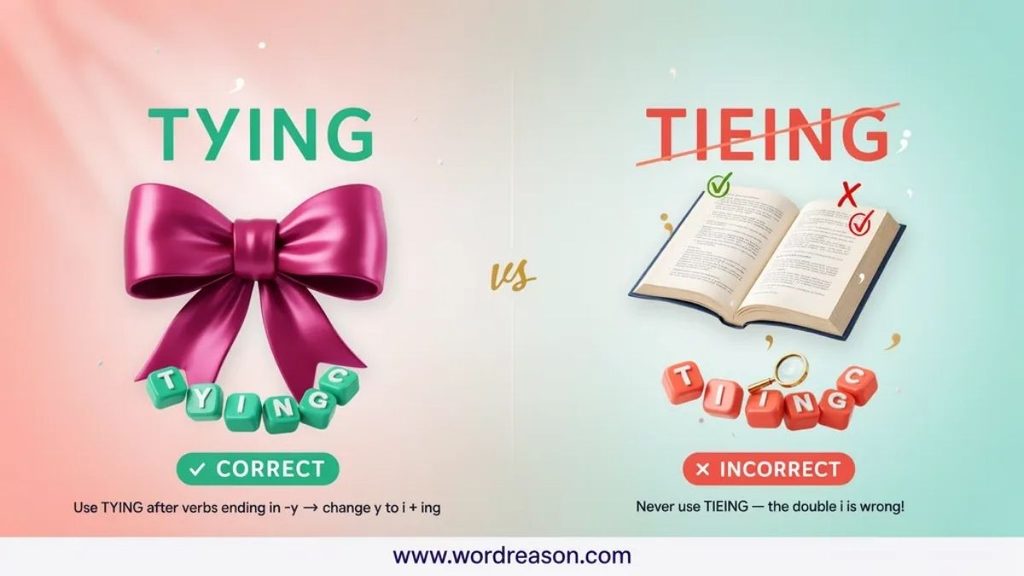
The main difference between tying and tieing is spelling accuracy. Both forms may look understandable to readers, but only tying follows the standard English spelling rule.
| Feature | Tying | Tieing |
|---|---|---|
| Standard spelling | Yes | No |
| Dictionary usage | Accepted | Nonstandard or incorrect |
| Grammar | Correct -ing form of tie | Incorrect formation |
| Suitable for formal writing | Yes | No |
| Suitable for everyday writing | Yes | No |
You may occasionally encounter tieing in older documents, informal writing or spelling discussions. However, seeing a spelling somewhere does not automatically make it correct. For modern writing, choose tying in every standard context.
Is Tieing Ever Correct?
No. Tieing is not the standard spelling of the present participle or gerund form of tie.
Even though the word may seem logical, English spelling does not form this word by simply attaching -ing to the base verb. Instead, the final -ie changes to y.
For example, write
She is tying her hair before exercising.
Do not write
She is tieing her hair before exercising.
The first sentence uses the accepted spelling. The second contains a spelling error.
Is Tying Different in American and British English?
No. There is no American and British spelling difference between these two forms.
Both American English and British English use tying. The spelling does not change based on the country, writing style, or regional variety of English.
This differs from words such as color and colour, where American and British English use different standard spellings. With tying, the same form works in both varieties.
Learn the difference between confusing more English words
Losses or Loses Which spelling Is Correct?
How to Use Tying in a Sentence
The easiest way to understand a word is to see how it works in everyday sentences. The examples below show how tying fits different situations.
Everyday Examples of Tying
People use tying frequently when describing ordinary tasks. These actions may involve shoes, clothing, packages, ropes or other objects.
| Example sentence | Explanation |
|---|---|
| I am tying my shoelaces before the walk. | Fastening shoes |
| She is tying her hair into a ponytail. | Securing hair |
| He is tying a bow around the gift. | Making and securing a bow |
| They are tying the boxes together with rope. | Connecting boxes |
| The worker is tying the package securely. | Fastening a package |
| My brother is tying a fishing knot. | Making a knot for fishing |
| The nurse is tying the bandage carefully. | Securing a bandage |
Examples of Tying in Sports
Sports writers and commentators often use tying when a player or team makes the score equal.
The following sentences demonstrate this use
The striker is tying the game with a powerful shot.
Our team is tying the match after scoring twice.
The final basket is tying the score at 82 points.
The athlete is tying the previous Olympic record.
Two players are tying for first place in the tournament.
In each example, tying refers to making a score, record, or position equal.
Examples of Tying in Figurative Expressions
The word also appears in sentences that describe connections between ideas, events, or responsibilities.
The final chapter is tying all the storylines together.
The manager is tying the new project to the company goals.
The detective is tying the evidence to the suspect.
We are tying up the loose ends before the presentation.
The speaker is tying the main points together in the conclusion.
These examples show that tying does not always require a physical object or knot. It can also describe an abstract connection.
Learn the difference between confusing more English words
Grate or Great Which spelling Is Correct?
Common Mistakes When Spelling this
Even familiar words can cause spelling confusion. The problem often comes from applying a general spelling rule to a word that follows a different pattern.
Here are some common mistakes to watch for when using tying.
Writing Tieing Instead of Tying
This is the most common mistake. Since tie ends in a silent e, writers sometimes add -ing without changing the original spelling.
However, the correct form replaces ie with y.
Incorrect: He is tieing the rope to the fence.
Correct: He is tying the rope to the fence.
Confusing Tying With Tied
Although tying and tied come from the same base verb, they serve different grammatical purposes.
Tying describes an ongoing action or functions as a gerund. Tied usually describes a completed action or a resulting condition.
For example
She is tying her shoes.
She tied her shoes before leaving.
The first sentence describes an action in progress. The second describes an action that has already happened.
Using Tie When Tying Is Needed
The base verb tie does not always fit where the sentence needs an ing form.
Incorrect He is tie his shoes.
Correct He is tying his shoes.
After forms of the verb be, such as is, am and are, an ing form commonly describes an action in progress.
Applying the Wrong Spelling Rule
Another mistake happens when writers assume that every verb ending in a silent e simply loses that letter before -ing.
That rule works for many verbs, but it does not explain words ending in -ie.
Remember the difference
Make becomes making.
Write becomes writing.
Tie becomes tying.
The final example follows the special ie to y rule.
Learn the difference between confusing more English words
Forest or Forrest Which Spelling Is Correct?
Tie, Ties, Tied and Tying Understanding All Verb Forms
The verb tie has several forms. Each one serves a different purpose in a sentence. Understanding these forms will help you choose the right word and avoid grammatical errors.
| Verb form | Grammatical use | Example |
|---|---|---|
| Tie | Base form | I need to tie my shoes. |
| Ties | Third person singular present | She ties her hair every morning. |
| Tied | Past tense | He tied the package yesterday. |
| Tied | Past participle | The boxes have been tied together. |
| Tying | Present participle | They are tying the ropes. |
| Tying | Gerund | Tying knots takes practice. |
Tie
Tie is the base form of the verb. You use it after certain helping verbs and in the simple present tense with subjects such as I, you, we, and they.
Examples
I tie my shoes every morning.
They tie the packages before shipping them.
You should tie the rope tightly.
Learn the difference between confusing more English words
Fiend or Feen Which Spelling Is Correct?
Ties
Ties is the third-person singular form of the verb. Use it with subjects such as he, she, and it in the simple present tense.
Examples
She ties her hair before exercising.
He ties the ribbon around the box.
The player ties the score with a final goal.
Learn the difference between confusing more English words
Enquiries or Inquiries Which Spelling Is Correct?
Tied
Tied is the simple past tense and past participle of tie. It describes an action that happened earlier or appears in a perfect or passive construction.
Examples
I tied the rope to the post.
She tied the package yesterday.
They have tied the two boats together.
Learn the difference between confusing more English words
Creator vs Creater Which Spelling Is Correct?
Tying
Tying is the present participle and gerund form of tie. It can describe an ongoing action or function as a noun.
Examples
He is tying his shoes.
Tying a strong knot requires practice.
The team is tying the game in the final minute.
Learn the difference between confusing more English words
Emphasise or Emphasize which spelling is correct?
Synonyms and Alternative Expressions
Depending on the context, you can replace tying with several other words. The best choice depends on what you want to describe.
| Synonym | Meaning | Example |
|---|---|---|
| Fastening | Making something secure | She is fastening the strap. |
| Securing | Keeping something firmly in place | He is securing the package. |
| Binding | Holding things together | They are binding the documents. |
| Knotting | Making a knot | She is knotting the rope. |
| Connecting | Joining two or more things | He is connecting the wires. |
| Linking | Creating a relationship or connection | The report is linking the two events. |
| Attaching | Joining one thing to another | She is attaching the label. |
| Joining | Bringing separate things together | They are joining the pieces. |
These words are not interchangeable in every situation. For example, knotting specifically suggests making a knot, while connecting can describe a much broader relationship.
Learn the difference between confusing more English words
Totaling or Totalling? which spelling is correct?
Fill in the Blanks
Complete the following sentences by choosing the correct word or spelling.
- She is ______ her shoelaces before going outside.
- The correct spelling is ______, not tieing.
- He is ______ a ribbon around the gift box.
- They are ______ the knot next summer.
- The player scored a goal, ______ the game.
- I ______ the rope to the fence yesterday.
- ______ knots requires patience and practice.
- She ______ her hair every morning.
- The workers are ______ the packages securely.
- The team is ______ the score in the final minutes.
- He is ______ the two ropes together.
- The past tense of tie is ______.
- The -ing form of lie is ______.
- The -ing form of die is ______.
- The -ing form of vie is ______.
- Tying up loose ends means ______ unfinished tasks.
- She is ______ her shoes before exercising.
- The correct spelling is tying, not ______.
- They have ______ the boxes together.
- He is ______ a necktie for the meeting.
- Tying can describe fastening or ______ two things.
- The verb tie becomes ______ when adding -ed.
- Tying can also describe making two sports teams have an ______ score.
- The word ______ means securing something with a knot.
- Tying is the present participle and ______ form of tie.
Answer Session
Check your answers after completing all 25 questions.
- Tying
- Tying
- Tying
- Tying
- Tying
- Tied
- Tying
- Ties
- Tying
- Tying
- Tying
- Tied
- Lying
- Dying
- Vying
- Completing
- Tying
- Tieing
- Tied
- Tying
- Connecting
- Tied
- Equal
- Tying
- Gerund
Here’s a trusted source for clear word meanings:
Frequently asked questions
Is it tieing up or tying up?
Tying up is correct. It means fastening or securing something.
What is the meaning of tieing?
Tieing is a misspelling of tying. The correct word means fastening or connecting something.
Is it tieing the knot or tying the knot?
Tying the knot is correct. It means getting married.
Is it correct to say tying into or tieing into?
Tying into is correct. It means connecting or relating something to another thing.
Is tying or tieing correct?
Tying is the correct spelling in standard English.
s it correct to say tying out or tieing out?
Tying out is the correct spelling, although the expression is uncommon.
What is another word for tying?
Synonyms include fastening, securing, binding, knotting, connecting, and attaching.
What is the saying for tying a tie?
The common expression is tying a tie. Popular knots include the Windsor and Four-in-Hand.
How do you spell tying like tying something up?
The correct spelling is tying, with a y instead of ie.
Why do people say tying the knot?
It is an informal expression for getting married. The knot symbolizes the bond between two people.
Which is correct, tyed or tied?
Tied is correct. It is the past tense of tie.
Can you use tying as a noun in a sentence?
Yes. Example Tying knots requires practice.
conclusion
Spelling mistakes can sneak into even the simplest sentences, but now you know how to keep this one at bay. When it comes to tying or tieing, remember that tying is the only correct standard spelling. Simply replace the ie at the end of tie with y before adding ing. The same rule applies to words like lying, dying, and vying. Whether you’re tying your shoes, fastening a package or tying the knot, you can now write with confidence. So, leave tieing behind and keep your spelling firmly tied together. One small rule can make a big difference in clear, polished writing!

Bella AJS
Bella AJS is an experienced blogger and passionate language enthusiast at WordReason. She specializes in English grammar, word meanings, spelling, and commonly confused words. With a clear and practical writing style, Bella helps readers understand tricky language rules without the textbook headache. Her goal is simple: make English easier, clearer, and more enjoyable one word at a time.