
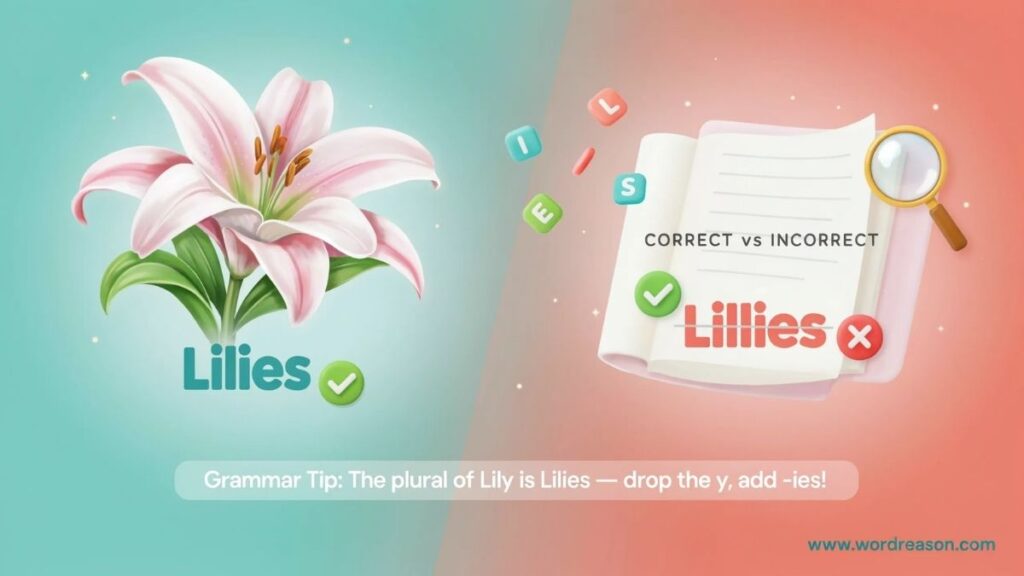
Lilies or Lillies one tiny spelling mistake can turn a lovely flower into a full-blown grammar mystery. Fortunately, solving it is easier than keeping a garden alive. The correct plural spelling is lilies, not lillies. But why does the letter y change to ies, and how can you remember the rule without getting tangled in spelling confusion? This guide makes learning simple, practical. Test your knowledge, spot common mistakes, and let your spelling skills bloom without a single grammatical weed!
Lilies or Lillies The Quick Answer
Lilies is the correct spelling when you refer to more than one lily flower. Lillies is a common misspelling because people often double the letter l by mistake.
The confusion comes from how English forms plurals. When a noun ends in a consonant followed by y, you generally replace the y with ies to make the plural. Since lily ends in l followed by y, the correct transformation is lily to lilies.
For example, you would write, She planted three lilies beside the fence, rather than She planted three lillies beside the fence.
Remember the basic distinction: one lily, several lilies. You do not need to double any letters.
Learn the difference between confusing more English words
Kindergarten or Kindergarden what it really means?
Why Is Lilies the Correct Spelling?
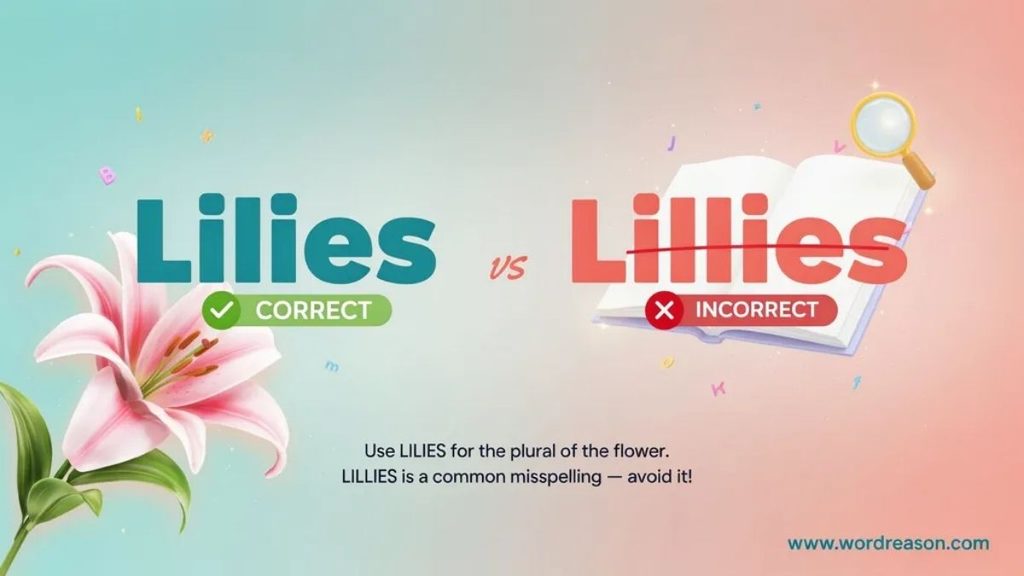
English follows a familiar spelling pattern for many nouns that end in a consonant plus y. Instead of adding only an s, you change the final y to ies. This rule explains why lilies is correct and lillies is not.
The Rule for Plural Words Ending in Y
Consider these common examples
| Singular | Plural |
|---|---|
| Lily | Lilies |
| Baby | Babies |
| City | Cities |
| Puppy | Puppies |
| Story | Stories |
Notice the pattern. Each singular noun ends in a consonant followed by y. To form the plural, replace the final y with ies while keeping the rest of the word intact.
However, words that end in a vowel followed by y usually take only an s. For instance, boy becomes boys, day becomes days, and key becomes keys.
That small distinction makes all the difference. Lily follows the consonant plus y pattern, so its plural is lilies.
Why Lillies Looks Correct but Is Not
The spelling lillies may look reasonable at first glance, especially because the word lily contains the letter l immediately before the y. However, the plural rule does not call for doubling that consonant.
Instead, you keep the original letters and change only the ending.
Correct lily → lilies
Incorrect lily → lillies
Think of the word as a small spelling puzzle. You only need to change the final letter pattern, not rebuild the entire word.
Learn the difference between confusing more English words
Outting or Outing What it really means?
What Does Lily Mean?
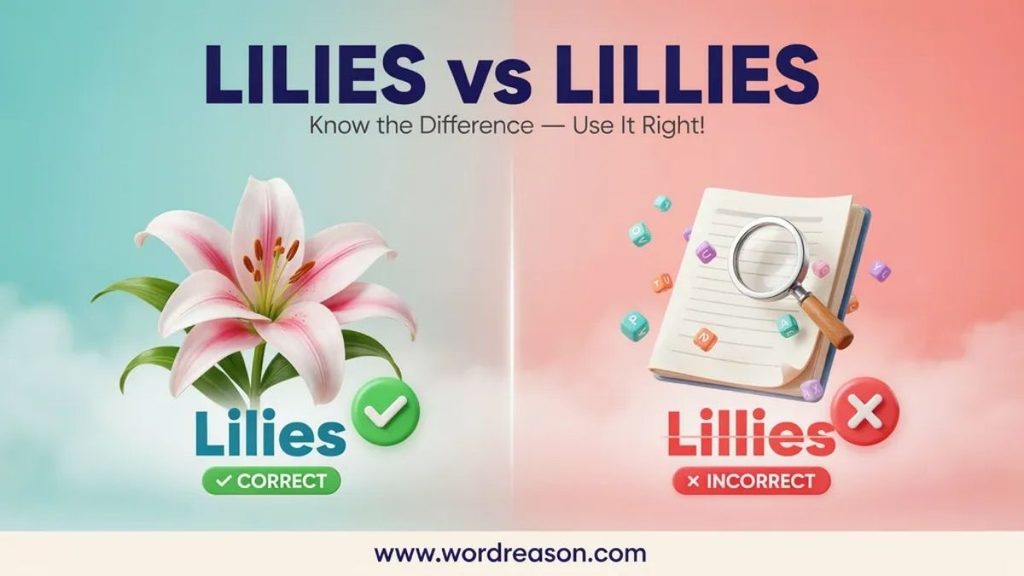
A lily is a flowering plant known for its distinctive blooms. Many lilies grow on upright stems and produce large, colorful flowers. Depending on the variety, the flowers may appear white, yellow, orange, pink, or other shades.
The word lily functions as a singular countable noun. When you refer to more than one of these flowers, you use lilies.
For example, A lily bloomed near the window describes one flower. By contrast, Several lilies bloomed near the window describes multiple flowers.
Lily vs Lilies Singular and Plural
The difference between lily and lilies is simply a matter of quantity. Use lily when referring to one flower and lilies when referring to two or more.
| Singular | Plural |
|---|---|
| One lily | Two lilies |
| A white lily | White lilies |
| This lily smells sweet. | These lilies smell sweet. |
| The lily needs water. | The lilies need water. |
Pay attention to the verbs, too. A singular subject usually takes a singular verb, while a plural subject takes a plural verb. For example, The lily looks fresh is correct, as is The lilies look fresh.
Is Lilly Ever a Correct Spelling?
Yes, Lilly can be a correct spelling of a person’s name. It can also appear as a surname or part of an official company name. However, that does not make lillies the correct plural of the flower.
The distinction depends on how you use the word. Lily is the standard spelling of the flower’s common name, while Lilly may be a person’s chosen name.
For example, Lilly sent me a birthday card can be correct when Lilly is the person’s name. However, The garden is full of lillies contains a spelling mistake when the writer means the flowers.
When writing someone’s name, always use the spelling that person uses.
Learn the difference between confusing more English words
Ambience or Ambiance Which Spelling Is Correct?
Key Differences
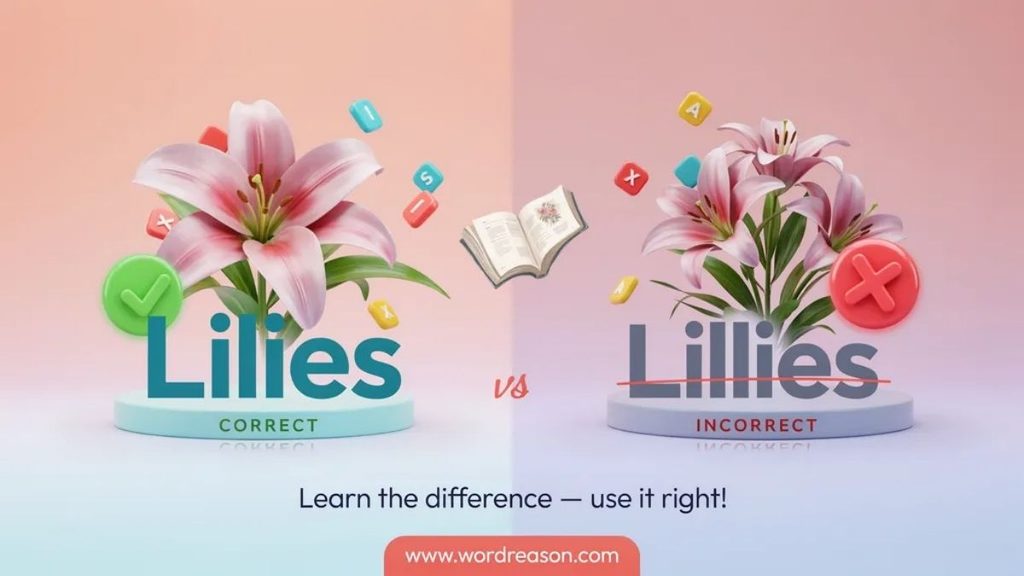
Although lilies and lillies look similar, only one is the standard spelling of the flower’s plural form. The extra “l” in lillies does not follow the accepted pluralization rule.
| Comparison | Lilies | Lillies |
|---|---|---|
| Standard English spelling | Yes | No, not for the flower |
| Refers to multiple lily flowers | Yes | Intended meaning, but misspelled |
| Follows the consonant-plus-y rule | Yes | No |
| Suitable for formal writing | Yes | No, unless reproduced as a deliberate error |
| Correct in American English | Yes | No |
| Correct in British English | Yes | No |
The important point is that this is not a regional spelling difference. Writers in the United States and the United Kingdom use lilies. You do not need to switch spellings depending on your audience.
Learn the difference between confusing more English words
Curtsy or Curtsey Which Spelling Is Correct?
How to Use Lilies Correctly in a Sentence
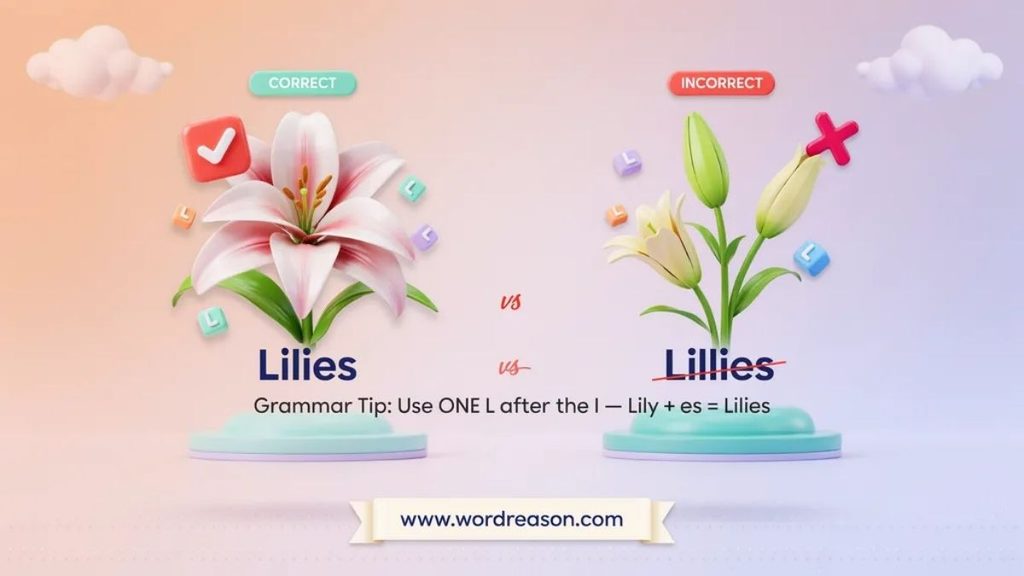
The easiest way to master a spelling rule is to see it in action. Once you start using lilies in different contexts, the correct form becomes much easier to remember.
Everyday Examples of Lilies
In everyday writing, lilies often appear in descriptions of gardens, bouquets, gifts, and flower arrangements.
For example, you might write, The white lilies on the dining table brightened the room. Another natural sentence is, We planted orange lilies along the garden path.
You could also say, My grandmother grows lilies in pots near her front door. Each example uses lilies correctly because the sentence refers to more than one flower.
Learn the difference between confusing more English words
Lieing or Lying Which Spelling Is Correct?
Lilies in Formal and Academic Writing
Formal writing follows the same spelling rule as casual conversation. Whether you are completing a school assignment, preparing a botanical report, or describing a garden, lilies remains the correct plural.
Consider these examples
The lilies produced bright flowers during the growing season.
Several lily varieties grow well in suitable garden conditions.
The researcher compared the growth of lilies under different light conditions.
Notice that the singular form lily can also appear before another noun, as in lily varieties. In that construction, lily acts as a noun modifier rather than referring to multiple flowers directly.
Learn the difference between confusing more English words
Devide or Divide Which Spelling Is Correct?
Lilies in Emails, News and Social Media
Different writing situations may call for different tones, but they do not change the spelling.
| Context | Example |
|---|---|
| The lilies for the event will arrive tomorrow. | |
| News writing | The garden displayed dozens of lilies this spring. |
| Social media | Fresh lilies always make the room feel brighter. |
| Academic writing | The study examined the growth patterns of lilies. |
| Personal message | I bought lilies for the kitchen table. |
These examples show that the correct spelling works across casual, professional, and academic settings. You can change your tone to suit the audience without changing the word itself.
Learn the difference between confusing more English words
Congratulations or Congradulations? which Spelling is Correct?
Common Spelling Mistakes With Lilies
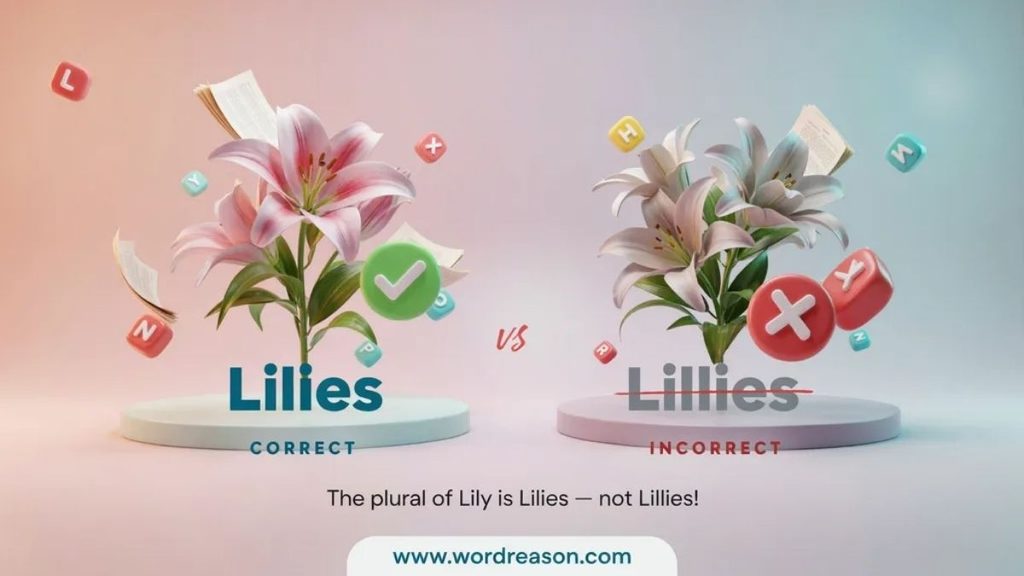
Even familiar words can cause confusion when their plural forms follow a spelling rule. Fortunately, a few simple comparisons can help you avoid the most common errors.
Writing Lillies Instead of Lilies
This is the main mistake people make when spelling the plural of lily. They double the l even though the word does not require it.
Incorrect The lillies need more sunlight.
Correct The lilies need more sunlight.
To avoid the error, remember that the plural changes the ending from y to ies. The middle of the word stays the same.
Writing Lilys Instead of Lilies
Another common error is adding only an s to the singular word. Although that pattern works for many English nouns, it does not work for lily.
Incorrect The garden contains several lilys.
Correct The garden contains several lilies.
Whenever a noun ends in a consonant followed by y, check whether the plural requires ies. This quick check can prevent many spelling mistakes.
Confusing Lily, Lilly and Lilies
These three forms can cause confusion because they look and sound similar. However, their uses differ.
Lily is the standard singular spelling of the flower. Lilies is its standard plural. Lilly can be a proper name, but it is not the standard spelling of the flower.
For example, Lilly watered the lilies is correct if Lilly is a person’s name. The first word identifies the person, while the second refers to the flowers.
Assuming British English Uses a Different Spelling
Some English words have different American and British spellings. Color and colour are a familiar example. However, lily does not follow that pattern.
Both varieties of English use lily for the singular and lilies for the plural. Writing lillies is not a British English alternative.
Learn the difference between confusing more English words
Inter vs Intra what it really means?
Where Does the Word Lily Come From?
The word lily has a long history in English. The Oxford Advanced Learner’s Dictionary traces it to Old English lilie, from Latin lilium and Greek leirion.
Although the word has ancient roots, its modern plural follows a familiar English spelling pattern. The ending changes from y to ies because the final y follows a consonant.
Understanding the origin of the word helps explain its history, but you do not need to memorize its linguistic roots to spell it correctly.
How the Word Lily Becomes Lilies
The plural form follows the standard consonant plus y rule. You retain the word’s main spelling and replace its final “y with ies.
The same pattern appears in words such as baby and city. Babies and cities use the same ending, which makes lilies easier to remember.
One related example is lily of the valley, the name of a flowering plant. When referring to multiple plants, the plural form is lilies of the valley. Only the first word changes to mark the plural.
Learn the difference between confusing more English words
Label or Lable which Spelling is correct?
Is Lilies Spelled Differently in American and British English?
No. Lilies is the standard plural spelling in both American and British English.
While regional spelling differences affect many English words, they do not affect this one. You can use lilies in an American school assignment, a British newspaper, a professional email, or an international publication without changing the spelling.
For consistency, use lily when referring to one flower and lilies when referring to multiple flowers. If you are editing a document, correct lillies wherever it appears as an ordinary spelling error.
Learn the difference between confusing more English words
Salvadoran or Salvadorian Which Spelling Is Correct?
Fill in the Blanks
Complete each sentence with the correct word or spelling. Choose from the words in parentheses.
- The garden is full of beautiful ______. (lilies / lillies)
- A white ______ stood in the glass vase. (lily / lilly)
- The plural form of lily is ______. (lilies / lillies)
- She planted a pink ______ near the fence. (lily / lilies)
- Several yellow ______ bloomed in the garden. (lilies / lillies)
- The correct spelling of the flower is ______. (lily / lilly)
- One ______ can brighten up a room. (lily / lillies)
- The florist arranged the ______ in a bouquet. (lilies / lillies)
- To make lily plural, change the letter y to ______. (ies / s)
- The word ______ refers to more than one lily. (lilies / lily)
- My mother loves growing ______ in her garden. (lilies / lillies)
- A white ______ can look elegant in a vase. (lily / lilly)
- The spelling ______ is incorrect for the plural of lily. (lillies / lilies)
- We saw three orange ______ at the flower shop. (lilies / lily)
- The singular form of lilies is ______. (lily / lillies)
- In the sentence, “The lily is beautiful,” the word lily is ______. (singular / plural)
- In the sentence, “The lilies are blooming,” the word lilies is ______. (singular / plural)
- American English uses the spelling ______ for the plural of lily. (lilies / lillies)
- British English also uses the spelling ______. (lilies / lillies)
- Lily is the name of a ______. (flower / plural)
- The name Lilly may be used as a personal ______. (name / plural)
- We bought a bunch of ______ for the celebration. (lilies / lillies)
- The gardener watered each ______ carefully. (lily / lilies)
- The correct spelling is lily for one flower and ______ for several flowers. (lilies / lillies)
- Remember, ______ is the correct plural spelling, not lillies. (lilies / lillys)
Answer Session
- lilies
- lily
- lilies
- lily
- lilies
- lily
- lily
- lilies
- ies
- lilies
- lilies
- lily
- lillies
- lilies
- lily
- singular
- plural
- lilies
- lilies
- flower
- name
- lilies
- lily
- lilies
- lilies
Here’s a trusted source for clear word meanings:
Frequently Asked Questions About Lilies or Lillies
Is it spelled lilies or lillies?
Lilies is the correct spelling when referring to more than one lily flower. Lillies is a common misspelling because it adds an unnecessary letter l.
How do you make the flower lily plural?
To make lily plural, change the final y to ies. The correct spelling is lilies, following the same rule as baby to babies and city to cities.
What is the singular form of lilies?
The singular form of lilies is lily. Use lily for one flower and lilies for two or more flowers.
Which is correct, lily or Lilly?
Lily is the standard spelling of the flower’s name. Lilly is also a valid personal name or surname, but it is not the standard spelling of the flower.
Is the flower lily or lilly?
The standard spelling of the flower is lily. The spelling lilly is generally incorrect when referring to the flower, although Lilly can be a person’s name.
Are lily and lilies the same?
Both words refer to the same type of flower, but they differ in number. Lily is singular, while lilies is plural.
Which spelling is more common, lily or Lilly?
For the flower, lily is the standard spelling. Lilly is commonly used as a personal name, so the more appropriate spelling depends on the context.
What is a cute nickname for Lily?
Popular nicknames for Lily include Lil, Lily Lou, Lils, Lilybug, and Lilypad. The best choice depends on the person’s personality and personal preference.
Does lilies mean I dare you to love me?
No. Lilies does not have a standard meaning of I dare you to love me. Flowers can carry symbolic meanings in particular cultures or romantic traditions, but that phrase is not an established general definition of lilies.
Answer Engine Optimization (AEO)
Is lilies the correct plural of lily?
Yes. Lilies is the correct plural of lily. Replace the final y with ies because the word ends in a consonant followed by y.
Why is lillies incorrect?
Lillies is incorrect because English does not double the l when forming the plural of lily. The correct spelling is lilies.
Is lilies correct in American and British English?
Yes. Both American and British English use lilies as the standard plural of lily.
How do you use lilies in a sentence?
Example: The white lilies in the garden bloomed beautifully in spring.
conclusion
Now you can stop wondering whether lilies or lillies is correct! The winner is lilies, while lillies belongs in the garden of spelling mistakes. Remember the simple rule: when a word ends in a consonant followed by y, change the y to ies to make it plural. So, one lily becomes two lilies, and your spelling confidence can bloom just as beautifully. After all, flowers belong in gardens, and spelling errors belong in the past!

Bella AJS
Bella AJS is an experienced blogger and passionate language enthusiast at WordReason. She specializes in English grammar, word meanings, spelling, and commonly confused words. With a clear and practical writing style, Bella helps readers understand tricky language rules without the textbook headache. Her goal is simple: make English easier, clearer, and more enjoyable one word at a time.