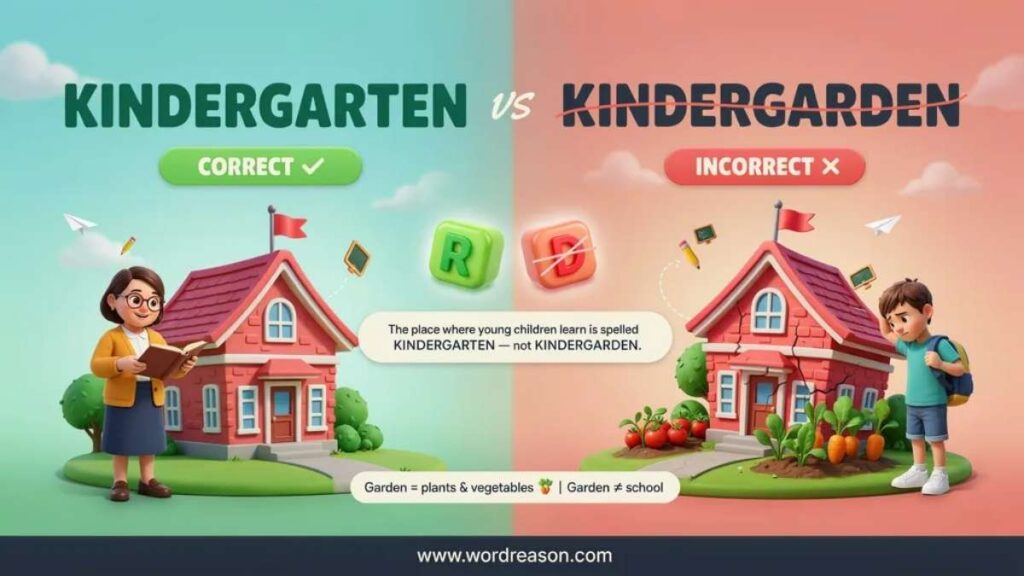
Kindergarten or kindergarden? One tiny spelling mistake can turn a simple word into a grammar puzzle! Although kindergarden looks reasonable because it resembles garden, it is incorrect in standard English. The correct spelling is kindergarten, a word borrowed from German that refers to an early learning environment for young children. However, remembering the extra letter T can feel like a lesson of its own. Whether you are writing a school assignment, preparing an article, or helping a child learn, knowing the difference matters. Let us explore the meaning, origin, pronunciation, and correct usage of kindergarten to clear up this common spelling confusion.
Kindergarten or Kindergarden Quick Answer
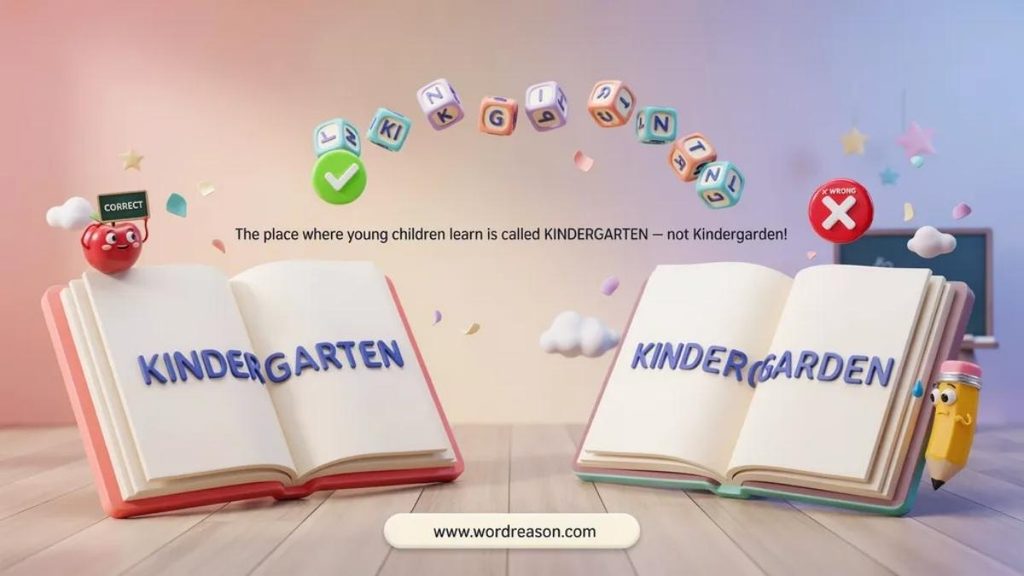
IT is the correct spelling in standard English. Kindergarden is a common misspelling, not an accepted alternative spelling of the ordinary educational term.
The confusion often occurs because English speakers recognize the word garden and naturally connect it with the ending of kindergarten. However, the English word comes from German, where the original spelling includes Garten, meaning garden.
Learn the difference between confusing more English words
Trys or Tries Which Spelling Is Correct?
Which Spelling Should You Use?
Use kindergarten in school assignments, emails, educational documents, blog posts, and everyday conversations.
For example, write, My daughter will start kindergarten next fall. Avoid writing, My daughter will start kindergarden next fall.
The second sentence communicates the intended meaning, but its spelling is incorrect. Therefore, always use kindergarten in formal writing, school registration forms, and professional communication.
If you are discussing the spelling mistake itself, you can write kindergarden to identify the incorrect form. Otherwise, choose kindergarten.
Learn the difference between confusing more English words
Skis or Skiis Which Spelling Is Correct?
What Does Kindergarten Mean?
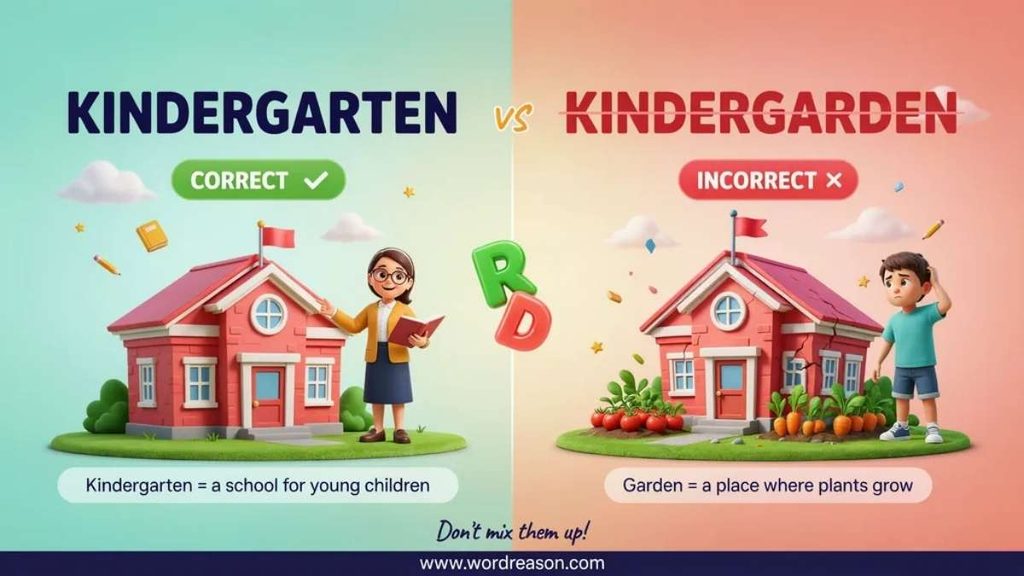
The kindergarten definition refers to an educational program for young children. In the United States, kindergarten commonly means the school year before first grade. It introduces children to early academic skills, classroom routines, social interaction, and learning through structured activities.
A kindergarten classroom often combines guided instruction with play. Children may practice recognizing letters, counting objects, listening to stories, following directions, and working with classmates.
The goal is not simply to make children memorize facts. Kindergarten also helps them develop communication, independence, and problem-solving skills that support later learning.
Kindergarten Meaning in Everyday English
In everyday English, kindergarten can refer to the educational program, the school year, or the setting where children attend classes.
Consider these examples
| Example sentence | Meaning |
|---|---|
| My nephew starts kindergarten this year. | Refers to a school year |
| The kindergarten teacher read a story aloud. | Describes a teacher role |
| Our local kindergarten offers morning classes. | Refers to an educational setting |
| Children learn basic math in kindergarten. | Describes the curriculum |
| She made new friends in kindergarten. | Refers to a school experience |
The exact meaning depends on context. For example, when someone says, “My child is in kindergarten,” they usually mean that the child is enrolled in that stage of education.
Kindergarten School Meaning and Age Range
In the United States, children commonly enter kindergarten at around five years old. However, the precise age requirement depends on state law, enrollment cutoff dates, and local school policies.
Some children turn five shortly before the school year begins, while others turn five during the first few months of classes. Families should check their local school district enrollment requirements rather than assume every child follows the same schedule.
Kindergarten is generally part of early childhood education. Children often learn through a mixture of activities, including recognizing letters, counting, identifying shapes, listening to stories, sharing with classmates, and following classroom instructions.
These activities prepare children for more formal learning in elementary school. Nevertheless, kindergarten programs vary in teaching methods, schedules, and academic expectations.
Kindergarten Sentence Examples
The following kindergarten sentence examples show how to use the word naturally in different situations.
| Example sentence | How the word is used |
|---|---|
| My nephew starts kindergarten this year. | School year |
| The kindergarten teacher read a story. | Teacher role |
| Our neighborhood has a kindergarten. | Educational setting |
| Children practice counting in kindergarten. | Learning activity |
| She made new friends in kindergarten. | School experience |
| The school opened two kindergarten classrooms. | School facilities |
| Kindergarten students practiced writing their names. | Enrolled children |
| We completed the kindergarten registration form. | Enrollment process |
Notice that kindergarten does not change its spelling according to the sentence. Whether you discuss a teacher, classroom, student, or enrollment form, the word retains its standard form.
What Is the Plural of Kindergarten?
The kindergarten plural form is kindergartens. To form the plural, add S to the end of the singular noun. You do not need an apostrophe or a change to the middle of the word.
For example, The kindergarten is near our home uses the singular form, while Several kindergartens operate in the district uses the plural.
The word kindergartens is different from kindergarten’s. The apostrophe in kindergarten’s usually indicates possession, as in The kindergarten’s playground is large. By contrast, kindergartens simply means more than one kindergarten.
Learn the difference between confusing more English words
Receipt or Reciept Which Spelling Is Correct?
Why Is Kindergarten Spelled This Way?
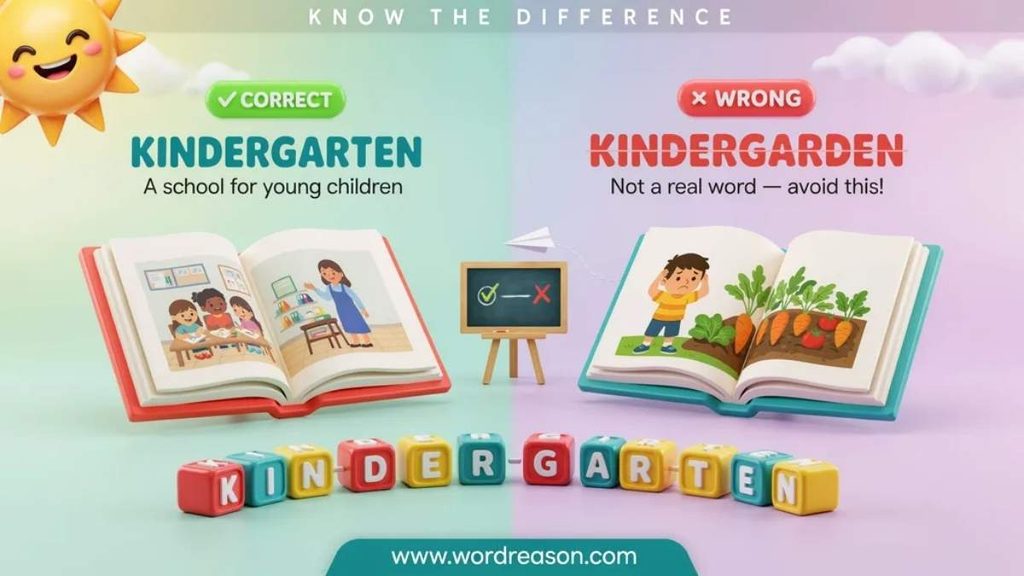
The easiest way to understand kindergarten spelling is to look at its German origin. English adopted the word rather than creating it from the English words kind and garden.
The word comes from the German term Kinder-Garten, associated with educator Friedrich Froebel in the nineteenth century. Kinder means children, and Garten means garden. The combined term literally suggests a garden of children.
This history explains why the word contains a T before the final EN. The spelling preserves the German element Garten. Replacing it with the English word garden changes the established spelling of the borrowed word.
German Origin of Kindergarten
Friedrich Froebel developed the kindergarten concept as an approach to early childhood education. He introduced the term in 1840 to describe an environment in which young children could develop through carefully guided activities, play, and observation.
The original idea compared children’s development with the growth of plants. A gardener provides suitable conditions for plants to grow. Similarly, an educator creates an environment that supports children’s learning and development.
This comparison explains the word’s meaning, but it does not mean a modern kindergarten must contain an actual garden. Today, the term refers to an educational stage or setting.
| German element | Meaning | Role in the word |
|---|---|---|
| Kinder | Children | Identifies the people the program serves |
| Garten | Garden | Suggests a place where growth takes place |
| Kindergarten | Children’s garden | The established term for an early childhood education setting |
How Did Kindergarten Enter the English Language?
English adopted kindergarten from German during the nineteenth century. Instead of translating the expression into a phrase such as children’s garden, English speakers retained the German-derived word.
Over time, kindergarten became established in English educational vocabulary, particularly in the United States. The word’s original spelling remained recognizable even as English speakers adapted its pronunciation to their own accents.
Historical records also show that kindergarden appeared as a variant spelling in the past. However, a spelling’s historical appearance does not automatically make it a standard modern alternative. For contemporary writing, kindergarten remains the recommended form.
Learn the difference between confusing more English words
Steer or Stear which spelling is Correct ?
Spelling in American and British English
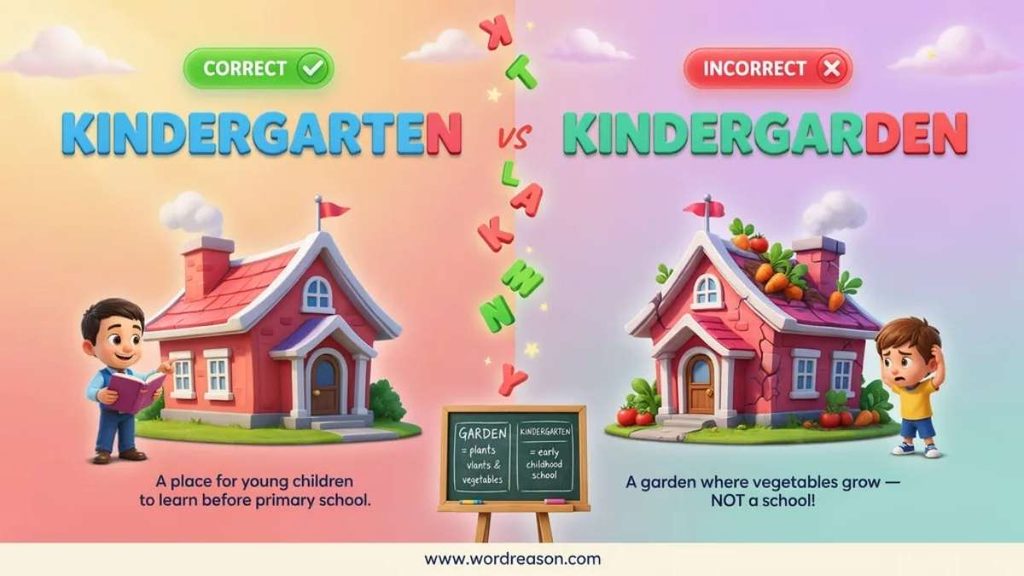
One common question is whether kindergarten spelling changes between American English and British English. The answer is straightforward: kindergarten is spelled the same way in both varieties of English.
The more important difference involves how people use the word. In the United States, kindergarten commonly refers to the first year of elementary school. In the United Kingdom, the term can refer to a nursery school for younger children, while reception is commonly used for the school year before Year 1 in England.
Kindergarten Spelling in American English
In the United States, kindergarten typically serves children around five years old and introduces them to formal elementary education.
For example, a parent might say, My son starts kindergarten in September. A teacher might explain, “The kindergarten class is learning the alphabet.”
American writers use kindergarten whether they discuss a public school, private school, or educational program.
Kindergarten Spelling in British English
British English also uses the spelling kindergarten. However, the word may refer to a nursery school rather than the specific first year of elementary education familiar to Americans.
In England, children commonly enter reception before moving to Year 1. Educational terminology differs across the United Kingdom, so it is best not to treat every British education system as identical.
For example, a British writer might refer to a nursery school, while an American writer might use preschool or kindergarten, depending on the child’s age and the program.
Kindergarten vs Preschool vs Reception
These terms overlap, but they do not always describe the same educational stage.
| Term | Typical use | Important distinction |
|---|---|---|
| Kindergarten | Commonly the year before first grade in the US | Often a defined school year |
| Preschool | Education before kindergarten or compulsory school | Programs vary in age range and structure |
| Reception | Entry year in many English schools | Usually precedes Year 1 |
| Nursery school | Early education for young children | May serve children younger than those in US kindergarten |
The key point is that regional terminology does not change the spelling of kindergarten. Whether you write for an American or British audience, use kindergarten when that is the term you intend.
Learn the difference between confusing more English words
Wierd or Weird Which Spelling Is Correct?
Why Do People Spell Kindergarten as Kindergarden?
The spelling confusion makes sense once you look at the word. English speakers already know garden, so their brains may connect the unfamiliar German-derived ending with a familiar English word.
This is an example of how familiar spelling patterns can influence memory. When a word contains an element that resembles another word, writers may unintentionally replace the original sequence with the more familiar one.
Several factors can contribute to the kindergarden spelling mistake. The familiar word garden may make the incorrect form look natural. Pronunciation can also contribute because the final syllables sound similar in many English accents. In addition, people who do not know the German origin may have no reason to remember the T.
None of these factors means a writer lacks language skills. Even experienced writers make spelling errors, especially with borrowed words.
An Easy Trick to Remember Kindergarten
The most reliable memory trick uses the word’s origin rather than its sound.
Remember the formula: Kinder + Garten = Kindergarten.
The German element Garten contains a T, and the standard English spelling retains it.
You can also remember this sentence Children grow in a kindergarten, but the word keeps its German Garten.
If you prefer a visual reminder, picture the word as two connected parts. Kinder means children, while Garten means garden. When you combine them, do not replace Garten with the English spelling garden.
This method works better than simply memorizing the whole word because it gives you a reason for the spelling. The next time you hesitate, recall the German origin instead of guessing from pronunciation.
Learn the difference between confusing more English words
Proove or Prove What Is the Correct Spelling?
How to Pronounce
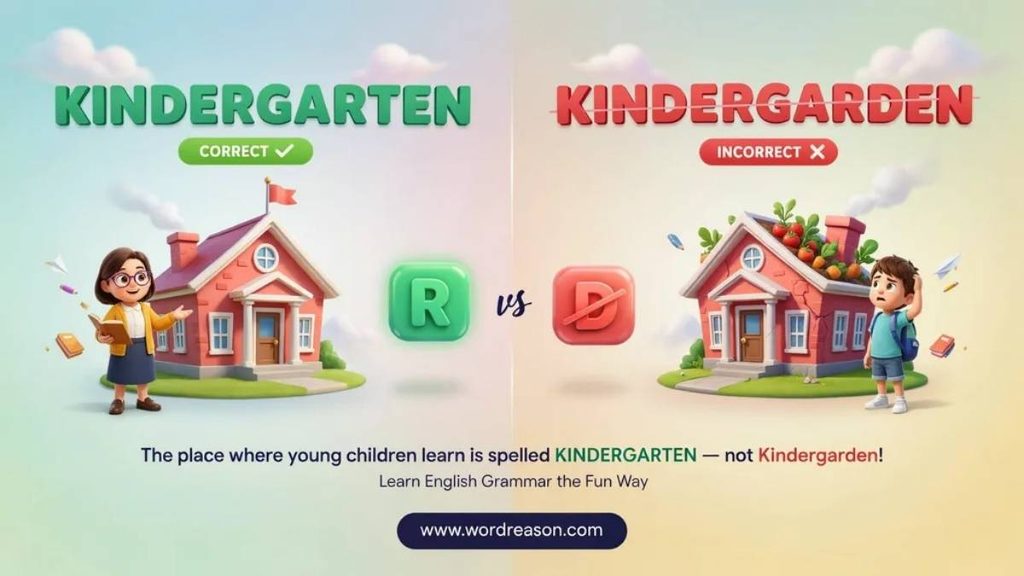
The kindergarten pronunciation can vary slightly across accents, but the standard American English pronunciation is commonly represented as /ˈkɪn.dɚˌɡɑr.tən/.
In simple terms, the word has four spoken syllables in a careful pronunciation, with the strongest stress on the first syllable. Some speakers reduce the final vowel or pronounce the word with fewer clearly separated syllables in natural conversation.
The British pronunciation differs mainly in its vowel sounds, not its spelling. You can hear the American and British pronunciations in standard dictionary pronunciation guides.
Is Kindergarten Pronounced Differently in British English?
Yes, accents can affect how speakers pronounce kindergarten. American speakers generally use a rhotic sound in the middle of the word, while many British speakers do not pronounce the letter R in the same way.
However, these accent differences do not change the written form.
| Feature | American English | British English |
|---|---|---|
| Spelling | Kindergarten | Kindergarten |
| Pronunciation | American vowel and R sounds | British vowel and R patterns |
| Standard spelling variant | None | None |
Do not use pronunciation alone to decide how to spell the word. English spelling often preserves a word’s history even when speakers pronounce it differently.
Learn the difference between confusing more English words
Families vs Family’s Which Is the Correct spelling?
Common Kindergarten Spelling Mistakes
The most important mistake to avoid is replacing the T in kindergarten with a D, producing kindergarden. However, a few related grammar and usage errors are also worth checking.
Incorrect vs Correct Kindergarten Examples
| Incorrect | Correct |
|---|---|
| My child starts kindergarden tomorrow. | My child starts kindergarten tomorrow. |
| She works at a kindergarden. | She works at a kindergarten. |
| The kindergarden teacher called home. | The kindergarten teacher called home. |
| We registered our son for kindergarden. | We registered our son for kindergarten. |
| There are three kindergarden classes. | There are three kindergarten classes. |
The correction is simple in every example: replace kindergarden with kindergarten.
Does Kindergarten Ever Need a Capital Letter?
Usually, no. Kindergarten is a common noun, so you normally write it in lowercase unless it begins a sentence or appears in a proper name or title.
For example, write My daughter enjoys kindergarten in ordinary usage. Capitalize the word at the beginning of a sentence, as in Kindergarten begins next week. If the word appears in an official program name, follow that name’s capitalization.
The capitalization rule is separate from the spelling rule. Even when you capitalize the word, you must retain the T.
Common Kindergarten Word Forms
Knowing the related forms can help you avoid errors in school documents and everyday writing.
| Word or phrase | Meaning | Example |
|---|---|---|
| Kindergarten | The educational program or school year | He attends kindergarten. |
| Kindergartens | More than one kindergarten | Several kindergartens serve the area. |
| Kindergarten teacher | A teacher who teaches kindergarten | The kindergarten teacher greeted the class. |
| Kindergarten student | A child enrolled in kindergarten | Each kindergarten student received a book. |
| Kindergarten classroom | A room used for instruction | The kindergarten classroom has learning centers. |
| Kindergarten registration | The process of enrolling a child | Kindergarten registration opens in March. |
Notice that kindergarten keeps the same spelling in each phrase. The surrounding words change the meaning, but they do not alter the spelling of the main term.
Learn the difference between confusing more English words
Feet or Foot Which is the correct spelling?
Kindergarten Usage and Search Trends
People often search for kindergarten or kindergarden because they want a quick spelling check. Searches such as how do you spell kindergarten, kindergarten vs. kindergarden, and is kindergarden a word reflect that practical need.
However, search popularity and spelling correctness are two different things. A misspelling can appear frequently in search queries without becoming an accepted standard spelling.
Learn the difference between confusing more English words
Likeable or Likable Which Spelling Is Correct ?
What Does Search Interest Tell Us?
Search interest can help explain why a spelling article is useful, but it cannot establish which spelling is correct.
Google Trends reports relative search interest for selected terms over a chosen region and period. Its values are normalized rather than presented as absolute search counts. A higher value does not necessarily mean a word has a higher total monthly search volume.
For an accurate comparison of kindergarten and kindergarden, use the same country or region, date range, search category, and search type.
Without a verified comparison for a specified period and location, it would be misleading to claim that one spelling receives a particular number of searches or that its popularity is rising.
The practical conclusion remains unchanged: use kindergarten in standard English writing, regardless of how often people search for the misspelling.
Learn the difference between confusing more English words
Cosy or Cozy Which Spelling Is Correct?
Fill in the Blanks
Complete each sentence with the correct word or phrase. The answers are provided separately below.
Practice Session
- The correct spelling is __________.
- __________ is a common spelling mistake.
- Kindergarten comes from the __________ language.
- The German word Kinder means __________.
- The German word Garten means __________.
- Kindergarten helps young children prepare for __________.
- Most children in the United States start kindergarten at age __________.
- The plural of kindergarten is __________.
- The correct spelling contains the letter __________ before the ending.
- Kindergarten is used in both British and __________ English.
- In the United States, kindergarten is usually the first year of __________ school.
- Preschool is another term related to __________ education.
- Friedrich Froebel helped develop the kindergarten __________.
- In Japan, kindergarten is called __________.
- The German word Kindergarten literally means children’s __________.
- Kindergarden is an incorrect __________.
- Children learn to share and __________ in kindergarten.
- In the United Kingdom, nursery school is a common term for early childhood __________.
- Kindergarten teachers help children develop basic learning __________.
- The word kindergarten has German __________.
- Children often learn numbers, letters, and __________ in kindergarten.
- Some Canadian areas use the terms junior and senior __________.
- The correct word is kindergarten, not __________.
- Kindergarten became established in the United States during the __________.
- To remember the spelling, focus on the word Garten, which begins with the letter __________.
Answer Key
- Kindergarten
- Kindergarden
- German
- Children
- Garden
- School
- Five
- Kindergartens
- T
- American
- Elementary
- Early childhood
- Approach
- Yōchien
- Garden
- Spelling
- Listen
- Education
- Skills
- Origins
- Shapes
- Kindergarten
- Kindergarden
- 1850s
- G
Here’s a trusted source for clear more words Comparison:
FAQs About Kindergarten or Kindergarden
Why is it kindergarten and not kindergarden?
Kindergarten is correct because English borrowed the word from German. Kindergarden is a common misspelling.
What is kindergarden?
Kindergarden is an incorrect spelling of kindergarten, an early education program for young children.
Why does America say kindergarten?
The United States adopted the German term for an early childhood education program developed by Friedrich Froebel.
Is kindergarten British or American?
Both use kindergarten, but Americans usually mean the first year of school. British speakers often use nursery school or preschool.
Do you say kindergarten or kindergarden?
Use kindergarten. Kindergarden is a spelling mistake.
What do Germans call kindergarten?
Germans also call it Kindergarten, which literally means children garden.
What is another name for kindergarten?
Common alternatives include preschool, nursery school, and pre-K, depending on the location and age group.
What is the golden rule in kindergarten?
Treat others as you want to be treated. Children also learn to share, listen, and respect others.
Do most kids start kindergarten at 5 or 6?
Most children in the United States start at age five, depending on local enrollment rules and their birthdays.
What does Japan call kindergarten?
Japan calls kindergarten yōchien (幼稚園).
What is kindergarten in Canada called?
The term varies by province. Many areas use kindergarten, while some offer junior and senior kindergarten.
When did kindergarten become a thing in the US?
Kindergarten began appearing in the United States in the 1850s and became more widespread in later decades.
AEO: Quick Answers
Is kindergarten or kindergarden correct?
Kindergarten is the correct spelling. Kindergarden is incorrect in standard English.
How do you spell kindergarten?
Kindergarten is spelled K-I-N-D-E-R-G-A-R-T-E-N.
What does kindergarten mean?
Kindergarten is an early education program for young children. In the United States, it usually means the first year of elementary school.
Is kindergarden a real word?
Kindergarden is a common misspelling. The standard spelling is kindergarten.
Why is there a T in kindergarten?
The T comes from the German word Garten, meaning garden.
What is the plural of kindergarten?
The plural is kindergartens.
conclusion
Choosing between kindergarten or kindergarden no longer needs to feel like a spelling test! Although kindergarden may look right because it resembles garden, kindergarten is the correct spelling in standard English. Its German origin explains why the word keeps its original spelling, including the important T. Remembering this small detail can save you from a common writing mistake. Whether you are helping a child with homework or polishing your own grammar, the right spelling makes your writing clearer and more professional. So, give kindergarden a pass and let kindergarten take the class. After all, even a tiny letter deserves a little attention!

Bella AJS
Bella AJS is an experienced blogger and passionate language enthusiast at WordReason. She specializes in English grammar, word meanings, spelling, and commonly confused words. With a clear and practical writing style, Bella helps readers understand tricky language rules without the textbook headache. Her goal is simple: make English easier, clearer, and more enjoyable one word at a time.