
English spelling can sometimes feel like a game where one extra letter causes all the trouble. The confusion around Proove or Prove is a perfect example. You may have typed proove while trying to prove a point, only to wonder which spelling actually belongs in your sentence. Although the difference looks tiny, it can affect the accuracy and professionalism of your writing. This guide clears up the confusion with simple explanations, practical examples and useful grammar tips. You will learn why prove is the correct modern spelling, how to use it naturally, and why proove should be avoided. By the end, this spelling puzzle will be easy to solve.
Proove or Prove Quick Answer
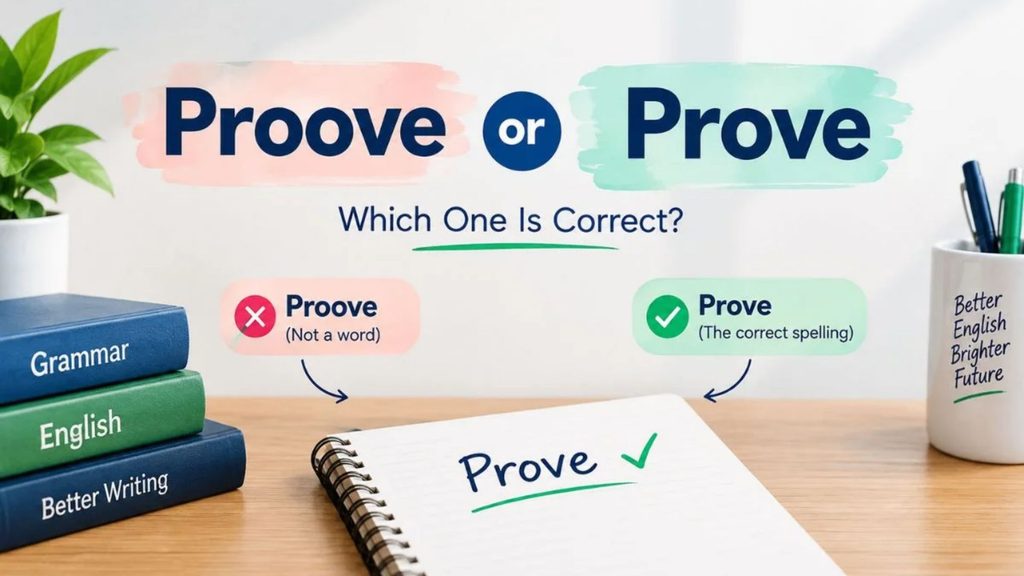
If you are wondering whether it is proove or prove, choose prove.
The standard spelling is prove.
The form proove is not the standard modern spelling.
The word prove functions as a verb. It means to use evidence, facts, reasoning, testing, or experience to establish something as true, valid, or genuine.
For example
The evidence may prove his claim.
She wanted to prove her point.
The experiment could prove the theory.
Can you prove that the statement is true?
The results proved useful.
If you need the correct spelling for an essay, email, report, article, assignment, or professional document, use prove.
Prove
Prove is a standard English verb.
It commonly means to establish that something is true by using evidence or reasoning. However, it can also describe discovering that something has a particular quality through experience.
For example
The documents prove that the transaction occurred.
Here, the documents provide evidence that establishes the claim.
The word can also describe personal ability.
She proved that she could handle the difficult assignment.
In this sentence, her actions demonstrated her ability.
Proove
Proove is not the standard modern spelling of the verb.
If someone writes
The evidence will proove the claim.
The standard correction is:
The evidence will prove the claim.
However, historical spelling deserves some care. English spelling was not always as fixed as it is today. Earlier writers used different spellings for many words, so an unusual form can sometimes appear in historical material. That does not make it appropriate for modern standard English.
For current writing, the rule is simple.
Use prove.
Proove vs Prove at a Glance
| Point | Proove | Prove |
|---|---|---|
| Standard modern spelling | No | Yes |
| Standard English verb | No | Yes |
| Meaning establish as true | Not as the modern standard form | Yes |
| Used in American English | No | Yes |
| Used in British English | No | Yes |
| Appropriate for formal writing | No | Yes |
| Related forms | Not standard | proves, proved, proven, proving |
Learn the difference between confusing more English words
Receive or Recieve which Correct is correct?
What Does Prove Mean?
The prove meaning is broader than simply showing someone that you are right.
At its core, prove means to establish something as true, correct, valid, or genuine. You can do this through evidence, logical reasoning, testing, experience, or demonstration.
The word has several common uses, which makes it useful in everyday English as well as academic and professional writing.
Prove Something Is True
This is one of the most common uses.
The new evidence may prove the allegation.
The evidence supports a conclusion and helps establish its truth.
Other examples include
The records prove the payment was made.
The experiment may prove the theory.
The photographs prove where the vehicle was parked.
The results prove that the system works.
The exact strength of the claim depends on the context. In scientific writing, for example, researchers often distinguish between evidence that strongly supports a conclusion and evidence that establishes it with complete certainty.
Prove a Point
The expression prove a point means to demonstrate that an argument, statement, or position is correct.
She brought the original documents to prove her point.
This expression appears in everyday speech as well as academic, professional, and argumentative writing.
However, proving a point is different from merely making a point. Anyone can make a claim. Proving it requires support.
Prove a Claim
A claim is an assertion that something is true.
To prove a claim, you need evidence or reasoning that establishes it.
For example
The researcher used several experiments to prove the claim.
In careful academic writing, though, the word prove should match the evidence. If the evidence only suggests a conclusion, words such as support, indicate, or suggest may be more accurate.
Prove Yourself
The phrase prove yourself has a slightly different meaning.
It often refers to demonstrating your ability, reliability, value, or competence through your actions.
The new manager quickly proved herself capable of leading the team.
Nobody is necessarily asking for documentary evidence here. Her performance demonstrates her ability.
This explains why prove appears in so many everyday expressions.
Learn the difference between confusing more English words
Useing or Using Which Spelling Is Correct?
Why Is Prove Spelled Without the Second O?
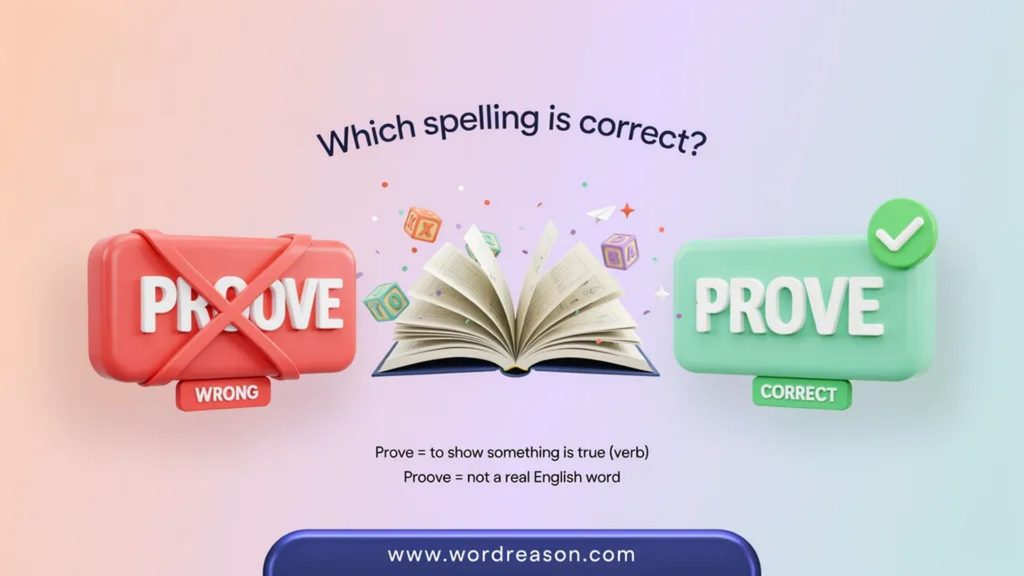
The spelling proove can look tempting because English contains many words with the double oo pattern.
Consider these examples
book
moon
school
smooth
proof
Because prove has a similar vowel sound to words such as proof, some writers may expect another o.
English spelling, however, does not always represent pronunciation in a perfectly predictable way. The long vowel sound in prove does not require two os.
The correct spelling is
P-R-O-V-E
The final e also plays a role in the words spelling and pronunciation.
That makes prove a useful reminder that pronunciation can help you recognize a word, but it does not always tell you exactly how to spell it.
Learn the difference between confusing more English words
Halves or Halfs Which Spelling Is Correct?
The Origin of Prove
The history of prove reaches back much further than modern English.
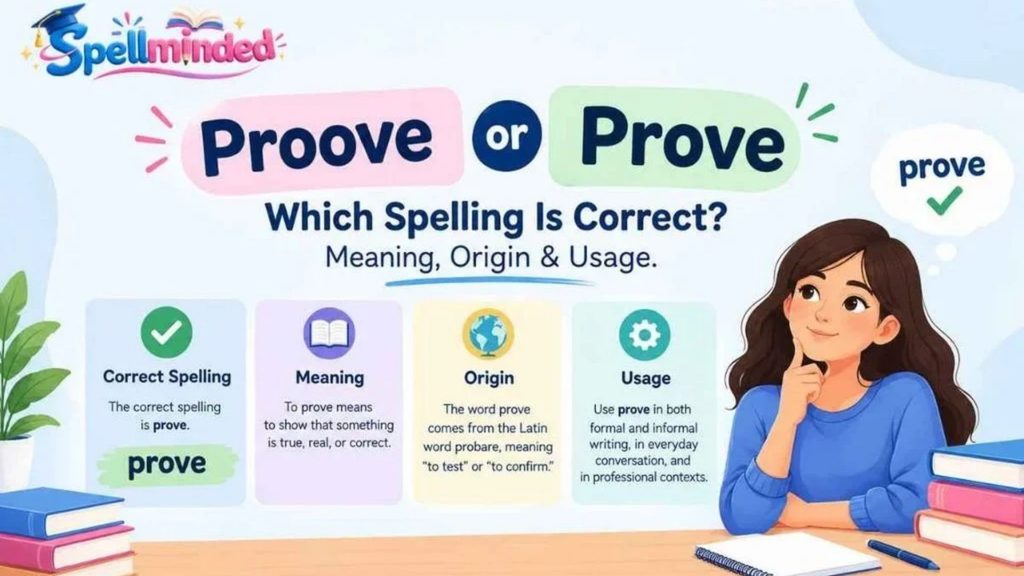
The verb developed from Old French forms such as prover and pruver and ultimately from the Latin probare. The Latin word carried meanings associated with testing, evaluating, approving, and demonstrating something as valid or worthy.
English adopted the verb around the early thirteenth century. Over time, the word developed several related meanings.
These included testing something, evaluating something, demonstrating something, establishing validity, checking accuracy, discovering something through experience, and demonstrating an ability or quality.
That history helps explain why prove still works in several different contexts today.
How the Meaning Developed
The word originally carried a strong sense of testing and evaluation.
Over time, its meaning expanded toward establishing certainty and demonstrating truth. English developed uses connected with making something certain, showing that something was true, and demonstrating a conclusion through reasoning or evidence.
This development gives the modern word a useful range.
You can prove a fact, a claim, a theory, a point, an argument, an identity, an ability, or a case.
The basic idea remains the same. Evidence, reasoning, experience, or action establishes something.
Is Proove an Old Spelling?
This question needs more nuance than a simple yes or no.
English spelling changed considerably before modern conventions became firmly established. Historical writers could spell the same word in different ways, particularly before spelling became more standardized.
Therefore, finding an unusual spelling in an old document does not automatically mean the writer made a mistake.
At the same time, historical evidence does not make that spelling acceptable in modern English.
The practical distinction is simple. Historical texts may preserve older spelling patterns. Modern writing follows current standard spelling. When editing modern English, prove is the appropriate form.
If you are researching historical spelling, an unusual form may be worth discussing. If you are writing a modern article, the answer is straightforward. Prove is the form to use.
Learn the difference between confusing more English words
Authorized or Authorised Which Spelling Is Correct?
in American and British English
There is no American versus British spelling difference here.
Some English words change spelling between varieties of English. For example, American English generally uses color while British English commonly uses colour.
Prove does not work that way.
Both American and British English use prove as the standard spelling.
| English Variety | Standard Spelling |
|---|---|
| American English | prove |
| British English | prove |
| Canadian English | prove |
| Australian English | prove |
The main difference you may notice concerns the related past participles proved and proven. Both are standard, although usage preferences can vary by region and context.
So, do not treat proove vs prove as a regional spelling issue.
It is not.
Learn the difference between confusing more English words
Realy or Really which spelling is correct?
Proove or Prove Grammar
The proove or prove grammar question becomes much easier once you identify the word as a verb.
The standard forms are
| Grammatical Form | Correct Word | Example |
|---|---|---|
| Base form | prove | They need to prove the claim. |
| Third person singular | proves | The evidence proves the point. |
| Past tense | proved | The test proved successful. |
| Past participle | proved | The method has proved useful. |
| Alternative past participle | proven | The method has proven useful. |
| Ing form | proving | They are proving the theory. |
Prove
Use prove as the basic form of the verb.
We need to prove the statement.
They hope to prove the theory.
Proves
Use proves with a singular third person subject in the present tense.
The evidence proves the claim.
This result proves that the method works.
Proved
Use proved as the past tense.
The experiment proved successful.
She proved her point.
It can also work as a past participle.
The method has proved reliable.
Proven
Proven is an accepted past participle and can also function as an adjective.
The method has proven effective.
She has a proven record of success.
Proving
When you add ing to prove, remove the final e.
Prove becomes proving.
The researchers are proving the effectiveness of the method.
Learn the difference between confusing more English words
Receipt or Reciept Which Spelling Is Correct?
What Is the Difference?
The connection between prove and proof causes another common spelling and grammar confusion.
Prove is a verb.
Proof is primarily a noun.
Compare these sentences:
The evidence may prove the claim.
The evidence provides proof of the claim.
In the first sentence, prove describes an action.
In the second sentence, proof names the evidence or basis that establishes something.
| Word | Main Role | Example |
|---|---|---|
| prove | Verb | The evidence will prove the claim. |
| proof | Noun | The evidence provides proof. |
| proved | Past verb form | The test proved successful. |
| proven | Past participle or adjective | The method has proven effective. |
| proving | Present participle | They are proving the theory. |
This distinction makes the spelling easier to remember.
Think of prove as the action and proof as the supporting evidence or result.
Learn the difference between confusing more English words
Steer or Stear which spelling is Correct ?
Common Spelling Mistakes
Writing Proove Instead of Prove
This is the main error behind the proove spelling search.
Incorrect
The evidence will proove the claim.
Correct
The evidence will prove the claim.
The correction is simple. Remove the extra o.
Confusing Prove With Approve
Prove and approve look similar, but they have different meanings.
Prove means to establish or demonstrate something.
Approve means to accept, authorize, or agree that something is satisfactory.
For example
The evidence may prove the claim.
The committee may approve the proposal.
The shared letters can make the words look related, but you should not substitute one for the other.
Confusing Prove With Improve
Improve means to make something better or to become better.
The company wants to improve customer service.
Prove means to establish or demonstrate something.
The results prove that the new system works.
The shared ending can create visual confusion, but the meanings are different.
Writing Proveing Instead of Proving
This error occurs when writers add ing without removing the final e.
Incorrect
The results are proveing the theory.
Correct
The results are proving the theory.
Remember the spelling pattern
prove becomes proving.
Writing Prooved Instead of Proved
If someone first writes proove, it can seem natural to create the past form prooved.
That form is not standard.
Use proved.
For example
The experiment proved successful.
Learn the difference between confusing more English words
Wierd or Weird Which Spelling Is Correct?
Proove or Prove Examples
The easiest way to understand the distinction is to see the words in real sentences.
Everyday Examples
I can prove that I was there.
You do not have to prove anything to me.
She proved that she could handle the pressure.
The message may prove useful later.
Academic Examples
The student used the equation to prove the answer.
The evidence supports the argument but does not fully prove the claim.
The researcher attempted to prove the theory through repeated testing.
Professional Examples
The report provides evidence that may prove the claim.
The test results proved the equipment reliable.
The company must prove that its figures are accurate.
Legal Examples
The prosecution must prove its case.
The evidence may help prove the allegation.
Legal writing can use prove in highly specific contexts. However, legal standards of proof depend on the jurisdiction and type of proceeding, so everyday dictionary meaning does not replace legal definitions.
Social Media Examples
I told you I was right. The screenshots prove it.
She posted the receipt to prove her claim.
Even informal writing still uses prove, not proove.
Learn the difference between confusing more English words
Skis or Skiis Which Spelling Is Correct?
Proove or Prove Common Sentence Corrections
| Incorrect | Correct | Why |
|---|---|---|
| The evidence will proove the claim. | The evidence will prove the claim. | Prove is the standard spelling. |
| I can proove my point. | I can prove my point. | The extra o is unnecessary. |
| She prooved that she was right. | She proved that she was right. | The past form is proved. |
| They are proveing the theory. | They are proving the theory. | Drop the final e before ing. |
| The test has prooven useful. | The test has proven useful. | Proven is an accepted past participle. |
| He needs to proove the answer. | He needs to prove the answer. | Use the base form after to. |
A Simple Case Study From Proove to the Correct Word Family
Consider this sentence
The experiment will proove that the material is safe.
The writer has added an unnecessary o.
The correct version is
The experiment will prove that the material is safe.
Now change the tense
The experiment proved that the material was safe.
Next, use the continuous form
The experiment is proving useful.
Finally, use the related noun
The results provide proof that the method works.
| Form | Correct Example |
|---|---|
| prove | The test will prove the theory. |
| proved | The test proved successful. |
| proven | The method has proven reliable. |
| proving | The researchers are proving its effectiveness. |
| proof | The results provide proof. |
This small word family makes the pattern much easier to remember.
Learn the difference between confusing more English words
Trys or Tries Which Spelling Is Correct?
How to Spell Prove Correctly
If you are asking how to spell prove, the answer is
P-R-O-V-E
There is one o.
A useful memory trick is to connect prove with proof without treating the words as identical.
Prove is a verb.
Proof is a noun.
For example:
The evidence can prove the claim.
The evidence provides proof of the claim.
You can also memorize the main verb family
prove, proves, proved, proven, proving
Once you recognize the family, forms such as prooved and proveing become easier to spot as errors.
Is Proove a Word?
The answer depends on what word means in the question.
If the question means whether proove is the standard modern English spelling of the verb meaning establish as true, the answer is no.
The standard form is prove.
If the question means whether this spelling has ever appeared in English, the answer requires historical context. English spelling changed substantially over time, and historical documents can contain variant forms.
That distinction matters because modern spelling standards and historical spelling practices are not the same thing.
So, for current English
Proove is not the standard spelling.
Prove is.
Is Proove Correct?
No, not as the standard modern spelling of the common verb.
Use
The facts prove the claim.
Not
The facts proove the claim.
The same rule applies whether you are writing American or British English.
Is Proove an English Word?
Proove is not the standard modern form of the English verb.
Historical texts may contain unusual spellings, but modern writers should use prove.
This distinction prevents two opposite mistakes. First, it avoids calling every historical spelling a modern spelling error. Second, it prevents historical variants from being presented as standard modern English.
Proove or Prove Synonyms
If you are searching for a proove or prove synonym, the correct word to replace is prove.
Depending on the sentence, alternatives can include demonstrate, establish, confirm, verify, substantiate, validate, show, support, authenticate, and test.
However, these words are not interchangeable in every situation.
For example, verify often emphasizes checking accuracy.
The editor verified the information.
Demonstrate can emphasize clearly showing something.
The experiment demonstrated the effect.
Substantiate focuses on providing evidence that supports a claim.
The records substantiate the report.
The best synonym depends on the exact meaning of the original sentence.
Prove in Academic and Scientific Writing
The word prove has a particularly precise role in academic work.
In mathematics, a proof establishes a statement through logical reasoning. A mathematical proof does not merely make an argument sound convincing. It demonstrates that the conclusion follows from accepted definitions, assumptions, axioms, or previously established results.
Scientific writing requires a little more caution.
An experiment can provide strong evidence for a hypothesis. However, scientific knowledge often develops through repeated testing, independent evidence, and further research.
Therefore, these two sentences do not necessarily communicate the same level of certainty.
The experiment proves the treatment works.
The experiment provides strong evidence that the treatment works.
The second statement may be more appropriate when the evidence supports a conclusion without establishing it with complete certainty.
Good writing is not about using the strongest possible word. It is about using the most accurate one.
Why Do People Spell Prove as Proove?
Several factors can explain the confusion.
First, pronunciation may encourage the mistake. The vowel in prove sounds similar to the vowel represented by oo in words such as proof.
Second, English spelling contains many irregular patterns. Readers cannot always derive the written form directly from pronunciation.
Third, prove and proof belong to the same word family. The double oo spelling in proof may influence the mental picture of prove.
Finally, typing quickly can turn a plausible looking spelling into an unnoticed error.
The mistake is understandable, but modern standard spelling still favors prove.
Prove or Proved Which Is Correct?
Both forms are correct. They serve different grammatical purposes.
Use prove as the base form.
We need to prove the statement.
Use proved for the past.
We proved the statement yesterday.
You can also use proved as a past participle.
The method has proved reliable.
So the question is not whether prove or proved is more correct. The right choice depends on the sentence.
Prove or Proven Which Is Correct?
Both proved and proven have legitimate uses.
For example
The method has proved effective.
The method has proven effective.
Both are standard.
Proven can also work as an adjective.
She has a proven record of success.
The important spelling point is that neither form becomes prooved or prooven.
Here is a polished practice session with 25 fill in the blanks focused on prove, proove, proof, proved, proven, and proving.
Practice Session
Test your understanding of the correct spelling and usage of prove. Complete each sentence with the most suitable word.
Fill in the Blanks
- The evidence helped ______ that the statement was true.
- She wants to ______ her point with clear facts.
- The scientist must ______ the theory through careful testing.
- His actions ______ that he was honest.
- The lawyer presented strong ______ in court.
- Can you ______ that this information is accurate?
- The experiment ______ the researchers theory.
- The student is trying to ______ her answer.
- They need more ______ before making a final decision.
- He has ______ himself through years of hard work.
- The results have ______ that the method works.
- The teacher asked students to ______ their answers.
- Good evidence can help ______ a claim.
- The report provides enough ______ to support the conclusion.
- She is ______ that her idea can work.
- The facts ______ his argument.
- The investigation helped ______ what really happened.
- He could not ______ his claim with reliable evidence.
- The new method has been ______ effective.
- Scientists continue ______ the safety of the treatment.
- The correct spelling is ______, not proove.
- The noun form of prove is ______.
- The past tense of prove is usually ______.
- The adjective form can be ______ when something has been tested and shown to be true.
- When prove takes ing, the correct spelling is ______.
Answers
- prove
- prove
- prove
- proved
- proof
- prove
- proved
- prove
- proof
- proved
- proven
- prove
- prove
- proof
- proving
- prove
- prove
- prove
- proven
- proving
- prove
- proof
- proved
- proven
- proving
Here’s a trusted source for clear more words Comparison:
FAQs
What does prove it mean?
Prove it means to provide facts, evidence, or reasons that show something is true or correct.
How do you spell proof correctly?
The correct spelling is proof. It is the noun related to the verb prove.
What is a better word for prove?
Depending on the context, alternatives include demonstrate, establish, verify, confirm, show and substantiate.
What does prove me mean?
Prove me means to provide evidence that confirms whether a statement about the speaker is true.
What is another way to say prove it?
You can say demonstrate it, show evidence, confirm it, establish it, or back it up.
How do you prove something?
You prove something by providing reliable facts, evidence, examples, or logical reasons that support your claim.
How do I prove it?
Give clear evidence that directly supports the statement or claim you want to establish.
Can prove be used in everyday conversation?
Yes. Prove is common in everyday speech, academic writing, professional communication, and formal contexts.
AEO Questions
Should prove it be written as two words?
Yes. Prove it is written as two separate words when prove acts as a verb and it acts as the object.
What is the difference between prove and proof in a sentence?
Prove is a verb that describes showing something is true. Proof is a noun that refers to the evidence used to support it.
When should I use prove instead of show?
Use prove when you need to emphasize evidence or certainty. Show is broader and often sounds more casual.
Can prove describe a person?
Yes. Prove can describe someone demonstrating their ability, value, honesty, or worth through actions or results.
What words commonly come after prove?
Common combinations include prove a point, prove a claim, prove a theory, prove a case, prove yourself, and prove something true.
Is prove suitable for formal writing?
Yes. Prove is a standard and appropriate word for academic, professional, scientific, and legal writing.
What is the simplest way to remember prove?
Remember that the correct modern spelling has one o after the pr: prove.
What is the opposite idea of prove?
Depending on the context, the opposite idea can be disprove, refute, question, or fail to establish
conclusion
The Proove or Prove confusion may look like a tiny spelling problem, but that extra o can quickly turn a correct word into a mistake. The correct modern spelling is prove, whether you are writing for school, work, social media or everyday communication. Use prove as a verb when you want to show that something is true, and use proof when you mean the evidence that supports it. Remember the simple rule: prove has one o after pr. Once you remember this, proove can stay where it belongs, outside your writing. After all, one extra letter does not need to prove anything.

Bella AJS
Bella AJS is an experienced blogger and passionate language enthusiast at WordReason. She specializes in English grammar, word meanings, spelling, and commonly confused words. With a clear and practical writing style, Bella helps readers understand tricky language rules without the textbook headache. Her goal is simple: make English easier, clearer, and more enjoyable one word at a time.