
The confusion between halves or halfs is common because most English nouns form their plurals by adding s.However, half follows a different pattern and becomes halves. That small change can create a surprisingly big spelling headache, especially when you’re talking about two equal parts. In this guide, you’ll learn which spelling is correct, why half changes to halves, and how to use both forms correctly. By the end, this simple spelling confusion will be easy to understand and even easier to avoid.
Halves or Halfs Quick Answer
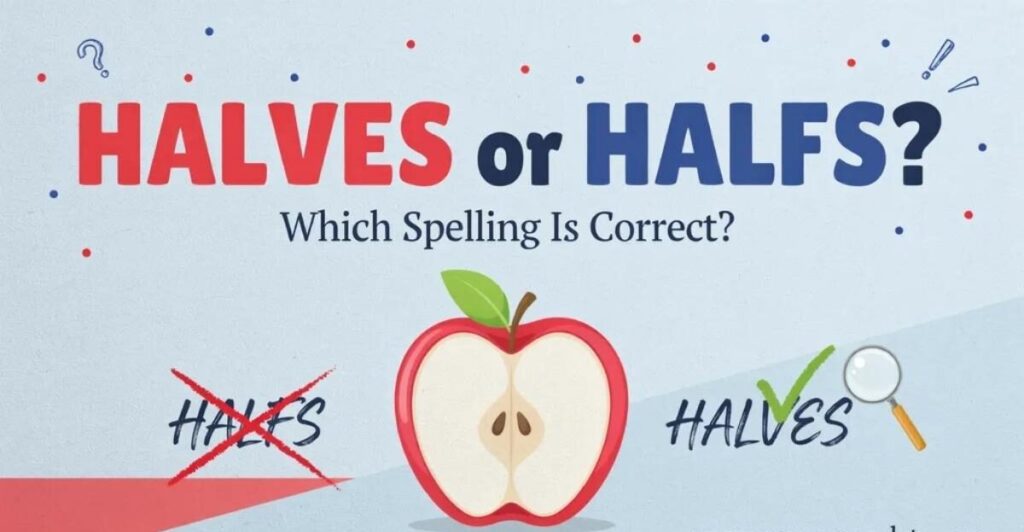
Halves is the correct standard plural of half.
Halfs is not the standard plural form in modern English. The spelling changes from f to v before the plural ending.
The basic pattern is
half → halves
This may seem unusual, but it is not unique. English contains several common nouns that change f to v when they form their plural.
For example, leaf becomes leaves, knife becomes knives, wife becomes wives, and wolf becomes wolves. Half follows the same general spelling pattern.
However, this does not mean every noun ending in f changes to ves. English has several exceptions. Roof becomes roofs, belief becomes beliefs, and chief becomes chiefs. Therefore, the safest approach is to learn the established plural form of each word rather than applying the f-to-ves pattern automatically.
For half, the correct form is firmly established
one half
two halves
both halves
three halves
equal halves
That distinction is worth remembering because halfs can look convincing even though it is not the standard plural spelling.
Learn the difference between confusing more English words
Volumn or Volume Which Is the Correct Spelling?
What Does Halves Mean?
Halves is the plural form of half. A half refers to one of two equal or nearly equal parts that together make a whole. Consequently, halves refers to more than one of those parts.
Imagine cutting an apple into two equal pieces. Each piece is a half. When you talk about both pieces together, you call them halves.
For example
The apple was cut into two halves.
The two halves were placed on separate plates.
The children received equal halves.
The meaning extends far beyond physical objects. You can talk about halves of a period, a group, a place, a quantity, or a game.
For instance, a soccer match has a first half and a second half. If you refer to both periods together, you can call them the two halves of the match.
Similarly, you might divide a room into two halves or describe the northern and southern halves of a country.
Cambridge defines half as either of two equal or nearly equal parts that make up a whole. It also gives examples involving cutting something in half and cutting something into halves.
Therefore, the central idea is simple: half refers to one part, while halves refers to multiple parts.
Learn the difference between confusing more English words
Bareable or Bearable Which Spelling Is Correct?
Why Is Halves the Correct Plural of Half?
The spelling of halves comes from an established English word-formation pattern. Instead of simply adding s to half, English changes the final f to v and adds es.
The result is
half → halves
This spelling may seem unusual if you are thinking only about regular plural nouns. For example, book becomes books, chair becomes chairs, and table becomes tables. In those cases, adding s is enough.
Half does not follow that regular pattern.
Instead, its plural belongs to a group of words with a similar spelling change. Leaf becomes leaves. Knife becomes knives. Wife becomes wives. Wolf becomes wolves. Half becomes halves.
This pattern developed over the history of English. Modern writers do not need to know every historical detail to use it correctly, but understanding the pattern makes the spelling easier to remember.
There is another useful clue. The pronunciation changes along with the spelling. In American English, Cambridge gives half as /hæf/ and halves as /hævz/. In other words, the final f sound in half becomes a v sound in halves.
That makes halves more than a random spelling that must simply be memorized. The pronunciation supports the spelling as well.
Learn the difference between confusing more English words
Barrel or Barrell which is the Correct Spelling?
Is Halfs a Word?
The important question is not whether the spelling halfs can ever appear in writing. It can certainly appear as a spelling mistake, especially when someone applies the regular plural rule without checking the established form.
The real question is whether halfs is the standard plural of half.
It is not.
Standard English uses halves.
Therefore, these sentences are correct
The cake was divided into two halves.
Both halves were placed on the table.
The two halves fit together perfectly.
On the other hand, these sentences use the nonstandard spelling:
The cake was divided into two halfs.
Both halfs were placed on the table.
The two halfs fit together perfectly.
The problem in each case is the same. The writer has added s directly to half instead of using the established plural form halves.
This mistake is understandable because many English nouns do form their plurals by simply adding s. Nevertheless, half belongs to a different plural pattern.
Learn the difference between confusing more English words
Speach or Speech Which Is the Correct Spelling?
Why Does Half Change to Halves?
The change from half to halves reflects an older English spelling and sound pattern. Over time, certain nouns ending in f developed plural forms in which the f changed to v.
That pattern remains visible in several everyday words.
Leaf becomes leaves.
Knife becomes knives.
Life becomes lives.
Wife becomes wives.
Wolf becomes wolves.
Half becomes halves.
Nevertheless, English does not apply this pattern consistently to every word ending in f. That is why it is better to think of this as a pattern with exceptions rather than an absolute rule.
Consider roof. Its standard plural is roofs, not rooves. Likewise, belief becomes beliefs, and chief becomes chiefs.
This gives us an important lesson about English spelling. Grammar rules often describe patterns, but individual words may preserve forms that do not follow the most obvious pattern.
For half, however, there is no uncertainty in standard modern English. The plural is halves.
Learn the difference between confusing more English words
Studder or Stutter Which Spelling Is Correct?
The Grammar Rule F to VES Plurals
The f to ves pattern appears in a number of common English nouns. In these words, the spelling changes when the noun becomes plural.
The pattern can be seen clearly in this table
| Singular | Plural |
|---|---|
| half | halves |
| leaf | leaves |
| calf | calves |
| loaf | loaves |
| knife | knives |
| life | lives |
| wife | wives |
| wolf | wolves |
However, the following words keep the f and simply take s
| Singular | Plural |
|---|---|
| roof | roofs |
| belief | beliefs |
| chief | chiefs |
| proof | proofs |
| cliff | cliffs |
Consequently, the idea that every noun ending in f must change to ves is too broad.
A better rule is this: some common nouns ending in f or fe form their plurals with ves, while others use the regular s ending.
That is why you should remember the specific plural form of half rather than relying entirely on a general spelling rule.
The important pair is
half → halves
Once that pair becomes familiar, the spelling becomes much easier.
Learn the difference between confusing more English words
Monkeys or Monkies Which Spelling Is Correct?
What Is the Difference?
Half is singular, while halves is plural.
That distinction sounds simple, but it becomes much clearer when you see the words in real sentences.
Consider this sentence
I ate half of the sandwich.
Here, only one portion is being discussed.
Now consider
I ate both halves of the sandwich.
Here, the sandwich has been divided into two parts, and both parts are being discussed.
The difference can be summarized in this table
| Form | Meaning | Example |
|---|---|---|
| half | one of two parts | I ate half the sandwich. |
| halves | more than one half | I ate both halves of the sandwich. |
Oxford Learner’s Dictionaries defines half as either of two equal parts into which something can be divided and gives the plural as halves. It also provides examples involving two halves of a city and other divided things.
Therefore, if the sentence refers to one part, use half. If it refers to two or more half parts, use halves.
Learn the difference between confusing more English words
Buoy or Bouy which spelling is correct?
Halves as a Verb
There is another reason halves can cause confusion. The word is not always a plural noun.
Halves can also be a verb.
The base verb is halve. To halve something means to divide it into two equal parts or to reduce it by half.
For example
Halve the apple before serving it.
She halves the recipe when cooking for two people.
The company halves its prices during the promotion.
In the second and third examples, halves is a verb because it follows a third-person singular subject.
Oxford gives the verb forms as halve for I, you, we, and they, and halves for he, she, and it. The past form is halved, while the -ing form is halving.
This means halves has two different grammatical jobs.
As a noun, halves is the plural of half.
As a verb, halves is the third-person singular form of halve.
Context tells you which meaning applies.
For example
The two halves were equal.
Here, halves is a plural noun.
She halves the recipe.
Here, halves is a verb.
The spelling is identical, but the grammatical function is different.
Learn the difference between confusing more English words
Leasee or Lessee which Spelling is correct?
Half, Halve, Halves and Halved
These related forms are easy to mix up because they look almost identical. However, each one has a distinct role.
| Word | Function | Meaning | Example |
|---|---|---|---|
| half | noun or other grammatical use | one of two parts | I ate half the cake. |
| halve | verb | divide by two | Halve the recipe. |
| halves | plural noun or verb | more than one half or divides by two | The cake has two halves. |
| halved | past tense or past participle | divided or reduced by half | The price was halved. |
The relationship becomes clearer when you separate the noun and verb forms.
The noun pattern is
half → halves
The verb pattern is
halve → halves → halved → halving
Oxford confirms that halve means either to reduce something by half or to divide something into two equal parts.
Consequently, if you are talking about the pieces themselves, you need halves. If you are describing an action performed by someone or something, you may need halves as the verb form of halve.
Learn the difference between confusing more English words
Hoofs or Hooves which spelling is Correct?
Halves in Everyday English
Halves appears in many ordinary situations, so learning the word is useful beyond spelling exercises.
Food provides some of the clearest examples.
The orange was cut into two halves.
Place both halves on the plate.
The recipe can be divided into halves.
The word also appears when discussing time.
A sports game can have two halves. A book can have two halves. A period of history can be described as having an early and later half.
For example
The first half of the game was exciting.
The second half of the book moves more quickly.
The two halves of the presentation covered different topics.
Cambridge notes that half can refer to one of two periods of play in sports, which naturally produces the plural halves when both periods are discussed.
The same idea applies to places and physical areas.
The river divides the city into two halves.
The northern and southern halves of the country have different climates.
The two halves of the room were separated by a screen.
In every case, halves refers to multiple parts that relate to a larger whole.
Learn the difference between confusing more English words
Receive or Recieve which Correct is correct?
In Half vs Into Halves
These expressions are closely related, but they emphasize slightly different ideas.
When you say, Cut the apple in half, the focus is on the action of dividing the apple into two parts.
When you say, Cut the apples into halves, the focus falls more naturally on the resulting pieces.
Both constructions are standard.
Cambridge gives examples of both forms, including Cut the apple in half and Cut the larger tomatoes into halves.
This distinction is useful because writers sometimes assume that every sentence involving two parts must use halves. That is not the case.
For example
Cut the cake in half.
This is completely correct.
However
The cake was divided into two halves.
This is also correct.
The first sentence emphasizes the act of division. The second emphasizes the two resulting parts.
Learn the difference between confusing more English words
Useing or Using Which Spelling Is Correct?
Common Mistakes
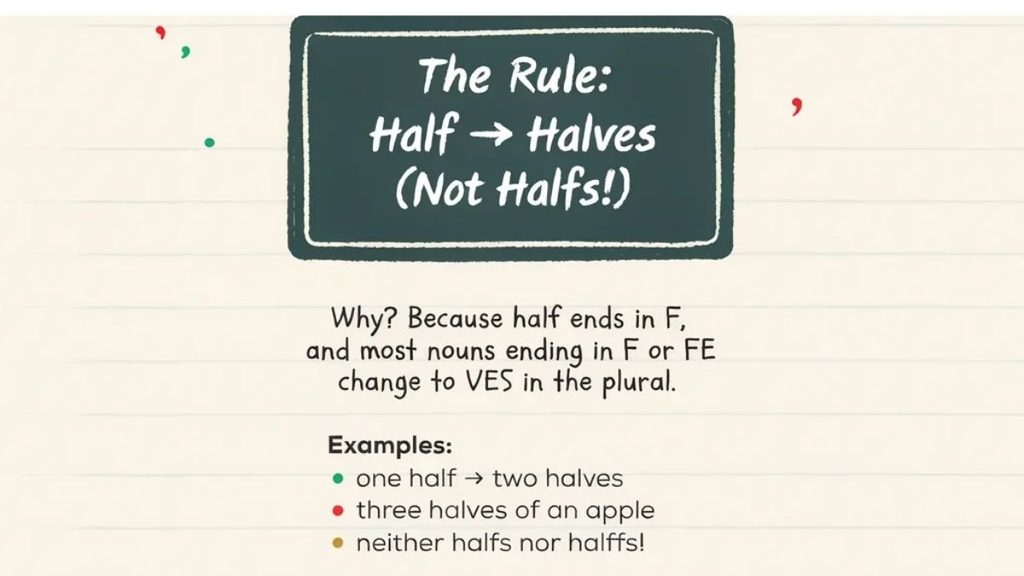
The most common mistake is simply adding s to half.
The incorrect form is
two halfs
The correct form is
two halves
The same mistake appears after words such as both, three, several, and equal.
For example, the correct forms are both halves, three halves, several halves, and equal halves.
The mistake usually happens because writers remember a basic English plural rule: add s to a singular noun. That rule works for many words, but it does not work for every noun.
For example, car becomes cars. Book becomes books. Chair becomes chairs.
However, half becomes halves.
Therefore, when a word has an irregular or less predictable plural, it needs to be learned as a complete word pair.
The most useful pair to remember is
half → halves
Halves vs Half’s
Another common source of confusion is the apostrophe in half’s.
Halves and half’s do not mean the same thing.
Halves is the plural of half.
Half’s is a possessive form of the singular noun half in contexts where something belongs to or is associated with one half.
Compare these sentences
The two halves were equal.
The half’s edge was damaged.
In the first sentence, halves simply means more than one half.
In the second sentence, half’s indicates possession or association.
The apostrophe does not make a plural.
This is an important spelling point because English uses apostrophes for possession, not for ordinary plural formation.
Therefore, the correct plural is halves, not half’s and certainly not halfs.
Halves in Common Expressions
The word half appears in many established expressions, and some of them naturally use halves.
One familiar expression is “half and half.” It describes equal amounts of two different things. Cambridge gives this meaning and also notes the American English noun half-and-half for a mixture of milk and cream commonly used in coffee.
Another expression is go halves. It means that two people share a cost equally.
For example
We decided to go halves on the gift.
The expression do things by halves also uses the plural form. It describes doing something without giving it full effort or commitment.
For example
She never does things by halves.
These expressions show that halves is not merely a textbook plural. It appears naturally in everyday English.
British English vs American English
There is no standard spelling difference between British and American English when it comes to the plural of half.
Both varieties use halves.
Cambridge lists the plural as halves in its British and American entries. The pronunciation differs somewhat between the varieties, but the spelling remains the same.
Therefore, American English does not use halfs as an alternative spelling.
If you are writing for an American audience, use halves.
If you are writing for a British audience, use halves.
The spelling remains unchanged.
Halves Pronunciation
Spelling and pronunciation support each other in this word.
In American English, Cambridge gives half as /hæf/ and halves as /hævz/. The final consonant therefore changes from an f sound to a v sound, followed by a z sound.
This is useful because pronunciation can help reinforce the spelling.
When you say half, the final sound is an f sound.
When you say halves, the final sound is a v sound followed by a z sound.
The spelling reflects that difference
half
halves
Oxford likewise lists the pronunciation of halves with the v sound.
So, if you are learning both the spelling and pronunciation, pay attention to that final sound change.
A Simple Way to Remember Halves
The easiest memory trick is to connect half with other familiar words that change f to v.
Think of these pairs
leaf → leaves
knife → knives
wife → wives
wolf → wolves
half → halves
However, remember that this is a memory pattern rather than an absolute rule for every word ending in f.
Another useful trick is to connect the word with the number two.
One half.
Two halves.
Both halves.
Two equal halves.
As soon as you see a sentence referring to multiple parts, check whether the noun should be halves.
For example
The cake was divided into two ___.
The answer is halves.
That simple mental test can prevent the most common spelling mistake.
Halves or Halfs Comparison Table
| Feature | Halves | Halfs |
|---|---|---|
| Plural of half | Correct | Incorrect in standard English |
| Refers to multiple half-parts | Yes | No |
| Used after two | Yes | No |
| Used after both | Yes | No |
| Standard American English | Yes | No |
| Standard British English | Yes | No |
| Can function as a verb | Yes | No as the ordinary form of halve |
| Example | The two halves matched. | The two halfs matched. |
Halves or Halfs Examples in Sentences
The best way to understand the spelling is to see it working naturally in different contexts.
The apple was cut into two halves.
Both halves of the sandwich were placed on the plate.
The two halves of the document were printed separately.
The first half of the game was more exciting than the second.
The river divides the city into two halves.
She saved one of the halves for later.
The children received equal halves of the cake.
The broken object fell into two halves.
Both halves fit together perfectly.
The teacher divided the paper into two halves.
These examples cover food, sports, documents, places, objects, and classroom situations. In every case, halves functions as the plural noun.
A Practical Decision Guide
When you are unsure whether to use half, halves, halve, or halved, focus on what the sentence means.
If you mean one of two parts, use half.
I ate half the apple.
If you mean more than one part, use halves.
I ate both halves of the apple.
If you mean the action of dividing something into two, use halve.
Halve the apple before serving it.
If the division has already happened, use halved.
The apple was halved before serving.
This distinction makes the four forms much easier to remember.
| Meaning | Correct form | Example |
|---|---|---|
| One part | half | I ate half the apple. |
| Multiple parts | halves | I ate both halves. |
| Divide by two | halve | Halve the apple. |
| Divided by two | halved | The apple was halved. |
Practice Session
Complete each sentence with the correct form of the word: half, halves, or halve.
Fill in the Blanks
- The cake was divided into two equal ________.
- I ate ________ of the sandwich.
- We decided to ________ the cost of dinner.
- Please cut the apple into two ________.
- She drank ________ a glass of water.
- Two ________ make a whole.
- Let’s go ________ on the cost of the meal.
- He ate ________ of the pizza.
- The recipe says to ________ the amount of sugar.
- The two ________ of the orange were the same size.
- I only need ________ a cup of flour.
- The company plans to ________ its expenses.
- The children received equal ________ of the cake.
- She finished ________ of her homework.
- The teacher divided the class into two ________.
- We can ________ the bill between us.
- One ________ of the room was empty.
- The price was ________ of what it was last year.
- The baker cut the bread into two ________.
- They agreed to go ________ on the purchase.
- Each player received one ________ of the prize.
- The number of visitors was ________ what it was last month.
- The orange was cut into two ________.
- Please ________ the recipe if you are cooking for two people.
- The cookie broke into two ________.
Answer Session
- halves
- half
- halve
- halves
- half
- halves
- halves
- half
- halve
- halves
- half
- halve
- halves
- half
- halves
- halve
- half
- half
- halves
- halves
- half
- half
- halves
- halve
- halves
Here’s a trusted source for clear more words Comparison:
FAQs
Which is correct, halfs or halves?
“Halves” is correct. “Halfs” is incorrect.
Shall we go halves or halfs?
“Go halves” is correct. It means to share something equally.
Which is correct, a half or an half?
“A half” is correct because “half” begins with a consonant sound.
Is it two halfs or two halves?
“Two halves” is correct. “Halfs” is a spelling mistake.
What is the plural of half?
The plural of “half” is “halves.”
Is halfs a word?
“Halfs” is not the standard plural form of “half.” Use “halves.”
Why does half become halves?
“Half” has an irregular plural. Its spelling changes to “halves.”
What does halves mean?
“Halves” means two equal parts of a whole.
How do you pronounce halves?
“Halves” is pronounced “havz,” with a silent “l.”
Is a half singular?
Yes. “A half” refers to one part of a whole.
AEO
What is the correct spelling halves or halfs?
“Halves” is the correct spelling.
What is the plural form of half?
The plural form of “half” is “halves.”
Do you say go halves or go halfs?
You say “go halves.”
Do you say a half or an half?
You say “a half.”
Is two halves correct English?
Yes. “Two halves” is grammatically correct.
What does go halves mean?
“Go halves” means to share something equally.
Is half singular or plural?
“Half” is singular. “Halves” is plural.
Which is correct two halfs or two halves?
“Two halves” is correct.
What article comes before half?
Use “a” before “half,” as in “a half.”
conclusion
The halves or halfs confusion may look like a tiny spelling problem, but one missing letter can quickly turn a correct sentence into a grammar headache. The good news is that the rule is simple half becomes halves when you need the plural form. So, write two halves, equal halves, and go halves, not two halfs or go halfs. Also, remember that the singular form is a half, not an half. Once you learn this pattern, you won’t have to second guess yourself every time half appears in a sentence. Keep halves in mind, and let halfs stay out of your writing.

Bella AJS
Bella AJS is an experienced blogger and passionate language enthusiast at WordReason. She specializes in English grammar, word meanings, spelling, and commonly confused words. With a clear and practical writing style, Bella helps readers understand tricky language rules without the textbook headache. Her goal is simple: make English easier, clearer, and more enjoyable one word at a time.