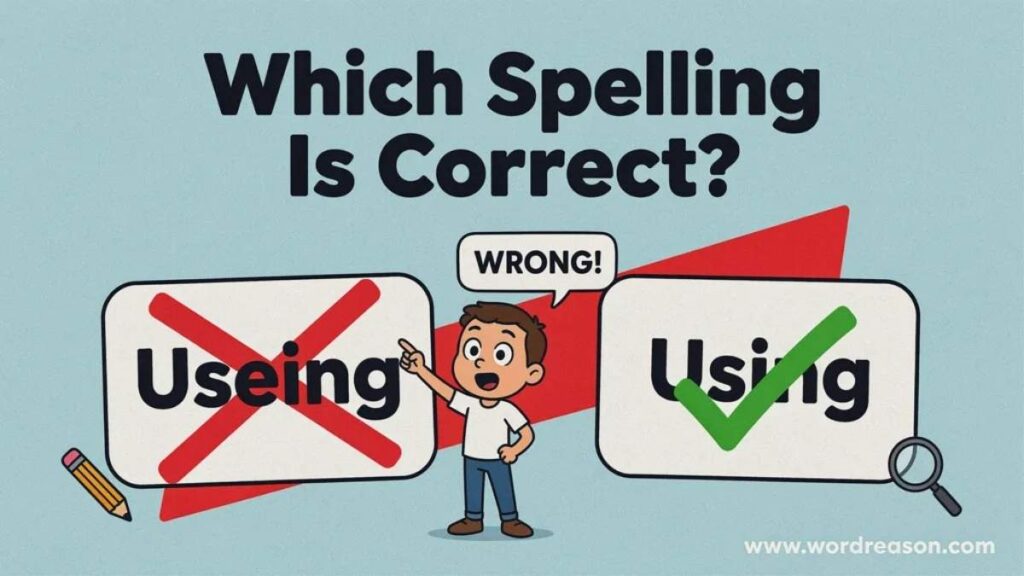
The useing or using confusion is a common spelling mistake because adding ing to use seems as simple as adding the suffix. However, English spelling has a small surprise here. The correct form is using, not useing. The final e in use disappears before ing joins the word. In this guide, you will learn why using is correct, why useing causes confusion, and how to remember the spelling without second guessing yourself. Once you know the rule, this mistake becomes easy to avoid.
Useing or Using Quick Answer
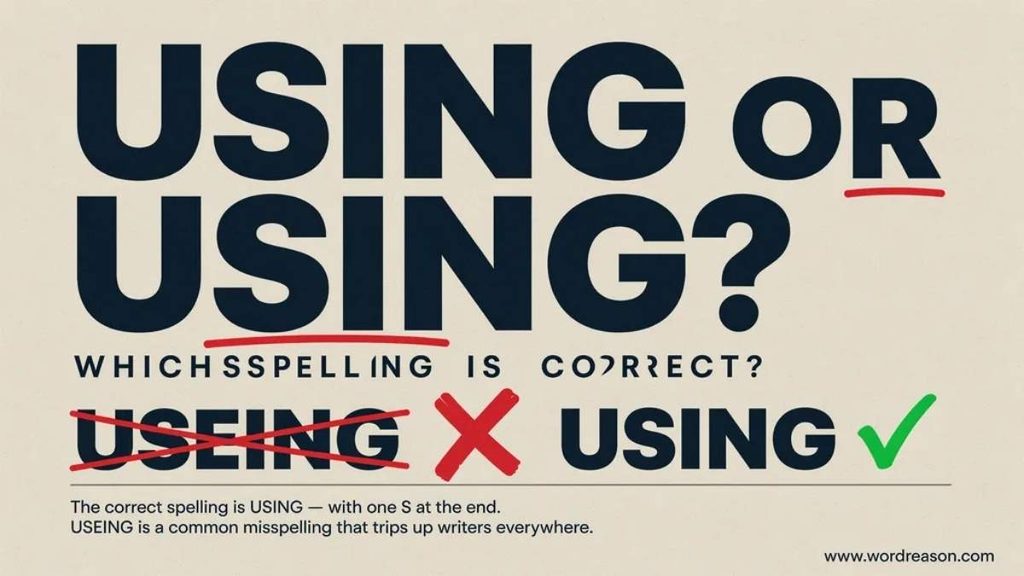
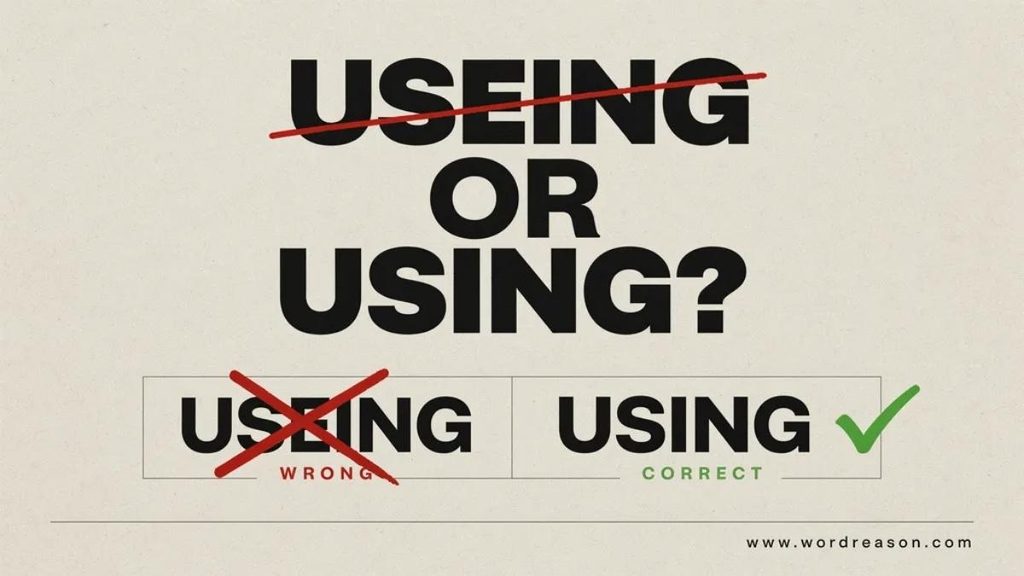
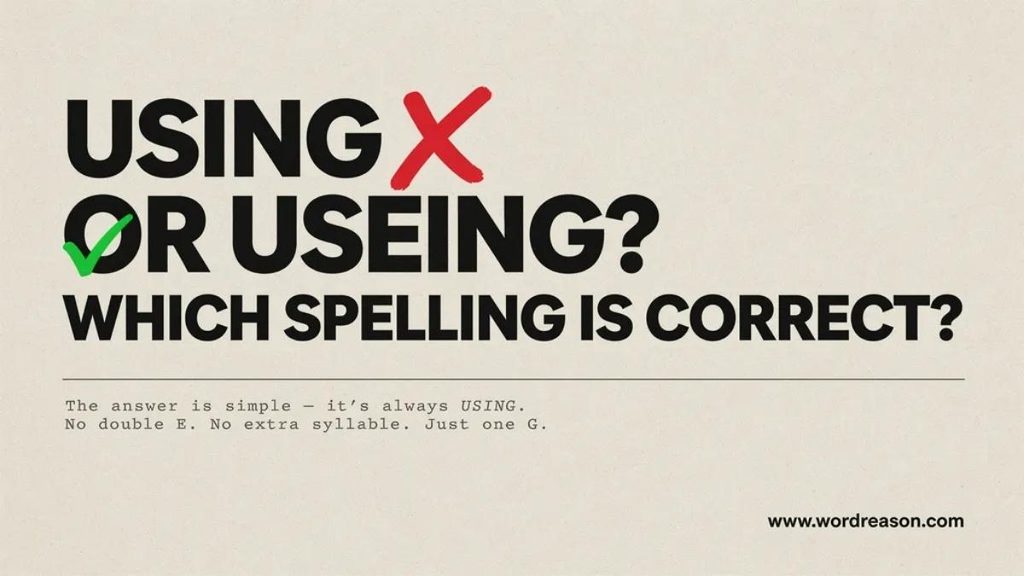
If the question is useing or using which spelling is correct, the answer is using.
Using is the standard English spelling. Useing is an incorrect form.
| Form | Correct? | Explanation |
|---|---|---|
| using | Yes | Correct -ing form of use |
| useing | No | Incorrect spelling |
| use | Yes | Base form of the verb |
| uses | Yes | Third-person singular form |
| used | Yes | Past and past participle form |
The formation is:
use + -ing → using
The final e in use does not remain before -ing. Instead, English removes the final silent e and then adds the suffix.
So, if you are asking “is using or useing correct,” choose using.
For example
She is using her laptop.
That sentence is correct.
She is useing her laptop.
That sentence contains a spelling error.
The difference may look small, but the rule behind it is useful far beyond this one word.
Learn the difference between confusing more English words
Volumn or Volume Which Is the Correct Spelling?
Why Is Using the Correct Spelling?
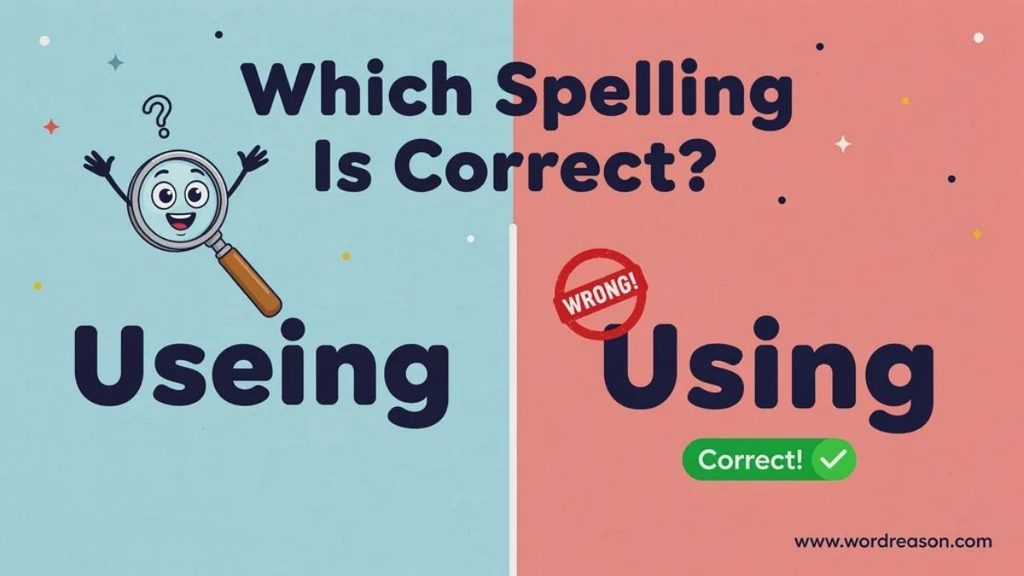
The correct spelling using follows a common English spelling pattern involving verbs that end in a silent e.
When a verb ends in a silent e, English often removes that final e before adding ing. This pattern is commonly called the silent e rule.
Consider the following forms
| Base verb | Correct -ing form |
|---|---|
| use | using |
| make | making |
| take | taking |
| write | writing |
| drive | driving |
| give | giving |
| move | moving |
| dance | dancing |
| love | loving |
| hope | hoping |
The important point is that the final e disappears before ing.
Consequently, use does not become useing. It becomes using.
This explains why the correct spelling using looks slightly different from the base word use. The spelling changes when the verb takes the suffix.
Cambridge Dictionary identifies using as the present participle of use. It also gives real examples of using in ordinary and professional contexts, which confirms that using is the established form in standard English.
Learn the difference between confusing more English words
Many or Meny Which Spelling Is Correct?
Is Useing a Word?
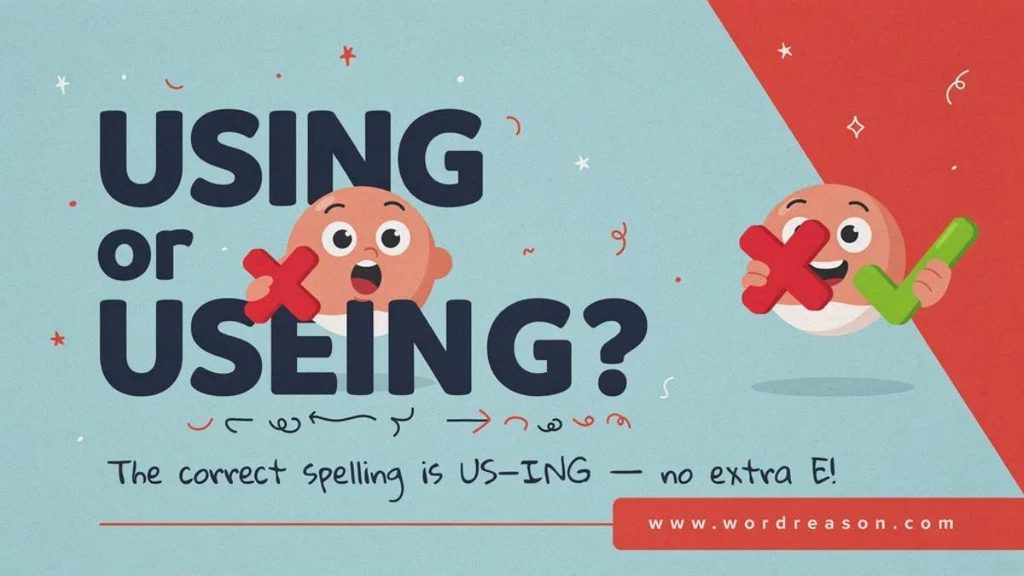
No. Useing is not the standard spelling of the ing form of use.
If you search for is useing a word or is useing correct, the confusion usually comes from treating suffixes too mechanically. A writer may see use and assume that adding ing means keeping every original letter:
use + ing → useing
However, English spelling changes the word before the suffix is added
use → us + ing → using
Therefore, useing is best understood as a common spelling mistake rather than a genuine alternative form.
You might still encounter useing in online comments, unedited writing, typing mistakes, or other informal material. However, seeing an incorrect spelling somewhere does not make it a standard English word.
For formal writing, academic work, professional communication, and published content, use using.
Learn the difference between confusing more English words
Bareable or Bearable Which Spelling Is Correct?
Using Meaning and Grammar
The using meaning comes from the verb use.
Cambridge Dictionary defines use as a verb meaning to put something, such as a tool, skill, or building, to a particular purpose.
The word using is the -ing form of that verb.
For example
I use a dictionary.
I am using a dictionary.
The first sentence uses the base form use. The second uses using as part of a progressive verb phrase.
Using can also function as a gerund. Therefore, its grammatical role depends on how it appears in the sentence.
Consider this example
Using a dictionary can improve your vocabulary.
Here, using a dictionary acts as the subject of the sentence.
Now compare it with
She is using a dictionary.
Here, using forms part of the verb phrase is using.
The spelling stays exactly the same in both sentences. Only the grammatical function changes.
Learn the difference between confusing more English words
Barrel or Barrell which is the Correct Spelling?
Using as a Present Participle
A present participle is the -ing form of a verb. It can appear with forms of be to create progressive constructions.
For example
She is using the new software.
They are using a different method.
I am using my phone.
We were using an older version.
In each sentence, using describes an action.
The construction can show an action happening now or around a particular period.
For instance
She is using the computer.
The sentence presents the action as ongoing.
Cambridge Dictionary lists using specifically as the present participle of use and provides examples from real English usage.
Learn the difference between confusing more English words
Speach or Speech Which Is the Correct Spelling?
Using as a Gerund
The same -ing form can also work as a gerund.
A gerund is an -ing form that functions as a noun within a sentence.
For example
Using clear examples makes grammar easier.
The phrase using clear examples acts as the subject.
Likewise
Using a dictionary can help you understand unfamiliar words.
Here, using a dictionary functions as the subject of the sentence.
This distinction can seem complicated at first. However, you can often understand it by looking at the role of the word in the sentence.
Compare
She is using a dictionary.
Using a dictionary is helpful.
In the first sentence, using belongs to the verb phrase is using. In the second, using begins a phrase that functions as the subject.
The spelling does not change.
Learn the difference between confusing more English words
Studder or Stutter Which Spelling Is Correct?
Using in a Sentence
The phrase using in a sentence is one of the most useful ways to understand the word because context makes the grammar clearer.
Consider these examples.
She is using my notebook.
They are using a new system.
I am using a calculator.
We are using the latest version.
Using examples makes difficult ideas easier to understand.
He improved his writing by using shorter sentences.
Are you using the correct file?
The students are using their dictionaries.
Each example contains using, but the surrounding words determine its grammatical function.
For example, in She is using my notebook, using forms part of the progressive verb phrase.
In Using examples makes difficult ideas easier to understand, the word begins a gerund phrase that acts as the subject.
Therefore, learning the word in context can be more useful than simply memorizing its spelling.
Learn the difference between confusing more English words
Monkeys or Monkies Which Spelling Is Correct?
The Silent E Rule Explained
The main spelling issue becomes much clearer when you understand how English handles final silent e.
Many familiar verbs end with e
make
take
write
give
drive
move
use
When these verbs take -ing, the final e usually disappears.
For example
make → making
take → taking
write → writing
give → giving
drive → driving
move → moving
use → using
This pattern is often called the silent e spelling rule.
The practical process looks like this
use
remove the final e
us
add -ing
using
That gives the correct form.
Therefore, the spelling rule for use + ing is not difficult once the steps become familiar.
Learn the difference between confusing more English words
Buoy or Bouy which spelling is correct?
Why Do You Drop the E in Using?
The final e in use belongs to the spelling of the base word. However, when the verb takes the -ing suffix, standard English spelling changes the form.
This is why the word does not simply keep every letter from use.
The same thing happens in other familiar words
hope → hoping
love → loving
dance → dancing
close → closing
move → moving
The pattern helps explain why useing looks wrong to experienced readers. The spelling does not match the established word-building pattern.
However, it is important not to turn this into an absolute rule for every English word ending in e. English contains exceptions and separate spelling patterns.
For example
see → seeing
agree → agreeing
be → being
These forms show that English spelling rules depend on the structure and history of individual words.
Therefore, a better lesson is this: when a common verb ends in a silent e, dropping the e before -ing is a strong and useful pattern, but individual exceptions still need to be learned.
Learn the difference between confusing more English words
Leasee or Lessee which Spelling is correct?
Useing vs Using Common Mistakes
The most common useing vs using mistake happens when someone adds -ing directly to the base word without changing its spelling.
The incorrect version looks logical at first
use + ing = useing
However, standard spelling requires the final e to disappear
use + ing = using
For example
Incorrect She is useing the computer.
Correct She is using the computer.
Incorrect They are useing a new method.
Correct They are using a new method.
Incorrect He is useing my phone.
Correct He is using my phone.
Once the silent e rule becomes familiar, the error becomes much easier to spot.
Learn the difference between confusing more English words
Hoofs or Hooves which spelling is Correct?
Using vs Use
Another source of confusion involves the difference between the base verb and its -ing form.
Use is the base form
I use this application every day.
Using is the -ing form
I am using this application right now.
The two words belong to the same verb, but they perform different grammatical jobs.
Compare these examples
I use this tool regularly.
1.She uses this tool regularly.
2.She used this tool yesterday.
3.She is using this tool now.
The four forms are use, uses, used, and using.
Understanding this small family of forms makes the correct spelling easier to remember.
Learn the difference between confusing more English words
Receive or Recieve which Correct is correct?
Use, Uses, Used and Using
The following table brings the forms together.
| Verb form | Example | Main function |
|---|---|---|
| use | “I use this program.” | Base form |
| uses | “She uses this program.” | Third-person singular present |
| used | “He used this program yesterday.” | Past form |
| used | “They have used this program before.” | Past participle |
| using | “They are using this program.” | -ing form |
The important spelling point is that only the -ing form creates the useing vs using question.
The correct form remains using.
Using vs Suing
Some readers also search for how do you spell suing because suing and using look similar.
The correct spelling of the legal verb is suing.
However, suing and using come from different base verbs.
sue → suing
use → using
For example:
The company is suing the contractor.
The company is using a new contract.
Although the two words look similar, their meanings have nothing to do with each other.
The spelling pattern is also interesting because both verbs lose their final e before -ing.
Therefore
sue → suing
use → using
This comparison can help reinforce the broader spelling pattern.
Is Using the Same in American and British English?
Yes. There is no American-versus-British spelling difference between using and useing.
Both varieties use using.
| English variety | Correct form |
|---|---|
| American English | using |
| British English | using |
| Canadian English | using |
| Australian English | using |
Therefore, if you are writing for a US audience, use using. If you are writing for a British audience, use using as well.
This case does not work like color and colour or center and centre. The spelling remains the same.
Cambridge provides separate resources covering British and American English, while its dictionary entry identifies using as the present participle of use. Nothing about the standard form changes the spelling to useing in either variety.
Common English Spelling Patterns With ing
The spelling of using connects with a much larger part of English word formation.
When adding -ing to verbs, English does not always attach the suffix without changing anything. Instead, different spelling patterns can apply.
For verbs ending in a silent e, the final e commonly disappears.
For example
make → making
take → taking
write → writing
give → giving
drive → driving
hope → hoping
move → moving
use → using
Other verbs simply take -ing
read → reading
help → helping
talk → talking
clean → cleaning
jump → jumping
Still other verbs can double a final consonant:
run → running
sit → sitting
swim → swimming
Therefore, adding -ing involves more than simply attaching three letters to the base word.
The good news is that using belongs to one of the easier patterns.
How to Spell Using Correctly
If you want a quick method for remembering how to spell using, start with the base verb.
The base verb is use.
Next, identify the final silent e.
Then remove the e.
Finally, add -ing.
The result is
use → us → using
That is the correct spelling.
A useful memory sentence is
Drop the silent e before adding -ing.
Once you connect use with other familiar examples such as make → making and write → writing, the pattern becomes much easier to recall.
Why Is Useing Such an Easy Mistake to Make?
At first glance, useing looks reasonable.
That happens because many learners are taught a basic rule: add -ing to a verb to describe an ongoing action.
For example
read → reading
walk → walking
play → playing
So it is natural to think
use → useing
However, English spelling contains several word-building patterns. The base word can change when a suffix arrives.
The final e in use is the important detail.
Once that detail becomes familiar, the confusion largely disappears.
In other words, the problem is not that using has an unusual spelling. Instead, the problem comes from applying an overly simple just add -ing rule.
A Simple Memory Trick for Using
Imagine the final e in use as a temporary passenger.
When -ing arrives, the e gets dropped.
So
use → using
The same idea works with
make → making
take → taking
write → writing
drive → driving
This gives you a useful mental pattern rather than an isolated spelling to memorize.
If you ever pause over useing or using again, look at the final e and remember the silent e rule.
The answer should become immediate
using.
Practice Session
Choose the correct word, using or useing, to complete each sentence.
- She is ________ her new laptop.
- We are ________ a different method.
- He enjoys ________ his free time wisely.
- They are ________ the correct spelling.
- I am ________ a dictionary.
- Sarah is ________ a pencil to draw.
- Are you ________ this computer?
- He started ________ the new software.
- We were ________ an old camera.
- She is ________ her phone right now.
- The teacher showed us how to use the word ________ correctly.
- I prefer ________ simple words in my writing.
- They are ________ the correct grammar rule.
- He is ________ a calculator.
- She continued ________ the same technique.
- Are they ________ the right tool?
- I am ________ this example to explain the rule.
- The students are ________ dictionaries.
- He practices ________ English every day.
- We are ________ the correct form of the verb.
- She was ________ her tablet when I called.
- I learned the rule by ________ several examples.
- He is ________ the word in a sentence.
- They started ________ the new system.
- Remember: “use” becomes ________ when you add -ing.
Answer Session
- using
- using
- using
- using
- using
- using
- using
- using
- using
- using
- using
- using
- using
- using
- using
- using
- using
- using
- using
- using
- using
- using
- using
- using
- using
Here’s a trusted source for clear more words Comparison:
FAQs
Is useing correct?
No. “Useing” is incorrect. The correct spelling is “using.”
Which is correct using or useing?
“Using” is correct. “Useing” is a common spelling mistake.
How do you spell using?
The correct spelling is U-S-I-N-G: “using.”
Why is using spelled without the e?
The final e in “use” is dropped before adding -ing: use → using.
What does using mean?
“Using” is the -ing form of “use.” It means putting something into action or making use of it.
Is using a verb?
Yes. “Using” is the -ing form of the verb “use.” For example, “She is using my phone.”
Is use to correct?
It depends on the sentence. Use “used to” in affirmative statements about past habits, but use “use to” after “did” or “didn’t.”
Which is correct I used to live or I use to live?
“I used to live” is correct in an affirmative sentence. For example, “I used to live in New York.”
Is it your using or you’re using?
“You’re using” means “you are using.” For example, “You’re using the wrong word.” “Your using” can also be grammatical in specific structures, but it has a different meaning.
Is are using or is using correct?
Both are correct. Use “is using” with a singular subject and “are using” with “you,” “we,” “they,” or plural subjects.
Can using be a gerund?
Yes. In “Using a dictionary helps,” “using” functions as a gerund.
Can using be a present participle?
Yes. In “She is using a laptop,” “using” is part of the present progressive verb phrase.
Is using correct in American and British English?
Yes. “Using” is the standard spelling in both American and British English.
AEO: Quick Answers
What is the correct spelling of using?
“Using” is the correct spelling. “Useing” is incorrect.
Why is useing wrong?
The final e in “use” is dropped before adding -ing, giving “using.”
What is the spelling rule for use + ing?
Drop the final e and add -ing: use → using.
Is using a word?
Yes. “Using” is the standard -ing form of “use.”
What is an example of using in a sentence?
“She is using a new computer.”
What is the difference between use and using?
“Use” is the base form, while “using” is the -ing form. For example, “I use a phone” and “I am using a phone.”
What is the difference between used and using?
“Used” commonly refers to a past action, while “using” describes an action in progress. For example, “She used it yesterday” and “She is using it now.”
Should I write “useing” in formal writing?
No. Use “using” in standard English writing.
Is “I am useing” correct?
No. The correct sentence is “I am using.”
Does “use” become “using”?
Yes. The final e is removed before -ing is added: use → using.
If you want, I can also make these FAQs more SEO-focused for featured snippets while keeping every answer very short.
conclusion
The useing or using confusion may look like a tiny spelling puzzle, but now you know the answer. Using is the correct spelling, while useing is a common mistake. The trick is simple: when you add -ing to use, drop the final e and write using. This same pattern appears in words such as making, taking, writing, and giving. So, the next time useing tries to sneak into your sentence, show it the door. Remember the simple formula: use + ing = using. Once this rule becomes familiar, you can write using confidently without stopping to wonder whether that extra e belongs there.

Bella AJS
Bella AJS is an experienced blogger and passionate language enthusiast at WordReason. She specializes in English grammar, word meanings, spelling, and commonly confused words. With a clear and practical writing style, Bella helps readers understand tricky language rules without the textbook headache. Her goal is simple: make English easier, clearer, and more enjoyable one word at a time.