
English spelling can turn one missing letter into a surprisingly big problem. The confusion over realy or really is a perfect example. You might type realy in a hurry and wonder whether that missing l really matters. It does. Really is the correct spelling, while realy is a common spelling mistake. The difference may look tiny, but the wrong spelling can make your writing seem careless, especially in school, work, or professional communication. In this guide, you’ll learn why really has two l’s, what the word means, how to use it correctly, and an easy trick to remember its spelling without giving that second l another chance to disappear.
Realy or Really Which Spelling Is Correct?
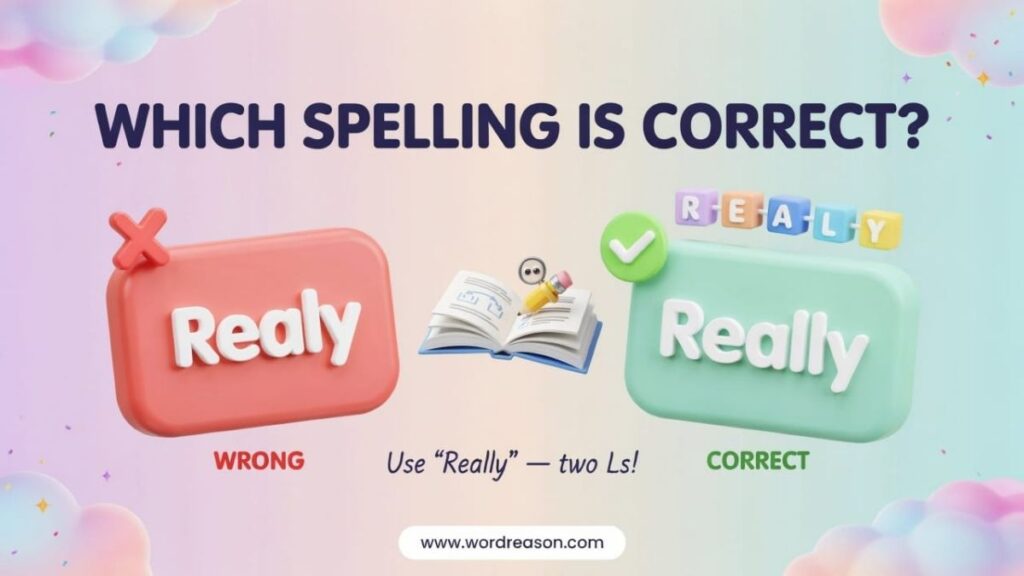
Really is the correct spelling.
Realy is not the standard spelling of the word. When someone writes realy, they usually mean really but have accidentally left out one l.
The difference is only one letter, yet that letter matters.
The correct form is
really
The incorrect form is
realy
For example, consider these sentences
I realy like this book.
I really like this book.
The first sentence contains a spelling error. The second uses the standard form.
Similarly, you should write
She is really tired.
Not:
She is realy tired.
The same spelling applies in American English and British English. Therefore, realy is not a regional spelling, and really is not limited to one variety of English.
If you are searching for the realy or really which spelling is correct, the answer remains the same: really.
Learn the difference between confusing more English words
Volumn or Volume Which Is the Correct Spelling?
What Does Really Mean?
The really meaning depends on the sentence. In everyday English, the word commonly expresses truth, emphasis, intensity, certainty, or surprise.
For example, in the sentence Did you really see him? really relates to whether the event actually happened.
However, in The movie was really good, the word increases the strength of good.
That difference is important because really does not have just one fixed meaning. Instead, context determines exactly what the speaker intends.
Really Means Actually or In Fact
One common use of really means actually or in fact.
For example
Did you really see the accident?
What really happened?
She really lives in New York.
He really finished the work yesterday.
In each sentence, really adds a sense of truth or confirmation.
Consider the difference between What happened? and What really happened? The second question asks about the actual situation rather than a rumor, assumption, or appearance.
Likewise, She is not really angry suggests that her apparent anger does not fully represent how she actually feels.
Really Means Very or Very Much
Really can also strengthen an adjective or adverb. In this use, it often has a meaning close to very or very much.
For example
The water is really cold.
That was a really difficult exam.
She is really talented.
The movie was really interesting.
He runs really quickly.
Here, really adds emphasis. The sentence The movie was interesting gives a basic description. Adding really makes the description stronger: The movie was really interesting.
This use appears constantly in everyday English. It is natural in conversation and also works in many types of writing.
Really Can Express Surprise or Disbelief
There is another familiar use of really. When someone says “Really?” the word can express surprise, interest, doubt, or disbelief.
For example
I got the job.
Really?
The speaker is not necessarily asking for a dictionary definition of anything. Instead, the response shows that the information was unexpected.
Similarly:
You are moving to California.
Really? When?
Here, really signals surprise and invites the other person to continue.
The meaning can change with tone. A cheerful Really? may show excitement, while a doubtful Really? may suggest that the speaker is not completely convinced.
Learn the difference between confusing more English words
Studder or Stutter Which Spelling Is Correct?
What Is Realy?
If you are asking is realy correct, the answer is no in standard English.
Realy is generally a misspelling of really. It does not represent a separate standard English word with a different meaning.
The mistake often happens because the base word is real. A writer may see real and then add ly mentally
real + ly = realy
That looks logical at first glance. However, the standard spelling is really.
This is why the error can be so easy to make. The writer understands the word and its meaning but misses one letter while forming or typing it.
For example
I realy want to go.
The writer clearly intends really. Correcting the sentence only requires one small change
I really want to go.
Therefore, the realy spelling is best treated as a common spelling error rather than as a different vocabulary item.
Learn the difference between confusing more English words
Monkeys or Monkies Which Spelling Is Correct?
Why Is Really Spelled With Two L’s?
The question why is really spelled with two l’s has a simple practical answer: the standard English form is really.
The word is closely connected with real and the adverb-forming suffix -ly. When you put the parts together, the spelling is
real + ly = really
Notice what happens at the boundary. The final l in real is followed by the l in ly. That gives the word two consecutive l’s.
This makes the following comparison useful
real + ly → really
not
real + ly → realy
The second version drops one l and therefore produces a misspelling.
You do not need to memorize a complicated rule every time you write the word. Instead, remember the complete pattern: real plus ly gives really.
That simple memory trick can prevent the mistake almost immediately.
Learn the difference between confusing more English words
Buoy or Bouy which spelling is correct?
What Is the Difference?
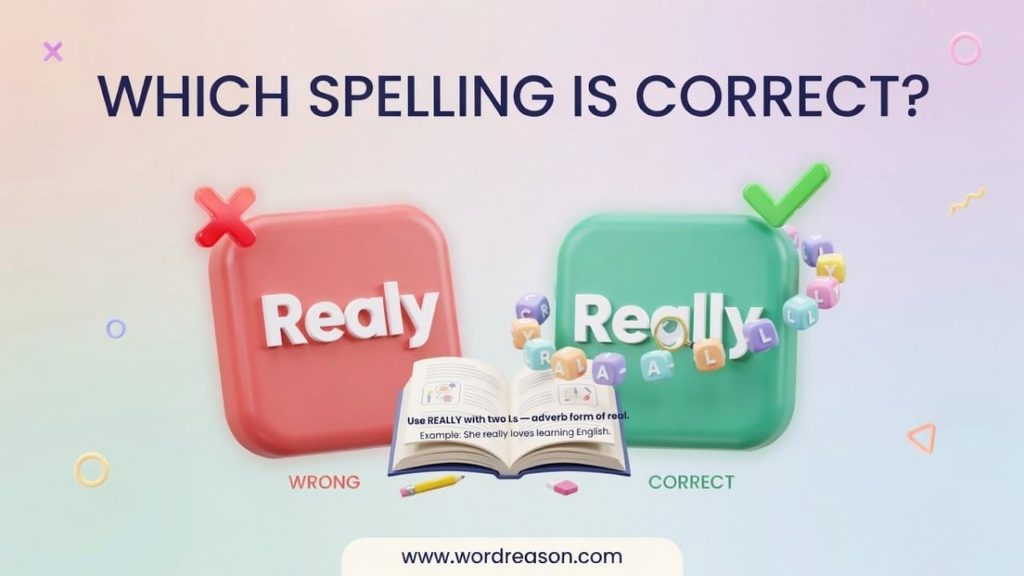
The realy vs really difference is not a difference in meaning between two standard English words. It is a difference between the standard spelling and a common misspelling.
| Form | Standard spelling? | Meaning |
|---|---|---|
| really | Yes | Actually, truly, genuinely, very, or very much depending on context |
| realy | No | Usually intended to mean really |
For example
I really understand the problem.
The word really is correct because it is the standard adverb.
Writing I realy understand the problem creates a spelling error even though most readers will understand what the writer means.
This distinction matters in school assignments, professional emails, articles, applications, reports, and other forms of writing where correct spelling affects the overall quality of the text.
Learn the difference between confusing more English words
Leasee or Lessee which Spelling is correct?
What Part of Speech Is Really?
Really is primarily an adverb.
That means it can modify or add information to other words and expressions. Depending on the sentence, it can emphasize an adjective, another adverb, a verb, or a statement.
For example
The room is really cold.
Here, really modifies the adjective cold.
Now consider
She speaks really clearly.
In this sentence, really modifies the adverb clearly.
It can also emphasize a verb’
I really like this song.
She really wants the job.
They really enjoyed the trip.
In each example, really strengthens the action or feeling expressed by the verb.
Understanding this role makes it easier to see why real and really cannot always replace each other.
Learn the difference between confusing more English words
Hoofs or Hooves which spelling is Correct?
Really vs Real What Is the Difference?
Real and really are related words, but they normally serve different grammatical purposes.
Real commonly works as an adjective. Really commonly works as an adverb.
Compare these two sentences
That is a real problem.
That problem is really serious.
In the first sentence, real describes the noun problem.
In the second sentence, really modifies the adjective serious.
Another comparison makes the difference even clearer
She has real talent.
She is really talented.
Real describes talent, while really adds emphasis to talented.
This distinction is useful because some spelling mistakes actually come from a grammar problem. A writer may know that real and really are related but may not know which form belongs in the sentence.
Learn the difference between confusing more English words
Receive or Recieve which Correct is correct?
How to Spell Really
If you are wondering how to spell really, start with the base word real.
Then connect it with the suffix -ly
real + ly = really
The result contains two l’s
really
This gives you a quick spelling check.
If you write realy, stop and look at the middle of the word. One l has disappeared.
A useful mental reminder is
REAL + LY
The two l’s meet in the middle.
Once you learn this pattern, the correct spelling becomes much easier to remember.
Learn the difference between confusing more English words
Useing or Using Which Spelling Is Correct?
How to Pronounce Really
Really has the same standard spelling in American and British English, although pronunciation can vary slightly by accent.
In American English, a common pronunciation is represented as /ˈriː.ə.li/. In British English, a common pronunciation is /ˈrɪə.li/.
The vowel sounds can therefore differ between accents. However, those pronunciation differences do not create different spellings.
You should not treat realy as though it has its own standard pronunciation. Since realy is a misspelling of really, the intended word is still really.
When you hear the word in fast conversation, it may sound less carefully separated than it does when spoken slowly. That is normal. Spoken English often reduces or blends sounds, while written English keeps the standard spelling.
Learn the difference between confusing more English words
Authorized or Authorised Which Spelling Is Correct?
American English and British English Is the Spelling Different?
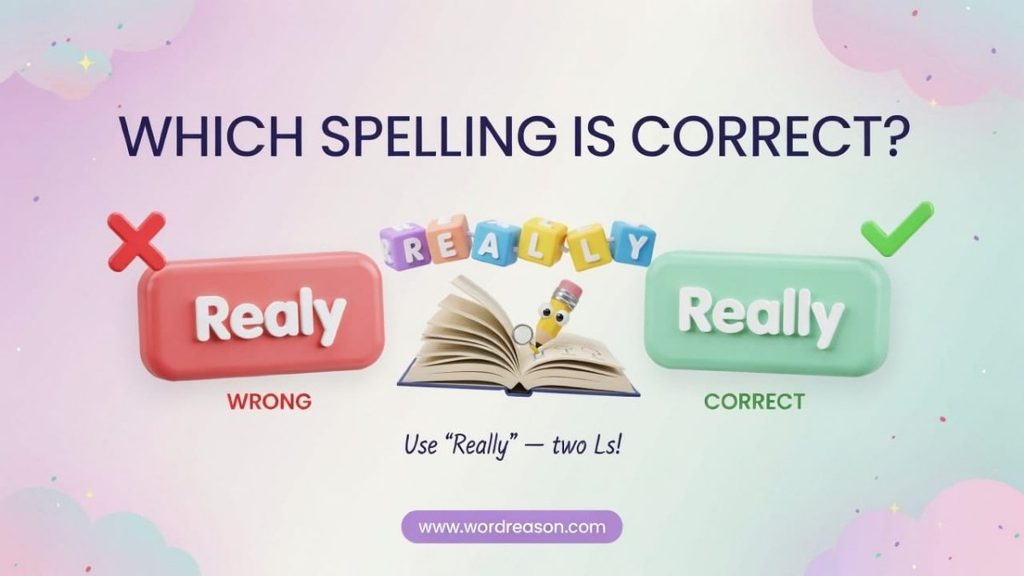
No. Both American English and British English use really.
This point is worth clarifying because English has many genuine spelling differences between regional varieties.
For example, American English commonly uses color, while British English commonly uses colour. Similarly, American English often uses center, while British English uses centre.
Really does not follow that pattern.
American English uses
really
British English uses
really
Therefore, realy should not be described as a British spelling or an American spelling. It is simply an incorrect form of the standard word.
Learn the difference between confusing more English words
Halves or Halfs Which Spelling Is Correct?
Common Mistakes With Really
The most obvious error is realy, but several other problems can appear when people use this word.
Writing Realy Instead of Really
This is the main spelling mistake.
Incorrect
I realy enjoyed the movie.
Correct
I really enjoyed the movie.
The correction is simple: restore the second l.
Using Real Instead of Really
Sometimes the problem is not spelling but grammar.
For example
She is real talented.
In general standard English, the clearer form is
She is really talented.
Here, really functions as an adverb that modifies talented.
The distinction becomes clearer when the adjective real modifies a noun
She has real talent.
So, real and really are both correct words, but they do different jobs.
Using Really Too Many Times
Really is a useful word, but repetition can make writing less precise.
Consider
The movie was really good. The actors were really good, and the story was really interesting. The ending was really surprising.
The grammar is fine. However, the repeated use of really makes the description less specific.
A stronger version could say
The movie was enjoyable. The actors were convincing, the story was engaging, and the ending was genuinely surprising.
The point is not that really should disappear from your writing. Instead, use it when it adds meaning. When a more precise word communicates the idea better, choose that word.
Really in a Sentence Examples
IT appears in many sentence patterns, so seeing it in context helps clarify its use.
Really Showing Truth
I really saw him at the station.
What really happened?
She really knows how to solve the problem.
They really finished the project on time.
These examples connect really with truth or actual circumstances.
Really Showing Intensity
The room is really cold.
That was a really difficult question.
The new restaurant is really popular.
This book is really useful.
Here, really strengthens an adjective.
Really Emphasizing a Verb
I really appreciate your help.
She really wants this opportunity.
We really enjoyed the concert.
He really needs more time.
In these sentences, really gives additional emphasis to the action or feeling.
Really in Questions
Did you really say that?
Do you really believe him?
Are you really leaving tomorrow?
Did she really win?
Questions with really often ask whether the information is true or express surprise about it.
Really as a Response
Really?
This short response can communicate several things depending on the situation.
For example
I am getting married next month.
Really?
The speaker may be surprised and interested.
However, if someone says
You broke the same rule again.
Really?
The same word could sound doubtful or defensive.
That is one reason context and tone matter so much in everyday English.
Realy or Really Common Sentence Corrections
The following examples show how one missing letter changes the spelling.
| Incorrect | Correct |
|---|---|
| I realy like this book. | I really like this book. |
| She is realy kind. | She is really kind. |
| Do you realy mean it? | Do you really mean it? |
| It was realy difficult. | It was really difficult. |
| He realy wants the job. | He really wants the job. |
| We realy enjoyed the trip. | We really enjoyed the trip. |
| That was realy surprising. | That was really surprising. |
| I realy need your help. | I really need your help. |
The pattern is consistent. Whenever realy appears with the intended meaning of actually, truly, genuinely, or very, the standard spelling is really.
Really in Formal and Informal Writing
Really works in both informal and formal contexts, although the best choice depends on the purpose of the writing.
In casual conversation, it sounds completely natural
I really like this place.
I really need some coffee.
That was really funny.
In professional writing, really can also be appropriate
The results were really significant.
However, formal writing often benefits from greater precision. If the intended meaning is extremely, use extremely when that is more exact. If the intended meaning is genuinely, use genuinely. the intended meaning is actually, use actually.
For example
The findings were really important.
could become
The findings were significant.
The second sentence is more direct because the adjective itself communicates the intended idea.
Still, there is no grammatical reason to avoid really altogether. It is a standard English adverb with a wide range of normal uses.
Synonyms for Really
The best synonym for really depends on what the word means in the sentence.
When really means actually, possible alternatives include actually, in fact, and indeed.
For example
What really happened?
can become
What actually happened?
When really means genuinely, words such as truly and genuinely may work.
For example
I really appreciate your help.
can become
I genuinely appreciate your help.
When really means very or very much, alternatives can include very or extremely.
For example
The weather is really hot.
can become
The weather is extremely hot.
However, these words are not always interchangeable. A synonym should match the intended meaning rather than simply replace the word because it appears in a thesaurus.
Is Really an Intensifier?
Yes. Really often works as an intensifier.
An intensifier strengthens another word without changing its basic category.
Consider
The test was difficult.
Now compare
The test was really difficult.
The adjective difficult remains the same. Really simply increases the emphasis.
The same pattern appears in
The soup is really hot.
She is really happy.
That was really strange.
The instructions were really clear.
This use explains why really appears so frequently in conversation. Speakers often need a simple way to increase emphasis, and really does that naturally.
Where Should Really Go in a Sentence?
The position of really depends on what it modifies.
Before an adjective
The weather is really cold.
Before an adverb
She speaks really clearly.
Before many main verbs
I really like this song.
Before certain auxiliary or modal constructions
You really should try it.
She really can help.
These patterns show why grammar matters alongside spelling. Knowing that really is the correct form is only the first step. You also need to understand how it works in a sentence.
A Simple Case Study How One Missing Letter Creates Confusion
Imagine a student writes
I realy enjoyed the science project. The experiment was realy interesting, and I realy want to try it again.
The meaning is easy to understand. Nevertheless, every occurrence of realy contains the same spelling error.
Now apply the real + ly memory trick
I really enjoyed the science project. The experiment was really interesting, and I really want to try it again.
Nothing about the meaning changed. The writer simply restored the standard spelling.
This example shows why realy is best understood as a spelling mistake rather than as a separate word. The intended meaning was never unclear. The problem was the missing l.
How to Remember the Correct Spelling of Really
The easiest memory method is
real + ly = really
Think of the word as a meeting point between real and ly.
The final l in real meets the l at the beginning of ly. As a result, you get two l’s
really
Not
realy
If you tend to make this mistake while typing, pause whenever you write the word and look at the middle. If you see only one l, add the missing letter.
Another useful reminder is simply
Really has two l’s.
It is short, practical, and easy to recall when you are proofreading.
Realy or Really Quick Comparison
| Question | Answer |
|---|---|
| Realy or really which is correct? | Really |
| Is realy correct? | No |
| Is really correct? | Yes |
| What is the correct spelling of really? | Really |
| What does really mean? | Actually, truly, genuinely, very, or very much depending on context |
| What part of speech is really? | Primarily an adverb |
| Why does really have two l’s? | The standard spelling is really, associated with real plus -ly |
| Is realy a standard English word? | No, it is generally a misspelling of really |
| Is really different in British English? | No, the standard spelling remains really |
| Is really different in American English? | No, the standard spelling remains really |
| What is the easiest spelling trick? | Remember real + ly = really |
Practice Session
Fill in each blank with the correct word really or realy.
- I ______ enjoyed the movie last night.
- She is ______ good at writing.
- Do you ______ believe that story?
- This book is ______ interesting.
- He ______ wants to learn English.
- Are you ______ ready to leave?
- I ______ appreciate your help.
- The test was ______ difficult.
- She ______ likes reading novels.
- Did they ______ finish the project?
- That was a ______ amazing performance.
- I ______ need some rest today.
- He is ______ excited about the trip.
- Do you ______ know the answer?
- The weather is ______ pleasant today.
- She ______ understood the lesson.
- I am ______ sorry for the mistake.
- They ______ enjoyed their vacation.
- Is this ______ what you wanted?
- He ______ tried his best.
- The children were ______ happy.
- I ______ thought you were joking.
- This exercise is ______ easy.
- She ______ cares about her work.
- Did you ______ see him yesterday?
Answer Session
- really
- really
- really
- really
- really
- really
- really
- really
- really
- really
- really
- really
- really
- really
- really
- really
- really
- really
- really
- really
- really
- really
- really
- really
- really
Here’s a trusted source for clear more words Comparison:
FAQs About Realy or Really
Is it spelled realy or really?
Really is correct. Realy is a common spelling mistake.
What does really mean?
Really can mean actually, truly, genuinely, or very, depending on the context.
What is the difference between really and very?
Both add emphasis, but really can modify verbs, while very usually modifies adjectives and adverbs.
Is realy a typo or a word?
Realy is generally a misspelling of really, not the standard English form.
How do you spell really?
The correct spelling is really, with two l’s.
Is truly grammatically correct?
Yes. Truly is a standard adverb meaning genuinely or sincerely.
What does realy mean?
Realy has no standard meaning in English. It is usually a misspelling of really.
What does really mean in a sentence?
It can show truth, emphasis, intensity, or surprise, depending on the sentence.
Is “I really am sorry” correct?
Yes. The sentence is grammatically correct and emphasizes sincerity.
What is a synonym for very or really?
Depending on the context, synonyms include truly, extremely, genuinely, highly, and actually.
AEO: Quick Answers
Why does really have two l’s?
Really follows the spelling of real + ly, resulting in two l’s.
Is realy an English word?
Realy is not the standard spelling. Use really in normal English writing.
What part of speech is really?
Really is primarily an adverb.
Can really mean very?
Yes. For example, “The food is really good” means the food is very good.
Can really modify a verb?
Yes. For example, “I really like this book.”
Is really used in American and British English?
Yes. Really is the standard spelling in both varieties of English.
How can I remember the spelling of really?
Use the simple pattern: real + ly = really.
conclusion
When it comes to realy or really, one little l makes all the difference. Really is the correct spelling, while realy is a common spelling mistake that can sneak into your writing when you type too quickly. The easiest way to remember it is to think of real + ly = really. That gives you the two l’s you need. Really can mean actually, truly, or very, depending on the context, so it is a useful word in everyday English. The next time realy tries to steal an l, remember: real already has one, and adding ly brings another along for the ride.

Bella AJS
Bella AJS is an experienced blogger and passionate language enthusiast at WordReason. She specializes in English grammar, word meanings, spelling, and commonly confused words. With a clear and practical writing style, Bella helps readers understand tricky language rules without the textbook headache. Her goal is simple: make English easier, clearer, and more enjoyable one word at a time.