English spelling has a funny way of turning one tiny letter into a surprisingly big headache. The confusion over Trys or Tries is a perfect example. You may have typed trys and wondered whether it was correct, especially when writing about repeated attempts or rugby scores. However, the correct spelling is tries, not trys. The reason becomes simple once you understand how English handles words ending in consonant + y. Instead of guessing, you can follow one clear spelling rule. So, let us clear up the confusion, explore the meaning and uses of tries, and look at simple examples that make the correct form easy to remember.
Trys or Tries Which Spelling Is Correct?
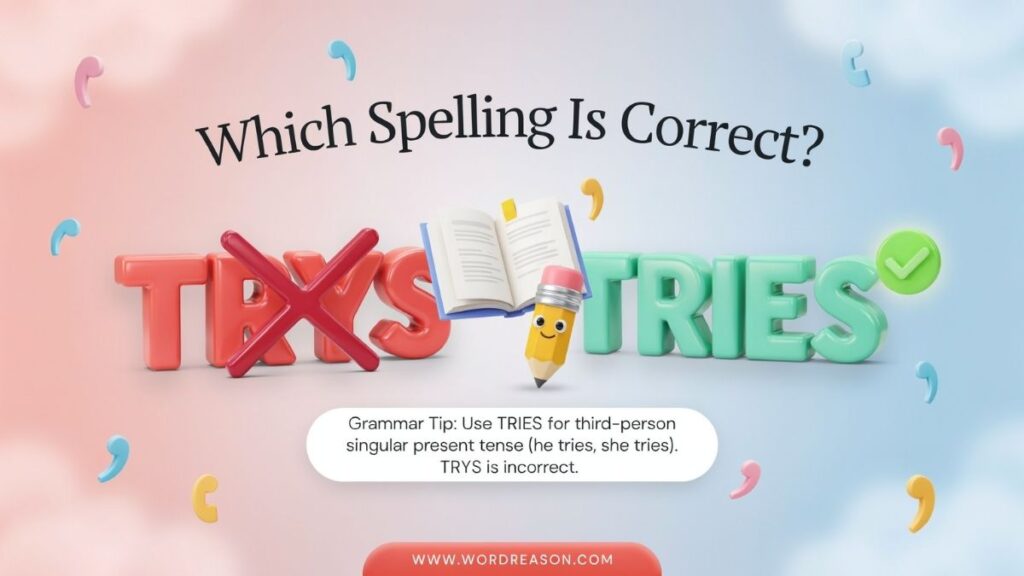
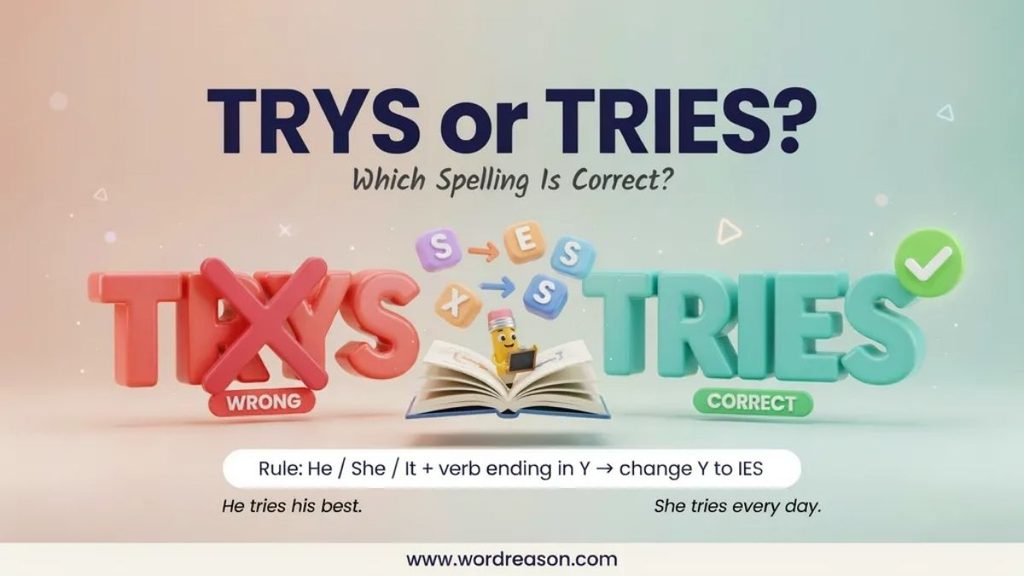
Tries is the correct spelling in standard English.
Trys is a common spelling mistake. It may look logical because many English words form their third-person singular or plural forms by adding s. However, try follows a different spelling pattern.
The word try ends with a consonant, r, followed by y. When this word needs the relevant plural or third-person singular form, the final y changes to i and es is added.
That gives us
try → tries
This same pattern appears in words such as cry, carry, study, reply, and hurry.
For example, cry becomes cries, carry becomes carries, study becomes studies, reply becomes replies, and hurry becomes hurries.
Therefore, if you are asking for the correct spelling tries or trys, the answer is tries.
The same answer applies whether you are writing about everyday actions, repeated attempts, schoolwork, business communication, or rugby.
| Form | Standard English | Main use |
|---|---|---|
| try | Yes | Base verb or singular noun |
| tries | Yes | Third-person singular verb or plural noun |
| tried | Yes | Past tense and past participle |
| trying | Yes | Present participle or gerund |
| trys | No | Common spelling mistake |
Learn the difference between confusing more English words
Volumn or Volume Which Is the Correct Spelling?
Why Is Tries Spelled With ies?
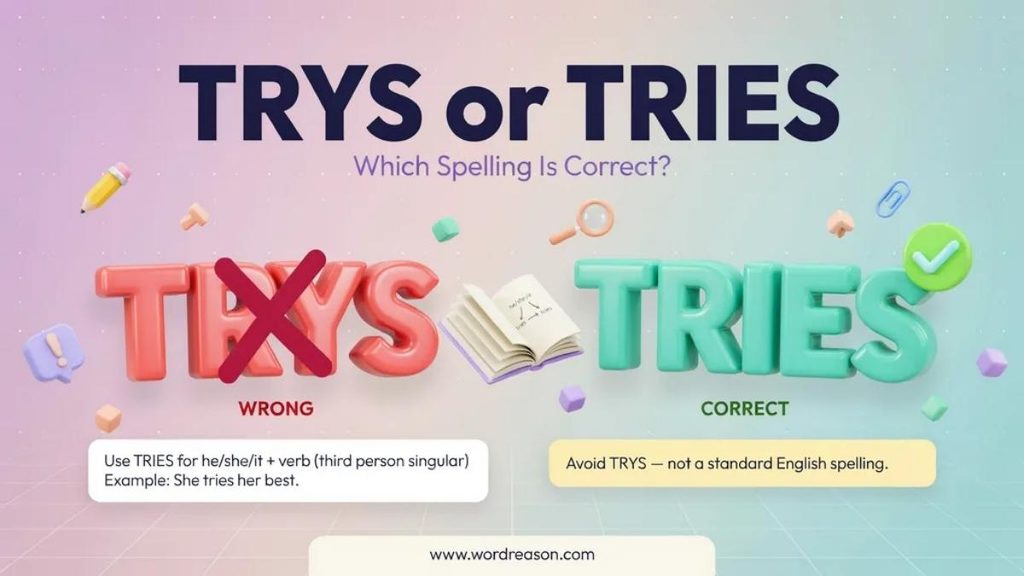
The reason tries has ies instead of ys comes from the spelling rule for words ending in a consonant plus y.
When a word ends in a consonant followed by y, the y commonly changes to i before an ending such as es.
For example
try → tries
cry → cries
reply → replies
carry → carries
study → studies
party → parties
The spelling change helps English words keep a recognizable pronunciation and grammatical form.
However, you should not apply this rule to every word that ends in y. The letter before y matters.
When a word ends in a vowel plus y, the y normally stays in place when you add s.
For example
play → plays
enjoy → enjoys
stay → stays
boy → boys
toy → toys
This gives you a useful comparison
| Pattern | Example | Correct form |
|---|---|---|
| Consonant + y | try | tries |
| Consonant + y | cry | cries |
| Consonant + y | study | studies |
| Vowel + y | play | plays |
| Vowel + y | enjoy | enjoys |
| Vowel + y | boy | boys |
Therefore, the key question is not simply whether a word ends in y. Instead, look at the letter immediately before the y.
In try, the letter before y is r, which is a consonant. As a result, try becomes tries.
Learn the difference between confusing more English words
Studder or Stutter Which Spelling Is Correct?
Is Trys a Word?
If the question is is trys a word? the practical answer is no when you mean the standard plural or third-person form of try.
In ordinary standard English, you should write tries instead.
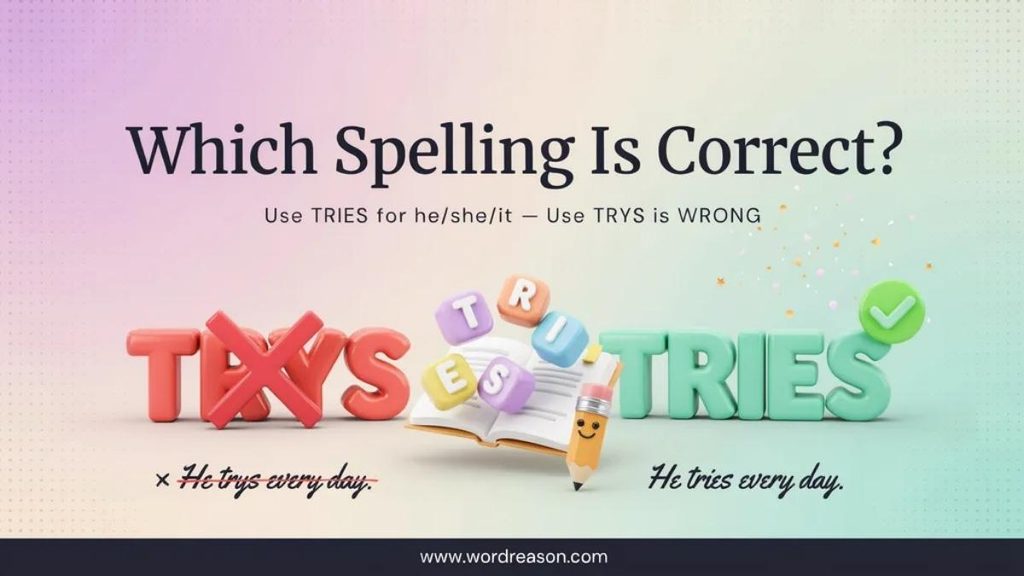
For example, this sentence is incorrect
She trys to finish her work.
The correct sentence is
She tries to finish her work.
Likewise, this sentence is incorrect:
He made three trys.
The correct version is
He made three tries.
So, if you are checking the correct spelling of trys, use tries instead.
The confusion is understandable because adding s works for many English words. Nevertheless, English spelling has several patterns that require a change in the original word. The consonant + y pattern is one of them.
Learn the difference between confusing more English words
Monkeys or Monkies Which Spelling Is Correct?
Is Tries a Word?
Yes, tries is a standard English word.
It has two important grammatical uses. It can function as a verb, and it can function as a plural noun.
As a verb, tries is the third-person singular present-tense form of try.
For example
She tries to understand the instructions.
As a noun, tries is the plural form of try.
For example
It took several tries to solve the problem.
Cambridge Dictionary lists try as both a verb and a noun. As a noun, its plural is tries. It also defines try as an attempt and gives examples using several tries.
Therefore, the answer to is tries a word? is clearly yes.
Learn the difference between confusing more English words
Buoy or Bouy which spelling is correct?
Tries Meaning and Definition
The tries meaning depends on how the word functions in a sentence.
As a verb, tries describes an effort made by a singular third-person subject. As a noun, tries refers to more than one attempt.
The basic meaning of try is connected with making an effort or attempting something. Cambridge Dictionary also gives try the meaning of testing something to see whether it works or is suitable.
Consider the following sentence
She tries to solve the puzzle.
Here, tries means that she makes an effort to solve it.
Now consider
She made three tries before solving the puzzle.
Here, tries means three separate attempts.
The word therefore carries a closely related meaning in both cases. The grammatical role changes, but the idea of effort or attempt remains.
Learn the difference between confusing more English words
Leasee or Lessee which Spelling is correct?
Tries as a Verb
As a verb, tries is the third-person singular form of try in the present simple tense.
This means that you normally use tries with he, she, it, or another singular subject.
For example
He tries to arrive early.
She tries to remain calm.
It tries to connect to the network.
The student tries to answer the question.
The machine tries to restart.
However, you use the base form try with I, you, we, and they.
For example
I try to arrive early.
You try to remain calm.
We try to solve the problem.
They try to help.
This difference is an example of subject-verb agreement.
The pattern becomes much clearer when the forms appear together
| Subject | Correct form | Example |
|---|---|---|
| I | try | I try to help. |
| You | try | You try again. |
| We | try | We try our best. |
| They | try | They try different methods. |
| He | tries | He tries again. |
| She | tries | She tries to help. |
| It | tries | It tries to reconnect. |
Therefore, when you are asking when to use tries, check the subject first.
If the subject is singular and third person, tries may be the correct form.
Learn the difference between confusing more English words
Hoofs or Hooves which spelling is Correct?
Tries as a Noun
The word try can also function as a noun.
As a noun, a try means an attempt or effort. Its plural form is tries.
So the pattern is simple
one try
two tries
three tries
several tries
many tries
multiple tries
Cambridge Dictionary defines the noun try as an attempt to do something and identifies its plural form as tries.
For example
1.It took one try to solve the puzzle.
2.It took two tries to solve the puzzle.
3.It took three tries to solve the puzzle.
Notice that the meaning does not change simply because the number changes. The spelling changes because the noun becomes plural.
Therefore, if you are looking for the plural of try, the answer is tries.
Learn the difference between confusing more English words
Receive or Recieve which Correct is correct?
Plural of Try What Is the Correct Form?
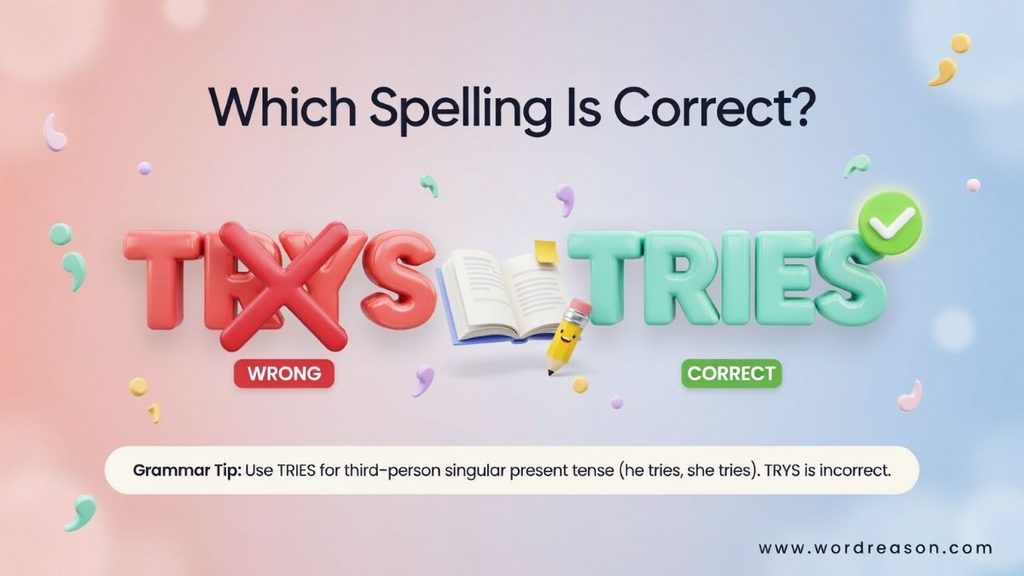
The plural of try is tries.
This follows the same consonant + y spelling rule used by many other English words.
When try becomes plural, the final y changes to i and es is added.
try → tries
This is the plural form of try, whether you are talking about attempts, opportunities, or rugby scoring plays.
For example
One try was enough.
Two tries were enough.
Three tries were enough.
Several tries were needed.
The phrase plural form of try therefore refers to tries, not trys.
If you are wondering what is the plural of the word try, there is no special exception to memorize. The normal consonant + y pattern gives you the answer.
Learn the difference between confusing more English words
Useing or Using Which Spelling Is Correct?
3 Tries or Trys?
If you are deciding between 3 tries or trys, the correct expression is 3 tries.
You can also write three tries when the number is spelled out.
Both forms are correct
3 tries
three tries
However, this form is incorrect
3 trys
The number does not affect the spelling rule. Whether you have two, three, five, or twenty attempts, the plural remains tries.
For example
1.The student had two tries.
2.The student had three tries.
3.The student had five tries.
So, if you are searching for three tries or trys, choose three tries.
The easiest way to remember it is to think of the singular first
one try
Then change it into the plural
three tries
Learn the difference between confusing more English words
Halves or Halfs Which Spelling Is Correct?
Tries in a Sentence
The phrase tries in a sentence usually refers to examples showing how the word functions in context.
Here are several natural examples
She tries to finish her work before dinner.
He tries a different approach when the first method fails.
The computer tries to reconnect automatically.
The child tries to reach the shelf.
The player tries to score before the final whistle.
It took several tries to open the old door.
After three tries, she finally solved the problem.
The examples show why context matters. In the first five sentences, tries works as a verb. In the last two, tries works as a plural noun.
That distinction can help you avoid confusing the two forms.
Learn the difference between confusing more English words
Authorized or Authorised Which Spelling Is Correct?
Trys in a Sentence
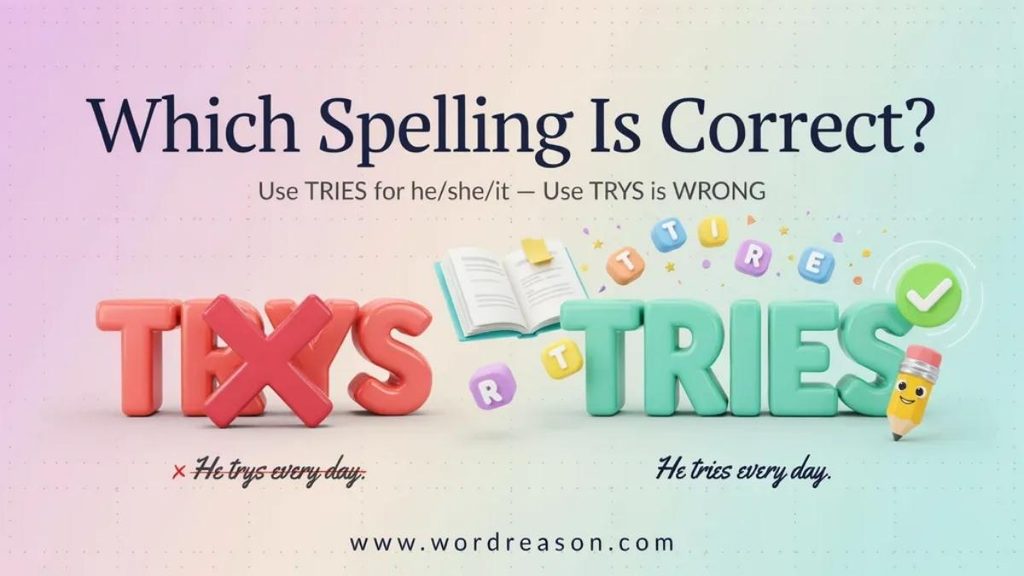
If you search for trys in a sentence, you may find examples online that use the spelling as an error. In standard English, however, the correct form is normally tries.
Incorrect
She trys to call every evening.
Correct
She tries to call every evening.
Incorrect
The team scored three trys.
Correct
The team scored three tries.
Incorrect
He trys another method.
Correct
He tries another method.
The important point is that the sentence does not need a different rule. The same spelling rule applies each time.
Learn the difference between confusing more English words
Realy or Really which spelling is correct?
Examples for Everyday Writing
Everyday writing gives you plenty of opportunities to use tries correctly.
In a school context, you might write:
The student tries to answer every question.
After several tries, she understood the problem.
In a workplace context, you might write
The system tries to reconnect when the connection fails.
He tries a different approach during the meeting.
In casual conversation, you might say
She tries her best every day.
Give it a few tries before you decide.
In technical writing, you might see
The application tries to connect to the server again.
The device tries to restart after the update.
These examples show that tries is not limited to one type of writing. It works naturally across many contexts.
Trys Examples: What Should Be Corrected?
When a sentence contains trys, replacing it with tries will usually solve the spelling problem.
For example
She trys to explain the situation.
becomes
She tries to explain the situation.
Similarly
He made several trys.
becomes
He made several tries.
The correction is small, but it makes the sentence follow standard English spelling rules.
Try, Tries, Tried and Trying
Another common source of confusion is the difference between try, tries, tried, and trying.
These forms all come from the same verb, but each has a different grammatical role.
Try is the base form.
For example
I try to exercise regularly.
Tries is the third-person singular present form.
For example
She tries to exercise regularly.
Tried is the simple past and past participle form.
For example
She tried to exercise yesterday.
Trying is the present participle or gerund form.
For example
She is trying to exercise regularly.
Cambridge Dictionary identifies tried as the past simple and past participle of try.
This gives you a useful set of try verb forms
| Form | Example |
|---|---|
| try | They try again. |
| tries | She tries again. |
| tried | She tried yesterday. |
| trying | She is trying now. |
Therefore, do not use tries simply because the sentence refers to an attempt. The subject and tense determine the correct form.
When to Use Try
Use try as the base form when the grammar requires it.
With I, you, we, and they in the present simple, use try.
I try to help.
You try to understand.
We try to improve.
They try to solve the problem.
You also use try after modal verbs such as can, will, should, and might.
For example
She can try again.
They will try tomorrow.
You should try another method.
He might try later.
In each case, try remains in its base form.
When to Use Tries
Use tries when a singular third-person subject performs the action in the present simple.
For example
He tries to help.
She tries to understand.
It tries to connect.
The student tries again.
The company tries to reduce costs.
You can also use tries as a plural noun when you are talking about multiple attempts.
For example
He needed three tries.
She succeeded after several tries.
The machine worked after two tries.
Therefore, tries can look the same in both roles, but the surrounding sentence tells you whether it is a verb or a noun.
When to Use Tried
Use tried for the simple past and past participle.
For example
She tried yesterday.
He tried a different method.
They tried several solutions.
She has tried everything.
If the action happened in the past, tried is often the form you need.
So, compare these sentences
1.She tries again every day.
2.She tried again yesterday.
3.She is trying again now.
Each sentence uses a different form because each sentence has a different grammatical structure.
When to Use Trying
Use trying when you need the -ing form.
For example
She is trying to help.
They are trying to solve the problem.
He keeps trying.
The word trying can also function as a noun-like form in some grammatical structures.
For example
Trying something new can be useful.
Therefore, try, tries, tried, and trying should not be treated as interchangeable spellings.
Trys or Tries in Rugby
The search phrase trys or tries rugby can cause additional confusion because try has a special meaning in rugby.
In rugby, a try is a scoring play. The plural is tries.
For example
The team scored three tries.
The player scored two tries.
The match included several tries.
Cambridge Dictionary specifically lists the rugby meaning of try as a scoring action in which a player puts the ball on the ground behind the opposing team’s goal line.
The spelling remains tries because the plural still follows the same English spelling pattern:
try → tries
Therefore, even in rugby writing, trys is not the standard plural form.
This is a useful example because the meaning changes while the spelling rule stays the same.
Common Mistakes With Trys and Tries
One common mistake is simply adding s to try.
That produces trys, but the standard spelling requires y to change to i before es.
Another mistake occurs when writers forget that tries can be both a verb and a noun.
For example
She tries to solve it.
Here, tries is a verb.
She made three tries.
Here, tries is a noun.
A third mistake involves tense.
1.She tries every day.
2.She tried yesterday.
3.She is trying now.
These sentences use three different forms of the same verb.
Finally, some writers apply the y to ies rule to every word ending in y. That creates another problem.
Try becomes tries because a consonant comes before y.
Play becomes plays because a vowel comes before y.
Enjoy becomes enjoys because a vowel comes before y.
Therefore, the spelling rule depends on the letter before the final y.
Why Trys Is Incorrect
The reason trys is incorrect in standard English is not random. It fails to follow the normal spelling pattern for try when the word takes the relevant ending.
The word has the structure
consonant + y
When the plural noun or third-person singular verb form is needed, the y changes to i and es is added.
That produces
try → tries
The same process appears in
cry → cries
reply → replies
study → studies
carry → carries
This pattern is one of the useful English spelling rules that makes apparently confusing forms easier to predict.
British English vs American English
The spelling does not change between standard American English and standard British English.
Both use tries.
American English:
She tries to help.
British English:
She tries to help.
The difference is therefore not a regional spelling issue. You should not use trys because you are writing for an American audience, and you should not use it because you are writing for a British audience.
In both varieties, tries is the standard form.
Common Collocations With Tries
The word tries appears naturally in many common expressions.
As a verb, you may see phrases such as tries again, tries to help, tries to explain, tries to understand, tries his best, and tries her best.
For example
She tries again after making a mistake.
He tries to explain the problem.
The student tries to understand the lesson.
She tries her best during every competition.
As a noun, you may see phrases such as several tries, multiple tries, three tries, two tries, after a few tries, and after several tries.
For example
It worked after several tries.
He solved the puzzle in three tries.
The machine started after two tries.
These natural combinations can help you recognize the correct form when you are writing quickly.
A Simple Way to Remember the Correct Tries Spelling
The easiest memory trick is short
Consonant + y → change y to i and add es.
Apply it to try
try → tries
Then compare it with play
play → plays
Why the difference?
Because r is a consonant, while a is a vowel.
The same comparison works with other words
cry → cries
study → studies
reply → replies
play → plays
enjoy → enjoys
stay → stays
Therefore, instead of memorizing trys and tries as two unrelated spellings, remember the rule behind tries.
Once the rule makes sense, the correct spelling becomes much easier to produce naturally.
Trys or Tries Quick Comparison
| Question | Correct answer |
|---|---|
| Is trys a word? | Not as the standard form of try |
| Is tries a word? | Yes |
| What is the plural of try? | tries |
| What is the plural form of try? | tries |
| What is the third-person singular of try? | tries |
| Is 3 tries correct? | Yes |
| Is 3 trys correct? | No |
| Is three tries correct? | Yes |
| Is three trys correct? | No |
| Is tries used in rugby? | Yes |
| Is trys standard English? | No |
Practice Session
Complete each sentence with the correct form of try, tries, tried, or trying.
Fill in the Blanks
- She ______ to improve her English every day.
- He made three ______ before solving the puzzle.
- I will ______ again tomorrow.
- The player scored two ______ in the match.
- Maria ______ her best to help her friend.
- They ______ to arrive early every morning.
- We ______ several times before we succeeded.
- He is ______ to open the door.
- The child ______ to reach the shelf.
- I made one more ______ to fix the computer.
- She ______ to call her brother yesterday.
- You should ______ one more time.
- The team had several ______ to score.
- He ______ to understand the instructions.
- They are ______ to solve the problem.
- She made five ______ before getting the answer right.
- I always ______ to stay organized.
- The machine ______ to restart automatically.
- We ______ our best during the competition.
- He is ______ to learn the new skill.
- The rugby team scored three ______.
- She ______ to complete the task before lunch.
- After several ______, he finally succeeded.
- They ______ to find a better solution.
- He ______ again after making a mistake.
Answer Session
- tries
- tries
- try
- tries
- tries
- try
- tried
- trying
- tries
- try
- tried
- try
- tries
- tries
- trying
- tries
- try
- tries
- tried
- trying
- tries
- tries
- tries
- try
- tried
Here’s a trusted source for clear more words Comparison:
FAQs
What is the plural of try?
The plural of try is tries.
Which is correct, trys or tries?
Tries is correct. Trys is incorrect in standard English.
Why does try become tries?
Because try ends in a consonant + y. The y changes to i before adding -es.
Is trys a word?
Trys is not the standard spelling. Use tries instead.
What does tries mean?
Tries means attempts or makes an effort, depending on the context.
How do you use tries in a sentence?
Example: “She tries to finish her work on time.”
Is tries a noun or a verb?
Tries can be both a plural noun and a verb.
Is it he try or he tries?
“He tries” is correct.
Is 3 tries correct?
Yes. “3 tries” is the correct form.
What is another word for tries?
Depending on context, tries can mean attempts or efforts.
AEO Questions
How do you spell tries correctly?
The correct spelling is tries.
Why is trys incorrect?
Try changes to tries because it ends in consonant + y.
What is the plural form of try?
The plural form is tries.
What is the third-person singular of try?
The third-person singular form is tries.
What is the difference between try and tries?
Try is used with I, you, we, and they. Tries is used with he, she, and it.
Can tries be a noun?
Yes. As a noun, tries means attempts.
Can tries be a verb?
Yes. It is the third-person singular form of try.
Is tries the same as attempts?
As a noun, tries can mean attempts.
What is the past tense of try?
The past tense is tried.
What is the present participle of try?
The present participle is trying.
Is three trys correct?
No. The correct form is “three tries.”
Is tries correct in rugby?
Yes. The plural of the rugby term try is tries.
conclusion
The Trys or Tries”confusion may seem like a tiny spelling problem, but one letter can make a big difference. Tries is the correct form, while trys is a common mistake. When try becomes plural, the final y changes to i and takes -es. The same rule creates the third-person singular form: “she tries,” “he tries,” and “it tries.” The pattern also stays the same in rugby, where more than one score is called tries. Therefore, remember the simple rule: one try, several tries. Once this pattern sticks, you can leave trys behind and write tries with confidence. English may have tricky rules, but this one is easy to tackle.

Bella AJS
Bella AJS is an experienced blogger and passionate language enthusiast at WordReason. She specializes in English grammar, word meanings, spelling, and commonly confused words. With a clear and practical writing style, Bella helps readers understand tricky language rules without the textbook headache. Her goal is simple: make English easier, clearer, and more enjoyable one word at a time.