
English spelling has a funny way of making simple words surprisingly confusing. The debate over Wierd or Weird proves the point. Both spellings look almost right, but only one belongs in standard modern English. If you have ever typed wierd, paused, and wondered whether something looked off, you are not alone. The correct spelling is weird, even though it does not follow the spelling pattern many people expect. However, once you understand its spelling, meaning, pronunciation, and usage, the confusion becomes much easier to avoid. This guide explains why weird is correct, why wierd appears so often, and how to remember the difference with confidence.
Wierd or Weird Quick Answer
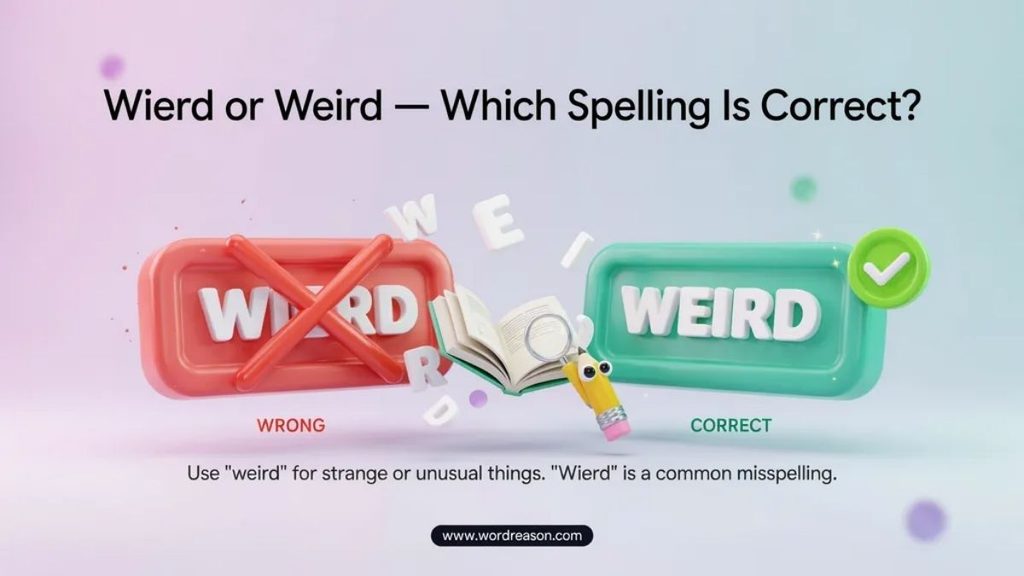
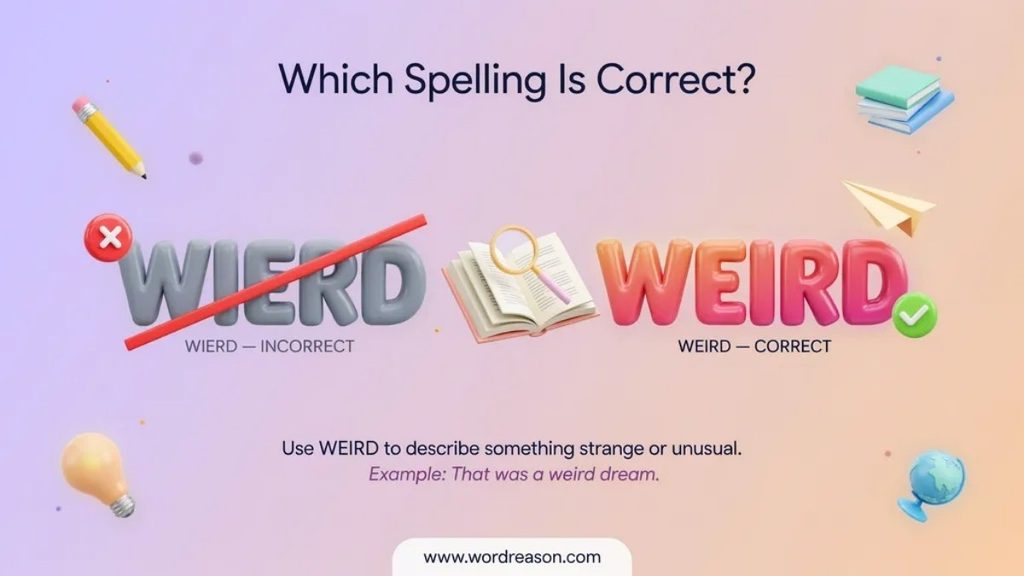
The correct spelling is weird.
Wierd is a common spelling mistake that occurs when the letters i and e appear in the wrong order. If you mean something strange, unusual, unexpected, or different from what you normally expect, use weird.
For example, the correct sentence is
That was a weird dream.
The incorrect sentence is
That was a wierd dream.
The correct spelling is W E I R D.
The incorrect form is W I E R D.
The only difference is the order of the middle vowels. However, that small difference determines whether the spelling is standard English.
Learn the difference between confusing more English words
Hoofs or Hooves which spelling is Correct?
Which Is Correct?
Weird is the correct spelling.
It is a standard English adjective that describes something strange, unusual, unexpected, or outside what seems normal. Major English dictionaries recognize weird as an established English word.
Wierd, on the other hand, is generally a misspelling of weird in modern English.
Weird Is the Correct Spelling
You can use weird in both casual and formal writing when the meaning fits the situation.
For example
That was a weird question.
He had a weird dream.
Something weird happened yesterday.
The movie had a weird ending.
She noticed a weird pattern in the data.
The word can describe people, objects, places, sounds, ideas, feelings, behavior, and situations.
Wierd Is a Common Spelling Mistake
Wierd usually appears because writers reverse the middle vowels.
Instead of W E I R D, they write W I E R D.
This mistake does not usually indicate that the writer does not know the word. In many cases, the writer simply remembers the vowel order incorrectly.
The mistake becomes especially understandable because many familiar English words contain IE, such as believe, friend, field, and piece.
However, weird uses EI.
Learn the difference between confusing more English words
Receive or Recieve which Correct is correct?
Why Do People Spell Weird as Wierd?
The question of why people spell weird as wierd has a straightforward answer. The spelling looks as though it could follow a familiar English pattern.
Many people learn the I before E rule during childhood. As a result, they may naturally write wierd instead of weird.
English spelling, however, contains many exceptions. The I before E rule works as a useful pattern, but it does not work as an absolute rule.
The I Before E Rule
A common version of the spelling rule says I before E except after C.
This helps with words such as believe, piece, field, and chief.
However, English has plenty of exceptions and additional patterns.
| IE Words | EI Words |
|---|---|
| believe | receive |
| piece | ceiling |
| field | receipt |
| friend | weird |
| chief | eight |
This comparison shows why spelling rules should be treated as helpful patterns rather than perfect formulas.
Weird is one of the words you simply need to remember.
Why Is Weird an Exception to I Before E?
The modern spelling of weird developed through the long history of the English language. It did not emerge because of the modern classroom spelling rule.
The word has roots connected with Old English wyrd, which referred to fate, destiny, or fortune. Over time, the word developed new forms and meanings.
Eventually, weird became associated with supernatural ideas and then with things that seemed strange or uncanny. Its modern meaning developed later.
Therefore, its spelling reflects its historical development rather than the simplified I before E rule.
Learn the difference between confusing more English words
Useing or Using Which Spelling Is Correct?
Weird Meaning and Definition
The basic weird meaning is strange or unusual.
The word can also describe something unexpected, unnatural, unfamiliar, or difficult to explain.
For example
That is a weird color.
I had a weird feeling about the place.
That is a weird coincidence.
The machine produced a weird result.
The meaning changes slightly according to context.
1.In the sentence That is a weird color, weird means unusual.
2.In I have a weird feeling, it may suggest something difficult to explain or slightly unsettling.
3.In That is weird, it often expresses surprise.
Weird Adjective Meaning
Weird functions mainly as an adjective.
It can describe a person, place, sound, dream, idea, feeling, experience, behavior, object, or situation.
For example
The detective noticed a weird pattern in the evidence.
Here, weird describes the pattern.
Another example is
She heard a weird sound from the attic.
Here, weird describes the sound.
What Does Weird Mean?
Weird means noticeably strange, unusual, unexpected, or different from what you normally consider ordinary.
The word does not always have a negative meaning.
For example
He has a weird sense of humor.
This could sound critical, but it could also be playful.
Similarly
The artist creates weird and interesting sculptures.
Here, weird can suggest creativity and originality rather than something bad.
Context determines the tone.
Weird Meaning in Chat and Text
The phrase weird meaning in chat usually refers to the casual way people use the word in text messages and online conversations.
For example
I saw Tom at the airport this morning.
That is weird. He told me he was home.
In this situation, weird means unexpected or inconsistent with what the speaker believed.
Another example is
She sent me the same message three times.
That is weird.
Here, the word expresses surprise or concern.
People also use phrases such as That is weird, So weird, This is weird, That feels weird, and Weird but funny.
The tone can be playful, confused, surprised, or critical.
Weird Meaning in Conversation
In everyday conversation, weird often works as a quick reaction to something unexpected.
For example
The lights turned on by themselves.
That is weird.
The speaker does not necessarily mean that something supernatural happened. The word simply communicates that the event seems unusual.
This flexible use explains why weird appears so often in casual English.
Learn the difference between confusing more English words
Halves or Halfs Which Spelling Is Correct?
Weird Person Meaning
The phrase weird person meaning usually refers to someone whose behavior, personality, appearance, interests, or manner seems unusual to the speaker.
However, describing someone as weird can sound judgmental.
For example
He is a weird person.
This sentence can suggest that the speaker does not approve of the persons behavior.
A more neutral alternative might be
He is an unconventional person.
The second sentence focuses on difference without necessarily criticizing the person.
Therefore, consider your tone before calling someone weird.
Learn the difference between confusing more English words
Authorized or Authorised Which Spelling Is Correct?
Weird Pronunciation and Spelling
Pronunciation can contribute to the spelling confusion because English spelling does not always provide an obvious clue about which letters to use.
In American English, weird is commonly pronounced with a sound similar to weerd. British pronunciation can differ slightly.
Despite pronunciation differences, the spelling remains weird in both major varieties of English.
This gives English learners an important lesson. Pronunciation does not always tell you exactly how a word should be spelled.
The Origin of the Word Weird
The history of weird goes back hundreds of years.
The word ultimately connects with Old English wyrd, which referred to fate, destiny, fortune, or what was destined to happen.
The historical path is more complicated than a simple one word to one word change. Over time, weird became associated with supernatural ideas and the expression Weird Sisters.
Shakespeare made the Weird Sisters famous in English literature through Macbeth. These figures are associated with supernatural forces and predictions about fate.
Later, the adjective weird developed the meaning of something supernatural, uncanny, strange, or unusual.
Eventually, the modern everyday meaning became much broader.
A simplified development looks like this
Old English wyrd to fate and destiny to supernatural associations to uncanny to strange or unusual
This history also helps explain why modern spelling does not always follow a simple spelling rule.
Learn the difference between confusing more English words
Realy or Really which spelling is correct?
British English vs American English Spelling
There is no British versus American spelling difference for weird.
Both varieties use weird.
| English variety | Correct spelling |
|---|---|
| American English | weird |
| British English | weird |
| Canadian English | weird |
| Australian English | weird |
The pronunciation may vary between regions, but the spelling remains the same.
Therefore, wierd is not a British alternative to weird.
It is simply a common spelling error in modern standard English.
Learn the difference between confusing more English words
Trys or Tries Which Spelling Is Correct?
Weird vs Wierd Comparison
The easiest way to settle the weird vs wierd question is to look at the middle letters.
| Feature | Weird | Wierd |
|---|---|---|
| Standard modern spelling | Yes | No |
| Means strange | Yes | No |
| Middle vowels | EI | IE |
| Common in English | Yes | No |
| Suitable for formal writing | Yes | No |
| Common spelling error | No | Yes |
The most important detail is WEI, not WIE.
Once you remember that sequence, the spelling becomes much easier.
Learn the difference between confusing more English words
Skis or Skiis Which Spelling Is Correct?
Common Mistakes With Wierd or Weird
Several habits can lead to the wrong spelling.
Reversing the Middle Vowels
This is the most common error.
Wierd becomes weird.
The writer knows the word but places i before e instead of e before i.
Following the I Before E Rule Automatically
The I before E rule may encourage you to write wierd.
However, English spelling contains many exceptions.
Weird is one of the words that does not follow the expected IE pattern.
Spelling the Word From Its Sound
English pronunciation does not always provide enough information to determine spelling.
If you hear weird in conversation, the sound alone does not tell you whether the written word should contain IE or EI.
Reading the word helps build visual memory.
Typing Too Quickly
Fast typing can create spelling errors even when you know the correct form.
This happens often in text messages, social media posts, comments, quick emails, and informal notes.
A quick review can catch the mistake before you publish or send the text.
Learn the difference between confusing more English words
Receipt or Reciept Which Spelling Is Correct?
Weird in English Grammar
Weird is mainly used as an adjective.
It can appear before a noun or after a linking verb.
Weird Before a Noun
A common structure is weird followed by a noun.
Examples include weird behavior, weird expression, weird idea, weird sound, weird situation, weird dream, weird person, and weird experience.
For example:
The detective noticed a weird pattern.
Here, weird modifies pattern.
Weird After a Linking Verb
Weird can also follow verbs such as feel, seem, look, and sound.
Examples include
That feels weird.
The situation seems weird.
The room looks weird.
His explanation sounds weird.
This tastes weird.
These structures appear frequently in everyday English.
Learn the difference between confusing more English words
Steer or Stear which spelling is Correct ?
Weird in a Sentence
The best way to understand a word is often to see it in context.
| Context | Example |
|---|---|
| Dream | I had a weird dream last night. |
| Sound | We heard a weird noise outside. |
| Behavior | His weird behavior made everyone uncomfortable. |
| Food | This soup tastes weird. |
| Conversation | That was a weird conversation. |
| Feeling | I have a weird feeling about this. |
| Coincidence | That is a weird coincidence. |
| Movie | The movie had a weird ending. |
| Social media | That is a weird thing to post. |
| Workplace | The software produced a weird result. |
These examples show that weird can describe many different experiences.
It can suggest humor, surprise, discomfort, confusion, mystery, or simple difference from the norm.
Weird vs Strange
Weird and strange are close synonyms, but they can carry slightly different tones.
Strange often describes something unfamiliar, unusual, or difficult to understand.
Weird can sound more personal or expressive.
Compare
I entered a strange building.
This could simply mean the building was unfamiliar.
I entered a weird building.
This suggests that something about the building felt unusual or unsettling.
The same difference can appear when describing a persons behavior.
She has a strange hobby.
This sounds fairly neutral.
She has a weird hobby.
This sounds more casual and can sound judgmental.
Weird vs Unusual
Unusual is generally more neutral than weird.
For example
He has an unusual approach to teaching.
This sounds professional and descriptive.
He has a weird approach to teaching.
This sounds more conversational and may suggest that the approach seems odd to the speaker.
Use unusual when you want to point out a difference without adding much personal judgment.
Use weird when you want to express a stronger reaction.
Weird vs Odd
Odd is another close synonym.
Compare
That is an odd decision.
That is a weird decision.
Odd can sound more restrained. Weird often sounds more conversational and expressive.
Both words can describe something that does not seem normal.
The best choice depends on the tone you want.
Weird vs Bizarre
Bizarre generally suggests a stronger degree of strangeness.
For example
She wore a weird hat.
The hat looked unusual.
Now compare:
She wore a bizarre hat covered in flashing lights and plastic insects.
Bizarre creates a much stronger impression.
Therefore, weird and bizarre can work as synonyms in some contexts, but they do not always have the same intensity.
Weird Synonyms and Their Meanings
Weird has many synonyms. However, each one can create a slightly different impression.
| Synonym | General meaning | Example |
|---|---|---|
| Strange | Unfamiliar or unusual | That was a strange experience. |
| Unusual | Not common or typical | She has an unusual hobby. |
| Odd | Noticeably different | That is an odd choice. |
| Peculiar | Distinctively strange | He has a peculiar habit. |
| Bizarre | Extremely strange | It was a bizarre situation. |
| Unconventional | Outside normal methods | She has an unconventional approach. |
| Unfamiliar | Not previously known | The place felt unfamiliar. |
| Uncanny | Mysteriously strange | The resemblance was uncanny |
Is Weird a Word?
Yes. Weird is a standard English word.
It is primarily an adjective meaning strange, unusual, unexpected, or different from what seems ordinary.
The word also has related forms, including weirdly, weirdness, weirder, and weirdest.
These forms show how naturally the word functions within English grammar.
Is Wierd a Word?
If you are asking whether wierd is the standard modern spelling of the adjective meaning strange, the answer is no.
The correct spelling is weird.
You may see wierd in online comments, messages, social media posts, or other informal writing. People often make spelling mistakes when typing quickly.
However, seeing a spelling online does not automatically make it a standard English form.
For standard writing, use weird.
Is Wierd a Real Word or a Misspelling?
For ordinary modern English, wierd should be treated as a misspelling when the intended meaning is strange or unusual.
This distinction matters because English has historical spellings and older forms that do not always match current standard forms.
Historical variation does not make wierd an acceptable modern alternative to weird.
For modern writing, the choice is simple.
Use weird.
Avoid wierd.
Why Is Weird Spelled Weird?
The modern spelling comes from the words historical development.
The word connects with Old English wyrd, which meant fate or destiny. Later forms became associated with supernatural ideas and the Weird Sisters. Over time, the adjective developed its modern sense of something strange or unusual.
English spelling often preserves forms that developed through centuries of linguistic change.
Therefore, modern spelling does not always fit a simple rule learned in school.
Weird is one of those examples.
How to Spell Weird Correctly
If you are wondering how to spell weird correctly, remember
W E I R d
Break it into two parts
WEI plus RD
The most important part is WEI.
Do not write WIE.
Write WEI.
Easy Way to Remember the Spelling of Weird
A useful memory phrase is
E before I makes it weird.
This works because it connects the spelling directly to the word itself.
Another method is to compare it with familiar words such as receive, ceiling, and weird.
Seeing these words together can strengthen the pattern.
Weird Spelling Memory Tip
Whenever you hesitate, look at the middle.
If you have written WIE, switch the two vowels.
WIE becomes WEI.
That small correction solves the most common spelling error.
Weird Spelling and Pronunciation
Weird also demonstrates why English spelling and pronunciation do not always match perfectly.
The written form is WEIRD.
The pronunciation can vary between American and British English, but the spelling stays the same.
For English learners, this is an important reminder. Learning a word through listening helps with pronunciation, while seeing the written form helps build accurate spelling.
The more often you read weird correctly, the more familiar the EI sequence becomes.
A Practical Example of the Spelling Mistake
Imagine someone writes
The character had a wierd reaction when he heard the news.
The meaning is clear, but the spelling is incorrect.
The corrected sentence is
The character had a weird reaction when he heard the news.
Only one letter position changes, yet the second sentence follows standard English spelling.
The same issue can appear in professional writing
We noticed a wierd error in the report.
The standard version is
We noticed a weird error in the report.
This small example shows why proofreading matters. A single spelling mistake can make otherwise good writing look careless.
Commonly Misspelled English Words
Weird is one of many English words that cause spelling confusion.
| Common misspelling | Correct spelling |
|---|---|
| wierd | weird |
| recieve | receive |
| seperate | separate |
| definately | definitely |
| accomodate | accommodate |
| occured | occurred |
| embarass | embarrass |
These mistakes happen for different reasons. Sometimes pronunciation causes confusion. Sometimes people remember a familiar spelling pattern. At other times, typing quickly creates the error.
The larger lesson is simple. English spelling contains patterns, but those patterns are not always absolute.
When to Use Weird Instead of Another Word
Weird works well when you want to describe something that seems strange or unexpected.
However, another word may communicate your exact meaning better.
Use weird for a casual reaction
That was a weird conversation.
Use unusual for a neutral description
That was an unusual conversation.
Use strange when something seems unfamiliar
That was a strange conversation.
Use bizarre when something seems extremely strange
That was a bizarre conversation.
Use unconventional when something differs from normal methods
She uses an unconventional teaching method.
The best word depends on your intended meaning and tone.
Is Wierd Ever Correct?
For the modern adjective meaning strange or unusual, wierd is not the standard spelling.
Therefore, do not use it in school assignments, essays, articles, reports, business writing, professional emails, applications, or formal documents.
Use weird instead.
English has historical spelling variations, so it is safer to avoid absolute claims that the letter sequence has never appeared in older texts. What matters for modern standard English is that weird is the established spelling of the adjective.
Quick Tips to Avoid the Wierd Spelling Mistake
Write weird, not wierd.
Remember W E I R D.
Focus on the EI sequence.
Do not apply the I before E rule automatically.
Treat spelling rules as patterns rather than perfect laws.
Learn the visual form of the word.
Proofread when writing quickly.
Use a spelling checker when necessary.
Remember the phrase E before I makes it weird.
Read the word regularly to strengthen your spelling memory.
Practice Session
Complete each sentence by choosing the correct word or form. Focus on the spelling, meaning, and usage of weird.
Fill in the Blanks
- The correct spelling is ______.
- Wierd is a common spelling ______.
- I had a very ______ dream last night.
- That is a ______ noise coming from outside.
- The word weird means strange or ______.
- She had a ______ feeling about the situation.
- Do not write ______ when you mean strange.
- The correct middle letters in weird are ______.
- Weird is mainly used as an ______.
- That movie had a ______ ending.
- The Old English word related to weird was ______.
- The I before E rule has several ______.
- He told me a ______ story about his trip.
- The situation became even ______ after midnight.
- She noticed a ______ pattern in the data.
- The British and American spelling of the word is ______.
- A more neutral synonym for weird is ______.
- Bizarre can describe something extremely ______.
- The phrase That is weird can express ______ or surprise.
- Remember the spelling W E I ______.
- The incorrect spelling W I E R D should be changed to ______.
- He has an ______ sense of humor.
- This food tastes ______.
- The word weirdo comes from the word ______.
- To avoid the spelling mistake, remember ______ before I in weird.
Answers
- weird
- mistake
- weird
- weird
- unusual
- weird
- wierd
- EI
- adjective
- weird
- wyrd
- exceptions
- weird
- weirder
- weird
- weird
- unusual
- strange
- confusion
- R
- WEIRD
- weird
- weird
- weird
- E
Here’s a trusted source for clear more words Comparison:
Frequently Asked Questions About Wierd or Weird
What does wierd mean?
Wierd is a misspelling of weird, which means strange or unusual.
Why is e before i in weird?
Weird is spelled with EI because that is its standard modern spelling.
How do you spell weird in the UK?
The correct British spelling is weird. It is the same in American English.
Is it wierdo or weirdo?
Weirdo is correct. It is an informal word for a strange or unusual person.
What is correct, wierd or WEIRD?
Weird is correct. Wierd is a common spelling mistake.
What is a worse word for weird?
Bizarre, disturbing, or creepy can sound stronger than weird, depending on the context.
How to say weird in a respectful way?
Use words such as unusual, unconventional, distinctive, or different for a more neutral tone.
Is it spelled bizzare or bizarre?
Bizarre is correct. Bizzare is a misspelling.
How do you say weird in Old English?
The related Old English word was wyrd, meaning fate or destiny.
AEO: Wierd or Weird
What is the correct spelling of weird?
Weird is the correct spelling. Wierd is incorrect.
Why is weird spelled with EI?
Weird uses EI because that is the established spelling in modern English.
Is wierd an English word?
Wierd is not the standard modern spelling of the word meaning strange. Weird is correct.
What does weird mean?
Weird means strange, unusual, unexpected, or different from normal.
What is the difference between weird and strange?
Both mean unusual. Weird often sounds more casual, while strange can sound more neutral.
What is the difference between weird and unusual?
Weird often expresses a personal reaction. Unusual simply means different from what is normal.
Why do people write wierd instead of weird?
People often reverse the middle vowels or apply the I before E rule incorrectly.
What is an easy way to remember weird?
Remember WEI. A useful memory phrase is E before I makes it weird.
Can weird describe a person?
Yes. Weird can describe a person who seems unusual, although it may sound judgmental.
Is weird a formal English word?
Yes. Weird is a standard English adjective, although more precise words may suit formal writing.
conclusion
The Wierd or Weird confusion may look like a tiny spelling problem, but one misplaced vowel can make your writing look less polished. The correct spelling is weird, while wierd is a common misspelling. Although the I before E rule may tempt you to write the vowels in the wrong order, weird is one of those words that refuses to play by the expected pattern. However, remembering the EI in weird can save you from this familiar spelling trap. Whether you are describing a strange situation, unusual behavior, or a bizarre experience, choose weird. Keep the spelling WEI in mind, and let wierd stay where it belongs: in the list of mistakes to avoid.

Bella AJS
Bella AJS is an experienced blogger and passionate language enthusiast at WordReason. She specializes in English grammar, word meanings, spelling, and commonly confused words. With a clear and practical writing style, Bella helps readers understand tricky language rules without the textbook headache. Her goal is simple: make English easier, clearer, and more enjoyable one word at a time.