
The debate over likeable or likable can leave even confident writers scratching their heads. One spelling keeps the letter E, while the other drops it without changing the meaning. So, which version should you choose? Here is the good news both spellings are correct. However, their popularity differs between American and British English. In this guide, you will discover their meanings, spelling differences, practical examples, and common mistakes, helping you choose the right spelling for your audience without letting one little letter spoil your writing.
Likeable vs Likable Quick Comparison
| Feature | Likeable | Likable |
|---|---|---|
| Correct spelling | Yes | Yes |
| Meaning | Pleasant or easy to like | Pleasant or easy to like |
| American English | Accepted, but less commonly preferred | Generally preferred |
| British English | Especially common | Also accepted |
| Part of speech | Adjective | Adjective |
| Pronunciation | Same | Same |
| Example | She has a likeable personality. | She has a likable personality. |
| Related noun | Likeability | Likability |
Learn the difference between confusing more English words
Authorized or Authorised Which Spelling Is Correct?
Quick Answer
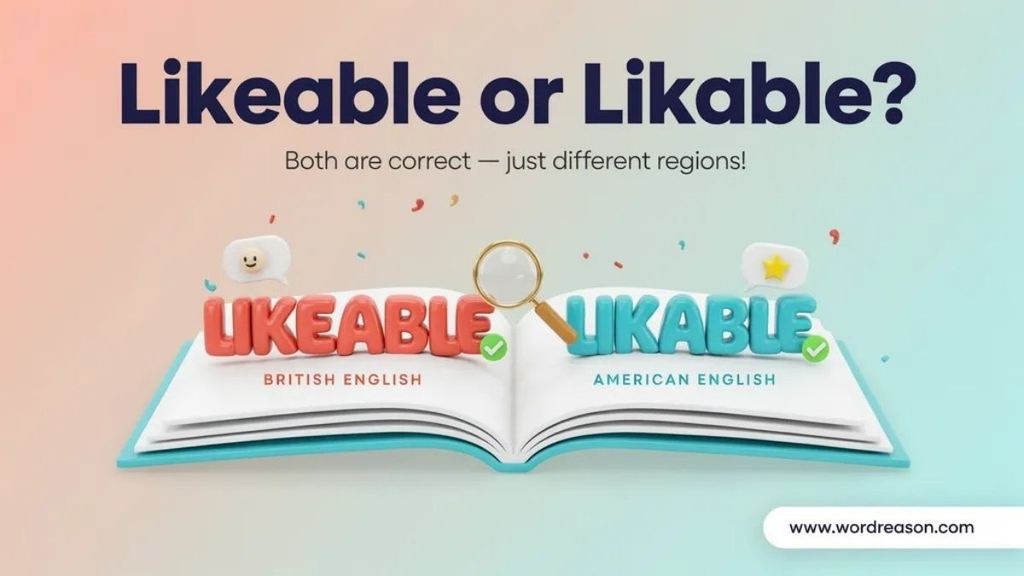
Both likeable and likable are correct spellings. Neither word is a misspelling, and neither changes the meaning of the sentence.
The main difference involves regional spelling preferences. Likable is generally preferred in American English, while likeable is especially common in British English. Both forms mean pleasant, agreeable or easy to like. They function as adjectives and share the same pronunciation.
For example, an American writer might say, The new manager is friendly and likable. A British writer might use, The new manager is friendly and likeable.
Both sentences are grammatically correct. The spelling changes, but the meaning remains the same.
The easiest rule to remember is to use likable for American English and likeable for British English unless your dictionary, publisher, or style guide recommends another form.
Learn the difference between confusing more English words
Realy or Really which spelling is correct?
What Does Likeable or Likable Mean?
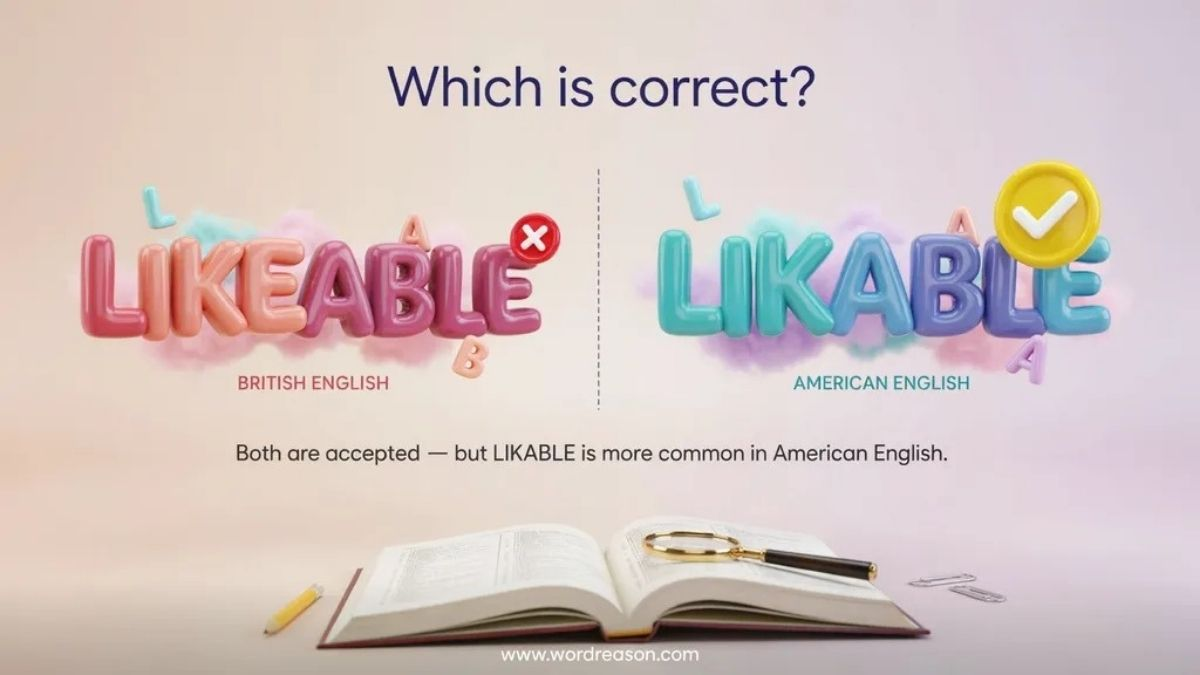
Likeable and likable describe a person or thing that creates a positive impression. The words often refer to personality, behavior, or qualities that make someone pleasant to be around.
A likeable person might be kind, honest, funny, approachable, or considerate. However, a person doesn’t need to possess every positive quality to be likeable. Sometimes, a little patience or a warm smile is enough to make others feel comfortable.
Likeable Definition and Likable Definition
Both words mean easy to like or pleasant to be around. They describe the qualities that make a person or thing appealing to others.
Consider these examples
Maya is a likable colleague who treats everyone with respect.
The author created a likeable character with realistic flaws.
Our new neighbor has a friendly and likable personality.
The restaurant has a welcoming atmosphere that makes it easy to like.
Each example uses the adjective to express a positive impression. You can switch the spelling in these sentences without changing the intended meaning.
Learn the difference between confusing more English words
Trys or Tries Which Spelling Is Correct?
What Does a Likeable Person Mean?
A likeable person is someone others enjoy spending time with. Their appeal may come from their personality, behavior, or ability to make people feel valued.
Kindness helps people feel respected. Friendliness makes others feel welcome. Honesty builds trust, while humor can make conversations more enjoyable. Similarly, a person who listens carefully and respects different opinions often makes a positive impression.
However, being likeable doesn’t mean pleasing everyone. People have different preferences, personalities, and values. Someone who is easy to like in one setting might not appeal to every person.
For example, a quiet colleague may be highly likeable because they listen carefully. An outgoing colleague might win people over through humor and enthusiasm. Both personalities can make a positive impression in different ways.
Likeable or Likable as an Adjective
Likeable and likable are adjectives. An adjective describes a person, place, thing or idea.
You can place either word before a noun or after a linking verb such as is, seems, or becomes.
| Grammar pattern | Example |
|---|---|
| Before a noun | She is a likable teacher. |
| After a linking verb | The teacher seems likeable. |
| With an intensifier | He is very likable. |
| In a comparison | She is more likeable than the other character. |
| In the superlative | He is the most likable person on the team. |
Learn the difference between confusing more English words
Skis or Skiis Which Spelling Is Correct?
Why Are Both Likeable and Likable Correct?
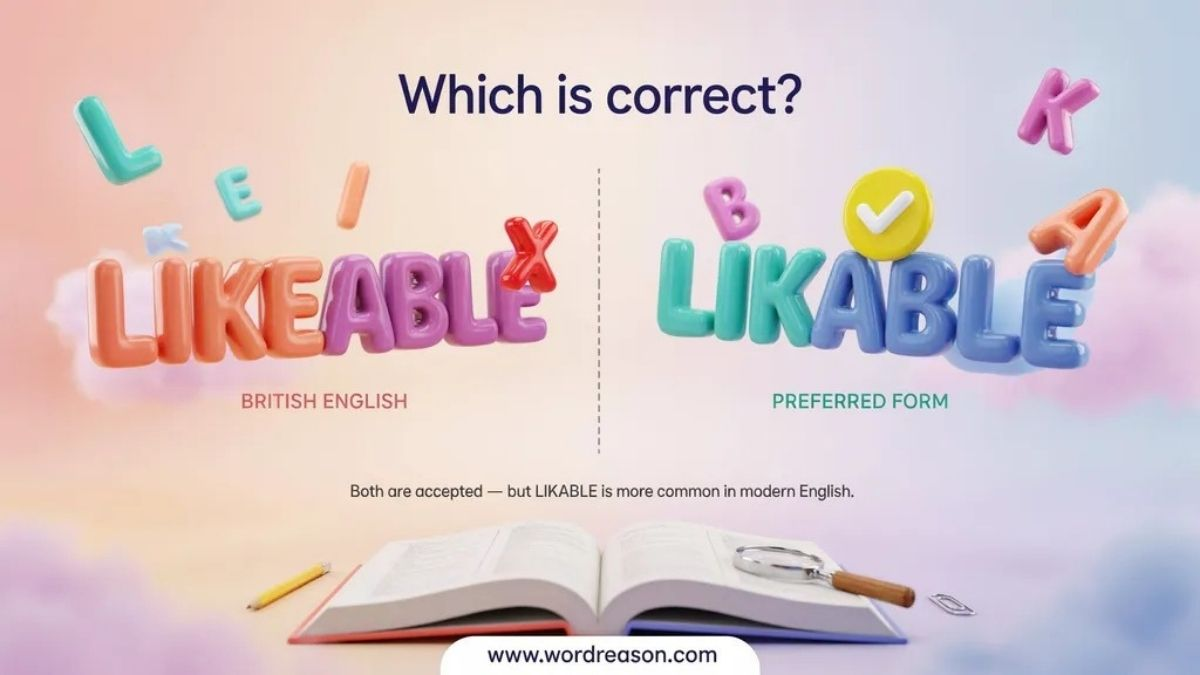
English contains many words with alternative spellings. Some differences reflect regional preferences, while others come from established spelling patterns that dictionaries recognize.
Likeable and likable belong to the first group. Both are standard English forms, although one may be more common in a particular region.
Major English dictionaries recognize both spellings. American dictionaries generally favor likable, while British dictionaries commonly list likeable as the preferred form.
The Role of the Suffix able
The suffix -able often means capable of being or suitable for something. Writers use it to form adjectives from verbs and other word roots.
For example, read becomes readable, wash becomes washable, and enjoy becomes enjoyable. The same pattern helps explain likeable and likable.
The suffix helps express the idea that something has a particular quality or can produce a certain result. In this case, both forms communicate the idea of inspiring liking.
English accepts both spellings, so you don’t need to force one spelling rule onto every situation.
Why Does Likeable Keep the Letter E?
The spelling likeable preserves the final e from the root word like. This form remains especially common in British English.
Some writers find it easier to recognize the original word when the spelling retains the e. However, keeping the final e isn’t a universal rule for words formed with able.
English spelling depends on established usage as well as general patterns. That’s why different words may handle a final e differently.
Why Does Likable Drop the Letter E?
The spelling likable removes the final e before adding able. This shorter form has become the usual preference in American English.
Compare the two forms likeable keeps the final e, while likable drops it.
Both words retain the same meaning and pronunciation. The shorter spelling isn’t a shortcut or an error. It’s an established form used in standard American English.
Is Likeable a Misspelling of Likable?
No. Likeable isn’t a misspelling of likable, and likable isn’t a misspelling of likeable.
Both appear in recognized English dictionaries. The difference reflects spelling preferences rather than a difference in grammar or meaning.
For example, an American editor may change likeable to likable to match a publication’s house style. That change improves consistency, but it doesn’t mean the original spelling was inherently incorrect.
Learn the difference between confusing more English words
Receipt or Reciept Which Spelling Is Correct?
in American and British English
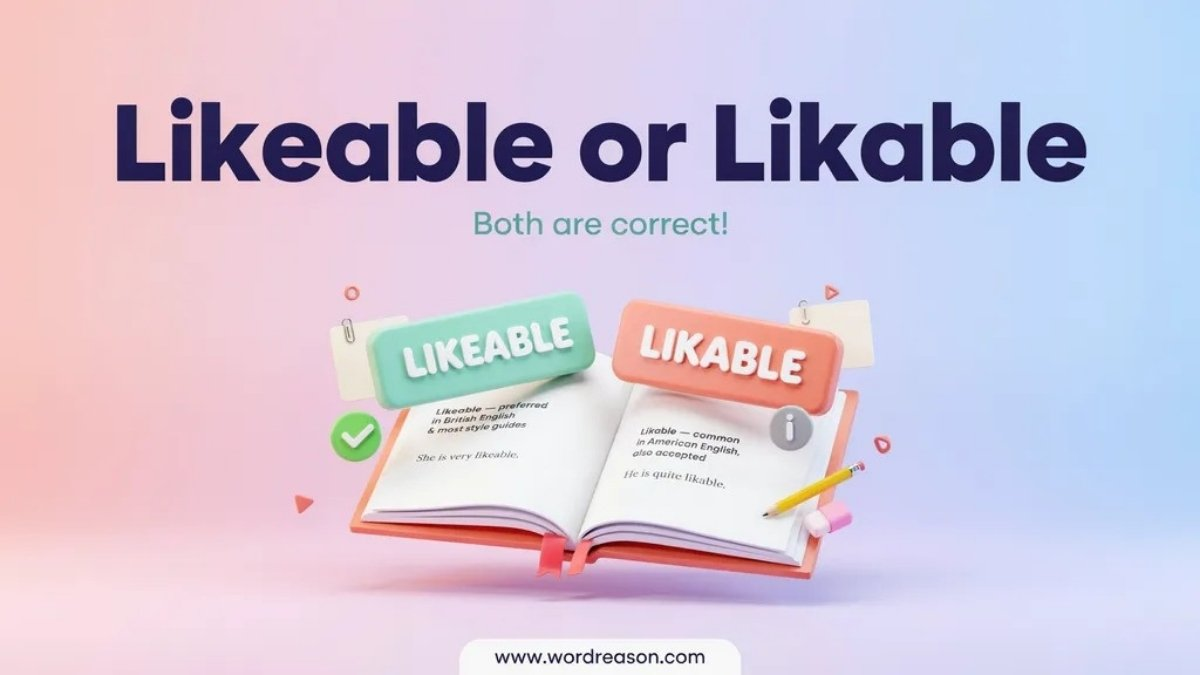
Regional spelling conventions explain most of the confusion surrounding these words. American and British English share the same basic vocabulary, but they differ in several spelling preferences.
For example, American English generally uses color, while British English commonly uses colour. Similarly, likable is generally preferred in American English, whereas likeable is especially common in British English.
Which Spelling Is Preferred in American English?
If you’re writing for a US audience, choose likable as your default spelling.
American dictionaries recognize likable as a standard form. The spelling appears in general writing, journalism, business communication, and educational material.
Examples include
The new teacher has a likable personality.
The author created a likable main character.
Our new colleague is friendly and likable.
The film introduces a likable hero whose honesty makes the story engaging.
Using likable follows the usual American preference. However, you can still encounter likeable in American publications, and its appearance doesn’t automatically make a sentence incorrect.
Which Spelling Is Preferred in British English?
For British English, likeable is a natural default.
British dictionaries commonly use this spelling, although likable remains understandable and acceptable.
Examples include
The actor plays a warm and likeable character.
The novel features a likeable main character.
Her likeable personality helps her connect with customers.
The new neighbor seems friendly and likeable.
The British-preferred spelling preserves the same meaning as the American-preferred form.
Which Spelling Should International English Writers Use?
If you write for readers in several countries, choose the spelling that best fits your main audience. Then apply it consistently.
| Audience | Practical recommendation |
|---|---|
| United States | Likable |
| United Kingdom | Likeable |
| Canada | Follow the publication’s style; likable is a reasonable North American default |
| Australia | Follow the publication’s style; likeable is a reasonable British-style default |
| International audience | Choose one form and use it consistently |
Learn the difference between confusing more English words
Steer or Stear which spelling is Correct ?
The Origin and History of Likeable and Likable
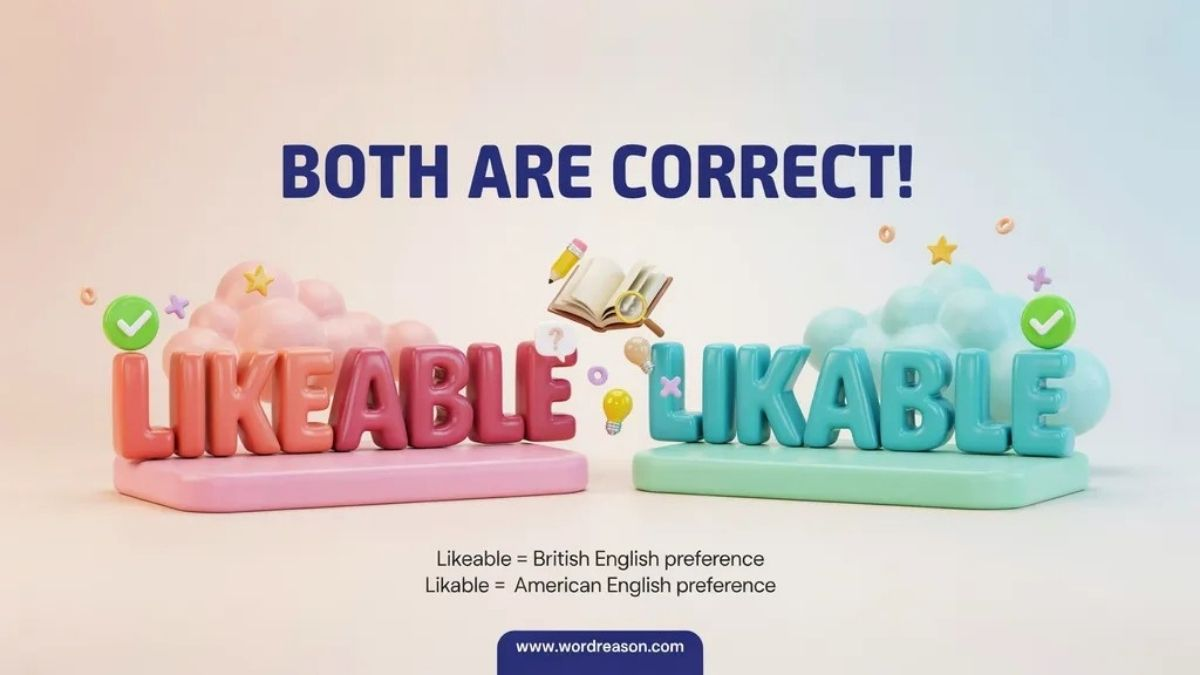
Understanding the root word helps explain why both spellings make sense.
The word like has a long history in English. As a verb, it expresses enjoyment, approval, or a favorable feeling toward someone or something.
For example, you might say, I like this book, or She likes her new job. The adjective likeable or likable builds on the same idea by describing something that inspires liking.
The Root Word Like and Its Meaning
The word like can serve different grammatical roles, depending on the sentence. In its verb form, it expresses a positive feeling or preference.
When writers add the suffix able, they create an adjective that describes a person or thing capable of inspiring that response.
For example
I like the new character.
The new character is likeable.
The new character is likable.
The first sentence expresses a personal preference. The other two describe a quality that may encourage people to like the character.
How the Two Spellings Developed
Both spellings developed through English spelling conventions. Over time, likable became the usual American form, while likeable remained especially common in British English.
Modern dictionaries recognize both variants. Their difference reflects regional convention rather than a difference in meaning or pronunciation.
You don’t need to treat one spelling as a newer or less legitimate version simply because it’s less common in your region.
Learn the difference between confusing more English words
Wierd or Weird Which Spelling Is Correct?
When Should You Use Likeable or Likable?
The right spelling depends on your audience, your publication’s editorial rules, and the type of document you’re writing.
Use Likable for American English Writing
Choose likable when writing for an American audience unless your publisher or style guide specifies otherwise.
For example
The candidate has a likable personality.
The author created a likable character.
Our new colleague is friendly and likable.
This choice follows standard American usage and helps maintain consistency throughout your writing.
Use Likeable for British English Writing
Choose likeable when writing for a British audience or a publication that follows British spelling conventions.
For example
The actor plays a warm and likeable character.
She is a likeable person with a good sense of humor.
The book’s main character is surprisingly likeable.
The spelling fits common British usage while preserving the same meaning.
Likeable or Likable in AP Style
If you’re writing a news article, don’t assume that the Associated Press Stylebook requires a particular spelling without checking its current guidance.
AP recommends Merriam-Webster as its primary dictionary for spelling and usage questions. When a style guide doesn’t provide a specific instruction, consult the recommended dictionary and follow your newsroom’s house style.
For an article that follows AP style, check the current style guide for a specific rule. Consult the recommended dictionary if no rule addresses the word. Follow your publication’s house style when it gives a clear preference, and use the selected spelling consistently.
This approach is more reliable than assuming that one form is automatically required by AP style.
Keep the Spelling Consistent Throughout Your Content
Consistency makes writing look polished and professional.
Imagine that a blog post describes a character as likable in the introduction, likeable in the middle, and likable again in the conclusion. Readers will probably understand the article, but the inconsistent spelling can make the editing look careless.
Choose one form before you begin writing. Apply that choice to headings, tables, captions, and the main text.
Learn the difference between confusing more English words
Proove or Prove What Is the Correct Spelling?
Likeable or Likable in Real World Examples
The easiest way to understand the difference is to see how the words work in context. Because likeable and likable have the same meaning, you can replace one with the other in these examples without changing the intended message.
Examples About People and Personalities
A person’s likeable qualities often include warmth, honesty, kindness, and a good sense of humor.
She is a likable friend who always keeps her promises.
Everyone appreciates his likeable personality.
The new student seems quiet but very likable.
Her likeable nature helps her make friends easily.
He became more likable when he learned to listen without interrupting.
Each sentence describes a positive impression of a person.
Examples in Professional Emails and Business Writing
In professional settings, likeable or likable can describe a colleague, manager, client, or public-facing personality.
The new team leader is approachable and likable.
Her friendly communication style makes her a likeable colleague.
The speaker delivered a clear, engaging, and likable presentation.
His likable manner helped create a comfortable atmosphere during the meeting.
For formal performance reviews, words such as collaborative, respectful, and approachable may communicate more precise information than likable alone.
Examples in News Writing and Formal Writing
News articles can use either spelling, depending on the publication’s regional conventions and style guide.
The actor is known for playing likable characters.
The biography presents a likeable but complicated public figure.
Her likable personality helped her connect with the audience.
The report describes the manager as approachable and likeable.
The adjective works when it expresses an observation or characterization. In formal reporting, however, avoid presenting a subjective judgment as an established fact without context.
Examples in Social Media and Casual Conversations
In informal writing, both forms are easy to understand.
He seems likeable from his videos.
That character is so likable!
She has a really likable sense of humor.
The creator’s likeable personality attracts a loyal audience.
You don’t need to change your spelling simply because you’re writing a social media caption instead of a formal document. Follow your usual regional preference.
Learn the difference between confusing more English words
Families vs Family’s Which Is the Correct spelling?
Common Mistakes When Using Likeable or Likable
Although both spellings are correct, writers can still make mistakes when choosing between them or using the word in a sentence.
Assuming One Spelling Is Always Incorrect
The most common error is treating likeable as wrong in American English or likable as wrong in British English.
Neither assumption is accurate. Both forms are accepted, although their frequency differs by region.
Remember that a preferred spelling isn’t necessarily the only correct spelling.
Mixing American and British Spellings
Using different regional forms in the same article can create inconsistency.
For example, consider this sentence
The character is likable, friendly, and likeable to everyone.
The sentence is understandable, but it uses both variants without a clear reason. A cleaner version would be:
The character is likable, friendly, and easy to get along with.
Alternatively, use likeable throughout if that suits your publication’s style.
Confusing Likeable With Similar Words
Some words have related meanings but aren’t exact substitutes.
| Word | Meaning | Example |
|---|---|---|
| Likeable | Easy to like | She is a likeable teacher. |
| Lovable | Inspires affection | The puppy is lovable. |
| Friendly | Kind and welcoming | Our neighbors are friendly. |
| Charming | Pleasant in an appealing way | He has a charming smile. |
| Approachable | Easy to speak to | The manager is approachable. |
| Agreeable | Pleasant or willing to cooperate | She has an agreeable manner. |
Choose the word that expresses your intended meaning. A person can be friendly without being particularly charming, just as a character can be lovable while behaving in ways that make them difficult to like.
Using Likeable or Likable When Another Word Fits Better
Likeable and likable describe an overall favorable impression. They don’t necessarily communicate a specific skill or behavior.
Consider this sentence
The likable employee completed the report before the deadline.
The adjective likable doesn’t explain why the employee completed the report on time. A more informative sentence would be
The reliable employee completed the report before the deadline.
The second version provides a clearer reason for the praise. Use likeable or likable when you genuinely mean that someone or something is easy to like.
Learn the difference between confusing more English words
Feet or Foot Which is the correct spelling?
Likeable or Likable Synonyms and Related Words
If you want to avoid repeating likeable or likable, several synonyms can help you express the same general idea. However, the best alternative depends on the context.
Common Synonyms for Likeable and Likable
Pleasant describes someone or something enjoyable to be around. Appealing emphasizes attractiveness or interest, while charming suggests a naturally pleasing manner.
Friendly describes kindness and warmth. Approachable emphasizes how easy someone is to talk to. Amiable means good-natured, and affable describes someone who communicates in a friendly, relaxed way.
Other useful alternatives include warm, personable, endearing, good-natured, easygoing, engaging, and congenial.
These words are related to the meaning of likeable, but they emphasize different qualities. For instance, affable focuses on friendliness in conversation, while endearing suggests that someone inspires affection.
Likeable vs Likable vs Lovable
Although likeable and lovable sound similar, they don’t mean exactly the same thing.
A likeable person is easy to like. A lovable person inspires affection or love, often because of their warmth, innocence, or endearing qualities.
For example, the detective is a likable character who treats witnesses fairly. Meanwhile, the little puppy is lovable because it follows everyone around.
A fictional character can also be lovable without being likable. The character might have good intentions but behave selfishly or make poor decisions.
Likeable vs Likable vs Friendly
Friendly describes behavior that shows kindness, warmth, or goodwill. Likable describes the favorable impression someone creates.
For example, the receptionist was friendly and greeted every visitor warmly. The receptionist was likable because she was friendly, helpful, and patient.
The second sentence explains why the person creates a positive impression. These words often overlap, but they serve different purposes.
Likeability or Likability Which Noun Spelling Is Correct?
The same spelling question appears when you turn the adjective into a noun.
Both likeability and likability are accepted forms. They describe the quality or characteristic of being easy to like.
| Adjective | Noun | Common preference |
|---|---|---|
| Likable | Likability | American English |
| Likeable | Likeability | British English |
For example, her likability helped her connect with the audience. His likeability made him popular with colleagues.
The adjective describes the person, while the noun refers to the quality itself.
You may also encounter likableness and likeableness, although forms ending in -ability often sound more natural in everyday writing.
Likeable or Likable Which Spelling Is Better?
If you’re writing an article about likeable or likable, your goal should be to answer the reader’s question clearly rather than repeat both keywords as often as possible.
Search engines can recognize related spellings and concepts. You don’t need to force every variation into every paragraph.
Should You Target Likeable or Likable as a Keyword?
Choose the primary spelling based on your target audience.
For a US-focused website, likeable or likable can serve as the main topic, while likable spelling, likeable meaning, and is likable a word can appear naturally in relevant sections.
For a British audience, you can emphasize likeable spelling, likeable definition, and likeable or likable in British English.
Useful related search phrases include likeable vs. likable, likeable or likable meaning, is likeable or likable correct, likeable spelling, likable spelling, likeable or likable grammar, likeable or likable in American English, likeable or likable in British English, likeable or likable examples, and likeability vs. likability.
Use these phrases where they help answer a question. Avoid inserting them into sentences where they sound unnatural.
How to Use Both Spellings Naturally in an Article
A helpful spelling-comparison article can cover both versions without awkward repetition.
Use the main keyword in the title and introduction, explain the difference in a comparison table, and address regional usage in a dedicated section.
You can also use related questions as FAQ headings. This approach covers the topic comprehensively while keeping the article readable.
Why Search Intent Matters More Than Spelling Variations
Someone searching for likeable or likable probably wants a quick answer, a clear definition, or guidance about American and British English.
Your article should provide those answers early. Readers shouldn’t have to scroll through a long history of English spelling before learning which version to use.
The most useful SEO strategy is to satisfy the reader’s actual question with accurate information, clear examples, and consistent formatting.
Practice Session
Test your understanding of the correct spelling, meaning, and usage of likeable and likable. Complete the 25 fill-in-the-blank sentences, then check your answers.
Fill in the Blanks
- Both likeable and likable are considered ______ spellings.
- The spelling likable is more common in ______ English.
- The spelling likeable is widely used in ______ English.
- Both words have the same ______.
- A ______ person is pleasant and easy to like.
- Her friendly attitude makes her very ______.
- Kindness can make someone more ______.
- Both likeable and likable are ______.
- Likeable is formed from the word like and the suffix ______.
- Likable drops the final ______ from like.
- Likeability and likability are both ______ spellings.
- A charming person is often considered ______.
- Someone who is easy to talk to is ______.
- The opposite of likable is ______.
- Honesty can make a person more ______.
- Arrogance may make someone less ______.
- A person who is liked by many people is often called ______.
- Amiable means friendly and ______.
- Charismatic people often attract and influence ______.
- You should choose a spelling that suits your target ______.
- In American English, ______ is generally preferred.
- In British English, ______ is widely used.
- Likeable and likable are both written as ______ word.
- Respect and empathy can make someone more ______.
- When writing formally, follow your preferred style ______.
Answer Key
- Correct
- American
- British
- Meaning
- Likable
- Likeable
- Likable
- Adjectives
- -able
- E
- Correct
- Likable
- Approachable
- Unlikable
- Likable
- Likable
- Popular
- Pleasant
- People
- Audience
- Likable
- Likeable
- One
- Likable
- Guide
Here’s a trusted source for clear more words Comparison:
FAQs About Likeable or Likable
Why does likeable have an E?
Likeable keeps the final E in like before adding -able. Likable drops the E. Both spellings are correct.
What is a likable person?
A likable person is friendly, pleasant, and easy to get along with.
What is a better word for likeable?
Synonyms include charming, friendly, pleasant, amiable, and personable.
Which is correct: likeability or likability?
Both are correct. Likeability is common in British English, while likability is preferred in American English.
Which is correct: likable or likeable?
Both are correct. Likable is more common in American English, while likeable is widely used in British English.
Is likeable one word or two?
Likeable is one word. Likable is also one word.
What do you call someone who is very likeable?
You can call them charming, charismatic, amiable, or personable.
What makes a person not likable?
Dishonesty, arrogance, disrespect, and a lack of empathy can make someone less likable.
What is the most likable personality?
People often appreciate kindness, honesty, empathy, and a good sense of humor. However, preferences vary.
How do you describe someone who is likeable?
Describe them as friendly, approachable, warm, considerate, or pleasant.
What is the opposite of likeable?
Common opposites include unlikable, unpleasant, disagreeable, and obnoxious.
What do you call someone who is well liked?
You can describe them as popular, admired, respected, or well regarded.
AEO: Quick Answers
Is likable preferred in American English?
Yes. Likable is the more common American English spelling.
Is likeable used in British English?
Yes. Likeable is widely used in British English, although likable is also accepted.
Do likeable and likable mean the same thing?
Yes. Both mean pleasant or easy to like.
Can I use likeable in formal writing?
Yes. Both spellings are acceptable. Follow your audience’s spelling conventions or preferred style guide.
Which spelling should I use for SEO?
Use likable for an American audience and likeable for a British audience. Include the alternative naturally where relevant.
conclusion
Choosing between likeable or likable does not have to turn your writing into a spelling detective story. Both forms are correct and share the same meaning, so neither deserves a red mark. However, likable is more common in American English, while likeable is widely used in British English. The key is to understand your audience and stay consistent. Remember, one spelling keeps the E and the other lets it go, but both remain perfectly acceptable. Now that you know the difference, you can write with confidence and avoid unnecessary confusion. After all, good grammar should make your writing more likable, not less!

Bella AJS
Bella AJS is an experienced blogger and passionate language enthusiast at WordReason. She specializes in English grammar, word meanings, spelling, and commonly confused words. With a clear and practical writing style, Bella helps readers understand tricky language rules without the textbook headache. Her goal is simple: make English easier, clearer, and more enjoyable one word at a time.