
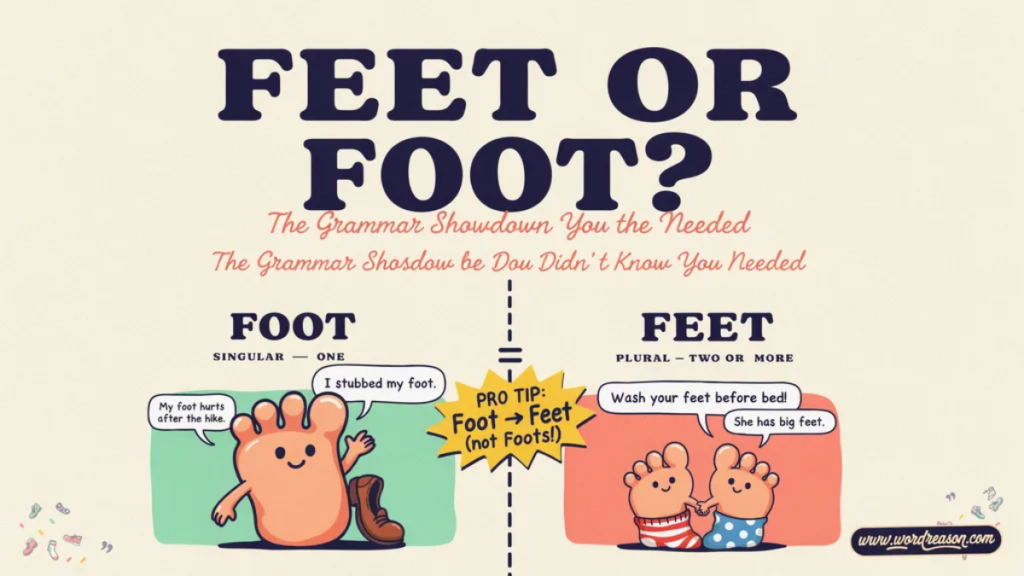
Feet or Foot can confuse even confident English writers. You may know your height perfectly, yet choosing the correct word can still feel like a grammar workout. Is it five feet tall or five foot tall? And why do we say a ten foot ladder instead of a ten-feet ladder? Do not worry; your grammar is not stumbling over its own feet. The rules are easier than they seem.
Feet or Foot Quick Answer
The correct choice depends on whether you mean one foot or more than one. Both words are correct, but they are not interchangeable in every sentence.
| Situation | Correct form | Example |
|---|---|---|
| One body part | Foot | My left foot hurts. |
| Two body parts | Feet | Both my feet hurt. |
| One unit of length | Foot | The board is one foot long. |
| More than one unit | Feet | The board is five feet long. |
| Measurement before a noun | Foot | We bought a five-foot board. |
| Describing height | Feet | She is six feet tall. |
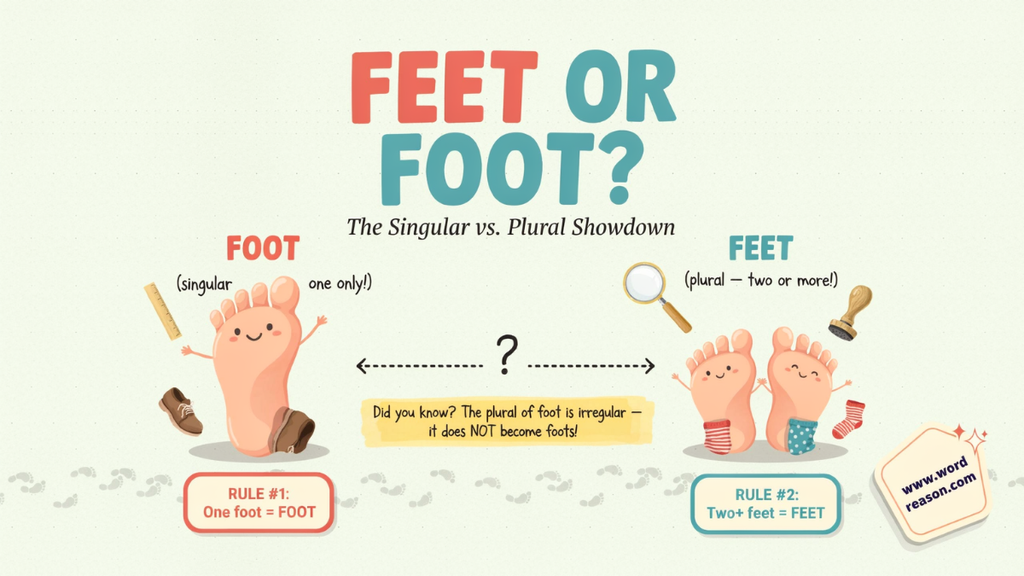
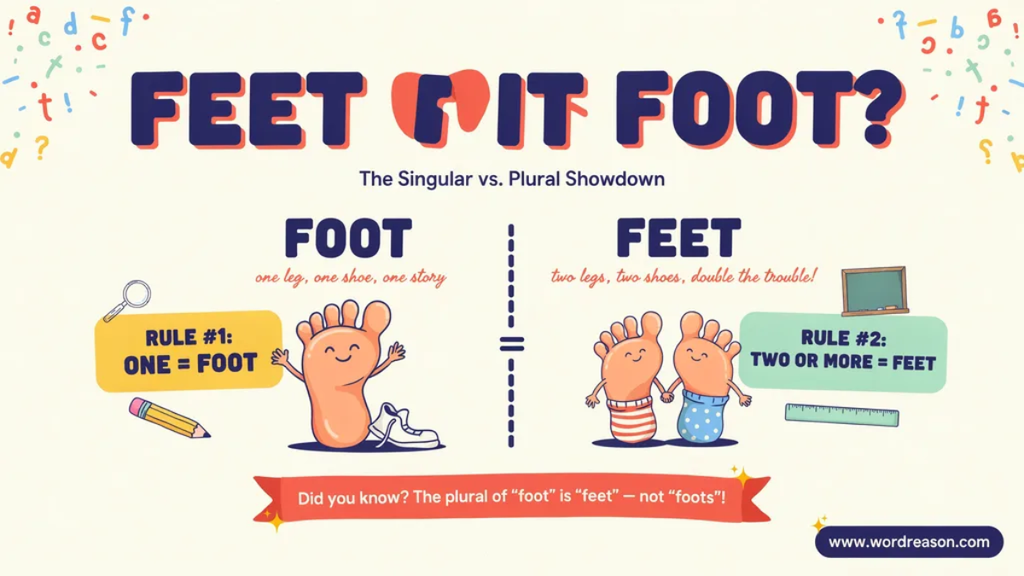
The easiest rule to remember is this use foot for one and feet for more than one, except that compound measurement expressions before nouns generally use the singular form.
When to Use Foot
Use foot when referring to one body part or one unit of length.
For example, My right foot hurts after the long walk refers to one body part. Similarly, The shelf is one foot wide describes a measurement of one unit.
You might also say, We need a foot of rope to finish the repair. In this sentence, foot describes a specific length.
You will also use foot in compound adjectives that describe the size of something. For example, a six foot fence is correct because the measurement acts as one descriptive unit before the noun.
When to Use Feet
Use feet when referring to two or more body parts or multiple units of measurement.
For example, My feet are cold refers to both feet. Similarly, The hallway is twelve feet long describes a length of twelve units.
You might also write, The airplane flew several hundred feet above the ground. Here, feet describes a measurement greater than one foot.
Remember that feet is an irregular plural noun. You do not make the plural by adding an s to foot. Instead, the vowel changes from oo to ee.
Learn the difference between confusing more English words
Halves or Halfs Which Spelling Is Correct?
What Do Foot and Feet Mean?
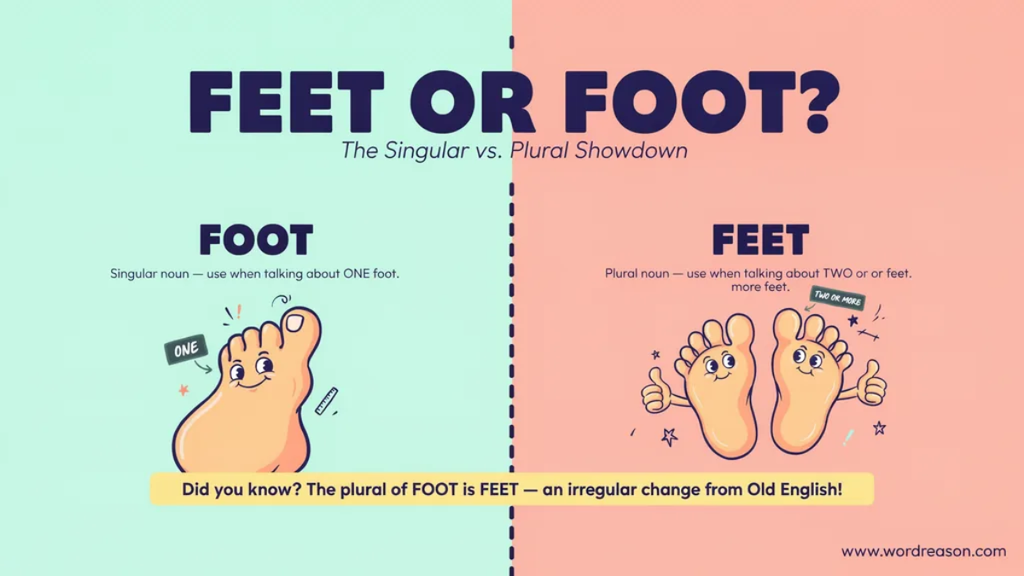
The words foot and feet have two main uses in English: they describe parts of the body and units of length. Although these meanings are related historically, the sentence tells you which meaning the writer intends.
Foot as a Body Part
A foot is the part of the leg below the ankle. It helps you stand, walk, run, jump, and keep your balance. Each person typically has two feet, although an injury or a medical condition may affect how someone uses them.
Consider these examples She hurt her foot while playing soccer, He placed one foot on the bottom step, and The doctor examined my right foot.
In each sentence, foot refers to one body part. Even when you describe the feet of several people, choose the singular form if you mean only one foot per person.
For example, Each child raised a foot is correct because each child refers to one child at a time, and each child raised one foot.
Feet as a Body Part
Feet refers to more than one foot. You will often see it in sentences about walking, sports, injuries, shoes, and everyday activities.
Consider these examples My feet hurt after standing all day, The children dipped their feet into the pool, and Please keep your feet off the furniture.
Notice the verb in these examples. The sentence My feet hurt uses hurt, not hurts, because feet is plural. This is a basic subject-verb agreement rule that helps your writing sound natural.
Foot and Feet as Units of Measurement
The word foot also names a unit of length in the imperial measurement system. It is widely used to describe height, distance, furniture dimensions, room sizes, and construction materials.
A foot has an exact, internationally defined length. One foot equals 12 inches, 0.3048 meters, or 30.48 centimeters.
| Measurement | Inches | Centimeters | Meters |
|---|---|---|---|
| 1 foot | 12 | 30.48 | 0.3048 |
| 2 feet | 24 | 60.96 | 0.6096 |
| 5 feet | 60 | 152.4 | 1.524 |
| 6 feet | 72 | 182.88 | 1.8288 |
| 10 feet | 120 | 304.8 | 3.048 |
These conversions are useful when you compare measurements from different countries or follow building instructions.
For example, a six foot table measures 182.88 centimeters in length if its stated length is exactly six feet. A ten-foot room measures 3.048 meters from one end to the other when the measurement is exact.
Learn the difference between confusing more English words
Authorized or Authorised Which Spelling Is Correct?
Why Is the Plural of Foot Feet?
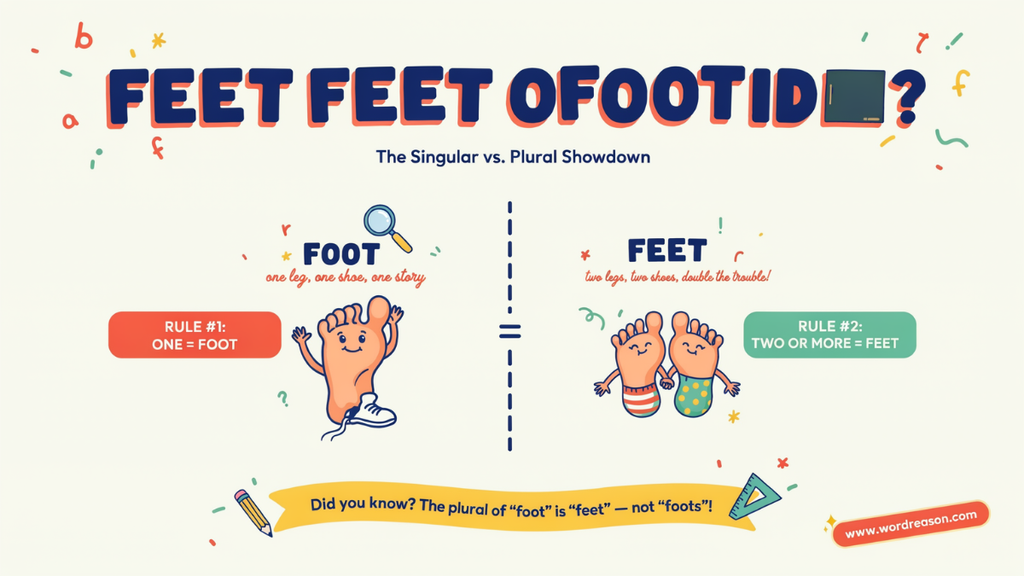
English contains many irregular plural nouns. Unlike regular nouns, which usually form their plural by adding s or es, irregular nouns change in other ways.
| Singular | Plural |
|---|---|
| Foot | Feet |
| Tooth | Teeth |
| Goose | Geese |
| Man | Men |
| Woman | Women |
| Child | Children |
| Mouse | Mice |
The word foot follows an older English pattern in which the vowel changed to mark the plural. This type of vowel change is sometimes called mutation or umlaut. Similar historical changes appear in words such as tooth/teeth and goose/geese.
Over time, English kept these older plural forms even as many other nouns adopted the more familiar s ending.
That is why feet is correct and foots is generally incorrect when you mean multiple human feet or ordinary units of length. You do not need to memorize the historical details to use the words properly, but understanding that foot is irregular explains why its plural looks different.
Learn the difference between confusing more English words
Realy or Really which spelling is correct?
Grammar The Rules You Need to Know
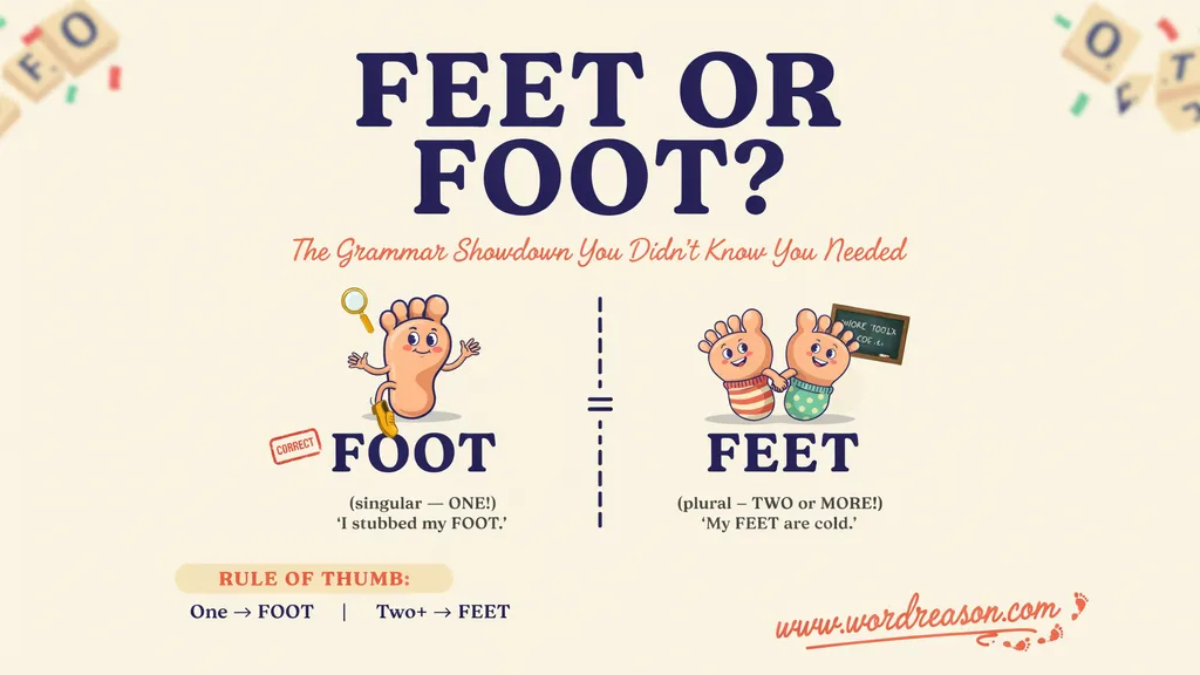
Knowing the basic definitions is only the first step. To use foot and feet confidently, you also need to understand how number, measurement expressions, and sentence structure affect your choice.
Singular and Plural Nouns
The simplest rule concerns whether you mean one item or more than one.
Use foot with a singular subject when you are talking about one body part. Use feet when you mean multiple feet.
| Incorrect | Correct |
|---|---|
| My feet is swollen. | My feet are swollen. |
| My foot are swollen. | My foot is swollen. |
| The feet looks healthy. | The feet look healthy. |
| Both foot hurt. | Both feet hurt. |
The difference also affects verbs. A singular subject usually takes a singular verb, while a plural subject takes a plural verb in the present tense.
For instance, The foot looks healthy is correct, while The feet look healthy is also correct. The noun and verb must agree.
Foot or Feet After Numbers
A common question is whether to write 2 feet or 2 foot, 5 feet or 5 foot, and 10 feet or 10 foot.
In ordinary standalone measurements, use foot with one and feet with numbers greater than one.
| Number | Standard measurement | Example |
|---|---|---|
| 1 | 1 foot | The box is 1 foot wide. |
| 2 | 2 feet | The box is 2 feet wide. |
| 3 | 3 feet | The table is 3 feet long. |
| 5 | 5 feet | The ladder is 5 feet tall. |
| 6 | 6 feet | The wall is 6 feet high. |
| 10 | 10 feet | The cable is 10 feet long. |
Therefore, five feet is the standard choice in a sentence such as The table is five feet long. Similarly, The fence is ten feet high follows the usual plural measurement rule.
Why Do We Say Six Foot Tall but Six Feet Tall?
At first glance, these expressions may look inconsistent. In fact, they serve different grammatical purposes.
Use six feet tall when the measurement follows the person or object being described. For example, My brother is six feet tall, The wall is six feet high, and The tree is six feet tall.
Use six foot tall when the entire measurement phrase comes before a noun. For example, My brother is a six foot tall athlete, They built a six foot tall wall, and We planted a six foot tall tree.
In the second group, six foot tall acts as a compound adjective. English generally uses the singular unit form in these measurement modifiers, even when the number is greater than one.
The same pattern appears in expressions such as a ten mile journey, a three-hour meeting, and a five-pound bag.
Remember She is six feet tall but She is a six foot tall woman.
Foot or Feet in Compound Measurements
A compound measurement combines a number and a unit to describe a noun. Writers often join the parts with a hyphen to make the relationship clear.
Examples include a two-foot gap, a four-foot table, a ten foot ladder, a three foot wall, and a twenty foot room.
In these examples, foot stays singular because the measurement functions as a single modifier before the noun.
| Before a noun | After the noun |
|---|---|
| A ten-foot ladder | The ladder is ten feet long. |
| A three-foot wall | The wall is three feet high. |
| A four-foot table | The table is four feet wide. |
| A six-foot fence | The fence is six feet tall. |
The hyphen helps connect the number and measurement when they work together as an adjective. In a compound such as a six foot fence, the unit is normally singular and hyphenated.
However, you do not need a hyphen in The fence is six feet tall. Here, the measurement follows the noun and describes its height rather than forming a compound adjective before it.
Is 5-Foot-6 Grammatically Correct?
Yes. 5 foot 6 is a common informal way to write a persons height, especially in American English. It means five feet and six inches.
For example, She is 5 foot 6 or He stands 5 feet 6 inches tall are both understandable ways to express this height.
In formal writing, the clearest option is often 5 feet 6 inches tall. In casual writing, profiles, sports discussions, and everyday conversation, 5-foot-6 is widely understood.
When using a compound description before a noun, you might write a 5 foot 6 athlete. For maximum clarity in formal documents, spell out the full measurement if the style guide requires it.
Learn the difference between confusing more English words
Trys or Tries Which Spelling Is Correct?
Common Mistakes When Using Feet and Foot
Even confident English speakers sometimes mix up these words, especially when describing height or writing measurements. The good news is that most mistakes become easy to spot once you understand the rules.
Using Foot Instead of Feet
Incorrect: My two foot are cold.
Correct: My two feet are cold.
The number two indicates more than one body part, so the plural noun feet is necessary. The verb must also agree with the plural subject.
Another example is Both feet hurt after the race. The word both refers to two things, so it normally takes a plural noun.
Using Feet Instead of Foot in Compound Adjectives
Incorrect They built a six feet tall wall.
Correct They built a six foot tall wall.
When a measurement comes before a noun and functions as a compound adjective, the unit generally stays singular. This rule applies even when the number is greater than one.
| Incorrect | Correct |
|---|---|
| A ten-feet ladder | A ten foot ladder |
| A three-feet-wide desk | A three foot wide desk |
| A six-feet-tall wall | A six foot tall wall |
However, use the plural form when the measurement follows the noun The ladder is ten feet tall.
Confusing in Measurements
Incorrect The table is five foot long.
Correct The table is five feet long.
In standard American English, five feet long is the usual form for a standalone measurement. You may encounter expressions such as five foot in informal speech, certain dialects, or specialized usage, but five feet is the safer choice for standard writing.
The same rule applies to other measurements. The room is ten feet wide, The fence is six feet high, and The rope is three feet long are all standard examples.
Using the Wrong Verb With Foot or Feet
Incorrect My feet hurts after work.
Correct My feet hurt after work.
The noun feet is plural, so it takes the plural verb hurt. By contrast, a singular subject takes hurts.
| Singular | Plural |
|---|---|
| My foot hurts. | My feet hurt. |
| One foot looks swollen. | Both feet look swollen. |
| Her foot feels cold. | Her feet feel cold. |
A quick way to catch this mistake is to identify the subject before choosing the verb. If the subject is feet, use a plural verb.
Writing Foots Instead of Feet
Incorrect: I measured the room and found that it was ten foots long.
Correct: I measured the room and found that it was ten feet long.
Foots is not the standard plural form for body parts or ordinary units of length. Use feet instead.
Although foots can occur as a specialized verb form in nautical language, that uncommon use does not change the ordinary noun rule.
Learn the difference between confusing more English words
Skis or Skiis Which Spelling Is Correct?
in Everyday Sentences
Grammar rules are easier to remember when you see them in realistic situations. The following foot and feet examples show how the words work in conversation, personal descriptions, construction, and professional writing.
Everyday Conversation
People often use these words when talking about walking, exercising, shopping or feeling tired.
My left foot hurts because I wore tight shoes refers to one foot. Take your feet off the coffee table refers to both feet. Similarly, I stepped on something sharp with my bare foot identifies one body part, while The dog left muddy footprints because its feet were wet uses the plural form.
Notice that foot identifies one body part, while feet refers to multiple body parts.
Learn the difference between confusing more English words
Receipt or Reciept Which Spelling Is Correct?
Height and Personal Descriptions
Height is one of the most common reasons people search for feet or foot.
Consider these examples My sister is five feet tall, The basketball player is six feet tall, and He is a six foot tall athlete.
You can also write, The model is 5 feet 6 inches tall or She is a 5 foot 6 athlete.
These sentences follow the same basic rules. Standalone measurements use feet for quantities greater than one, while compound adjectives generally use the singular form foot.
For clarity, remember that five feet equals 60 inches or 152.4 centimeters. Six feet equals 72 inches or 182.88 centimeters.
Home, Furniture and Construction
Measurements appear frequently in building plans, product descriptions, and home improvement projects. Using the right form makes instructions easier to understand.
For example, The dining table is four feet long, We need a six foot ladder to reach the ceiling, and The wall is eight feet high are all correct.
You might also write, A three foot gap separates the cabinets or The room measures twelve feet by ten feet.
These examples show why the distinction matters beyond grammar exercises. A clear measurement helps people select the correct materials, estimate space, and avoid mistakes when planning a project.
School, Work and Formal Writing
In professional writing, use standard measurement forms and keep the wording consistent.
| Context | Correct example |
|---|---|
| The shelf measures five feet in length. | |
| News report | The water rose three feet overnight. |
| School assignment | The plant grew two feet during the season. |
| Construction report | Install a six-foot support rail. |
| Product description | This table is four feet wide. |
| Social media | Finally finished my six-foot bookshelf! |
The same grammar rules apply across all these settings. You do not need a different plural rule for emails, reports, or social media posts.
A Practical Example Measuring a Room
Imagine that you are buying a rug for a bedroom. The room measures twelve feet long and ten feet wide.
You might write The bedroom is twelve feet long and ten feet wide. A ten foot rug may fit across the room, depending on its placement and the clearance needed around the edges.
Now imagine describing the same room before the noun We bought a twelve-foot rug for the bedroom.
The measurement uses foot in the compound modifier twelve foot rug, but feet in the standalone measurement twelve feet long. Understanding this difference helps you describe dimensions naturally and accurately.
Learn the difference between confusing more English words
Steer or Stear which spelling is Correct ?
Foot or Feet in American and British English
Some English words change spelling between American and British English. For example, Americans often write color, while British writers use colour. However, foot and feet follow the same basic grammar rules in both varieties.
Neither foot nor feet is exclusively American or British. Both forms are standard in each variety of English.
Learn the difference between confusing more English words
Wierd or Weird Which Spelling Is Correct?
American English Examples
American English commonly uses feet to describe a persons height, the dimensions of a room, and the length of everyday objects.
Examples include The ceiling is eight feet high, We bought a six-foot fence and The runner finished six feet ahead of the next competitor.
Learn the difference between confusing more English words
Proove or Prove What Is the Correct Spelling?
British English Examples
British English uses the same singular and plural forms.
Examples include The room is twelve feet long, The path is six feet wide, and They installed a six-foot fence.
The main difference is not the grammar of foot and feet, but the measurement systems people use in different situations.
Feet vs Meters and Other Units
The United States commonly uses feet and inches for a persons height and many everyday dimensions. The United Kingdom uses both imperial and metric units, depending on the setting. For instance, feet and inches are familiar in discussions of height, while meters and centimeters are common in many official, scientific, and technical contexts.
Here are a few useful conversions: one foot equals 12 inches, one foot equals 30.48 centimeters, five feet equals 152.4 centimeters, six feet equals 182.88 centimeters, and ten feet equals 3.048 meters.
These values are exact conversions when the original measurement is exact. When converting measured objects, the final result may need rounding to match the precision of the original measurement.
The unit you choose may vary by audience, but the grammatical distinction remains the same: foot is singular, and feet is plural in ordinary measurement expressions.
Families vs Family’s Which Is the Correct spelling?
Practice Session
Fill in each blank with the correct word: foot or feet.
- One ___ equals 12 inches.
- My left ___ hurts after walking.
- Both my ___ are cold.
- The table is four ___ long.
- She is five ___ tall.
- We need a ten-___ ladder.
- The wall is eight ___ high.
- He bought a three-___ ruler.
- The dog is two ___ away from me.
- This is a six-___-tall tree.
- My right ___ is swollen.
- The room is twelve ___ wide.
- They built a four-___ fence.
- The child is three ___ tall.
- The rope is fifteen ___ long.
- We climbed a twenty-___ hill.
- The door is seven ___ high.
- He is six ___ tall.
- I need a five-___ board.
- The fish tank is two ___ wide.
- She has a small ___ injury.
- The distance between the buildings is fifty ___.
- They purchased an eight-___ pole.
- My ___ hurt after the long journey.
- The swimming pool is thirty ___ long.
Answer Key
| No. | Answer | Correct phrase |
|---|---|---|
| 1 | foot | One foot |
| 2 | foot | My left foot |
| 3 | feet | Both my feet |
| 4 | feet | Four feet long |
| 5 | feet | Five feet tall |
| 6 | foot | A ten-foot ladder |
| 7 | feet | Eight feet high |
| 8 | foot | A three-foot ruler |
| 9 | feet | Two feet away |
| 10 | foot | A six-foot-tall tree |
| 11 | foot | My right foot |
| 12 | feet | Twelve feet wide |
| 13 | foot | A four-foot fence |
| 14 | feet | Three feet tall |
| 15 | feet | Fifteen feet long |
| 16 | foot | A twenty-foot hill |
| 17 | feet | Seven feet high |
| 18 | feet | Six feet tall |
| 19 | foot | A five-foot board |
| 20 | feet | Two feet wide |
| 21 | foot | A foot injury |
| 22 | feet | Fifty feet |
| 23 | foot | An eight-foot pole |
| 24 | feet | My feet hurt |
| 25 | feet | Thirty feet long |
Here’s a trusted source for clear more words Comparison:
FAQs About Feet or Foot
When Should You Use Feet or Foot?
Use foot for one and feet for more than one. For example, one foot long and five feet long.
Is 5 Foot or 5 Feet Correct?
Five feet is standard She is five feet tall. Before a noun, use five foot, as in a five foot wall.
Is It 3 Foot or 3 Feet?
Three feet is correct for a standalone measurement. Before a noun, use three foot, as in a three foot wall.
Is It Feet or Foot for Legs?
Use foot for one and feet for both. For example, My left foot hurts and Both my feet hurt.
Do You Say I Am 5 Foot or 5 Feet?
I am five feet tall is standard American English. You can also say I am five foot five informally.
Is It 8 Foot or 8 Feet?
Eight feet is standard The ceiling is eight feet high. Before a noun, write an eight foot ceiling.
Is 9 Foot or 9 Feet Correct?
Nine feet is correct The rope is nine feet long. Before a noun, use nine foot, as in a nine foot rope.
How Many Inches Are in One Foot?
One foot equals exactly 12 inches or 30.48 centimeters.
AEO Quick Answers About Feet or Foot
What Is the Difference Between Foot and Feet?
Foot is singular, while feet is plural. Use foot for one and feet for more than one.
Why Is the Plural of Foot Feet?
Foot is an irregular noun inherited from older English. Its vowel changes to form feet rather than adding an s.
Why Do We Say a 10-Foot Ladder?
Measurements used as compound adjectives before nouns generally take the singular form. Therefore, write “a ten-foot ladder” but “the ladder is ten feet tall.”
Is Six Feet Tall Correct?
Yes. Write “six feet tall” but “a six-foot-tall person.”
How Do You Convert Feet to Centimeters?
Multiply the number of feet by 30.48. For example, five feet equals 152.4 centimeters.
Are Foot and Feet Interchangeable?
No. Use foot for singular measurements and feet for plural measurements. Compound adjectives use the singular form, as in “a five-foot fence.”
conclusion
Choosing between feet or foot does not have to make your grammar stumble. Remember the simple rule: use foot for one and feet for more than one. However, when a measurement comes before a noun, use the singular form, as in a ten-foot ladder. Now you can confidently describe your height, measure a room, or talk about a long walk without tripping over these words. English grammar has plenty of surprises, but this one is easy to master. Keep practicing, avoid common mistakes, and let your grammar stand firmly on both feet!

Bella AJS
Bella AJS is an experienced blogger and passionate language enthusiast at WordReason. She specializes in English grammar, word meanings, spelling, and commonly confused words. With a clear and practical writing style, Bella helps readers understand tricky language rules without the textbook headache. Her goal is simple: make English easier, clearer, and more enjoyable one word at a time.