
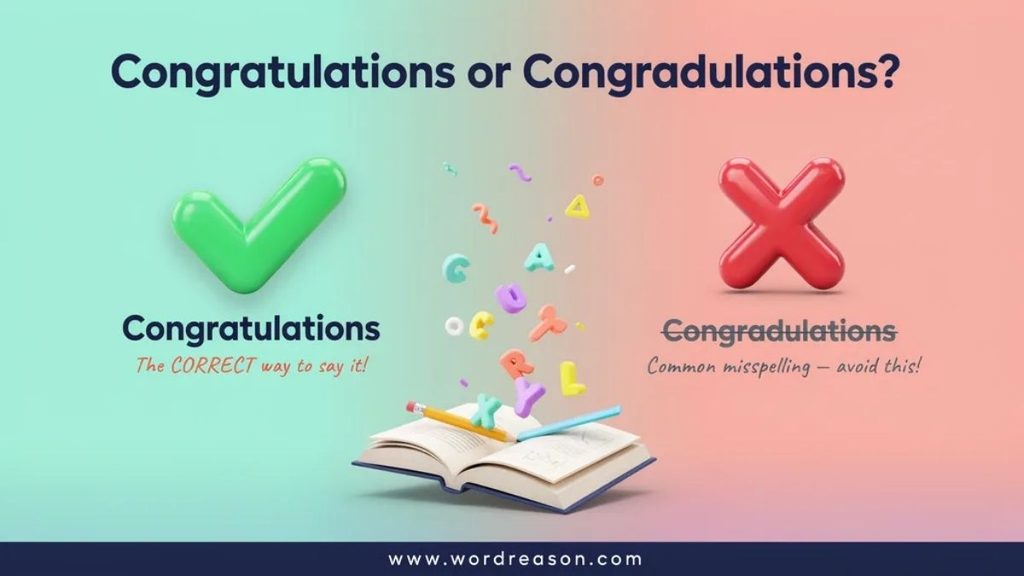
The confusion between congratulations or congradulations is common, especially when celebrating a graduation. Since graduation contains the letters grad, adding a d to congratulations might seem reasonable. However, English spelling has its own rules, and this is an easy mistake to make. The correct spelling is congratulations, whether you are celebrating a graduation, promotion, wedding, or personal achievement. In this article, you will discover the difference between the two spellings, learn the correct meaning, explore common mistakes, and find simple ways to write congratulatory messages with confidence.
Congratulations Mean
IT is an expression people use to show happiness, approval, or appreciation when something good happens to another person. It communicates that you recognize an achievement and want to share in the excitement.
For instance, when a friend passes an important examination, you might say, Congratulations on passing your exam! If a colleague receives a promotion, you could write, Congratulations on your new position.
The word also appears during major life events. People offer congratulations for weddings, graduations, new jobs, business achievements, awards, and other meaningful milestones.
Why Do People Say Congratulations?
People use congratulations for several reasons. First, the expression recognizes effort or success. Second, it helps people share positive feelings. Finally, it strengthens personal and professional relationships by showing that someone cares about an important moment.
Consider a student who has worked hard for several years to earn a degree. Saying “Congratulations on your graduation” acknowledges the achievement and communicates genuine happiness for the student.
Similarly, a simple congratulatory message can make a colleague feel appreciated after a successful project. In personal relationships, the same expression can celebrate engagements, weddings, new homes, and other memorable events.
Is Congratulations Always Plural?
In everyday English, congratulations usually appears in the plural form, even when you congratulate only one person.
For example, Congratulations on your promotion is natural when speaking to one colleague. You do not need to change congratulations to congratulation simply because you are addressing one person.
The plural form functions as a conventional expression. English speakers commonly use it as a complete message, such as Congratulations! or Many congratulations!
The singular noun congratulation also exists, but it appears less often in everyday conversation. It may refer to an act of congratulating someone or appear in formal expressions such as Please accept my congratulations.
Learn the difference between confusing more English words
Families vs Family’s Which Is the Correct spelling?
Why Is Congradulations a Common Misspelling?
The spelling congradulations looks plausible because English contains many words related to academic achievement that include the letters grad. Graduation, graduate, and undergraduate are familiar examples.
As a result, some people mistakenly insert the letter d into congratulations. They may connect the word with graduation in their minds, especially when writing a message for someone who has completed school or college.
However, the words have different meanings and spellings. Congratulations comes from congratulate, while graduation comes from graduate.
The Difference Between Congratulations or Congradulations
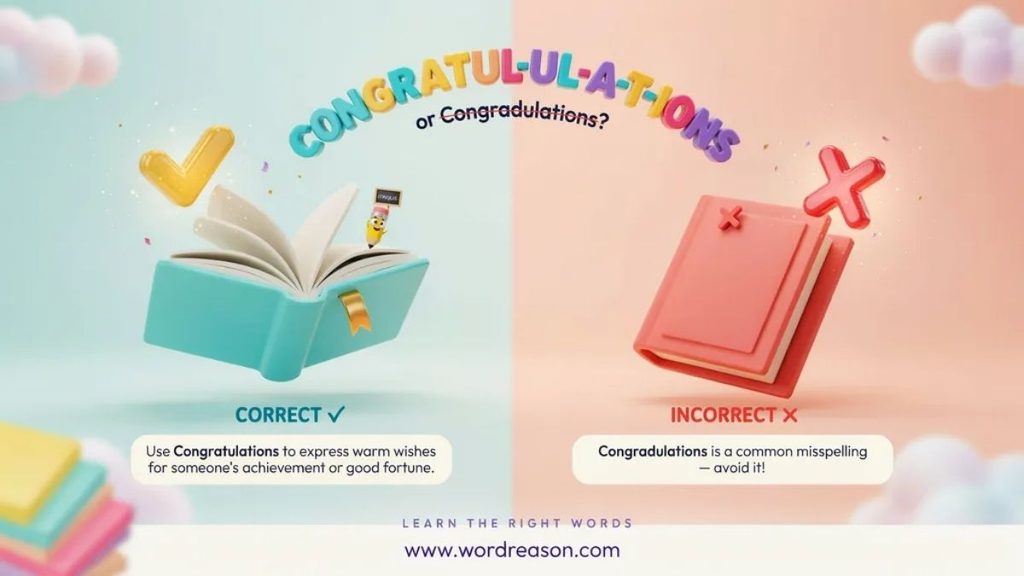
The main difference is straightforward: congratulations is the accepted spelling, while congradulations is a spelling error in standard English.
The incorrect version often appears in informal online posts, text messages, comments, and greeting cards. Because readers can usually understand the intended meaning, the mistake may not prevent communication. Nevertheless, it can make writing appear careless, particularly in professional or academic settings.
For example, writing Congradulations on your promotion in a formal email may distract the reader from the positive message. Writing Congratulations on your promotion communicates the same idea with the correct spelling.
here is the difference between Congratulations or Congradulations
A Simple Way to Remember the Correct Spelling
Connect congratulations with the verb congratulate. Both words contain the same central spelling pattern: congratul.
The correct word does not include a d after congra. Remembering this pattern makes it easier to avoid the common mistake.
You can also remember the distinction by separating the words according to their meanings. Congratulations expresses happiness about success, while graduation describes the completion of a course of study or the ceremony associated with that achievement.
Although you may use congratulations to celebrate a graduation, the two words are not interchangeable.
Learn the difference between confusing more English words
Feet or Foot Which is the correct spelling?
Congratulations vs Congradulations Spelling and Meaning
The following examples show how the two spellings differ in practical situations.
| Example | Explanation |
|---|---|
| Congratulations on your graduation! | Correct spelling and natural usage |
| Congradulations on your graduation! | Incorrect spelling of congratulations |
| Congratulations on your new job! | Correct expression for a professional achievement |
| Congradulations on your new job! | Understandable, but incorrectly spelled |
| Congrats on your success! | Correct informal expression |
| Congratulations to everyone who participated. | Correct expression for addressing a group |
Notice that the spelling remains congratulations whether you celebrate a graduation, promotion, wedding or personal achievement. The occasion does not change the spelling.
Learn the difference between confusing more English words
Likeable or Likable Which Spelling Is Correct ?
The Meaning and Origin
The word congratulations has a long history connected with expressing happiness for another person. It comes from the verb congratulate, which developed from the Latin word congratulari. This Latin word means to wish joy or express shared happiness.
The historical meaning remains closely connected to modern usage. When you congratulate someone, you recognize a positive event and express pleasure about it.
Over time, congratulations became a familiar expression in English. Today, people use it in casual conversations, formal letters, business communications, ceremonies, and celebrations.
How the Word Family Works
Understanding related words can help you spell and use congratulations correctly.
| Word | Meaning | Example |
|---|---|---|
| Congratulate | To express pleasure about another persons success | I want to congratulate you on your award. |
| Congratulation | An act or expression of congratulating | She received a message of congratulation. |
| Congratulations | An expression of happiness about success | Congratulations on your achievement! |
| Congratulatory | Expressing praise or good wishes | They sent a congratulatory message. |
| Congrats | An informal shortened form of congratulations | Congrats on the new job! |
These words share a common root, so learning them together can improve spelling and vocabulary. However, each word has its own grammatical role.
For example, congratulate is a verb, while congratulatory is an adjective. Congratulations usually functions as a plural noun or a conventional expression.
Learn the difference between confusing more English words
Cosy or Cozy Which Spelling Is Correct?
American English vs British English
Some English words have different spellings in American and British English. For example, American English commonly uses color, while British English often uses colour. However, congratulations follows the same standard spelling in both varieties.
| Feature | American English | British English |
|---|---|---|
| Standard spelling | Congratulations | Congratulations |
| Incorrect spelling | Congradulations | Congradulations |
| Informal expression | Congrats | Congrats |
| Common example | Congratulations on your promotion! | Congratulations on your promotion! |
Therefore, you do not need to change the spelling based on your audience. Whether you write to someone in the United States, the United Kingdom, Canada, Australia, or another English-speaking region, congratulations remains the correct choice.
Pronunciation can vary slightly across accents, but these differences do not change the written form.
Learn the difference between confusing more English words
Kindergarten or Kindergarden what it really means?
Congratulation or Congratulations Which One Should You Use?
Many writers wonder whether congratulation or congratulations is correct. Both forms exist in English, but they do not serve exactly the same purpose.
In ordinary conversation, congratulations is the usual choice when you want to celebrate a persons achievement. You would normally write “Congratulations on your wedding” rather than “Congratulation on your wedding.”
The singular form appears in more specific grammatical situations. For example, a writer might refer to “a message of congratulation” when describing an expression of praise. This usage is grammatically valid, although it sounds more formal and less common in everyday speech.
When to Use Congratulations
Use congratulations when you want to express happiness about an achievement, event, or success. It works in direct messages, greeting cards, emails, speeches, and public announcements.
Examples include Congratulations on your graduation, Congratulations on the promotion, and Congratulations to the entire team.
The word also works as a complete expression. If someone tells you that they have won an award, you can simply respond, Congratulations!
When to Use Congratulation
Use congratulation when the sentence specifically requires the singular noun. This form appears less often, particularly in casual conversation.
For example, She sent a note of congratulation after the election is grammatically possible. The phrase describes the act or message of congratulating someone.
However, if your goal is to send a direct message of good wishes, congratulations is almost always the more natural option.
Learn the difference between confusing more English words
Outting or Outing What it really means?
How to Use Congratulations Correctly in Sentences
Correct spelling matters, but sentence structure also affects how natural your message sounds. Fortunately, congratulations fits into several common patterns.
Congratulations on an Achievement
The preposition on commonly follows congratulations when you refer to a specific success or milestone.
Examples include Congratulations on your new job, Congratulations on completing your degree, and Congratulations on winning the competition.
This construction sounds natural because it clearly identifies the event you are celebrating.
Congratulations to a Person or Group
Use to when you want to identify the person or group receiving the congratulations.
For example, Congratulations to Maria on her promotion identifies the recipient and the achievement. Likewise, Congratulations to the graduating class addresses a group.
You can combine to and on when the sentence requires both. For example, “Congratulations to the team on its successful launch” identifies the recipients and the reason for celebration.
Congratulations in Formal Writing
In professional communication, a complete sentence often sounds more thoughtful than a short expression alone.
For example, “Congratulations on your promotion. Your hard work and dedication have earned this achievement” communicates appreciation while maintaining a professional tone.
A formal letter may also use Please accept my congratulations on your recent appointment. This wording suits professional relationships, official announcements, and formal correspondence.
Congratulations in Casual Messages
Informal messages can be shorter and more personal. You might write “Congratulations! You did it!” or “Congrats on the big news!”
The best wording depends on your relationship with the recipient and the occasion. A close friend may appreciate a warm, enthusiastic message, while a business contact may prefer a more restrained expression.
Learn the difference between confusing more English words
Ambience or Ambiance Which Spelling Is Correct?
Common Congratulations Spelling Mistakes
Even familiar words can cause confusion, especially when people write quickly or rely on how a word sounds. Recognizing common errors makes proofreading easier.
| Incorrect or less suitable wording | Better choice | Reason |
|---|---|---|
| Congradulations on your success. | Congratulations on your success. | Congradulations is misspelled. |
| Congradulations on graduating. | Congratulations on graduating. | The correct word does not contain a “d” after “congra.” |
| Congradulations to you both. | Congratulations to you both. | The standard spelling applies to individuals and groups. |
| Congradulation on the award. | Congratulations on the award. | The plural expression is more natural for direct congratulations. |
| Congrads on your promotion. | Congrats on your promotion. | Congrats is the standard informal shortening. |
One useful proofreading habit is to check the word congratulate whenever you are unsure how to spell congratulations. If you can spell the verb correctly, the related noun becomes easier to remember.
Another helpful habit is to read the entire sentence before sending it. This allows you to check the spelling as well as the tone, punctuation, and intended meaning.
Learn the difference between confusing more English words
Curtsy or Curtsey Which Spelling Is Correct?
Is Congradulations a Word?
Congradulations is not a standard English spelling. Dictionaries recognize congratulations as the correct form used to express happiness about another persons success.
You may still encounter congradulations online. Sometimes people use it accidentally, while others may use it as a joke or a deliberate play on words, particularly when discussing graduation.
That creative use does not make it the standard spelling. In school assignments, workplace emails, formal announcements, and ordinary written communication, use congratulations.
The distinction matters because readers generally expect standard spelling in situations where accuracy and professionalism count.
Learn the difference between confusing more English words
Lieing or Lying Which Spelling Is Correct?
Congratulations for Different Occasions
The correct spelling stays the same across different occasions, but the message can change according to the achievement.
Graduation
Graduation is one of the most common occasions for congratulatory messages. A thoughtful message can recognize the work someone has completed and the opportunities ahead.
For example, Congratulations on your graduation! I hope this achievement opens the door to exciting opportunities.
Although graduation and congratulations often appear together, they describe different things. Graduation refers to the educational milestone, while congratulations expresses happiness about that milestone.
Weddings and Engagements
For a wedding or engagement, a warm message can celebrate the relationship and the future of the couple.
For example, “Congratulations on your engagement! Wishing you both happiness as you begin this exciting chapter.”
The phrase congratulations on your wedding is also natural and widely used.
Promotions and New Jobs
Professional achievements often call for a message that balances enthusiasm with respect.
For example, Congratulations on your promotion. Your commitment and hard work have made a real difference.
This wording works well in workplace emails, professional cards, and messages to colleagues.
Awards and Personal Achievements
You can also use congratulations to recognize awards, sporting achievements, business milestones, and personal goals.
For example, Congratulations on completing your first marathon. Your determination is inspiring.
In each case, the message becomes more meaningful when you mention the specific achievement instead of offering only a general expression.
Learn the difference between confusing more English words
Devide or Divide Which Spelling Is Correct?
How to Write a Good Congratulatory Message
A good congratulatory message does not need to be long. It should use the correct spelling, identify the achievement where appropriate, and express genuine happiness.
Start with congratulations or congrats, depending on the level of formality. Then mention the occasion and add a personal thought or good wish.
For example, a professional message could read, Congratulations on your new role. I wish you continued success in this exciting opportunity.
A message to a friend could say, Congratulations! You worked so hard for this, and I am really happy for you.
For a graduation card, you might write, Congratulations on your graduation. Your dedication has brought you this far, and I hope the next chapter brings many wonderful opportunities.
These examples demonstrate how a simple expression can become more personal without becoming complicated.
Fill in the Blanks
Complete each sentence with the correct word or phrase.
- __________ on your graduation!
- The correct spelling is __________.
- __________ is a common spelling mistake.
- Please accept my __________ on your promotion.
- __________ on winning the competition!
- She received many __________ on her success.
- We want to __________ you on your achievement.
- __________ on your new job!
- He sent a __________ message to his colleague.
- Everyone offered their __________ to the graduate.
- __________, Class of 2026!
- They congratulated her __________ earning her degree.
- Please __________ your friend on the award.
- __________ on your wedding day!
- The word “congrats” is a short form of __________.
- Is “congradulations” the correct __________?
- She received a message of __________ after her success.
- We are happy to __________ you on your achievement.
- __________ on completing your studies!
- He wrote “congradulations” instead of the correct __________.
- The adjective form is __________.
- __________ to the entire team for its success!
- They sent their warmest __________ to the winner.
- Always check the __________ of congratulations before submitting your work.
- “Congratulations on your graduation” is a __________ sentence.
Answer Key
- Congratulations
- Congratulations
- Congradulations
- Congratulations
- Congratulations
- Congratulations
- Congratulate
- Congratulations
- Congratulatory
- Congratulations
- Congratulations
- On
- Congratulate
- Congratulations
- Congratulations
- Spelling
- Congratulation
- Congratulate
- Congratulations
- Spelling
- Congratulatory
- Congratulations
- Congratulations
- Spelling
- Correct
Here’s a trusted source for clear word meanings:
FAQs
Why do people say congradulations instead of congratulations?
People confuse congratulations with graduation. The correct spelling is congratulations.
Is it congradulations or congratulations for graduation?
Congratulations on your graduation is correct.
What is congraduation?
Congraduation is an informal blend of congratulations and graduation, not a standard English word.
Is congradulation a word?
No. The correct singular form is congratulation.
What is a fancy way of saying congratulations?
You can say “Heartfelt congratulations, Bravo, or Well deserved.
What does congradulation mean?
It is a misspelling of congratulations and has no standard meaning.
What can I say instead of congratulations to a graduate?
Say Well done on earning your degree or Wishing you success in your next chapter.
What is a good graduation day message?
Congratulations on your graduation! Wishing you a bright and successful future.
What should I say to a graduate?
Congratulations, Class ! Best wishes for your next adventure.
How do you spell congratulations correctly?
The correct spelling is congratulations, with a t, not a d.
What does congrats grad mean?
It is a casual way to say congratulations to someone who has graduated.
Can you use congratulation in a sentence?
Yes. Example: She sent a message of congratulation after his promotion.
Conclusion
Choosing between congratulations or congradulations may seem like a tiny spelling puzzle, but now you know the answer without needing a graduation cap or a grammar detective! Congratulations is the correct spelling, while congradulations is a common mistake caused by confusion with graduation. Remember, the word congratulate contains a t, and that little letter deserves its place. Whether you are celebrating a new job, a wedding, an award, or a graduation, use congratulations to share your happiness confidently. English spelling can be tricky, but this one is easy to remember. So, congratulations on learning the difference, and no congradulations allowed!

Bella AJS
Bella AJS is an experienced blogger and passionate language enthusiast at WordReason. She specializes in English grammar, word meanings, spelling, and commonly confused words. With a clear and practical writing style, Bella helps readers understand tricky language rules without the textbook headache. Her goal is simple: make English easier, clearer, and more enjoyable one word at a time.