

Outting or Outing adding an extra T might seem like a tiny mistake, but even small spelling errors can affect the quality of your writing. Whether you are describing a weekend adventure, a school trip, or a relaxing day with family, knowing the correct spelling helps you communicate clearly and confidently. In this guide, you will learn fill in the blank exercises with answers to test your knowledge, avoid common spelling mistakes and master the word outing without turning grammar practice into an outing of its own!
Outting or Outing Quick Answer
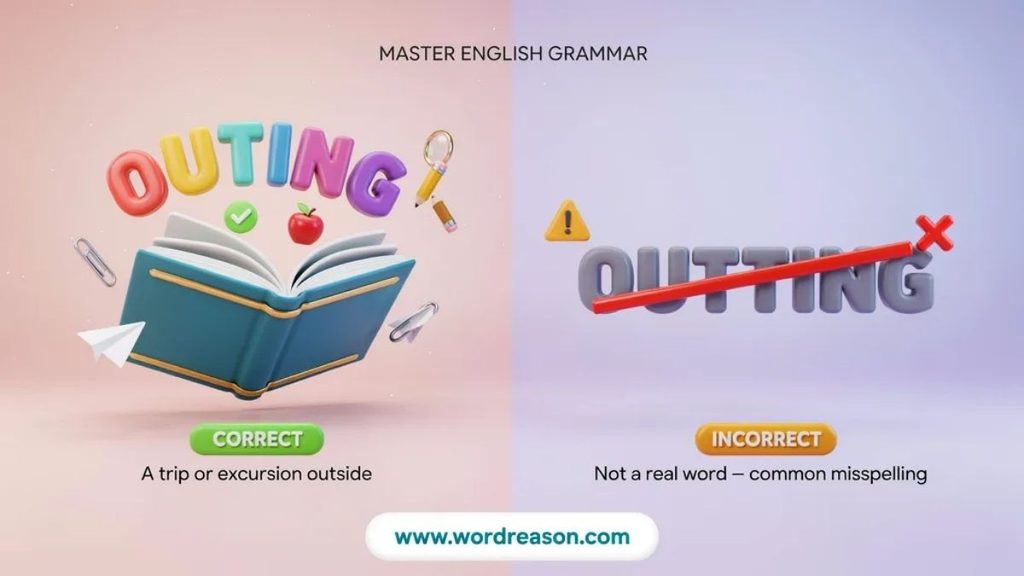
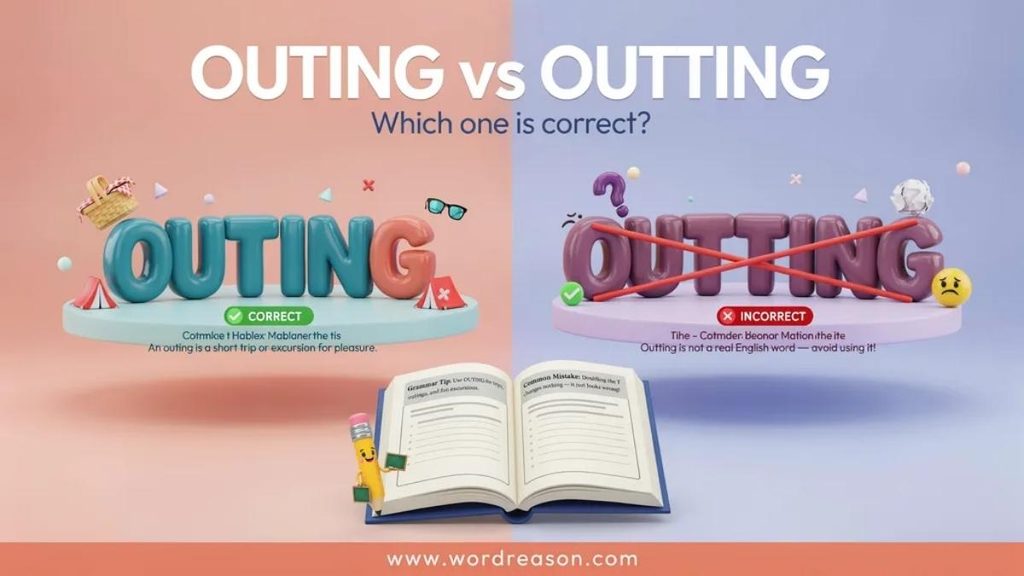
Outing is the correct spelling in standard English. Outting is generally a spelling mistake that occurs when writers add an unnecessary second t.
For example, you should write, We are planning an outing with friends this weekend. You should not write, We are planning an outting with friends this weekend.
The same spelling applies when you use the word in other contexts. Whether you describe a school excursion, a baseball performance, or the disclosure of private information, the standard spelling remains outing.
The correct plural is outings. You form it by adding s to outing, not by doubling the final consonant.
Learn the difference between confusing more English words
Skis or Skiis Which Spelling Is Correct?
What Does Outing Mean in English?

The outing definition depends on the sentence. Major English dictionaries recognize several uses of the word, including a short journey for pleasure or education, the public disclosure of private information, and an appearance in an athletic event.
Understanding these meanings helps you choose the right expression and avoid confusion.
Outing as a Short Trip or Excursion
An outing is a short trip away from home, school, or work, usually for pleasure, education, or recreation. It often involves a particular destination or activity and may last only a few hours.
For example, a family might visit a zoo, students might explore a historical site, or friends might spend an afternoon at a local park. Each activity can count as an outing.
Common expressions include family outing, school outing, day outing, social outing, and outdoor outing.
A family outing usually involves an activity shared by family members. A school outing often serves an educational purpose, while a social outing gives people an opportunity to spend time together.
Consider this sentence Our family planned an outing to the national park.
The word outing identifies the trip as an activity rather than a long vacation. It does not necessarily mean the family will stay overnight.
Outing as Public Disclosure of Private Information
The word outing also describes the act of revealing information about someone that they have not publicly disclosed themselves. This meaning often appears in discussions of privacy, journalism, public figures, sexual orientation, and gender identity.
For example, outing someone may mean publicly revealing that persons sexual orientation or gender identity without their consent.
This use differs greatly from a recreational trip. A family outing usually describes a leisure activity, while outing someone can affect their privacy, relationships, personal safety, and employment.
It is also important to distinguish outing someone from coming out. Coming out generally describes a persons voluntary decision to share their sexual orientation or gender identity. Outing someone usually involves another person disclosing that information without permission.
Context makes the meaning clear. In the sentence, The school organized an outing to the museum, the word refers to a trip. In the sentence, The journalist faced criticism for outing someone without consent, it refers to a private disclosure.
Outing as a Sports Performance
Sports writers use outing to describe an athletes appearance or performance in a particular contest. Baseball coverage uses the term frequently when discussing a pitchers work during a game.
For example, a reporter might write, The pitcher delivered an impressive outing against the visiting team.
Here, outing describes the pitchers performance rather than a trip. The plural form also appears in sports reporting when writers discuss several appearances or performances.
The spelling does not change between these meanings. Context determines what the word communicates.
Learn the difference between confusing more English words
Receipt or Reciept Which Spelling Is Correct?
Why Is Outing Correct and Outting Incorrect?

The Outting or Outing spelling becomes easier to understand when you look at how English forms words with suffixes.
The word outing consists of the base word out and the suffix ing. The spelling follows this pattern:
out + ing = outing
The final t remains single. English does not automatically double the final consonant whenever a word takes the suffix ing.
Compare these examples
| Base word | Correct form | Spelling pattern |
|---|---|---|
| Out | Outing | Keeps one t |
| Shout | Shouting | Keeps one t |
| Put | Putting | Doubles t |
| Sit | Sitting | Doubles t |
| Run | Running | Doubles n |
| Read | Reading | Keeps the original spelling |
The difference Outting or Outing explains why writers sometimes make the outting spelling mistake. They remember words such as putting and sitting, then apply the same pattern to outing.
However, English spelling depends on the structure of the base word. The fact that one word doubles its final consonant does not mean every word ending in that consonant must do the same.
Learn the difference between confusing more English words
Steer or Stear which spelling is Correct ?
Why Do People Write Outting?
The consonant doubling rule explains why some words double their final consonant before adding a vowel beginning suffix, such as ing.
In many short words that follow a consonant vowel consonant pattern, the final consonant doubles when the writer adds ing. For example, hop becomes hopping, run becomes running, and sit becomes sitting.
However, this rule has conditions. It does not apply to every word that ends in a consonant.
When Does English Double the Final Consonant?
A useful starting point is the consonant vowel consonant pattern, often shortened to CVC.
In the word hop, h is a consonant, o is a vowel, and p is a consonant. When you add ing, the spelling becomes hopping.
Other examples include run to running, cut to cutting, and stop to stopping.
Stress also matters in longer words. For example, begin becomes beginning because the final syllable receives the main stress. By contrast, visit becomes visiting rather than visitting because the stress falls on the first syllable.
These patterns explain why consonant doubling requires more than simply checking the last letter of a word.
Why Is Outing Spelled With One T?
The base word out does not follow the simple consonant vowel consonant pattern found in words such as put and sit. It contains the vowel combination ou followed by one final t.
When you add ing, the word becomes outing. You do not double the final consonant.
| Base word | Correct spelling | Example |
|---|---|---|
| Out | Outing | We planned an outing. |
| Shout | Shouting | The children were shouting. |
| Put | Putting | She is putting away the books. |
| Sit | Sitting | He is sitting near the window. |
| Cut | Cutting | They are cutting the paper. |
The contrast between out and put is particularly useful. Both words end in t, but the letters before that consonant differ. Their spelling patterns therefore differ when you add ing.
Remember this simple rule out becomes outing, not outting.
Is Outting a Real Word?
Outting is not the standard spelling of outing in contemporary English. Major dictionaries recognize outing as the accepted form for the meanings discussed in this article.
You may still see outting in a social media post, an informal message, a username, or a search query. These appearances usually reflect a typographical error or an intentional spelling choice.
A Outting or Outing spelling does not become standard simply because people use it online. In school assignments, professional documents, emails, and published articles, use outing.
Learn the difference between confusing more English words
Wierd or Weird Which Spelling Is Correct?
The Origin and History
The word outing developed from out, a word associated with being outside or moving away from an enclosed or familiar place. The noun came to describe an excursion or an occasion spent outside ones usual surroundings.
Historical dictionary references trace the word to Middle English. Its recreational meaning has been established in English for centuries, and modern dictionaries also record its later uses in sports and public disclosure.
The word appears in familiar expressions such as school outing, family outing, and day outing. Each describes an activity away from the persons usual environment.
Over time, outing gained additional meanings. Sports writers began using it to describe an appearance or performance in a contest. The word also developed a meaning connected with revealing private information about another person, especially information about sexual orientation or gender identity.
These meanings share the same spelling but serve different purposes. The historical development of a word can explain how its meanings expand, but it does not mean each meaning needs a different spelling.
Learn the difference between confusing more English words
Proove or Prove What Is the Correct Spelling?
British English vs American English Spelling

Some English words have different spellings in the United States and the United Kingdom. American English uses color, while British English commonly uses colour. Similarly, American English uses center, while British English uses centre.
Outing does not follow that pattern. Both varieties use outing with one t.
| Usage | American English | British English |
|---|---|---|
| One recreational trip | Outing | Outing |
| Several recreational trips | Outings | Outings |
| Public disclosure | Outing | Outing |
| Sports appearance | Outing | Outing |
| Nonstandard spelling | Outting | Outting |
The last row does not represent a legitimate regional difference. Outting is generally a spelling error in both varieties.
An American writer can say, We are planning a family outing this weekend. A British writer can use the same spelling and sentence without making a regional adjustment.
If you are writing for an international audience, there is no need to choose between British and American spellings for this word.
Learn the difference between confusing more English words
Families vs Family’s Which Is the Correct spelling?
Outing vs Outings Understanding the Singular and Plural
Outing is the singular noun, while outings is the plural form. You make the plural by adding s to the singular word.
For example, one trip is an outing, while three trips are outings.
The same distinction applies to the sports meaning. A pitcher may have one strong outing or several strong outings during a season.
Here are some natural examples
| Singular | Plural |
|---|---|
| Our class planned an outing. | Our class planned several outings. |
| The family enjoyed an outing. | The family enjoyed weekend outings. |
| The pitcher had a strong outing. | The pitcher had several strong outings. |
The plural does not require an extra t. Write outings, not outtings.
Learn the difference between confusing more English words
Feet or Foot Which is the correct spelling?
Common Spelling Mistakes Related to Outing
Even when you know the correct spelling, similar looking words can cause confusion. Understanding their grammatical differences helps you avoid common English spelling mistakes.
Outting vs Outing
This is the main distinction. Outing is the standard spelling, while outting is generally incorrect.
Correct: The children enjoyed an outing to the zoo.
Incorrect: The children enjoyed an outting to the zoo.
Correct: We planned several outings during the summer.
Incorrect: We planned several outtings during the summer.
If you catch yourself typing outting, return to the base word out and add ing without doubling the final letter.
Outing vs Going Out
Outing and going out can describe similar activities, but they have different grammatical functions.
IT is a noun that names a trip or event. Going out is a verb phrase that describes leaving home or taking part in an activity outside it.
For example, We planned an outing to the botanical garden names the event. We are going out to dinner tonight describes an action.
Both expressions are correct. Choose the one that fits the sentence and the meaning you want to communicate.
Outing vs Outed
Outing and outed come from the verb out, but they serve different grammatical functions when the word refers to revealing private information.
IT can describe the act of disclosure or function as the present participle of the verb. Outed is the past tense and past participle.
For example, The article discussed the ethics of outing a public figure describes the act. The article outed the public figure without consent describes a completed action.
The public figure was outed without consent uses the past participle in a passive construction.
These forms are not interchangeable in every sentence. Choose the one that matches the tense and grammar you need.
Learn the difference between confusing more English words
Likeable or Likable Which Spelling Is Correct ?
Outing in Everyday Examples
Seeing outing in different sentences helps you understand how the spelling works across several contexts.
Examples of Outing as a Trip
A family outing to the beach gave everyone a chance to relax.
The teacher organized an outing to the local history museum.
We planned a day outing to a nearby coastal town.
An outing with friends is a good way to catch up after a busy week.
The group went on an outdoor outing to explore the nature trail.
In each example, outing refers to a trip or recreational activity. The word can describe a casual plan or an organized event.
Examples of Outing as Public Disclosure
The article raised questions about the ethics of outing someone without consent.
The organization criticized the unauthorized outing of a private individual.
The discussion focused on privacy and the consequences of public disclosure.
In these sentences, outing does not refer to travel. It describes revealing information about another person. Writers should handle this meaning carefully because unauthorized disclosure can have serious personal consequences.
Examples of Outing in Sports
The pitcher had a dominant outing against the opposing team.
Her latest outing showed clear improvement.
The player delivered a strong outing despite difficult conditions.
In sports writing, outing often describes a particular appearance or performance. In baseball, the term frequently refers to a pitchers work during a game.
Learn the difference between confusing more English words
Cosy or Cozy Which Spelling Is Correct?
Outing Synonyms What Words Can You Use Instead?
The best outing synonym depends on the intended meaning. A word that works for a family trip may not work when discussing private information or an athletes performance.
Synonyms for a Recreational Outing
| Synonym | Meaning | Example |
|---|---|---|
| Excursion | A trip to a particular destination | We took an excursion to the historic village. |
| Day trip | A trip completed within one day | They planned a day trip to the coast. |
| Field trip | An organized educational visit | The class went on a field trip to the museum. |
| Trip | A general journey | We planned a trip to the mountains. |
| Get together | An informal social gathering | The friends arranged a weekend get together. |
Although excursion and outing often overlap, they do not always sound the same. Outing usually feels casual, while excursion can sound more formal or suggest a planned journey to a particular destination.
For example, a family outing to the park sounds natural in everyday conversation. A family excursion to the park is also correct, but it may sound more formal.
Related Terms for Public Disclosure
When outing means revealing private information, related terms include disclosure, revelation, and exposure.
Disclosure refers to making information known. Revelation emphasizes the act of revealing something previously unknown. Exposure can suggest that information has been brought into public view, often with negative consequences.
These words are not exact substitutes in every context. Choose the term that communicates the intended meaning accurately.
Learn the difference between confusing more English words
Kindergarten or Kindergarden what it really means?
How to Remember the Correct Spelling of Outing
A simple memory trick can help you avoid the outting spelling mistake.
Start with the base word:
out + ing = outing
The final t remains single. You do not need to add another one.
Another useful strategy is to compare outing with shouting. Both keep one t before ing. Then compare them with putting, which doubles its final consonant.
You can also memorize a complete sentence, such as We are planning a family outing. Recalling a familiar phrase can make the correct spelling easier to remember.
If you are unsure how to spell outing, remember the seven letters: o, u, t, i, n, and g. The word has one t.
Fill in the Blanks With Answers
Complete each sentence with the correct word: outing or outings.
Questions
- We planned a family _____ to the zoo.
- Our school organizes several _____ each year.
- The children enjoyed their weekend _____.
- Is the correct spelling outing or _____?
- We went on an _____ to the beach.
- The museum organizes educational _____ for students.
- Today’s _____ was fun and exciting.
- Our family enjoys outdoor _____.
- They planned a picnic as their weekend _____.
- The class went on two _____ this month.
- We had a wonderful _____ to the park.
- The summer camp arranged several group _____.
- Everyone enjoyed the family _____.
- Our next _____ will be to the aquarium.
- The children talked about their school _____.
- A trip to the botanical garden can be a pleasant _____.
- The club organizes regular social _____.
- We had three memorable _____ during our vacation.
- The students prepared for their class _____.
- Going to the beach was our favorite family _____.
- The organization planned several community _____.
- We enjoyed a short _____ after lunch.
- The weekend _____ was canceled because of rain.
- The travel group shared stories about their previous _____.
- A visit to the zoo is a popular family _____.
Answer Key
- outing
- outings
- outing
- outtings
- outing
- outings
- outing
- outings
- outing
- outings
- outing
- outings
- outing
- outing
- outing
- outing
- outings
- outings
- outing
- outing
- outings
- outing
- outing
- outings
- outing
Here’s a trusted source for clear more words Comparison:
FAQs About Outting or Outing
Is it outing or outings?
Outing is singular, and outings is plural. Outting is generally incorrect.
What is another word for outings?
Synonyms include trips, excursions, day trips, and visits.
What does outings mean?
Outings are trips or activities away from home, usually for fun or relaxation.
What does outing mean in slang?
In slang, outing someone means revealing private information about them without their consent, often about their sexual orientation or gender identity.
What does outing mean?
An outing is a short trip, recreational activity, or visit away from home.
How do you use outing in a sentence?
“We enjoyed a family outing to the zoo.”
What is another word for outing someone?
Depending on the context, alternatives include exposing, revealing, or disclosing private information.
What is another word for an outing with family?
Common alternatives include a family trip, family excursion, or family day out.
What does today’s outing mean?
It refers to a trip or activity planned for or taking place today.
What is considered an outing?
A visit to a park, museum, restaurant, or other place for recreation or socializing can be considered an outing.
What does a good outing mean?
A good outing is an enjoyable or successful trip or experience. In sports, it can mean a strong performance.
Is outing spelled with one T or two?
Outing is spelled with one T. Outting is generally a misspelling.
conclusion
Now you can put the confusion between outting or outing behind you! Remember, outing is the correct spelling with just one T, while outings is the plural form. That extra T has no invitation, so leave it out! Whether you are writing about family adventures, school trips, or weekend getaways, using the correct spelling keeps your writing clear and professional. Practice the 25 fill-in-the-blank exercises, check your answers, and learn from any mistakes. After all, grammar practice should be a learning adventure, not a spelling disaster. Keep practicing, stay confident, and enjoy your next outing without taking an extra T along!

Bella AJS
Bella AJS is an experienced blogger and passionate language enthusiast at WordReason. She specializes in English grammar, word meanings, spelling, and commonly confused words. With a clear and practical writing style, Bella helps readers understand tricky language rules without the textbook headache. Her goal is simple: make English easier, clearer, and more enjoyable one word at a time.