
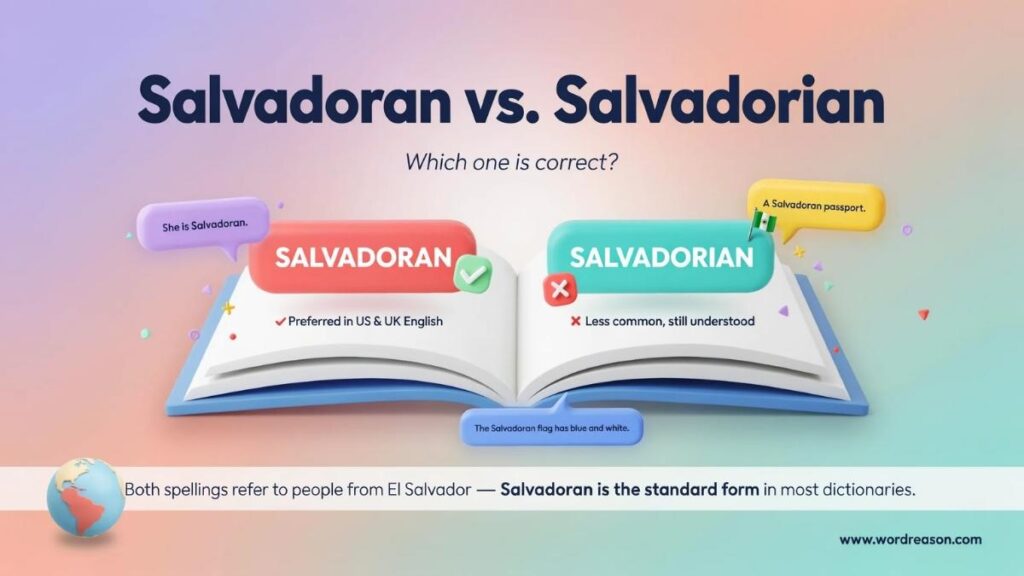
Choosing between Salvadoran or Salvadorian can turn a simple spelling question into a full blown grammar mystery. Before you let one extra syllable confuse your writing, here is the good news: both spellings appear in English, but Salvadoran is the preferred choice in standard American English. In this guide, you will learn what each word means, how to use it correctly, and which common mistakes to avoid. With clear explanations and practical examples, you will settle the spelling debate and write with confidence instead of second-guessing every sentence.
Difference Between Salvadoran and Salvadorian
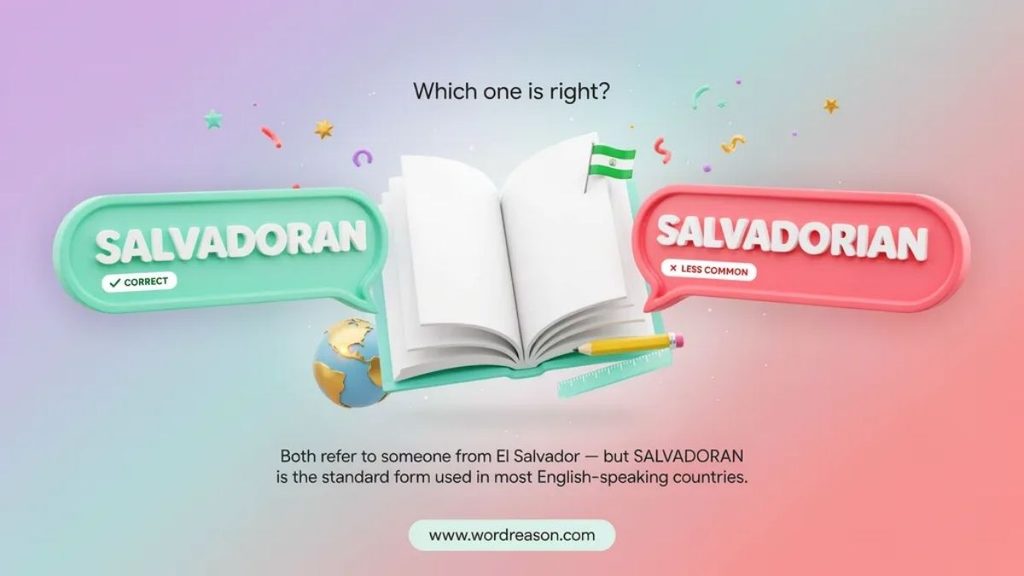
The main difference is spelling and usage, not meaning. Both terms can describe a person from El Salvador or something associated with the country.
However, the two forms do not have exactly the same level of preference in every style guide. Salvadoran is the more suitable default for American English, while it remains an accepted alternative in some English-language references.
Salvadoran Meaning
IT refers to a person who comes from El Salvador, a country in Central America. It can also describe the countrys people, culture, food, history, language communities, and other national characteristics.
For example, a person born in El Salvador may identify as Salvadoran. Similarly, a traditional dish associated with the country may be described as Salvadoran food.
The word works as both a noun and an adjective. As a noun, it identifies a person. As an adjective, it describes something connected to El Salvador.
Salvadorian Meaning
Salvadorian carries essentially the same meaning as Salvadoran. It can refer to a person from El Salvador or describe something related to the country.
For example, someone might write that a Salvadorian family moved to Texas or that a community celebrates Salvadorian traditions.
Although the spelling differs, the intended meaning usually remains the same. The main consideration is whether the word fits the style guide and audience for your writing.
Is Salvadorian Incorrect?
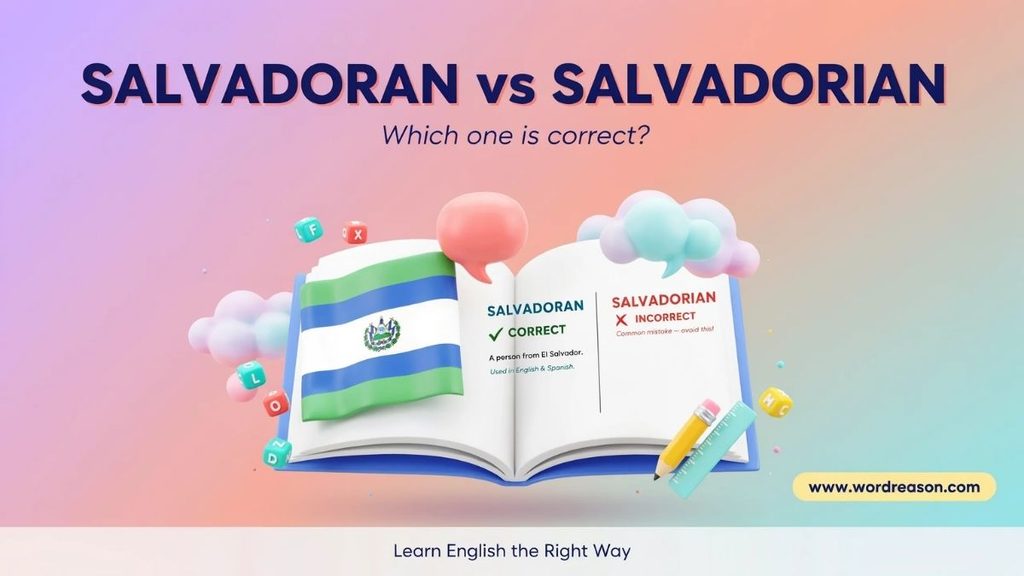
No. Salvadorian is a recognized spelling variant. The Canadian government terminology database TERMIUM Plus lists Salvadoran, Salvadorian, and Salvadorean as correct English forms for a native or long-term resident of El Salvador.
Nevertheless, a recognized variant is not necessarily the preferred choice in every context. If you are writing an American news article, school assignment, professional report, or SEO blog post, Salvadoran is generally the safer option.
In other words, Salvadorian is not automatically a spelling mistake. It is simply less suitable when a publication or organization specifically prefers Salvadoran.
Learn the difference between confusing more English words
Cosy or Cozy Which Spelling Is Correct?
Which Spelling Should You Use Salvadoran or Salvadorian?
For most readers in the United States, Salvadoran is the clearest default. It is familiar in American editorial usage and appears in established government and reference materials.
The Associated Press Stylebook is a major reference for American journalism, while the United States Government Publishing Office lists Salvadoran as the demonym for El Salvador. These sources support using Salvadoran in formal American writing.
Choose Salvadoran for American English
Use Salvadoran when writing an American English article, academic paper, business document, news report, or educational resource. It is also the recommended starting point for general online content.
For example, write, The Salvadoran community organized a cultural festival. This wording follows the preferred form without distracting readers with a less familiar variant.
Use Salvadorian When the Context Supports It
Salvadorian may be appropriate when a publication already uses that spelling, a source uses it in an official title, or a person or organization expresses a clear preference.
Consistency matters, too. If a publication follows a particular dictionary or editorial guide, use the form that guide recommends throughout the document.
What About Salvadorean?
Salvadorean is another documented English spelling. It has the same general meaning as Salvadoran and Salvadorian.
However, it is not the best default for standard American English. Unless a trusted source or established editorial preference calls for it, choose Salvadoran instead.
Learn the difference between confusing more English words
Kindergarten or Kindergarden what it really means?
Salvadoran or Salvadorian What Do Dictionaries and Style Guides Say?
Dictionaries record how people use language, while style guides help writers choose consistent forms for specific audiences. These resources may recognize several variants without recommending them equally.
The distinction matters because the question is not simply whether a spelling exists. It is also whether that spelling suits your purpose.
Associated Press Style Guidance
The Associated Press Stylebook is widely used by journalists, editors, and professional writers. Its guidance serves as an important reference for American editorial style.
For writing intended to follow AP style, Salvadoran is the appropriate choice. It provides a consistent form for describing people and things connected to El Salvador.
Government and Terminology References
The United States Government Publishing Office lists Salvadoran as the demonym for El Salvador in its style manual. This supports using the shorter spelling in formal American government writing.
Meanwhile, TERMIUM Plus, the Canadian government terminology database, recognizes Salvadoran, Salvadorian, and Salvadorean as correct forms. This shows that the longer spelling is not simply an invented error.
Dictionary Usage
Major English dictionaries can document variant forms, and their entries may distinguish a preferred spelling from alternatives. Merriam Webster serves as the primary dictionary reference for the Associated Press Stylebook.
The practical lesson is straightforward: check the reference that governs your writing. If no particular guide applies, Salvadoran is the most useful general recommendation for American English.
Learn the difference between confusing more English words
Outting or Outing What it really means?
Where Does the Word Salvadoran Come From?
The word Salvadoran comes from the name El Salvador, the Central American country whose name means the Savior in Spanish.
English uses many words that identify people by their country or region of origin. These words are known as demonyms. Examples include Canadian for someone from Canada, Mexican for someone from Mexico, and Salvadoran for someone from El Salvador.
The ending in Salvadoran follows a familiar pattern in English demonyms. The alternative ending in Salvadorian reflects another word-formation pattern that appears in English. Both forms developed through usage, which helps explain why writers encounter more than one spelling.
However, the existence of two forms does not mean every writer should alternate between them. In professional writing, a consistent preferred form makes the text easier to read and edit.
Learn the difference between confusing more English words
Ambience or Ambiance Which Spelling Is Correct?
in American and British English
Writers sometimes assume that Salvadoran belongs to American English and Salvadorian belongs to British English. That explanation is too simple.
American and British English differ in many spelling conventions, such as color and colour or center and centre. However, not every spelling variation follows a clear national divide.
The choice between Salvadoran and Salvadorian does not fit neatly into the same pattern as those familiar examples. Reference materials recognize variation, but Salvadoran remains the preferred choice for standard American writing.
| Writing situation | Recommended form | Example |
|---|---|---|
| American news article | Salvadoran | The Salvadoran team won the match. |
| American school assignment | Salvadoran | Salvadoran history includes many important cultural traditions. |
| General blog post | Salvadoran | Salvadoran cuisine includes popular dishes such as pupusas. |
| Text following a source that uses Salvadorian | Salvadorian, if appropriate | The Salvadorian organization published a report. |
| Text following a guide that lists Salvadorean | Salvadorean, if required | The source uses the spelling Salvadorean. |
The key point is that regional spelling habits do not always explain every variant. When the audience or publication has a preferred style, follow it. Otherwise, Salvadoran is the most practical choice.
Learn the difference between confusing more English words
Curtsy or Curtsey Which Spelling Is Correct?
How to Use in a Sentence
Both forms can function as nouns and adjectives. Understanding this distinction helps you use them naturally rather than forcing them into awkward sentences.
Salvadoran as a Noun
As a noun, Salvadoran refers to a person from El Salvador. The plural form is Salvadorans.
For example, A Salvadoran spoke at the community meeting identifies one person. The sentence “Several Salvadorans attended the festival” refers to more than one person.
The word should describe a persons national or cultural connection when that information is relevant. It should not replace a persons name or individual identity unnecessarily.
Salvadoran as an Adjective
As an adjective, Salvadoran describes something associated with El Salvador.
For example, We tried Salvadoran food at a local restaurant” describes the cuisine. Similarly, The museum displayed Salvadoran artwork identifies the artwork by its cultural or national connection.
The adjective can describe history, literature, music, traditions, communities, and many other subjects.
Salvadorian as a Noun or Adjective
Salvadorian follows the same basic grammatical pattern. It can identify a person or describe something related to El Salvador.
For example, A Salvadorian artist presented her work uses the term as a noun modifier. The sentence “The event celebrated Salvadorian culture” uses it as an adjective.
Although both forms can work grammatically, Salvadoran remains the recommended default for standard American writing.
Learn the difference between confusing more English words
Lieing or Lying Which Spelling Is Correct?
Should Salvadoran Be Capitalized?
Yes. Capitalize Salvadoran when using it as a noun or adjective referring to nationality or a connection to El Salvador.
For example, write a Salvadoran writer, Salvadoran traditions, and three Salvadorans attended the event.
The same capitalization principle applies to Salvadorian when you choose that variant. Nationality terms derived from country names generally take an initial capital in English.
However, do not capitalize unrelated words simply because they appear beside a nationality term. In the phrase Salvadoran cuisine, Salvadoran is capitalized, while cuisine remains lowercase.
Capitalization is a separate issue from spelling preference. Whether you choose Salvadoran or Salvadorian, apply the standard capitalization rules consistently.
Learn the difference between confusing more English words
Devide or Divide Which Spelling Is Correct?
Common Mistakes When Choosing Salvadoran or Salvadorian
Writers often become confused because they assume that one spelling must be entirely wrong. In reality, the issue involves preferred usage and consistency.
Assuming Salvadorian Is Always Wrong
This is one of the most common misconceptions. Salvadorian appears in established English-language terminology references, so calling it universally incorrect overlooks documented usage.
The better approach is to distinguish between an accepted variant and the preferred form for a particular audience.
Treating Salvadoran and Salvadorian as Different Nationalities
The spellings do not generally identify two separate nationalities. Both refer to people or things connected to El Salvador.
Changing the ending does not change the country being discussed. The choice is primarily a matter of spelling convention.
Switching Between Spellings in One Article
Using Salvadoran in one paragraph and Salvadorian in the next can make an article look inconsistent. Readers may wonder whether the author intends a difference in meaning.
Choose one form at the beginning and keep it throughout the article unless a quotation, official name, or specific source requires a different spelling.
Confusing Salvadoran With Salvadorian Spanish
Salvadoran and Salvadorian describe a nationality or a connection to El Salvador. They do not automatically name a separate language.
The language spoken by most people in El Salvador is Spanish. The country also has its own regional varieties of Spanish, along with Indigenous languages and other linguistic traditions.
If you mean the variety of Spanish associated with El Salvador, Salvadoran Spanish is a clear and useful expression.
Assuming Every Reference Uses the Same Rule
Different dictionaries, editorial guides, and terminology databases serve different purposes. Some prioritize a preferred form, while others record several accepted variants.
As a result, one source may recommend Salvadoran while another lists Salvadorian as an alternative. That difference does not necessarily indicate a contradiction. The sources may be answering different questions about usage and preference.
Learn the difference between confusing more English words
Congratulations or Congradulations? which Spelling is Correct?
Salvadoran or Salvadorian Real Life Examples
Examples make the distinction easier to remember. The following sentences demonstrate how each form can work in everyday writing.
| Example | Explanation |
|---|---|
| She is Salvadoran. | Salvadoran identifies her nationality or national background. |
| He is a Salvadorian musician. | Salvadorian identifies a person connected to El Salvador. |
| They serve Salvadoran food. | Salvadoran describes the food. |
| The event celebrated Salvadorian culture. | Salvadorian describes a cultural connection. |
| Salvadorans gathered for the festival. | Salvadorans is the plural noun form. |
| Salvadorian artists displayed their work. | Salvadorian describes the artists. |
| The school teaches Salvadoran history. | Salvadoran describes the history. |
| The report discusses Salvadorian communities. | Salvadorian describes the communities. |
For a standard American English article, you can replace the Salvadorian examples with Salvadoran and retain the same general meaning.
Which Form Sounds More Natural?
In American editorial writing, Salvadoran generally sounds more familiar and follows the preferred convention. However, readers can understand Salvadorian in the same contexts.
Natural wording also depends on the sentence. For example, Salvadoran families shared traditional recipes sounds clear and direct. There is no need to use a longer form simply to make the sentence sound more formal.
The strongest writing choice is the one that communicates the meaning clearly and follows the conventions of your audience.
Learn the difference between confusing more English words
Inter vs Intra what it really means?
Is Salvadoran More Common Than Salvadorian?
Salvadoran is the preferred form in many American editorial and government contexts. Its use in established style references also makes it a practical choice for formal writing.
Salvadorian appears in English-language publications and terminology databases as well. However, the presence of both spellings does not establish that they occur equally often.
To determine their exact relative frequency, you would need a defined collection of texts, such as a newspaper corpus or a searchable book database, along with a consistent date range and counting method. General dictionary entries alone cannot provide reliable numerical percentages.
For everyday writing, precise frequency figures are not necessary. If you want the form that aligns with standard American editorial conventions, choose Salvadoran.
Learn the difference between confusing more English words
Label or Lable which Spelling is correct?
Fill in the Blanks
- A person from El Salvador is called a __________.
- __________ is the preferred spelling in standard American English.
- Salvadorian is a recognized spelling __________.
- El Salvador is located in __________ America.
- The capital of El Salvador is __________.
- The official language of El Salvador is __________.
- A woman from El Salvador is called a __________ woman.
- The plural of Salvadoran is __________.
- Salvadoran can function as a noun and an __________.
- __________ food is famous for its pupusas.
- Pupusas are a traditional food from __________.
- Salvadoran describes something related to __________.
- Salvadoran and Salvadorian generally have the same __________.
- A person from Mexico is called a __________.
- A person from El Salvador is not automatically __________.
- The word Salvadoran should begin with a __________ letter.
- The term Latina can describe a woman from __________ America.
- The evil eye is known in Spanish as mal de __________.
- Salvadoran history refers to the history of __________.
- The plural of Salvadorian is __________.
- For formal American writing, __________ is the recommended spelling.
- A traditional Salvadoran dish is called a __________.
- Nationality and race do not have exactly the same __________.
- Writers should use one spelling __________ throughout an article.
- Salvadoran is a useful default for standard __________ English.
Answer Session
- Salvadoran
- Salvadoran
- Variant
- Central
- San Salvador
- Spanish
- Salvadoran
- Salvadorans
- Adjective
- Salvadoran
- El Salvador
- El Salvador
- Meaning
- Mexican
- Mexican
- Capital
- Latin
- Ojo
- El Salvador
- Salvadorians
- Salvadoran
- Pupusa
- Meaning
- Consistently
- American
Here’s a trusted source for clear word meanings:
FAQs About Salvadoran or Salvadorian
What do you call a person from El Salvador?
A person from El Salvador is called a Salvadoran.
Is it Salvadoran or Salvadorian food?
Salvadoran food is the preferred spelling in American English.
Why is it Salvadoran and not Salvadorian?
Salvadoran is the preferred form in American English, although Salvadorian is also recognized.
What do you call a woman from El Salvador?
A woman from El Salvador is called a Salvadoran woman.
Do I say I am Salvadorian or Salvadoran?
Both are recognized, but Salvadoran is preferred in standard American English.
Am I Latina if I am Salvadoran?
Yes, a Salvadoran woman can identify as Latina.
What is my race if I am Salvadoran?
Salvadoran is a nationality, not a race. Race depends on ancestry and personal identity.
What is the evil eye in El Salvador?
The evil eye, or mal de ojo, is a folk belief about harm caused by an envious or intense gaze.
What food is El Salvador most known for?
El Salvador is best known for pupusas, thick stuffed corn or rice cakes.
What are Salvadoran girls known for?
Salvadoran girls have diverse personalities and interests. No single trait describes everyone.
Is El Salvador a rich or poor country?
El Salvador is an upper-middle-income economy, but poverty and income inequality remain challenges.
Are Salvadorans considered Mexicans?
No. Salvadorans are from El Salvador, while Mexicans are from Mexico.
Conclusion
The Salvadoran or Salvadorian debate does not need to become a grammar headache. Both spellings appear in English, but Salvadoran is the preferred choice in standard American English. Salvadorian is also a recognized variant, so calling it completely wrong would be a spelling mistake of its own! Whether you are writing about Salvadoran food, culture, or people, choose one form and use it consistently. Now that you know the difference, you can stop playing detective with every dictionary and focus on what matters: clear, accurate writing. After all, one extra syllable should not steal the spotlight from your message!

Bella AJS
Bella AJS is an experienced blogger and passionate language enthusiast at WordReason. She specializes in English grammar, word meanings, spelling, and commonly confused words. With a clear and practical writing style, Bella helps readers understand tricky language rules without the textbook headache. Her goal is simple: make English easier, clearer, and more enjoyable one word at a time.