
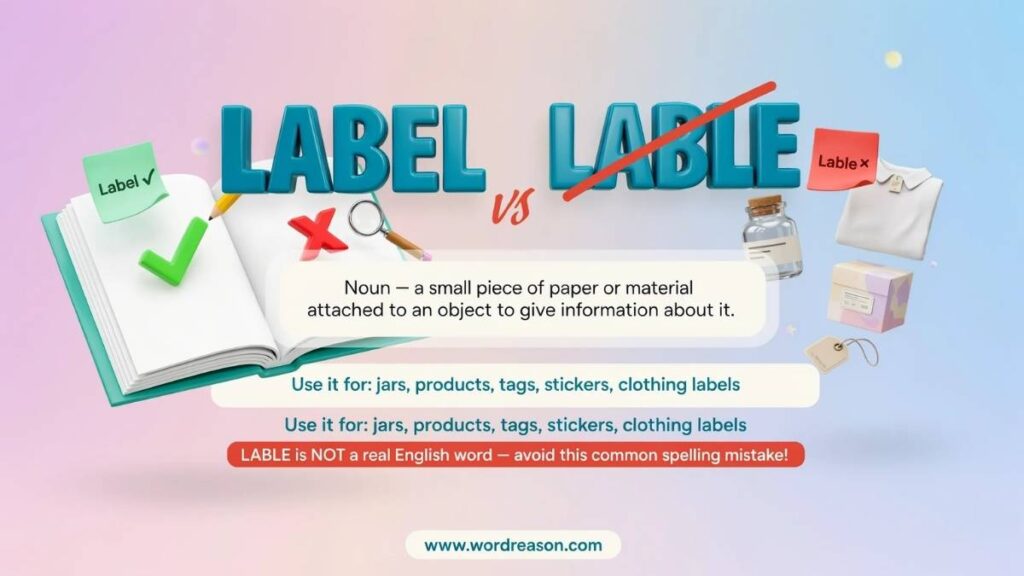
The confusion between label or lable is a common spelling mistake that can appear in emails, school assignments, product packaging, and shipping documents. Although the difference is just one letter, that tiny typo can make your writing look less polished. The good news is that the correct spelling is easy to remember once you understand the rule. In this article, you will learn the difference, explore practical examples, discover common mistakes, and test your knowledge with fill-in-the-blank exercises and answers.
Label or Lable Which Spelling Is Correct?
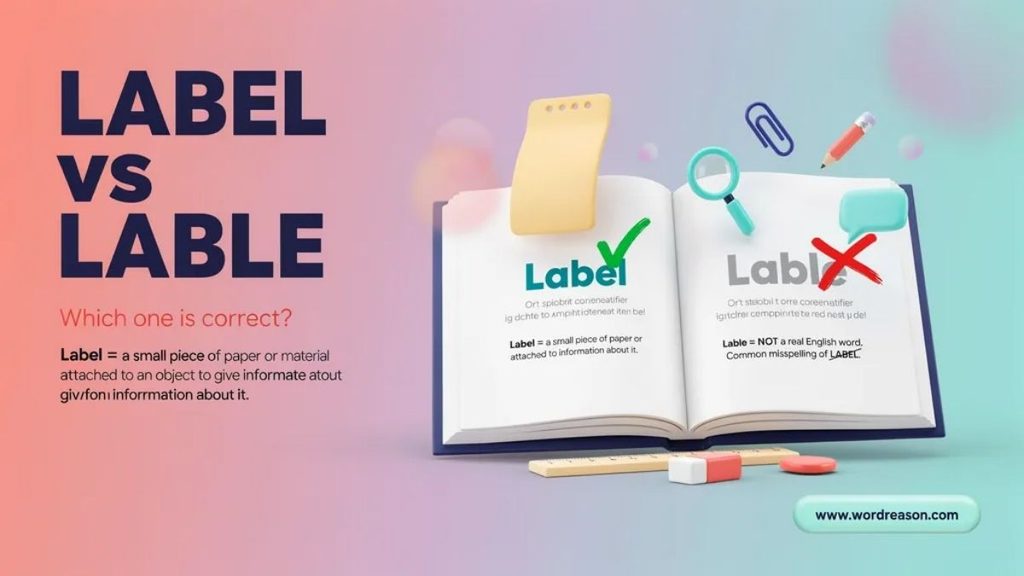
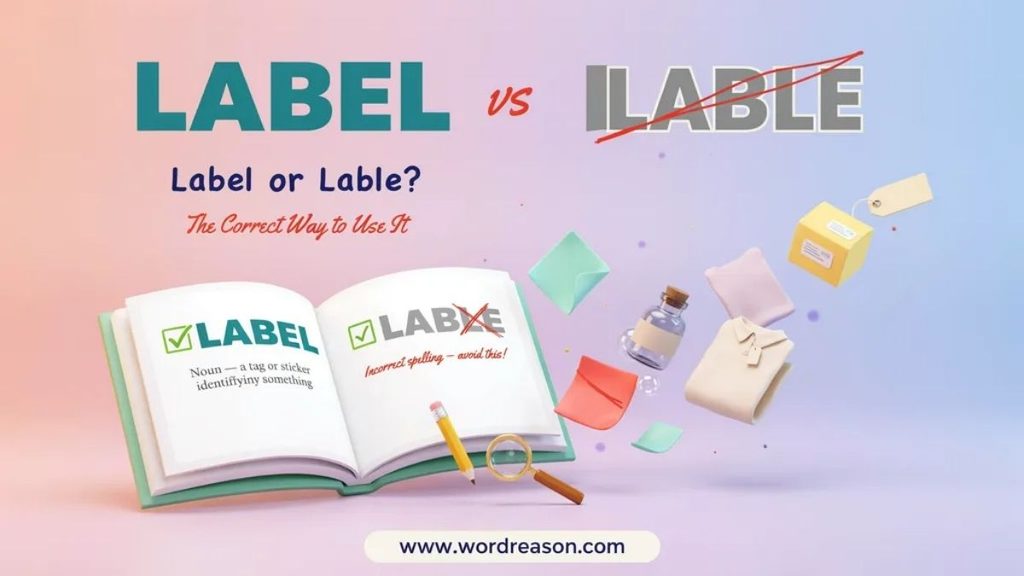
The correct spelling is label, with an e between the b and the final l. Although lable may seem reasonable when you write quickly or rely on memory, standard English dictionaries recognize label as the correct form.
The distinction does not depend on where you live. American, British, and Australian English all use label as the base word.
Label The Correct Spelling
The word label has several meanings. As a noun, it refers to a tag, sticker, printed description, or identifying name. As a verb, it means to attach identifying information to something or assign a name or category.
For example, you might read a label on a bottle to check its ingredients. You might also label a box before putting it into storage. In both cases, the word follows the same spelling.
Lable The Incorrect Spelling
The spelling lable usually appears when someone forgets the e before the final l. It can also result from typing too quickly or overlooking an error during proofreading.
Consider these examples
| Incorrect sentence | Correct sentence |
|---|---|
| Please lable each box before moving. | Please label each box before moving. |
| The lable lists the ingredients. | The label lists the ingredients. |
| She forgot to lable the diagram. | She forgot to label the diagram. |
These corrections follow standard English spelling rules. Unless you are referring to a specific name or specialized term, use label whenever you mean an identifying tag or the act of identifying something.
Learn the difference between confusing more English words
Likeable or Likable Which Spelling Is Correct ?
What Does ITs Mean in English?
The label definition covers both an identifying item and the act of identifying or classifying something. Its precise meaning depends on the context.
For instance, a label on a food package provides information about its contents. A label on a folder helps you organize documents. In a conversation, a label may describe a person’s identity, role, or behavior.
The word appears in business, education, science, technology, music, and everyday communication. Although these situations differ, the basic idea remains the same: a label helps identify or describe something.
Label as a Noun
When you use label as a noun, you refer to a piece of information, a tag, or a description that identifies something.
Physical labels often provide practical details. A clothing label may show the fabric composition and washing instructions, while a shipping label identifies the destination of a package. Figurative labels classify people, ideas, or behaviors.
| Type of label | Meaning | Example |
|---|---|---|
| Product label | Information about a product | Read the label before using the cleaner. |
| Shipping label | Information needed to deliver a package | Attach the shipping label to the box. |
| Address label | A sender’s or recipient’s address | Write the address on the label. |
| Warning label | Information about a possible hazard | Check the warning label before operating the machine. |
| Category label | A name that identifies a group | Add a category label to each file. |
| Clothing label | Information about fabric, size, or care | Check the clothing label before washing the shirt. |
| Record label | A company that produces or distributes music recordings | The singer signed with a record label. |
| Social label | A description applied to a person or group | She did not want a label to define her. |
As these examples show, a label does not always refer to a physical object. It can also describe an idea or classification.
Label as a Verb
When you use label as a verb, you describe the action of attaching identifying information or assigning a name or category.
The verb appears in everyday instructions, schoolwork, research, business operations, and discussions about people.
For example, a teacher might ask students to label the parts of a diagram. A warehouse worker may label packages before shipping them. A researcher might label samples to keep test results organized.
The word also has a figurative meaning. If someone labels another person as careless after one small mistake, that person assigns a description based on limited information.
Label Meaning in Different Contexts
Context helps determine what a label communicates. In science, a label identifies a specimen, structure, or part of a diagram. In business, labels help workers organize inventory and track shipments.
the technology, labels classify emails, files, and database entries. An email application might let you assign labels such as Work, Personal, or Urgent so you can find messages more easily.
In relationships, a label describes how people define their connection. Someone who asks whether a couple wants to put a label on their relationship usually wants to know whether they consider themselves dating, partners, or something else.
These meanings differ, but the spelling never changes. Use label in each context.
Learn the difference between confusing more English words
Cosy or Cozy Which Spelling Is Correct?
Label in a Sentence Practical Examples
Examples make it easier to understand how a word works in everyday writing. The following sentences show how to use label naturally in different situations.
Everyday Examples of Label
The label on this bottle has started to peel off.
Please put a label on the lunch container.
Each suitcase needs a name label.
I could not read the label because the print was too small.
She used colored labels to organize her notebooks.
Examples of Label as a Verb
Remember to label the box before putting it into storage.
The teacher asked the students to label the diagram.
Workers label products before sending them to stores.
The researcher labeled each sample with a unique number.
Avoid labeling someone based on a single mistake.
Examples of Label in Business and Science
The shipping label contains the delivery address.
The manufacturer updated the product label to include new information.
The scientist labeled each laboratory sample before testing it.
The team added a category label to every database entry.
The chart needs clear labels so readers can understand the data.
These examples also show how the word changes with its grammatical role. A label identifies something, while the verb label describes an action.
Learn the difference between confusing more English words
Kindergarten or Kindergarden what it really means?
Spelling in American English vs British English
English has several regional spelling conventions. For example, American English uses color, while British English generally uses colour. The base word label does not follow that pattern because both varieties spell it the same way.
However, certain forms change when you add endings. American English usually keeps one l in labeled and labeling, while British and Australian English commonly double the l in labelled and labelling.
American and British Label Spelling Comparison
| Word form | American English | British English | Australian English |
|---|---|---|---|
| Base form | Label | Label | Label |
| Plural noun | Labels | Labels | Labels |
| Present tense | Labels | Labels | Labels |
| Past tense | Labeled | Labelled | Labelled |
| Past participle | Labeled | Labelled | Labelled |
| Present participle | Labeling | Labelling | Labelling |
| Process noun | Labeling | Labelling | Labelling |
These are the usual spelling conventions. Individual publications may follow a particular style guide, so consistency matters when preparing professional writing.
Labeled or Labelled Which Is Correct?
Both labeled and labelled are correct. The appropriate choice depends on the English variety you follow.
American English generally uses labeled, while British and Australian English commonly use labelled.
For example, an American writer might say, The technician labeled every sample. A British writer would generally write, The technician labelled every sample.
The same distinction applies to sentences such as The packages were labeled yesterday and The packages were labelled yesterday.
Neither form is the same as lable. The difference concerns the number of l letters in the past-tense form, not the spelling of the base word.
Labeling or Labelling Understanding the Difference
The same regional pattern applies to labeling and labelling. American English generally uses labeling, while British and Australian English commonly use labelling.
For example, an American writer might write, Labeling the containers took an hour. A British writer would typically write, Labelling the containers took an hour.
The difference reflects regional spelling conventions for certain words ending in l when writers add endings. British English generally doubles the final l in these forms, while American English usually does not.
If you are writing an article in American English, use labeled and labeling. If you are following British English conventions, use labelled and labelling. Keeping the same pattern throughout your writing makes the text easier to read and more professional.
Learn the difference between confusing more English words
Outting or Outing What it really means?
Why Do People Confuse Label or Lable?
At first glance, lable may seem like a reasonable spelling. English contains many words whose pronunciation does not clearly reveal their spelling. However, standard spelling depends on established written forms, not simply on how a word sounds.
Pronunciation and Spelling Do Not Always Match
The word label is commonly pronounced /ˈleɪbəl/. It has two syllables, with the stress on the first syllable.
Because the final syllable contains an unstressed vowel sound, some writers may remember the pronunciation without remembering the exact letter sequence. That can lead to the incorrect form lable.
This example shows why pronunciation and spelling are not always interchangeable. English spelling reflects established word forms, which sometimes require separate memorization.
Typing Errors and Autocorrect
Fast typing can cause letters to disappear or appear in the wrong order. If you type lable instead of label, you might not notice the mistake because the two forms look similar.
Autocorrect and spelling tools can help, but they do not catch every error. Some tools may also struggle with unusual names or specialized terms.
For that reason, proofreading remains useful even when you rely on digital writing tools.
Learn the difference between confusing more English words
Ambience or Ambiance Which Spelling Is Correct?
Confusion About English Spelling Rules
English has many spelling patterns, but those patterns do not apply without exceptions. Writers may remember a rule incorrectly or assume that one word follows the same pattern as another.
Instead of guessing from pronunciation, learn the standard spelling of frequently used words. A dictionary can confirm the correct form whenever you are unsure.
How to Remember the Correct Spelling of Label
Remember the letter sequence L-A-B-E-L. The word contains lab followed by el, so the e comes before the final l.
You can also connect the spelling to a familiar phrase, such as read the label or label the box. Using the word in meaningful sentences helps reinforce the correct form.
Learn the difference between confusing more English words
Curtsy or Curtsey Which Spelling Is Correct?
Common Spelling Mistakes With Label
The most obvious mistake is writing lable, but related errors can also cause confusion when you use the word in different contexts.
Writing Lable Instead of Label
This is the central spelling error. The incorrect form usually appears when a writer omits the e before the final l.
Incorrect The lable contains the manufacturer’s information.
Correct The label contains the manufacturer’s information.
When you spot this error, replace lable with label unless you are referring to a specific name or another established term.
Learn the difference between confusing more English words
Lieing or Lying Which Spelling Is Correct?
Mixing American and British Spellings
Another common problem is mixing regional spelling conventions in the same document.
For example, an American English article might use labeled in one paragraph and labelled in another. Both forms exist, but switching between them without a clear reason can make the writing look inconsistent.
Choose a style and follow it throughout your article, report, or website.
Confusing a Label With a Tag or Sticker
The words label, tag, and sticker can describe similar objects, but they do not always mean the same thing.
| Word | Typical meaning | Example |
|---|---|---|
| Label | Information that identifies or describes something | A label lists a shirt’s fabric content. |
| Tag | A small attached marker or identifying item | A price tag shows the cost of a shirt. |
| Sticker | An adhesive piece of paper or plastic | A sticker decorates a notebook. |
A label may appear directly on packaging, on a tag, or on an adhesive sticker. The best word depends on the object’s purpose and form.
Using the Wrong Form of Label
Grammar matters as much as spelling. The correct form depends on the sentence.
| Sentence | Grammatical use |
|---|---|
| I label the folders every Friday. | Present tense |
| I labeled the folders yesterday. | American English past tense |
| I labelled the folders yesterday. | British English past tense |
| I am labeling the folders now. | American English present participle |
| I am labelling the folders now. | British English present participle |
| The labels are on the desk. | Plural noun |
These forms serve different grammatical purposes, so you should not swap them freely. For example, She labels the box describes a regular action, while “She labeled the box” describes a completed action in American English.
Learn the difference between confusing more English words
Devide or Divide Which Spelling Is Correct?
Label Pronunciation and Word Forms
Knowing how a word sounds and how it changes grammatically helps you use it confidently.
How to Pronounce Label
The common pronunciation of label is /ˈleɪbəl/ in the International Phonetic Alphabet.
The first syllable carries the stress, while the second syllable remains unstressed. This pronunciation may help explain why some writers find the spelling less intuitive than it looks.
However, pronunciation does not change the correct spelling. Whether you say the word aloud or use it in writing, the standard base form remains label.
The Different Forms of Label
The word changes according to number, tense, and grammatical function.
| Form | Grammatical use | Example |
|---|---|---|
| Label | Base verb or singular noun | Label the folder. |
| Labels | Plural noun or third-person singular verb | She labels the folders. |
| Labeled | American past tense or past participle | He labeled the package. |
| Labelled | British and Australian past tense or past participle | He labelled the package. |
| Labeling | American present participle or gerund | Labeling files saves time. |
| Labelling | British and Australian present participle or gerund | Labelling files saves time. |
| Labeler or labeller | A person or device that applies labels | The labeler printed the tags. |
Each form serves a different purpose. For instance, labels can refer to several identifying tags, while labels can also describe what one person does She labels the folders every morning.
Learn the difference between confusing more English words
Devide or Divide Which Spelling Is Correct?
The Origin and History of Label
The history of label helps explain why dictionaries treat it as an established English word rather than a spelling that depends on pronunciation.
The word entered English through older forms associated with Middle English and Anglo-French. Its earlier history connects to a strip or piece of material. Over time, its meaning expanded to include identifying marks, written descriptions, and acts of classification.
As trade, manufacturing, shipping, and recordkeeping developed, labels became useful for identifying products, organizing goods, and communicating information quickly.
Today, labels appear on everything from food packaging to digital files. Despite the word’s expanding uses, the standard spelling of its base form remains label.
Learn the difference between confusing more English words
Congratulations or Congradulations? which Spelling is Correct?
How to Check the Correct Spelling of Label
If you are unsure whether a word is spelled correctly, consult a reliable dictionary instead of guessing from its pronunciation.
Merriam-Webster, Cambridge Dictionary, Oxford Learner’s Dictionaries, and Collins Dictionary provide useful information about standard spelling, definitions, pronunciation, and grammatical forms. These references also help clarify regional differences in words such as labeled and labelled.
Can a Spelling and Grammar Checker Help?
Yes. A spelling and grammar checker can often identify lable as a likely misspelling and suggest label instead.
However, automated tools are not perfect. They may overlook errors or flag unusual names and specialized terms that are intentional.
For better results, check unfamiliar words in a dictionary, review the sentence to confirm the correct grammatical form, and keep your regional spelling conventions consistent. Finally, read the text once more before publishing or sending it.
Learn the difference between confusing more English words
Inter vs Intra what it really means?
fill in the blanks
Complete each sentence with the correct word or form: label, labels, labeled, labelling, or lable.
Questions
- The correct spelling of the word is ______.
- Please read the product ______ before using it.
- The shipping ______ contains the delivery address.
- The word ______ is a common spelling mistake.
- The shop assistant attached a ______ to the package.
- Food ______ provide information about ingredients.
- Please ______ each box with its contents.
- The bottle has a clear ______ on the front.
- The correct American English spelling is ______.
- The British English spelling is often written as ______.
- The factory worker printed several shipping ______.
- You should check the ______ for safety instructions.
- The teacher asked students to ______ the parts of the diagram.
- The word label can be used as a noun and a ______.
- A price ______ tells customers how much an item costs.
- The package was ______ before it was shipped.
- The word ______ should not be used instead of label.
- A brand ______ helps identify a company or product.
- The plural form of label is ______.
- In American English, the verb form is commonly spelled ______.
- In British English, the verb form is commonly spelled ______.
- A shipping ______ helps a delivery company identify a parcel.
- The product ______ lists its ingredients and expiration date.
- Please attach the correct ______ to every parcel.
- The spelling difference between labeled and labelled depends on the variety of ______.
Answer Key
- Label
- Label
- Label
- Lable
- Label
- Labels
- Label
- Label
- Label
- Labelled
- Labels
- Label
- Label
- Verb
- Label
- Labeled
- Lable
- Label
- Labels
- Labeled
- Labelled
- Label
- Label
- Label
- English
Here’s a trusted source for clear word meanings:
Frequently asked question
1. Is it shipping label or lable?
Shipping label is correct. A shipping label displays information such as the sender address, recipient address, tracking number, and barcode. Lable is a misspelling.
2. What does label mean?
A label is a word, tag, sticker, or piece of information that identifies something or describes its contents, purpose, or features. For example, a bottle label may list its ingredients and brand name.
3. Why is label not spelled lable?
Label is the standard English spelling. The word follows its established spelling pattern, with an e before the final l. Lable is a common spelling mistake, not an accepted alternative.
4. What does label it mean?
Label it means to identify, name, or describe something by attaching a label or assigning a name to it. For example, you might label a storage box to show what is inside.
5. Is label or lable correct?
Label is correct in standard English. Lable is incorrect. Use label when referring to a tag, sticker, product description, or the act of identifying something.
6. What is a shipping label called?
A shipping label is also called a mailing label or parcel label. It contains the delivery details and other information a carrier needs to process and deliver a package.
7. What is another word for label?
Depending on the context, synonyms for label include tag, sticker, marker, designation, title, and classification. For packaging, tag or sticker may fit best. For describing a category, designation or classification may be more suitable.
8. What is an example of a label?
A label on a food package is one example. It may show the product name, ingredients, nutritional information, expiration date, and manufacturer details.
9. What are the four types of labels?
Four common types of labels are brand labels, descriptive labels, informative labels, and grade labels. Brand labels identify the brand, descriptive labels explain product features, informative labels provide details such as ingredients or instructions, and grade labels indicate quality or classification.
10. Is lable spelled correctly?
No. Lable is a misspelling of label. The correct spelling is label in both American and British English.
11. How do Americans spell label?
Americans spell the word label. They also generally use labeled and labeling, with one final l before the suffix. These forms differ from the common British spellings labelled and labelling.
12. Which is correct, labelled or labeled?
Both spellings are correct, but usage depends on the variety of English. American English typically uses labeled, while British English commonly uses labelled. The base word is label in both varieties.
AEO
What is the correct spelling of label?
The correct spelling is label. Lable is a misspelling.
Is lable a real English word?
No. Lable is not a standard English word. Use label when referring to a tag, sticker, product information, or a category name.
How do you remember the spelling of label?
Remember that label contains the letters l-a-b-e-l. Writing the word as label and checking the final e before the last l can help prevent the common mistake lable.
What is the plural of label?
The plural of label is labels. For example, a warehouse worker may print several labels for outgoing packages.
What is the past tense of label?
The past tense is labeled in American English and labelled in British English. Both forms mean that someone attached a label or identified something.
Is label a noun or a verb?
Label can function as both a noun and a verb. As a noun, it refers to a tag or identifying information. As a verb, it means to identify or describe something.
What is the difference between label and tag?
A label usually provides identifying or descriptive information, while a tag often refers to a small attached piece of material or a digital keyword. The words can overlap depending on the context.
How do you use label in a sentence?
Example: Please check the label on the bottle before using the product.
Conclusion
The confusion between label or lable may seem like a tiny spelling problem, but one misplaced letter can turn a perfectly good label into a spelling mistake. The correct spelling is always label, whether you are writing about a product tag, a shipping label, or information on a package. Remember, lable is not an accepted alternative, so do not let that extra letter confusion stick around! With a little practice and careful proofreading, you can avoid this common error and write with greater confidence. Now that you know the difference, test yourself with the fill-in-the-blank exercises and keep your spelling skills properly labeled!

Bella AJS
Bella AJS is an experienced blogger and passionate language enthusiast at WordReason. She specializes in English grammar, word meanings, spelling, and commonly confused words. With a clear and practical writing style, Bella helps readers understand tricky language rules without the textbook headache. Her goal is simple: make English easier, clearer, and more enjoyable one word at a time.