

Grate or Great these two words sound identical, but their meanings are worlds apart. Great describes something excellent or wonderful, while grate means to shred food or irritate someone. Imagine wishing a friend a grate day instead of a great day. That tiny spelling mistake could turn a kind message into a grammar blunder! Luckily, learning the difference is easier than you think. This guide explains both words with simple definitions, practical examples, and common mistakes. You will also find to test your knowledge and sharpen your spelling skills.
Grate or Great Quick Answer
Both are correct English words. However, they serve different purposes, so you must choose the spelling that matches your intended meaning.
IT usually functions as a verb meaning to shred food into small pieces or to annoy someone. It can also function as a noun for a metal framework that covers an opening or supports fuel in a fireplace.
Great primarily functions as an adjective. It describes something excellent, impressive, large, significant, or considerable.
Consider these examples
| Sentence | Correct word | Why it works |
|---|---|---|
| Please grate the carrots. | Grate | It describes shredding food. |
| That was a great performance. | Great | It praises the performance. |
| His constant complaints grate on my nerves. | Grate | It means irritate. |
| She made a great discovery. | Great | It describes an important achievement. |
| The fireplace grate needs cleaning. | Grate | It names a physical structure. |
If you can replace the word with shred or irritate, IT is probably correct. If excellent, wonderful, or significant fits the sentence, great is likely the word you need.
Learn the difference between confusing more English words
Ambience or Ambiance Which Spelling Is Correct?
What Does Grate Mean?

The word has several meanings in English. Depending on the context, it can describe a cooking action, an irritating experience, or a physical object made of bars.
Understanding these meanings will help you recognize when it belongs in a sentence.
Grate as a Verb Meaning to Shred Food
In cooking, it means rubbing food against a grater or another rough surface to break it into small pieces. People commonly grate cheese, carrots, ginger, chocolate, and citrus peel.
For example, a recipe might instruct you to grate Parmesan cheese over freshly cooked pasta. A baker might grate lemon zest into cake batter to add a fresh citrus flavor.
Here are some everyday examples
Please grate two carrots for the salad.
She used a fine grater to grate fresh ginger.
He grated Parmesan cheese over the pasta.
The recipe asks you to grate the lemon peel before mixing the ingredients.
You can grate cold butter into flour to distribute it throughout pastry dough.
In each example, it describes an action. It tells you what someone should do to an ingredient.
The word also has related forms. Grated describes food that someone has already shredded, while grating can describe the process of shredding.
For example, you might grate cheddar cheese, add the grated cheese to a sauce, and finish the dish with more cheese just before serving.
One small distinction matters here: a grater is the tool, while it is the action. You use a cheese grater to grate cheese.
Grate Meaning to Annoy or Irritate
IT also has a figurative meaning. When something grates on you, it annoys or irritates you, especially when the behavior or sound continues over time.
Imagine sitting through a meeting while someone repeatedly taps a pen against the table. At first, the noise might seem harmless. After twenty minutes, however, it may begin to it on your nerves.
Consider these examples
His sarcastic comments grate on his coworkers.
The constant buzzing of the machine began to grate on me.
Her habit of interrupting people really grates on her friends.
The singer voice grated on the audience.
Repeated delays can grate on even the most patient customers.
The expression grate on someone nerves describes something that irritates or tests someone patience. The correct possessive form is grate on someone nerves only when the possessive apostrophe is supplied grate on someone’s nerves.
This figurative meaning connects to the idea of scraping or rubbing. Just as friction can produce an unpleasant sensation, repeated noises or irritating habits can wear down your patience.
However, it does not always describe a physical action. When you use it to discuss behavior or emotions, it often communicates annoyance rather than literal scraping.
Grate as a Noun
IT can also function as a noun. It refers to a framework of bars, often made of metal, that covers an opening or supports something.
You may encounter a grate in a fireplace, a drainage system, or an industrial setting.
Examples include
The logs rested on the iron grate inside the fireplace.
Rainwater flowed through the metal grate beside the sidewalk.
The maintenance worker removed the drain grate to clear a blockage.
The ventilation grate allowed air to circulate through the room.
A fireplace it supports logs while allowing air to circulate around the fire. A drain grate covers an opening while allowing water to enter the drainage system.
Although both objects may feature metal bars, their purposes differ. A fireplace grate supports fuel, while a drain grate protects an opening and allows water to pass through.
Do not confuse this with grater. A grater is a kitchen tool, whereas a grate can be an action, an irritating effect, or a physical structure.
Grate in Sentences
The following examples demonstrate how context changes the meaning of this.
| Example sentence | Meaning |
|---|---|
| Grate the carrots before adding them to the bowl. | Shred food |
| The alarm sound began to grate on me. | Irritate |
| The fireplace grate needed cleaning. | Metal framework |
| She grated fresh nutmeg over the dessert. | Shred an ingredient |
| His constant complaints grate on everyone in the office. | Annoy |
| Leaves covered the metal grate near the curb. | Drain covering |
The surrounding words usually reveal which meaning applies. Cooking instructions point to shredding, phrases about nerves suggest irritation, and references to fireplaces or drains indicate a physical structure.
Learn the difference between confusing more English words
Curtsy or Curtsey Which Spelling Is Correct?
What Does Great Mean?

IT is primarily an adjective with several related meanings. It can describe excellent quality, impressive ability, considerable size, or major importance.
People use it in everyday conversations, school assignments, professional writing, historical descriptions, and many other situations.
Unlike grate, great does not mean to shred food or irritate someone. Instead, it describes a quality, degree, or characteristic.
Great Meaning Excellent or Very Good
One of the most common meanings of it is excellent or very good.
You might describe a meal as great, praise a friend presentation as great, or call a vacation great because you enjoyed it.
Examples include
That was a great movie.
You did a great job on the presentation.
We had a great experience at the hotel.
She came up with a great idea for the school project.
The restaurant serves great food.
Your explanation was clear and great.
In these sentences, it expresses a positive judgment. It tells the reader or listener that something meets a high standard or creates a favorable impression.
The word also appears frequently in casual conversation.
For example, someone might ask, Would you like to join us for dinner? You could respond, Great! See you there.
Here, great communicates enthusiasm or approval. It does not describe physical size or historical importance. Instead, it signals that you like the idea.
Although great often expresses praise, its meaning depends on context. In a phrase such as a great deal of work, the word emphasizes quantity rather than quality.
Great Meaning Large or Significant
IT can also describe something considerable in size, amount, degree, or extent.
For example, the phrases a great distance, a great deal of money, and great effort refer to substantial amounts or degrees.
Consider these examples
The explorers traveled a great distance across the desert.
She spent a great deal of time preparing for the examination.
The repair required great effort.
The project involved a great amount of planning.
The company experienced great demand for its new product.
In these sentences, great emphasizes how much, how far, or how extensively something occurs.
It is especially common in the established expression a great deal, which can mean a large amount or extent.
For example, Learning a new language requires a great deal of practice means that learning a language requires substantial practice.
However, great does not always mean physically enormous. It can describe an abstract quantity, such as effort, responsibility, concern, or interest.
Great Meaning Remarkable or Distinguished
Another important meaning of great relates to exceptional ability, achievement, influence, or importance.
A great scientist may have made discoveries that changed scientific understanding. Great athlete may have achieved extraordinary results. A great leader may have influenced the course of history.
Examples include
Marie Curie made great contributions to science.
The athlete achieved great success through years of training.
The invention represented a great achievement in engineering.
The historical leader had a great influence on the country.
The team showed great determination during the final match.
In these examples, great describes something remarkable or worthy of recognition.
The word can express admiration, but it can also describe historical importance without making a judgment about someone character. For example, a historical figure may have had a great influence on political events even when people disagree about that person decisions.
Context matters because great can describe impact, skill, importance, or excellence rather than simply meaning good.
Great in Sentences
These examples demonstrate the different ways writers use great.
| Sentence | Meaning of great |
|---|---|
| We watched a great film last night. | Excellent |
| She has a great sense of humor. | Exceptional |
| The town lies a great distance from the capital. | Considerable |
| The discovery had great scientific importance. | Significant |
| He made great progress in mathematics. | Substantial |
| The musician became a great influence on younger performers. | Important or influential |
When you use this, ask yourself what quality you want to emphasize. Are you praising something, describing a large amount, or highlighting an important achievement? That question will help you select the right meaning.
Learn the difference between confusing more English words
Lieing or Lying Which Spelling Is Correct?
Key Differences
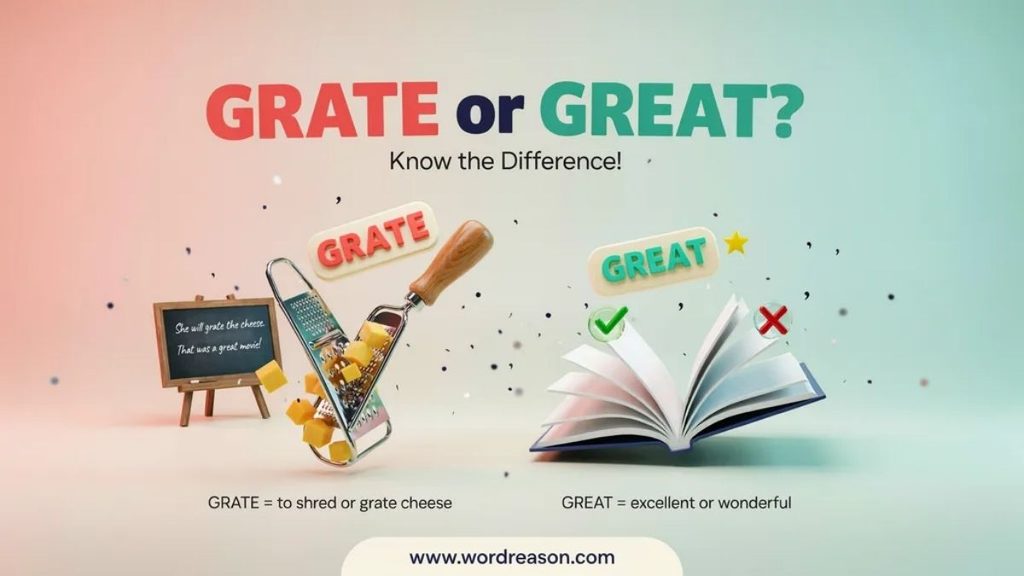
The main difference between , is their meaning, not their pronunciation.
Both words are pronounced /ɡreɪt/ in standard American English. However, they perform different grammatical roles and appear in different contexts.
| Feature | Grate | Great |
|---|---|---|
| Main grammatical role | Verb or noun | Primarily an adjective |
| Primary meanings | Shred, irritate, or a framework of bars | Excellent, large, important, or remarkable |
| Common context | Cooking, irritation, fireplaces, drainage | Praise, achievement, size, importance |
| Example | Grate the cheese. | The cheese tastes great. |
| Related expression | Grate on someone’s nerves | A great idea |
| Common synonyms | Shred, scrape, irritate | Excellent, wonderful, significant |
| Pronunciation | /ɡreɪt/ | /ɡreɪt/ |
What Is the Difference Between in a Sentence?
Compare these pairs to see how changing one letter changes the meaning.
Cooking
Correct Please grate the cheese.
Different meaning The cheese is great.
The first sentence gives an instruction. The second praises the cheese.
Compliments
Incorrect You did a grate job.
Correct You did a great job.
The correct sentence praises someone performance. it does not fit because the sentence has nothing to do with shredding or irritation.
Irritation
Correct The loud noise grates on my nerves.
Different meaning: The loud noise is great.
The first sentence says the noise is annoying. The second describes it positively, which may not match the intended message.
Achievement
Correct She made a great discovery.
Incorrect for the intended meaning She made a grate discovery.
The discovery is important or impressive, so great is the correct choice.
These examples show why spelling matters even when two words sound identical.
Learn the difference between confusing more English words
Devide or Divide Which Spelling Is Correct?
How to Choose the Correct Word

Choosing between them becomes easier when you focus on meaning before spelling.
Instead of asking which word looks right, identify the idea you want to express. Then choose the word that matches it.
Use Grate When You Mean Shred
Choose this when someone needs to break food into small pieces using a grater or a similar tool.
Examples include instructions such as Grate the mozzarella before adding it to the pizza, She grated fresh ginger into the soup, and The instructions say to grate one medium carrot.
A quick substitution test can help. If you can replace grate with shred without changing the basic meaning, this is likely correct.
For instance, it the carrots and Shred the carrots communicate similar instructions, although the texture and method can vary depending on the tool.
Use Grate When You Mean Irritate
Use this when you describe something that annoys someone, especially when the irritation continues over time.
Examples include The constant ringing grates on my nerves, His rude remarks grate on his colleagues, and The repetitive sound grated on everyone in the room.
Try replacing grate with irritate. If the sentence still makes sense, you probably need this.
The constant ringing irritates me expresses the same basic idea as The constant ringing grates on me.
Use Great When You Mean Excellent
Choose this when you want to describe something positively or express approval.
Examples include That was a great idea, The students gave a great performance, We had a great weekend, and She is a great teacher.
A useful test is to replace great with excellent or wonderful.
That was an excellent idea makes sense, so great is the correct choice in That was a great idea.
This trick works for many everyday uses, although no single synonym fits every meaning of great.
Use Great When You Mean Significant or Considerable
Use great when you want to emphasize importance, extent, or degree.
Examples include The decision had a great impact on the organization, She showed great courage during the emergency, The researchers made great progress, and The task required a great deal of patience.
In these sentences, excellent would not always preserve the intended meaning. Instead, consider synonyms such as substantial, significant, or considerable.
For example, The researchers made significant progress expresses nearly the same idea as The researchers made great progress.
Learn the difference between confusing more English words
Congratulations or Congradulations? which Spelling is Correct?
Why Do People Confuse them?
IT and great are commonly confused words because they sound alike. When you hear either word in conversation, you cannot tell which spelling the speaker intends without considering the context.
This makes the pair a classic example of English homophones.
they Are Homophones
A homophone is a word that shares its pronunciation with another word but has a different spelling or meaning.
Grate and great are homophones because both are pronounced /ɡreɪt/ in standard American English.
Other familiar examples include brake and break, right and write, pair and pear, flour and flower, and sea and see.
Homophones create spelling challenges because pronunciation alone cannot identify the correct word.
For example, if someone says, That was a great performance, you understand the meaning from the context. However, when typing the sentence, you must remember to use great rather than grate.
This is why proofreading should involve more than checking whether a word is spelled correctly. A spellchecker may accept both words because both exist in English.
Common Spelling Mistakes
The following examples show mistakes that can occur when writers choose the wrong homophone.
| Incorrect sentence | Correct sentence | Explanation |
|---|---|---|
| That was a grate movie. | That was a great movie. | Great describes an excellent movie. |
| Please great the cheese. | Please grate the cheese. | Grate means to shred the cheese. |
| You did a grate job. | You did a great job. | Great expresses praise. |
| The noise is great on my nerves. | The noise grates on my nerves. | Grates means irritates. |
| We had a grate vacation. | We had a great vacation. | Great describes a positive experience. |
| She made a grate discovery. | She made a great discovery. | Great describes an important discovery. |
The error often occurs because the writer focuses on how the word sounds rather than what it means.
A simple proofreading habit can prevent most of these mistakes: read the entire sentence and check whether the chosen word expresses the intended idea.
Learn the difference between confusing more English words
Inter vs Intra what it really means?
Everyday Examples
The best way to learn a commonly confused word pair is to see how each word works in realistic situations.
Grate or Great in Cooking
Cooking provides some of the clearest examples because it frequently appears in recipes.
Imagine that you are making a cheese sauce. A recipe might say, it one cup of cheddar cheese and stir it into the warm milk.
Here, it describes the action you need to perform.
Now consider this sentence The cheddar cheese gives the sauce a great flavor.
In this example, great describes the quality of the flavor.
Both words can appear in the same recipe, but they perform different jobs.
Other examples include Grate the carrots and mix them into the batter, The grated ginger gives the soup a fresh aroma, and This recipe is great for a quick weeknight dinner.
A small spelling mistake can make a recipe confusing. Great the carrots does not communicate the intended cooking instruction.
in Text Messages and Conversations
In casual conversations, great often expresses excitement, agreement, or approval.
For example
Are we still meeting at six?
Great! See you then.
The word communicates a positive response.
it is less common in everyday conversation unless someone describes an irritating sound, behavior, or situation.
Consider this exchange
Why do you look annoyed?
The constant buzzing from my phone is starting to grate on me.
The distinction remains the same in text messages, emails, and social media posts. Informal writing does not change the meanings of these words.
in School and Professional Writing
Both words appear in academic and professional contexts, although their uses differ.
A student might write, The experiment produced a great improvement in the accuracy of the results.
Here, great describes the extent of the improvement.
A cooking instructor might write, Grate the cheese before adding it to the mixture.
In a workplace report, a writer could say, The repeated interruptions began to grate on the team.
This sentence uses grate figuratively to describe irritation.
Professional writing benefits from accurate word choice because even a small spelling error can distract readers or make a sentence seem careless.
A Quick Comparison in Context
| Situation | Correct example | Why |
|---|---|---|
| Preparing dinner | Grate the Parmesan cheese. | Describes a cooking action |
| Praising a meal | The pasta tastes great. | Describes quality |
| Describing an annoying sound | The scraping noise grates on me. | Expresses irritation |
| Praising a performance | She gave a great performance. | Expresses approval |
| Referring to a fireplace | The wood rests on the grate. | Names a physical structure |
| Describing an achievement | They achieved great success. | Emphasizes importance or degree |
Notice how context provides the answer every time. You do not need to guess based on pronunciation.
Learn the difference between confusing more English words
Label or Lable which Spelling is correct?
Pronunciation
One reason people confuse grate and great is that they share the same pronunciation.
In standard American English, both words have the International Phonetic Alphabet transcription /ɡreɪt/.
The sound begins with /ɡ/, followed by /r/, then the vowel sound /eɪ/, as in day, and ends with /t/.
Because the spoken forms match, you generally cannot identify the correct spelling by listening alone.
Context provides the answer.
Grate the cheese makes sense as a cooking instruction.
The cheese tastes great makes sense as a compliment.
The sound grates on me describes irritation.
That sounds great expresses approval.
Pronunciation stays the same, but grammar and meaning determine the spelling.
Learn the difference between confusing more English words
Salvadoran or Salvadorian Which Spelling Is Correct?
The Origin of Grate and Great
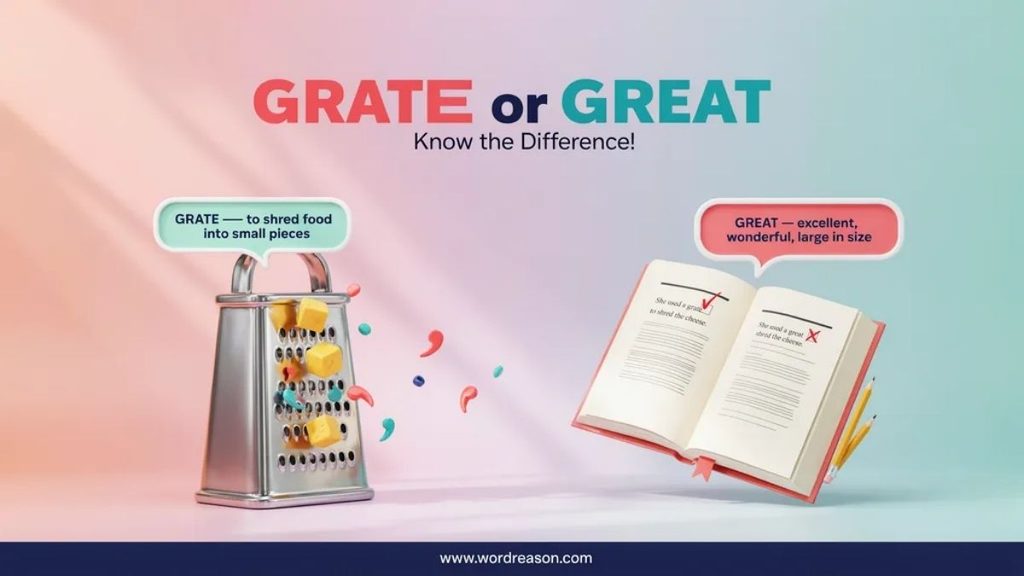
Although it sound alike today, they have different histories. Their modern meanings developed through separate word histories.
Origin and Development of Grate
The verb entered English through Middle English and Old French, with roots associated with scraping or scratching. Its history connects to the idea of rubbing a surface, which helps explain its modern cooking and irritation meanings.
When you grate cheese, you scrape it against a rough surface until it breaks into small pieces. The physical action reflects the word historical connection with scraping.
The figurative meaning also follows a similar pattern. An unpleasant noise or repeated behavior can seem to rub against your patience, creating irritation.
The noun this has a related but distinct history. It developed from words associated with a lattice or framework of bars. Its modern meaning appears in objects such as fireplace grates and drain grates.
Origin and Development of Great
Great developed from Old English grēat, meaning large or big. Over time, its meaning expanded beyond physical size.
Today, great can describe excellence, importance, influence, ability, or considerable degree.
The connection between these meanings remains visible in modern English.
For example, a great distance reflects the sense of considerable extent, while a great achievement emphasizes importance or distinction.
Likewise, calling someone a great artist often means that the person has exceptional skill or has made a lasting contribution to art.
Although the two words have similar sounds, their histories and meanings are distinct.
Learn the difference between confusing more English words
Lilies or Lillies Which Is the Correct Spelling?
British English vs American English
There is no British versus American spelling difference between them. Both words use the same spellings and carry the same basic meanings in both varieties of English.
The correct choice depends on the meaning of the sentence rather than the country where the writer lives.
For example, British and American writers both use Please grate the cheese as a cooking instruction and That was a great performance to praise someone performance.
The spelling does not change when you move between British and American English.
This distinction matters because some English words have regional spelling variations.
Neither spelling is a regional alternative to the other. Each word has its own meaning, and substituting one for the other creates a word choice error.
Learn the difference between confusing more English words
Losses or Loses Which spelling Is Correct?
Synonyms and Related Words
Synonyms can help you understand the difference between grate and great. However, you must choose synonyms based on the specific meaning you want to express.
Synonyms for grate
IT has different synonyms depending on whether it describes shredding, irritation, or a physical object.
| Meaning | Synonyms or related words | Example |
|---|---|---|
| Shred food | Shred, rasp, scrape | Grate the carrots. |
| Irritate someone | Annoy, bother, irritate, aggravate | His comments grate on me. |
| Metal framework | Grid, grill, metal bars | The drain grate needs cleaning. |
These words are not always interchangeable.
For example, shred and grate can both describe reducing food to small pieces, but the exact result depends on the tool and method. Likewise, a grill and a grate may look similar, but their designs and purposes can differ.
Synonyms for Great
Great also has several groups of synonyms.
| Meaning | Synonyms | Example |
|---|---|---|
| Excellent quality | Excellent, wonderful, superb, fantastic | We had a great meal. |
| Large or considerable | Huge, substantial, considerable, enormous | They traveled a great distance. |
| Important or influential | Significant, major, notable, influential | The discovery had a great impact. |
| Remarkable ability | Outstanding, exceptional, impressive | She is a great musician. |
Choose the synonym that matches the intended meaning.
For example, excellent fits naturally in a great idea, while substantial works better in a great amount of work.
Great does not have one universal synonym. Its meaning changes with the context.
What Is the Difference Between Great and Grateful?
Great and grateful are different words, even though they share some letters.
Great is an adjective that means excellent, considerable, or important.
Grateful is an adjective that means thankful or appreciative.
Compare these examples
You did a great job. This praises someone performance.
I am grateful for your help. This expresses appreciation.
The words are not interchangeable. You would not normally write I am great for your help when you mean that you appreciate someone assistance.
Remember that great describes a quality or degree, while grateful describes a feeling of thankfulness.
Quick Memory Tricks
If you regularly confuse grate and great, a few simple memory tricks can help you choose the right word.
Connect Grate With a Grater
Think about a kitchen grater. You use it to grate cheese, carrots, or other ingredients.
The shared spelling makes the connection easy to remember.
Whenever you see a cooking instruction involving shredding food,it is usually the correct choice.
Connect Great With Praise
Think of a great idea, a great friend, or a great performance.
Great often expresses approval or describes something important, impressive, or substantial.
If you want to compliment someone or describe something positively, great is usually the word you need.
Use the Substitution Test
Replace the word with a synonym and see whether the sentence still makes sense.
1.If shred fits, choose grate.
2.If irritate fits, choose grate.
3.If excellent fits, choose great.
4.If significant fits, great may be appropriate.
For example, consider the sentence, The presentation was a great success. Replacing great with excellent does not sound quite as natural, but great clearly expresses a positive outcome.
Now consider, Please grate the Parmesan cheese. Replacing this with shred gives Please shred the Parmesan cheese. That makes sense, so it is the correct choice.
Fill in the Blanks
Choose the correct word to complete each sentence.
- Have a _____ day at work.
- Please _____ the cheese for the pizza.
- She is a _____ teacher.
- The loud noise began to _____ on my nerves.
- We had a _____ time at the beach.
- Use a _____ to shred the carrots.
- He did a _____ job on the project.
- Her constant complaints _____ on everyone.
- This restaurant serves _____ food.
- Please _____ some chocolate over the cake.
- You have a _____ sense of humor.
- The metal _____ covered the drain.
- That was a _____ idea.
- His annoying voice began to _____ on me.
- They made _____ progress this year.
- Could you _____ the cucumber for the salad?
- Have a _____ weekend with your family.
- The fireplace had an iron _____.
- She showed _____ kindness to everyone.
- Scraping metal can produce a harsh sound that seems to _____.
- We enjoyed a _____ performance.
- Please _____ the potatoes before cooking.
- His rude attitude began to _____ on his friends.
- It was a _____ achievement.
- I hope you have a _____ day!
Answer Session
- great
- grate
- great
- grate
- great
- grate
- great
- grate
- great
- grate
- great
- grate
- great
- grate
- great
- grate
- great
- grate
- great
- grate
- great
- grate
- grate
- great
- great
FAQs About Grate or Great
Have a great day or grate day?
Have a great day is correct because great means pleasant or enjoyable.
What does grate mean in grateful?
Grate is not a separate word in grateful. Grateful means thankful.
What does grate on mean?
Grate on means to annoy or irritate someone.
How do you spell grate?
Grate is spelled G-R-A-T-E.
Which is correct, grate or great?
Both are correct, but they have different meanings.
What else can I say instead of have a great day?
You can say have a wonderful day, enjoy your day, or take care.
What is another word for grate?
For shredding, use shred or scrape. For annoying, use irritate or bother.
What is a stronger word for grateful?
Deeply thankful or sincerely appreciative.
What does grate mean in simple terms?
Grate means to shred food or irritate someone.
How do you use grate in a sentence?
Grate the cheese over the pasta.
Does grate mean annoy?
Yes, grate can mean to annoy or irritate.
What is grate used for?
Grate describes shredding food, irritating someone, or a metal framework.
AEO Quick Answers
Are grate and great homophones?
Yes, they sound alike but have different meanings.
How can I remember grate and great?
Grate relates to a grater. Great means excellent.
Can great describe a person?
Yes, great can describe a talented or admirable person.
Can grate be a noun?
Yes, a grate can be a metal frame over an opening.
Is great always a compliment?
No, it can also describe size or importance.
What is the difference between grate and gratitude?
Grate means shred or irritate. Gratitude means thankfulness.
What is the opposite of great?
Depending on context, it can be poor, awful, or terrible.
Can I use grate in formal writing?
Yes, when its meaning fits the sentence.
Why do people confuse grate and great?
They sound alike but have different meanings and spellings.
conclusion
Now you know the difference between grate and great, so you can stop letting these sound alike words grate on your grammar! Remember, great means excellent or wonderful, while grate means to shred food or irritate someone. One can make your day better, and the other can make your cheese ready for pizza. Before you finish writing, take a moment to check which word fits your sentence. A tiny spelling mistake can change your meaning faster than cheese disappears from a plate. ,Make your grammar great, not grate!

Bella AJS
Bella AJS is an experienced blogger and passionate language enthusiast at WordReason. She specializes in English grammar, word meanings, spelling, and commonly confused words. With a clear and practical writing style, Bella helps readers understand tricky language rules without the textbook headache. Her goal is simple: make English easier, clearer, and more enjoyable one word at a time.