
Losses or Loses these tricky words confuse even confident writers, and one tiny spelling mistake can turn a clear sentence into a grammar game nobody signed up for. Imagine writing that your team suffered three loses instead of three losses. Ouch! The scoreboard already looks bad, so why let grammar join the losing team? Fortunately, learning the difference between losses and loses is easier than you think. This guide explains their meanings, spelling rules, and correct usage, with fill in the blanks and a separate answer session to test your skills.
Difference Between Losses and Loses
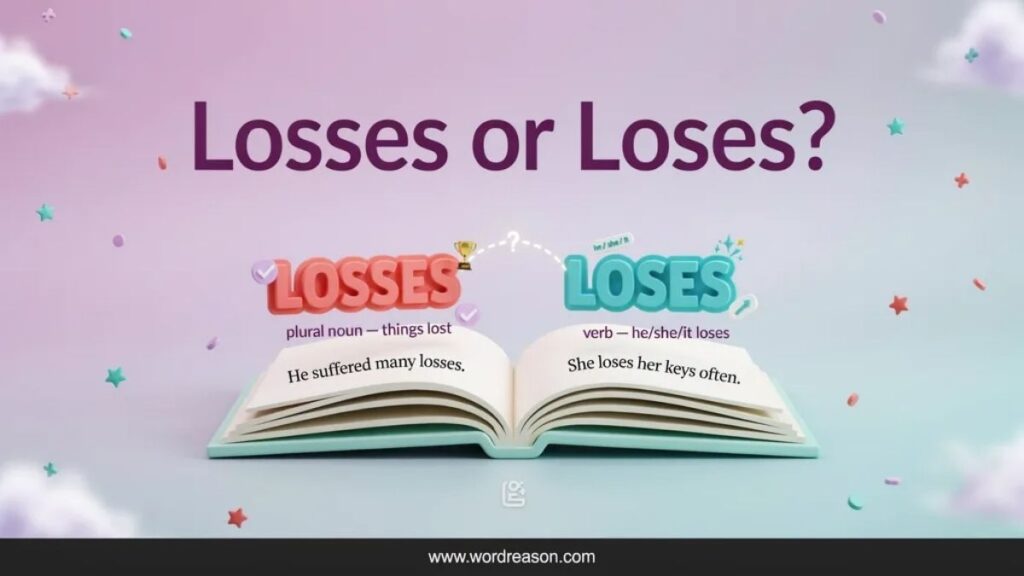
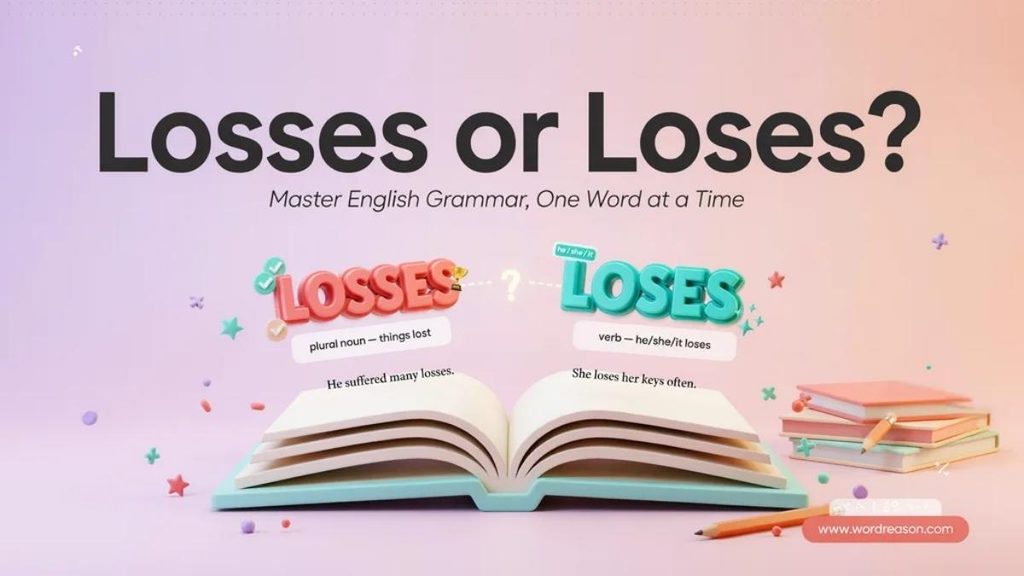
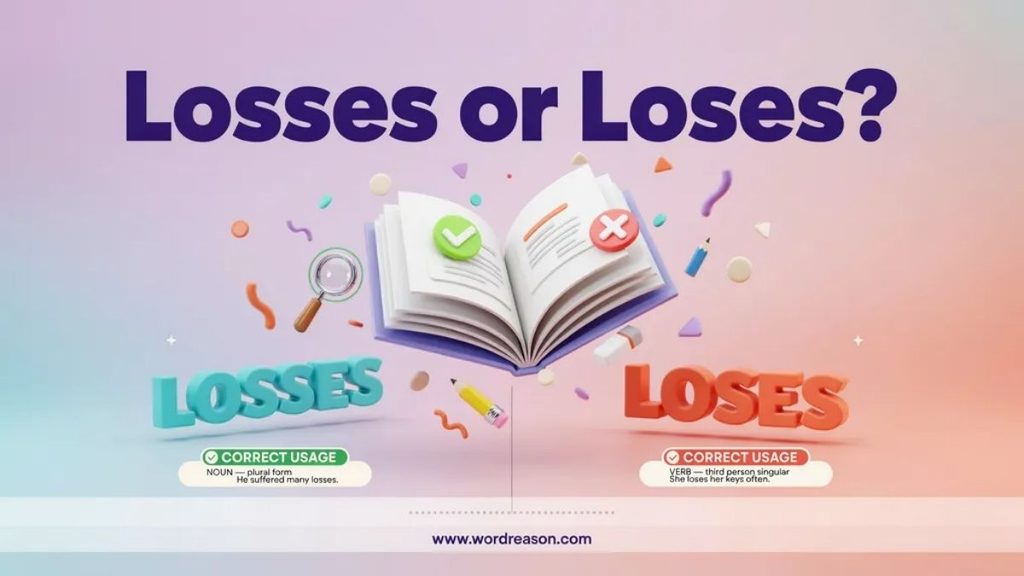
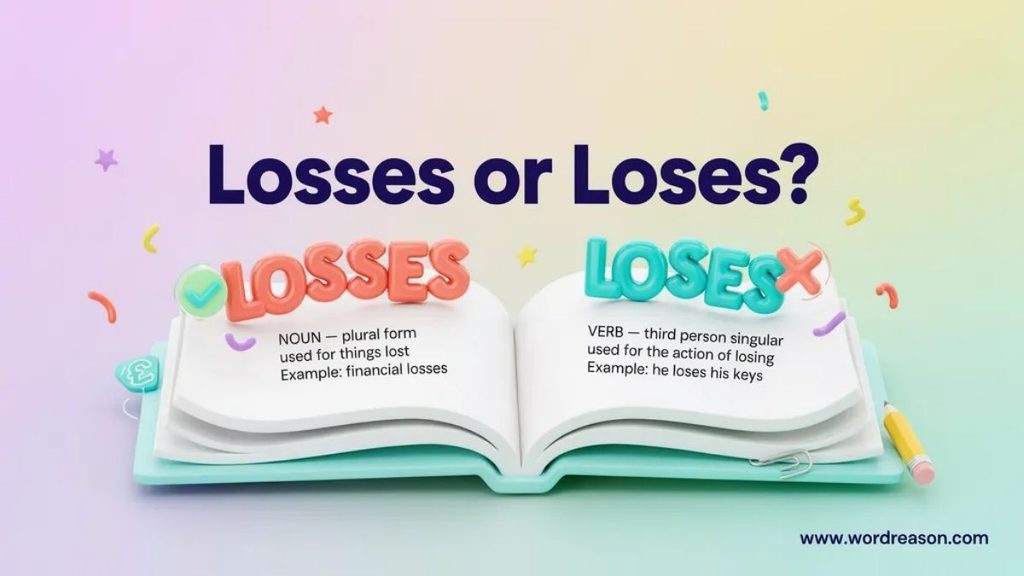
The main difference between losses and loses is their grammatical function. Loses is a verb, while losses is the plural form of the noun loss.
Use loses when you describe an action performed by a person, animal, team, business, or another subject. Use losses when you refer to multiple instances of losing, financial setbacks, defeats, or reductions.
For example, consider these two sentences
She loses her phone almost every month.
The company reported several losses during the year.
In the first sentence, loses describes an action. In the second sentence, losses names several negative outcomes.
Although the words look similar, you cannot switch them without changing the grammatical meaning of the sentence. Understanding this distinction is the key to choosing the correct spelling of losses or loses.
What Does Loses Mean?
Loses is the third person singular present tense form of the verb lose. It describes what someone or something fails to keep, find, maintain, or win.
For example, a student loses a pencil when the pencil goes missing. A football team loses a match when its opponent wins. A business loses money when its expenses or other financial setbacks leave it worse off.
The word loses usually appears with a singular subject such as he, she, it, the player, or the company.
Examples include
He loses his temper during difficult conversations.
The team loses another match.
My brother loses his glasses whenever he travels.
The company loses customers when its service declines.
In each sentence, loses expresses an action or outcome connected to the subject.
What Does Losses Mean?
Losses is the plural form of the noun loss. It refers to two or more losses, such as financial setbacks, sporting defeats, reductions, or things that have been lost.
The singular word loss describes one loss or the general experience of losing something. The plural form losses refers to multiple losses or separate instances of loss.
For example, a business might experience losses in several quarters. A team might suffer three losses during a tournament. A family might face financial losses after an unexpected expense.
Examples include
The business recorded significant losses last year.
Our team suffered four losses during the season.
The storm caused heavy crop losses.
The organization worked hard to recover from its financial losses.
In these sentences, losses names the setbacks or results rather than describing an action performed by the subject.
Learn the difference between confusing more English words
Outting or Outing What it really means?
When Should You Use Loses?
Use loses when you need a verb to describe an action in the present tense. It is the correct choice when a singular third person subject performs the action of losing.
The base verb is lose. When you use it with he, she, it, or a singular noun in the simple present tense, it usually becomes loses.
For example, write He loses his wallet instead of He loss his wallet.
The first sentence uses the correct present tense verb. The second sentence uses a noun where the sentence requires a verb.
Loses in Everyday Conversations
People use loses in ordinary conversations when talking about missing items, forgotten information, lost opportunities, or changes in behavior.
Examples
She loses her keys whenever she rushes out of the house.
He loses interest when a conversation becomes repetitive.
My friend loses track of time while reading.
The child loses his toy at the park.
The examples show that loses can describe physical objects as well as less tangible things, such as interest or track of time.
Loses in Sports and Competitions
In sports, loses describes a team or player that fails to win a game or competition.
Examples
The team loses its final match of the season.
Our school loses whenever it plays against the defending champions.
The player loses the championship after a close contest.
The club loses another game because of poor defense.
Notice that loses refers to the action or outcome involving the team or player. When you want to name the defeat itself, you usually need loss or losses instead.
For example, The team loses the match describes what happens. The team suffers another loss names the result.
Loses in Business and Finance
The verb loses also appears in business writing. It can describe declining revenue, reduced customers, falling value, or money spent without a corresponding return.
Examples
The company loses money on unprofitable products.
A retailer loses customers when prices increase too quickly.
The business loses revenue during the slow season.
The investor loses money when the value of an investment declines.
Use loses when the sentence describes what the company, retailer, business, or investor experiences or does.
However, if you are referring to multiple financial setbacks, losses is usually the correct choice.
For example, The company loses money every month describes an ongoing situation. The company reports monthly losses refers to the financial results.
Learn the difference between confusing more English words
Ambience or Ambiance Which Spelling Is Correct?
When Should You Use Losses?

Use losses when you need a plural noun that refers to multiple setbacks, defeats, reductions, or instances of losing something.
The singular noun is loss. To form its plural, add -es to create losses.
For example, one loss becomes two losses. One defeat becomes multiple defeats, and one financial setback can be part of several financial losses.
Losses in Business and Accounting
Businesses use losses to describe financial results when expenses, declines in value, or other costs exceed the relevant gains or income under the accounting measure being discussed.
Examples
The company reported substantial losses during the quarter.
The store experienced losses because of damaged inventory.
Several businesses faced financial losses after the flood.
The management team developed a plan to reduce future losses.
In financial writing, losses is especially useful when discussing results across several periods, business activities, investments, or events.
However, the word does not automatically mean bankruptcy. A business can report losses during a particular period and still continue operating.
Losses in Sports
In sports, losses refers to multiple games or competitions that a player or team failed to win.
Examples
The team finished the season with six losses.
The club hopes to avoid further losses in the tournament.
Our school recorded two losses and five wins.
The player learned valuable lessons from previous losses.
Use loss when discussing one defeat and losses when discussing more than one.
For example, The team suffered a loss describes one defeat. The team suffered three losses describes three defeats.
Losses in Everyday Life
Losses can also describe several things that someone has lost or multiple setbacks that affect everyday life.
Examples
The family faced financial losses after the unexpected repair bills.
The warehouse reported inventory losses after the inspection.
The business experienced job losses during its restructuring.
The community worked together to recover from its recent losses.
The meaning depends on context. Losses may involve money, possessions, employment, competition, or other situations in which something valuable has been lost or reduced.
Learn the difference between confusing more English words
Curtsy or Curtsey Which Spelling Is Correct?
A Closer Comparison
Now that you understand the basic meanings, compare how these words work in different sentences.
| Situation | Correct example | Why it is correct |
|---|---|---|
| Missing an object | He loses his phone frequently. | Loses describes an action. |
| Multiple sporting defeats | The team suffered three losses. | Losses names several defeats. |
| Financial decline | The business loses money each month. | Loses is the present tense verb. |
| Several financial setbacks | The business reported heavy losses. | Losses is a plural noun. |
| Losing an opportunity | She loses an important opportunity. | Loses describes what happens. |
| Multiple setbacks | The project experienced several losses. | Losses refers to multiple negative outcomes. |
| One defeat | The team suffered a loss. | Loss is a singular noun. |
| A past event | He lost his wallet yesterday. | Lost is the past tense of lose. |
The simplest way to remember the difference is to ask yourself whether the sentence describes an action or names a result.
If the sentence describes someone losing something, loses may be appropriate. If the sentence refers to several setbacks or defeats, losses is usually the right choice.
However, always check the subject and tense as well. Grammar depends on the entire sentence, not just the word you are trying to spell.
Learn the difference between confusing more English words
Lieing or Lying Which Spelling Is Correct?
Loss, Lose, Loses, Lost and Losses Explained

The confusion between losses and loses often begins with their related words. English uses several forms of lose and loss, and each one has a different role.
Understanding the complete word family makes it easier to choose the right form.
| Word | Part of speech | Main use | Example |
|---|---|---|---|
| Loss | Noun | One instance or experience of losing | The loss was unexpected. |
| Losses | Plural noun | Multiple instances of loss | The company reported losses. |
| Lose | Verb | Base form of the action | I do not want to lose my keys. |
| Loses | Verb | Present tense with a third person singular subject | She loses her keys often. |
| Lost | Past tense or past participle of lose | An action that happened earlier or is completed | He lost his wallet yesterday. |
| Losing | Verb form ending in -ing | An ongoing action or an activity used as a noun | They are losing confidence. |
Loss and Lose
Loss is a noun, while lose is a verb.
Use loss to name the experience or result of losing something. Use lose to describe the action of no longer having something, failing to win, or being unable to find something.
Examples
The loss of the documents delayed the project.
Please do not lose the documents again.
The first sentence names the event. The second sentence describes an action that someone should avoid.
Loss and Losses
Loss refers to one loss or the general condition of losing something. Losses refers to multiple instances or types of loss.
Examples
The team suffered a loss in the final.
The team suffered three losses this month.
The spelling changes because the second sentence refers to more than one defeat.
Lose and Loses
Lose is the base form of the verb. Loses is the third person singular form used in the simple present tense.
Examples
I lose my keys occasionally.
You lose focus when you are tired.
They lose their games when they stop practicing.
She loses focus when the room becomes noisy.
He loses money on unsuccessful investments.
The subject determines the correct form. Use lose with I, you, we, and they in the simple present tense. Use loses with he, she, it, or a singular noun.
Loses and Lost
Loses describes a present tense action involving a third person singular subject. Lost usually refers to a past action or serves as a past participle.
Examples
She loses her phone almost every week.
She lost her phone yesterday.
The first sentence describes a repeated or current pattern. The second refers to an event in the past.
Do not write losed or lossed as the past tense of lose. The correct form is lost.
Learn the difference between confusing more English words
Devide or Divide Which Spelling Is Correct?
Common Mistakes
Even confident English writers sometimes mix up these words because their spellings differ by only one letter. Fortunately, a few common mistakes become easy to fix once you understand the grammar.
Using Losses Instead of Loses
Incorrect: He losses his wallet every month.
Correct: He loses his wallet every month.
The subject he requires the present tense verb loses. Losses is a plural noun and cannot replace the verb in this sentence.
Using Loses Instead of Losses
Incorrect The company reported heavy loses last year.
Correct The company reported heavy losses last year.
The sentence refers to financial setbacks, so it needs the plural noun losses. The word reported does not make loses a suitable choice.
Learn the difference between confusing more English words
Congratulations or Congradulations? which Spelling is Correct?
Confusing Loss With Lose
Incorrect I do not want to loss my job.
Correct I do not want to lose my job.
The phrase do not want to requires the base form of a verb. Therefore, lose is correct.
Using the Wrong Past Tense
Incorrect She losed her favorite book.
Correct She lost her favorite book.
Lose is an irregular verb. Its past tense is lost, not losed or lossed.
Choosing a Word Without Checking the Sentence
Incorrect The team losses another match.
Correct The team loses another match.
The sentence describes the team failing to win a match. It needs a verb, so loses is correct.
By contrast, The team suffers several losses uses a noun to name the defeats.
The important lesson is simple: do not choose a word only because it looks familiar. Check what the sentence needs.
Learn the difference between confusing more English words
Inter vs Intra what it really means?
How to Choose Between Losses and Loses
You can use a straightforward method to make the correct choice whenever you are unsure.
Check Whether the Sentence Needs a Verb or a Noun
First, identify what the sentence is trying to express.
If you need to describe an action, loses may be correct. If you need to name multiple negative outcomes, losses may be correct.
For example
She loses her notebook frequently.
She has experienced several losses.
The first sentence describes an action. The second names several setbacks or losses.
Check the Subject
If you are using the verb lose in the simple present tense, check the subject.
Use loses with he, she, it, or a singular noun. Use lose with I, you, we, and they.
Examples
My sister loses her umbrella regularly.
My friends lose their umbrellas regularly.
The difference comes from subject and verb agreement.
Check Whether the Word Is Singular or Plural
When you use the noun loss, decide whether the sentence refers to one loss or several.
Examples
The loss affected the entire team.
The losses affected the entire team.
Both sentences are grammatically correct, but their meanings differ. The first refers to one loss. The second refers to multiple losses.
Learn the difference between confusing more English words
Label or Lable which Spelling is correct?
Replace the Word With a Simpler Expression
Another useful trick is to replace the word with a phrase that makes its function clearer.
If you can replace loses with fails to keep or fails to win, the verb is probably appropriate.
For example, He loses the game can become He fails to win the game.
If you can replace losses with several defeats or several setbacks, the plural noun is probably appropriate.
For example, The team suffered several losses can become The team suffered several defeats.
This technique helps you check both meaning and grammar before you finish writing.
Learn the difference between confusing more English words
Salvadoran or Salvadorian Which Spelling Is Correct?
Losses or Loses in Different Types of Writing
The distinction between these words stays the same across everyday conversations, professional emails, academic writing, social media, and formal reports. What changes is the context in which you use them.
In Emails and Workplace Communication
Professional writing often discusses performance, money, deadlines, and business outcomes.
Use loses to describe an action or ongoing result.
Example: The department loses valuable time when employees submit incomplete reports.
Use losses to describe multiple setbacks or financial results.
Example: The company recorded significant losses during the previous quarter.
Choosing the right form keeps business communication clear and professional.
In Academic Writing
Academic writing requires accurate grammar and precise word choice. Use loses when describing a subject that fails to retain something or fails to achieve a result. Use losses when referring to multiple reductions, failures, or instances of loss.
Example The experiment loses accuracy when the temperature changes.
Example The study examined biodiversity losses across several regions.
The correct choice depends on whether you are describing an action or naming multiple outcomes.
In Social Media and Text Messages
People often write quickly in messages and online posts. That makes similar words easy to confuse.
Examples
My team loses every time I watch the game.
Three losses in a row. We need a better strategy.
The first sentence describes an action. The second refers to several defeats.
Even in casual messages, correct spelling helps prevent misunderstandings.
In News and Financial Reports
News reports often use losses when discussing economic performance, business results, or sporting records.
Example The company announced significant financial losses.
A report might use loses when describing a current event or ongoing situation.
Example: The retailer loses customers as competing stores lower their prices.
The distinction remains grammatical rather than stylistic. Choose the word that fits the sentence.
Learn the difference between confusing more English words
Lilies or Lillies Which Is the Correct Spelling?
Easy Ways to Remember this
You do not need to memorize a long list of grammar rules. A few simple memory techniques can help you choose the correct form quickly.
Remember That Loses Is an Action
Think of loses as a word that tells you what someone or something does.
Examples
He loses his keys.
She loses the match.
The business loses money.
Each sentence describes an action or outcome involving a subject.
Remember That Losses Names Results
Think of losses as a noun that names setbacks or defeats.
Examples
The company suffered losses.
The team recorded five losses.
The storm caused crop losses.
Each sentence names one or more negative results.
Connect Losses to Loss
The word losses contains the complete word loss. Since loss is a noun, losses is its plural form.
Remember this pattern
One loss.
Two losses.
Several losses.
This makes the spelling easier to recall. When you refer to multiple losses, use the plural noun.
Practice Session
Complete each sentence with the correct word: losses, loses, loss, lose, lost, losing, or loose.
Fill in the Blanks
- She often ______ her keys at home.
- The team suffered three ______ this season.
- I do not want to ______ my job.
- Our team is ______ the match.
- The company reported financial ______.
- He ______ every time he plays against his brother.
- I ______ my wallet yesterday.
- Do not ______ sleep over small problems.
- The screw is too ______.
- The player learned from the teams ______.
- She does not want to ______ the competition.
- The team has more wins than ______.
- My brother ______ interest quickly.
- Losing my phone was a big ______.
- The business ______ money every month.
- The child is ______ patience.
- They experienced heavy financial ______.
- Please do not ______ your ticket.
- Our team ______ the final yesterday.
- The dog got ______ from its leash.
- The company suffered several financial ______ last year.
- He does not want to ______ his chance.
- Every player ______ something when they stop practicing.
- The unexpected job ______ upset her.
- The team keeps ______ important matches.
Answer Key
- Loses
- Losses
- Lose
- Losing
- Losses
- Loses
- Lost
- Lose
- Loose
- Losses
- Lose
- Losses
- Loses
- Loss
- Loses
- Losing
- Losses
- Lose
- Lost
- Loose
- Losses
- Lose
- Loses
- Loss
- Losing
FAQs
Which is correct, loses or losses?
Loses is a verb; losses is a plural noun.
Is it my team lose or loses?
In American English, “My team loses” is correct.
Which is correct, losing or loosing?
Losing means failing to win. Loosing means releasing something.
Which is correct: wins and losses or loses?
“Wins and losses” is correct for a record of victories and defeats.
Is losses a word?
Yes, losses is the plural of loss.
What is the difference between losses and loses?
Losses names multiple setbacks; loses describes an action.
Which is correct: loss or lose in a game?
Use loss as a noun and lose as a verb.
What does losses mean?
Losses means multiple defeats, setbacks, or reductions.
Is it loose or lose my job?
“Lose my job” is correct.
Do you lose or loose a person?
“Lose a person” is correct.
Is it loss or lost my job?
“I lost my job” is correct for a past event.
Is it lose or loose sleep?
Lose sleep is correct.
conclusion
Understanding the difference between losses and loses no longer has to feel like losing a grammar battle. Remember, loses describes an action, while losses refers to more than one setback or defeat. A quick check of your sentence can save you from confusing your readers and giving your grammar teacher an unexpected reason to celebrate. Keep practicing with the fill in the blanks, review the separate answer session, and learn from any mistakes. After all, everyone loses a point now and then, but nobody wants unnecessary spelling losses! With a little practice, you will choose the correct word confidently and keep your writing clear, accurate, and polished.

Bella AJS
Bella AJS is an experienced blogger and passionate language enthusiast at WordReason. She specializes in English grammar, word meanings, spelling, and commonly confused words. With a clear and practical writing style, Bella helps readers understand tricky language rules without the textbook headache. Her goal is simple: make English easier, clearer, and more enjoyable one word at a time.