
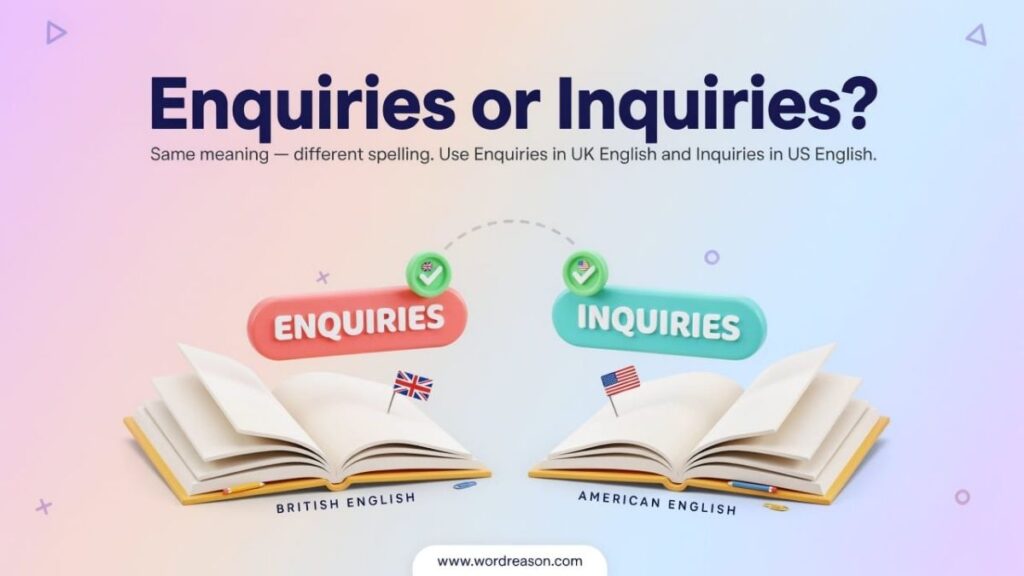
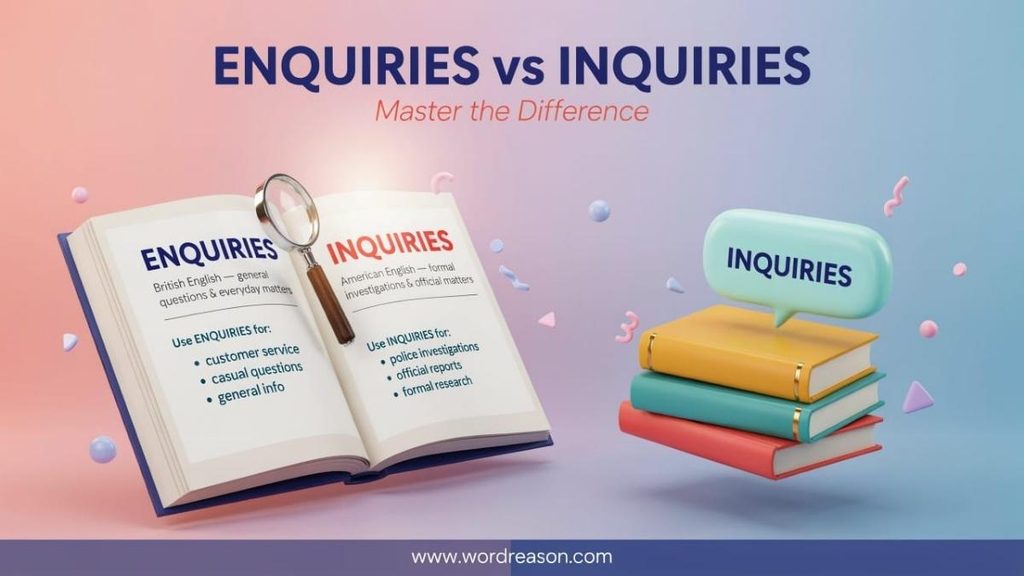
IF you typed an email, reached the word enquiries, and suddenly wondered whether inquiries would look more professional? You are not alone! The difference between enquiries or inquiries confuses many writers, but the good news is that neither spelling is wrong. The real secret lies in regional English preferences. British English commonly favors enquiries for everyday questions, while American English generally uses inquiries for both questions and investigations. Still, there is more to this spelling puzzle than swapping one letter. In this guide, you will discover the meanings, regional differences, common mistakes, and practical examples to help you write clearly and confidently.
Enquiries vs Inquiries Quick Comparison
| Feature | Enquiries | Inquiries |
|---|---|---|
| Spelling | Correct | Correct |
| British English | Common for general questions | Common for formal investigations and also accepted for general questions |
| American English | Rarely used | Standard spelling for both meanings |
| Main meaning | Requests for information | Requests for information or formal investigations |
| Verb form | Enquire | Inquire |
| Common use | Customer questions and everyday requests | Business emails, official investigations, and general questions |
| Best choice for US readers | Usually avoid | Use |
| Best choice for UK readers | Often suitable for general questions | Suitable for general questions and investigations |
Learn the difference between confusing more English words
Congratulations or Congradulations? which Spelling is Correct?
What Is the Difference Between Enquiries and Inquiries?
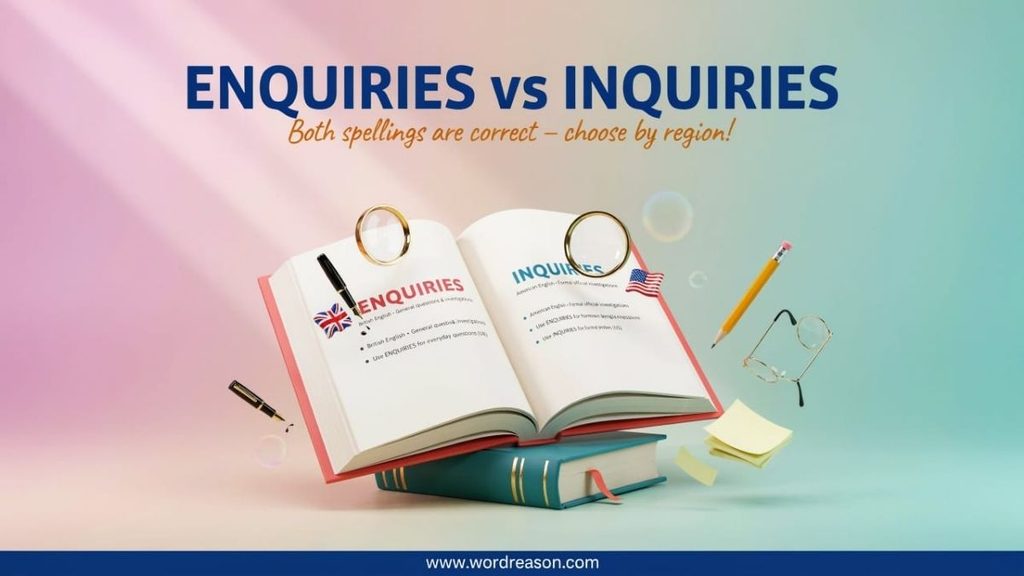
The main difference between enquiries and inquiries is regional spelling preference. Both words refer to requests for information, questions, or investigations. However, writers may choose one spelling over the other depending on their audience and the type of situation.
In British English, enquiries often refers to ordinary questions. For example, someone might make an enquiry about a course, ask about a product, or contact a hotel to check room availability.
Inquiries is also correct in British English. Some writers prefer it when discussing formal investigations, official reviews, or matters that require careful examination.
American English generally uses inquiries for both everyday questions and formal investigations. As a result, American readers are more familiar with this spelling.
Consider these examples.
| Example | Preferred spelling |
|---|---|
| A customer asks about delivery charges in the UK | Enquiry |
| A student requests information about a university course in the UK | Enquiry |
| A government investigates a public incident in the UK | Inquiry or enquiry, depending on style |
| A customer asks about a product in the US | Inquiry |
| An official investigation takes place in the US | Inquiry |
The important point is that neither spelling is inherently wrong. Your location, audience, and chosen style guide help determine which form works best.
Learn the difference between confusing more English words
Inter vs Intra what it really means?
What Does Enquiries Mean?
Enquiries is the plural form of enquiry. It refers to two or more questions or requests for information.
The word is particularly common in British English, where people often use it in everyday conversations, customer service, education, travel, and business communication.
For example, a customer might contact a company to ask about its prices. A prospective student might request information about admission requirements. Someone planning a trip might ask a hotel about available rooms.
All these situations involve enquiries.
Here are some examples in sentences.
The customer service team received several enquiries about the new product.
Our office handles enquiries about course registration and admission requirements.
The hotel responded to all guest enquiries before the weekend.
Please send your enquiries about the application process to the admissions office.
The word enquiries can appear in formal and informal writing. It is especially useful when writing for a British audience that commonly uses this spelling.
Learn the difference between confusing more English words
Label or Lable which Spelling is correct?
What Does Inquiries Mean?
Inquiries is the plural form of inquiry. It refers to multiple requests for information, questions, or investigations.
American English uses inquiries as the standard spelling in almost every context. British English also accepts this form, although some writers distinguish between enquiries and inquiries based on meaning.
For example, an American customer might send an inquiry about a refund. A government department might conduct an inquiry into a serious incident. Both uses are correct.
Consider these examples.
The company received several inquiries about its latest service.
The university answered inquiries from prospective students.
The committee launched an inquiry into the financial irregularities.
We received inquiries about the upcoming training program.
Inquiries works well in American business writing, academic communication, government documents, and everyday correspondence.
If you are unsure which spelling to choose for an American audience, inquiries is the safest option.
Learn the difference between confusing more English words
Salvadoran or Salvadorian Which Spelling Is Correct?
Enquiries or Inquiries in British English
British English recognizes both enquiries and inquiries. However, some British writers use the two forms to express slightly different meanings.
Enquiries commonly refers to ordinary requests for information. These might involve prices, opening hours, appointments, services, or general questions.
For example, a customer might contact a shop to make an enquiry about a product. A parent might contact a school to ask about enrollment. A traveler might send an enquiry about hotel facilities.
Inquiries, meanwhile, sometimes refers to formal investigations. A public inquiry might examine the causes of an accident or investigate the actions of an organization.
This distinction is a useful guideline, not an absolute rule. British dictionaries recognize overlapping usage, and some publications use inquiry for both meanings.
Here is a simple comparison.
| Situation | Common British usage |
|---|---|
| Asking about product availability | Enquiry |
| Requesting information about a school | Enquiry |
| Asking about appointment times | Enquiry |
| Examining a serious public incident | Inquiry |
| Investigating possible misconduct | Inquiry |
The choice can also depend on an organizations preferred style. If you are writing for a British company, check its existing documents or style guide before deciding which spelling to use.
Learn the difference between confusing more English words
Lilies or Lillies Which Is the Correct Spelling?
Enquiries or Inquiries in American English
American English generally favors inquiry and inquiries regardless of whether the situation involves a simple question or a formal investigation.
For example, an American business might provide an email address for customer inquiries. A college might invite inquiries from prospective students. A government agency might publish the findings of an official inquiry.
Although enquiries is a valid English spelling, it is much less common in the United States. Using inquiries will usually make your writing sound more natural to American readers.
Consider these examples.
Please direct all customer inquiries to our support department.
The company received hundreds of inquiries about its new service.
The committee opened an inquiry into the incident.
We welcome inquiries from students interested in the program.
If you write for an American audience, consistency is the easiest rule to follow. Use inquiry for the singular form and inquiries for the plural form.
Learn the difference between confusing more English words
Losses or Loses Which spelling Is Correct?
in Australian and Canadian English
English spelling varies across countries, and Australia and Canada have their own regional preferences.
Australian English generally follows many British spelling conventions. Both enquiries and inquiries appear in Australian writing, although enquiries is common for everyday requests for information.
For example, an Australian customer might make an enquiry about a delivery or send an enquiry to a university.
Canadian English often shows a mixture of British and American influences. Both forms are used, and inquiry may be more familiar in some professional or institutional settings.
The best spelling can depend on the organization, publication, or official document you are writing for.
| Region | Common preference |
|---|---|
| United Kingdom | Enquiries for everyday questions; inquiries also accepted |
| United States | Inquiries for both questions and investigations |
| Australia | Enquiries is common, with inquiries also used |
| Canada | Both forms appear, depending on context and style |
When writing for an international audience, consider using inquiries because it is widely recognized and standard in American English. However, if your organization consistently uses enquiries, there is no need to change its established spelling without a reason.
Learn the difference between confusing more English words
Grate or Great Which spelling Is Correct?
The History Behind Enquiries and Inquiries
The words enquiry and inquiry share the same historical roots. Both developed from forms associated with asking questions, seeking information, and examining a subject.
Their spelling differences developed through the history of English and the influence of French and Latin forms. Over time, regional writing conventions helped establish different preferences in British and American English.
British English retained both enquiry and inquiry. Some writers began using enquiry for ordinary questions and inquiry for more formal investigations. This distinction became familiar in certain contexts, particularly in public administration and formal writing.
American English generally settled on inquiry as the preferred spelling for both meanings.
These differences are part of a broader pattern in English. Words such as colour and color, organise and organize, and centre and center also show how spelling conventions differ across regions.
The existence of two spellings does not mean that one is a mistake. Instead, it reflects how English has developed in different countries.
Learn the difference between confusing more English words
Forest or Forrest Which Spelling Is Correct?
Enquire or Inquire Which Verb Is Correct?

They are the verb forms related to enquiry and inquiry. Both mean to ask for information, investigate something, or seek clarification.
The same regional preferences generally apply to these verbs.
British English commonly uses enquire for ordinary questions. Inquire may appear in formal investigations or other contexts, although both verbs can overlap in meaning.
American English generally favors inquire for both asking questions and investigating matters.
For example, a British customer might enquire about a product. An American customer would typically inquire about the same product.
Both sentences communicate the same idea.
Here are some additional examples.
Please enquire at reception if you need further assistance.
Customers can inquire about delivery options by contacting the support team.
The committee will inquire into the circumstances surrounding the incident.
I would like to enquire about the available courses.
When writing for a specific region, match the verb to the noun you are using. If your document uses enquiry, enquire will usually maintain consistency. If it uses inquiry, inquire is the natural match.
Learn the difference between confusing more English words
Fiend or Feen Which Spelling Is Correct?
Enquiries and Inquiries in Everyday Writing
Both spellings appear in everyday communication, but your audience should guide your choice.
In British English, enquiries is common in customer service messages, school communications, travel requests, and general correspondence.
For example, a business might write, Please contact our team with any enquiries about your order.
An American business would more commonly write, Please contact our team with any inquiries about your order.
The meaning remains unchanged.
The same principle applies to personal messages. A British student might send an enquiry about a course, while an American student would send an inquiry about that course.
Neither version changes the request itself. Only the spelling differs.
When writing for a mixed international audience, choose one form and use it consistently throughout your document. Switching between enquiries and inquiries without a clear reason can distract readers and make the text look poorly edited.
Enquiries or Inquiries in Business Emails
Business writing often requires clear, professional language. Choosing the appropriate spelling can help your message match the expectations of its intended readers.
For British businesses, enquiries is a familiar choice for ordinary requests for information. It commonly appears in customer service departments, contact pages, sales correspondence, and administrative documents.
For American businesses, inquiries is the standard choice for general questions and formal investigations.
Consider these examples.
A British business might write, Thank you for your enquiry about our services.
An American business would generally write, Thank you for your inquiry about our services.
A British company might also use the heading Customer Enquiries on its website. An American company would typically use Customer Inquiries.
Both versions are correct within their respective spelling conventions.
Which Spelling Should You Use in a Professional Email?
First, identify your audience. If you are writing to a British organization, enquiries may be the more natural choice for a general question. If you are writing to an American organization, inquiries is the standard form.
Next, check the company website or its existing documents. Organizations often maintain consistent terminology across customer service pages, email templates, and internal communication.
Finally, keep the spelling consistent. If your email uses enquiry in one paragraph, avoid switching to inquiry elsewhere unless you have a specific reason.
A consistent spelling choice helps your writing look polished and professional.
Common Mistakes When Using Enquiries and Inquiries
One common mistake is assuming that enquiries is always wrong in American English or that inquiries is incorrect in British English. Neither assumption is accurate. Both forms are accepted English spellings, although their popularity varies by region.
Another mistake is treating the difference as a strict grammatical rule. Some British writers distinguish between general requests and official investigations, but this distinction is not universal.
Writers also sometimes mix regional spelling conventions within a single document. For example, a text might use enquiries alongside other American spellings. This inconsistency is not necessarily a grammatical error, but it can make the writing appear less carefully edited.
Another frequent problem involves confusing the noun and verb forms. Enquiry and inquiry are nouns, while enquire and inquire are verbs.
For example, you can make an enquiry or enquire about something. You can also make an inquiry or inquire about something.
Remember that spelling preference and grammatical function are two different things. Choose the regional form that fits your audience, then make sure you use the correct noun or verb.
How to Choose Between Enquiries and Inquiries
Choosing the correct spelling becomes much easier when you follow a few practical guidelines.
Start by identifying your readers. American readers generally expect inquiries, while British readers are familiar with both forms.
Consider the meaning next. If you are writing in British English and want to distinguish ordinary questions from formal investigations, you can use enquiries for everyday requests and inquiries for official investigations. Just remember that this distinction is a convention rather than a universal rule.
Check the organizations style guide if one is available. A company may prefer a particular spelling regardless of the broader regional trend.
Finally, keep your writing consistent. Consistency matters more than trying to force a distinction that your audience or organization does not use.
For most American writing, inquiries is the easiest choice. For British writing, enquiries is often suitable for general questions, while inquiries remains a valid alternative.
Enquiries vs Inquiries More Examples in Sentences
Examples make the difference easier to understand because they show how each spelling works in context.
| Sentence | Explanation |
|---|---|
| We received several enquiries about the new course. | Common British usage for requests for information |
| Please send your inquiries to the customer service department. | Standard American usage |
| The office handles all enquiries about registration. | Common in British English |
| The agency launched an inquiry into the incident. | Suitable for a formal investigation |
| I would like to make an enquiry about the available rooms. | Common British phrasing |
| We welcome inquiries from qualified applicants. | Natural American business wording |
| The committee will conduct an inquiry into the complaint. | Refers to an investigation |
| Our team responds to customer inquiries within two business days. | Standard American spelling |
Notice that the surrounding sentence does not need to change significantly. The spelling choice depends mainly on the regional convention and the context.
Enquiries or Inquiries Which Is Better for SEO?
If you are creating website content, your spelling choice can affect how natural the page sounds to your intended audience. However, you should not assume that using one form automatically improves search rankings.
Start with your target market. A website designed for American customers will usually sound more natural with inquiry and inquiries. A website serving British customers may appropriately use enquiry and enquiries for general requests.
Use the spelling that matches your readers and apply it consistently in page headings, body text, contact forms, and customer service information.
You can also include relevant spelling variations when they genuinely help readers. For example, a page explaining the difference between enquiries and inquiries can naturally discuss both forms because the spelling difference is the subject of the content.
Avoid repeating both words unnaturally throughout a page. Search-focused writing should still be useful, readable, and clear.
The goal is to answer the readers question rather than fill the page with repeated keywords.
Enquiries or Inquiries A Simple Way to Remember
A straightforward memory trick can help you choose the right spelling.
Think of enquiries as a common British choice for everyday questions. Think of inquiries as the standard American spelling for both everyday questions and formal investigations.
If you are writing for a British audience, enquiry may feel natural when someone simply wants information. If you are writing for an American audience, inquiry is usually the safest option.
You can also remember the related verbs. Enquiry goes with enquire, while inquiry goes with inquire.
These pairings make it easier to maintain consistent spelling throughout your writing.
However, do not treat this memory trick as a rigid rule. Both forms are accepted, and regional preferences can overlap.
Fill in the Blanks
Complete each sentence with the correct word.
- The customer made an ______ about the price of the product.
- We received several ______ about our new services.
- American businesses usually use the spelling ______.
- In British English, ______ is common for general questions.
- The committee launched an official ______ into the incident.
- Please direct all customer ______ to our support team.
- She sent an ______ to the university about admission requirements.
- The company answered all the customer ______ promptly.
- I would like to make an ______ about your available courses.
- The government opened an ______ into the matter.
- The hotel received many ______ about room availability.
- In American English, the plural of inquiry is ______.
- The plural of enquiry is ______.
- He contacted the office to make an ______ about the application.
- Our team handles all general ______ about registration.
- The journalist made several ______ before publishing the story.
- Please contact us if you have any further ______.
- The school welcomes ______ from prospective students.
- The manager asked the staff to respond to every customer ______.
- The official ______ examined the causes of the accident.
- In British English, the verb related to enquiry is ______.
- In American English, the verb related to inquiry is ______.
- The phrase making ______ means seeking information.
- Both enquiry and inquiry are accepted English ______.
- For a US audience, customer ______ is the usual spelling.
Answer Session
- enquiry
- enquiries
- inquiry
- enquiry
- inquiry
- inquiries
- enquiry
- inquiries
- enquiry
- inquiry
- enquiries
- inquiries
- enquiries
- enquiry
- enquiries
- inquiries
- enquiries
- inquiries
- inquiry
- inquiry
- enquire
- inquire
- enquiries
- spellings
- inquiries
Frequently asked questions
1. What is the difference between enquiries and inquiries?
Enquiries is common in British English, while inquiries is standard in American English.
2. What does enquiry mean?
An enquiry is a request for information.
3. What is the difference between query and enquiry?
A query is a question, while an enquiry usually seeks specific information.
4. What is meant by enquiries?
Enquiries means multiple requests for information.
5. Which is better, enquiry or inquiry?
Both are correct. Choose based on your audience and regional spelling.
6. What are some examples of inquiries?
Customer questions about prices, services, or delivery are examples of inquiries.
7. What is a better word for enquiry?
Alternatives include question, query, request, and investigation.
8. How do you say enquiries?
It is pronounced in three syllables, with stress on the second.
9. Which is correct: for more enquiries or for more inquiries?
Both are correct. Enquiries is common in British English; inquiries is standard in American English.
10. Is the spelling of enquiries correct?
Yes, enquiries is the correct plural of enquiry.
11. What does making enquiries mean?
It means asking questions or seeking information.
12. What is an example of an enquiry?
I would like to make an enquiry about your courses.
conclusion
The debate over enquiries or inquiries is not a grammar battle, and neither spelling needs to be sent to the spelling police! Both are correct, but your audience determines which one fits best. British English commonly favors enquiries for everyday questions, while American English generally uses inquiries for everything from customer requests to official investigations. The trick is to understand the regional difference, avoid mixing spelling styles unnecessarily, and choose your words with confidence. So, the next time you write an email, answer a customer, or publish an article, you can leave the spelling doubts behind and focus on what really matters: making your message clear.

Bella AJS
Bella AJS is an experienced blogger and passionate language enthusiast at WordReason. She specializes in English grammar, word meanings, spelling, and commonly confused words. With a clear and practical writing style, Bella helps readers understand tricky language rules without the textbook headache. Her goal is simple: make English easier, clearer, and more enjoyable one word at a time.