
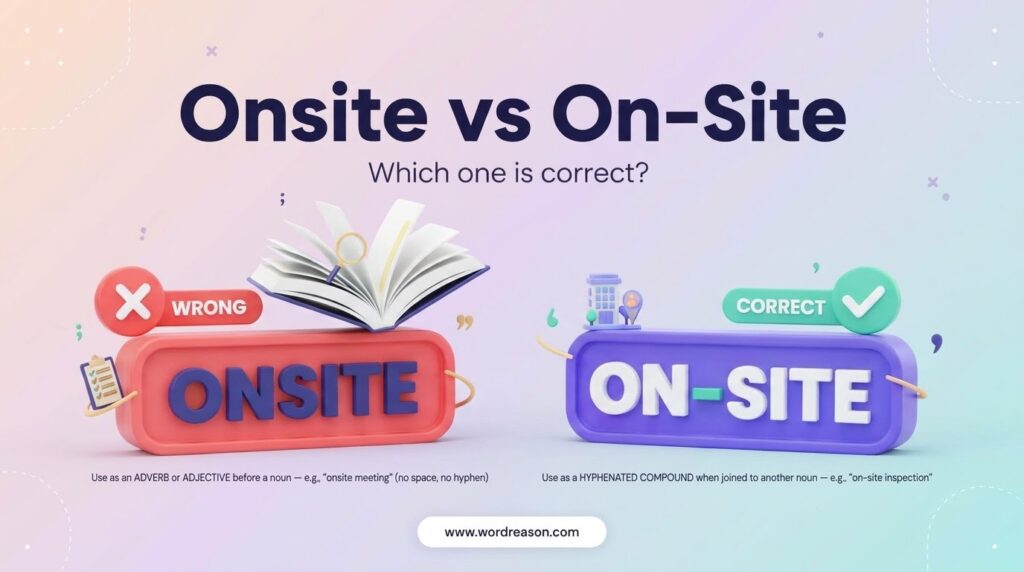
IF you ever found yourself second-guessing a simple word because a tiny hyphen or an extra space suddenly makes grammar feel like a guessing game? Welcome to the curious confusion of onsite vs. on-site vs. on site! These three look almost identical, sound equally natural, and share a similar meaning, yet their grammatical roles can make a surprising difference. Whether you are writing a professional email, updating a job description, or explaining where a service takes place, choosing the right form matters. But do not let a little hyphen steal your confidence! Let us untangle these spelling variations with clear grammar rules, practical examples, and easy explanations.
Onsite vs On-Site
Before exploring the grammar rules, look at how these three forms differ.
| Feature | Onsite | On-Site | On Site |
|---|---|---|---|
| Spelling | One word | One hyphenated unit | Two separate words |
| Word structure | Closed compound | Hyphenated compound | Open phrase |
| Main meaning | At a particular location | At a particular location | At or within a particular location |
| Common grammatical use | Adjective and adverb | Adjective and adverb | Prepositional phrase |
| Example | Onsite training | On-site training | The trainer is on site. |
| Workplace example | Onsite employee | On-site employee | The employee works on site. |
| General usage | Modern professional writing | Professional and editorial writing | Describing physical location |
The simplest distinction is that onsite and on-site can describe a service, activity, facility, or person connected with a particular location. Meanwhile, on site commonly works as a separate phrase that tells readers where someone or something is.
However, the closed and hyphenated forms can also function adverbially. Therefore, the difference is not simply adjective versus adverb. Sentence structure and spelling preference both matter.
Learn the difference between confusing more English words
Discard vs Disgard Which Spelling Is Correct?
Onsite Meaning

The word onsite means located at, happening at, or provided at a particular place. It generally refers to a physical location where people work, receive services, attend events, or carry out activities.
Unlike the two-word expression on site, onsite combines two elements into one word. This spelling is known as a closed compound.
You will often encounter it in modern workplace communication, company websites, job advertisements, and service descriptions.
For example, the company may provide onsite technical support, while a hospital might offer onsite medical services. Similarly, employees can attend onsite training sessions or use onsite facilities.
Onsite as an Adjective
An adjective describes a noun. When onsite functions as an adjective, it tells you where a person, service, facility, or activity is located or provided.
Consider the following examples in context.
An onsite employee works at the company physical workplace. Onsite training takes place at a particular location. Onsite parking refers to parking facilities available at a property. An onsite consultation happens at the client location, while onsite maintenance involves repair or maintenance work performed at a specific facility.
Notice how onsite provides additional information about the noun. It helps readers understand the type or location of the person, service, or facility being discussed.
For example, an onsite technician works at the relevant location rather than providing support exclusively from a remote office.
Onsite as an Adverb
An adverb modifies a verb, adjective, or another adverb. Onsite can also describe where an action happens.
Consider these sentences
The manager will work onsite tomorrow.
Our engineers can install the equipment onsite.
The consultant completed the inspection onsite.
Several employees prefer to work onsite.
The specialist will assist customers onsite.
Here, onsite explains where someone performs an action. It does not directly describe a noun.
This distinction matters because many writers assume that onsite can only function as an adjective. However, established dictionary usage also recognizes its adverbial function.
Onsite Meaning in Everyday and Professional English
The meaning of onsite remains fairly consistent across different industries. What changes is the location it refers to.
| Context | Meaning | Example |
|---|---|---|
| Workplace | At the company office | Onsite employees attend meetings in person. |
| Healthcare | At a hospital or medical facility | The clinic provides onsite consultations. |
| Construction | At the project location | Onsite workers inspect the building. |
| Technology | At the customer premises | The company offers onsite IT support. |
| Education | At the school or campus | Students receive onsite assistance. |
| Events | At the event venue | Onsite registration opens at 9 a.m. |
The central idea remains the same: the activity or service takes place at a particular physical location.
Learn the difference between confusing more English words
Thiefs or Thieves Which Spelling Is Correct?
On-Site Meaning
The hyphenated spelling on-site has essentially the same location-related meaning as onsite. It describes something located at or happening at a particular place.
The difference lies in its structure. On-site is a hyphenated compound, meaning two word elements connect through a hyphen.
For example, a contractor may provide on-site inspections, a company may arrange an on-site meeting, or a business may offer on-site technical assistance.
These sentences communicate the same general ideas as their onsite alternatives.
On-Site as a Compound Adjective
A compound adjective combines two or more words to describe a noun. Writers often use hyphens to connect these elements and make their relationship clear.
Common examples include on-site training, on-site assistance, on-site inspection, on-site accommodation, on-site installation, and on-site consultation.
In these expressions, the hyphen connects the elements into one descriptive unit.
Consider this sentence
The company hired an on-site technician.
The expression on-site describes the technician work location. It helps readers understand that the technician provides assistance at a particular physical facility.
However, remember that onsite technician is also an established spelling. The hyphen is not automatically required just because the expression appears before a noun.
On-Site as an Adverb
Although many writers associate hyphenated compounds with adjectives, on-site can also function adverbially.
For example, the engineer will complete the repairs on-site. Our team provides technical assistance on-site. The consultant will inspect the property on-site. Employees can register on-site.
In these examples, the expression describes where the action takes place.
The important point is that the hyphenated form does not have a completely different meaning from the closed form. Both can describe activities or services at a specific location.
When Is the Hyphenated Form Useful?
Some organizations prefer on-site because it makes the compound structure visually clear. It can also fit naturally into publications that consistently hyphenate similar expressions.
For example, a company might use on-site support, off-site support, on-site services, and off-site services.
This creates a consistent visual pattern.
However, that preference is a matter of editorial style rather than a universal English grammar requirement.
On Site as a Prepositional Phrase
A prepositional phrase begins with a preposition and includes its object. In this case, on is the preposition and site is its object.
Consider this example:
The engineer is on site.
The grammatical structure is straightforward.
| Word | Grammatical role |
|---|---|
| The | Article |
| Engineer | Noun |
| Is | Linking verb |
| On | Preposition |
| Site | Object of the preposition |
The complete phrase on site describes the engineer location. It functions as a location complement in the sentence.
Now compare it with this sentence
The company hired an onsite engineer.
Here, onsite works as an adjective that describes the noun engineer.
The meaning is similar, but the grammatical structure changes.
On Site in Everyday Sentences
The open form appears naturally when people describe physical presence or movement at a location.
For example, I will be on site by 8 a.m. The repair team is already on site. Please remain on site until the inspection ends. The manager arrived on site shortly after lunch. All contractors must sign in when they arrive on site.
These expressions are especially common in construction, engineering, event management, and workplace communication.
The phrase on site is not an incorrect or outdated version of onsite. It has a clear grammatical role and remains useful in modern English.
Learn the difference between confusing more English words
Programming or Programing Which Spelling Is Correct?
Onsite vs On-Site vs On Site Understanding the Three Forms

Now that you understand the individual meanings, it is time to compare all three spellings more closely.
The biggest mistake writers make is assuming that one form must replace the other two. In reality, English allows closed compounds, hyphenated compounds, and open phrases. Their use depends on established spelling conventions and sentence structure.
Closed Compound Onsite
A closed compound combines two elements into one word without a space or hyphen.
Examples of other closed compounds include bedroom, website, workplace, notebook, and football.
Similarly, onsite combines on and site into one word.
Example The company offers onsite childcare.
Hyphenated Compound On-Site
A hyphenated compound connects two elements with a hyphen.
Other examples include long-term, full-time, up-to-date, well-known, and on-site.
Example The company offers on-site childcare.
The hyphen visually connects the words and shows that they work together as one expression.
Open Phrase On Site
An open phrase contains separate words without a hyphen.
Examples include ice cream, post office, high school, real estate, and on site.
Example The childcare center is on site.
Here, the phrase describes where the center is located.
How the Three Forms Work in Sentences
The following examples show how the spelling changes with the sentence structure.
| Form | Example | Function |
|---|---|---|
| Onsite | We provide onsite training. | Adjective |
| On-site | We provide on-site training. | Adjective |
| Onsite | The engineer works onsite. | Adverb |
| On-site | The engineer works on-site. | Adverb |
| On site | The engineer is on site. | Prepositional phrase |
| On site | The materials are on site. | Prepositional phrase |
The important distinction is not that the three forms describe completely different places. They generally communicate the same location-related idea. Their grammatical structure and preferred spelling determine which one fits.
Learn the difference between confusing more English words
Bellow or Below Which spelling Is Correct?
When to Use Onsite vs On-Site
Choosing between onsite and on-site can feel confusing because both forms work in many of the same sentences. Fortunately, you do not need a complicated rule to make the decision.
Start by checking your preferred dictionary and editorial style guide. Then use that spelling consistently.
Use Onsite When Your Style Guide Prefers the Closed Form
Many modern publications and organizations use onsite as a single word.
For example, a company may provide onsite customer support. A hospital may have an onsite medical clinic. Employees may receive onsite training, while a facility may offer onsite parking. Similarly, a team may complete an installation onsite.
Cambridge Business English Dictionary recognizes onsite as both an adjective and an adverb. Its examples include workplace facilities, training, visits, and data backups.
Use On-Site When Your Style Guide Prefers the Hyphenated Form
Some dictionaries and editorial guides use on-site as their preferred spelling.
For example, a hospital provides on-site medical services. A contractor arranges an on-site inspection. A business schedules an on-site consultation, while a school organizes an on-site event.
Cambridge Dictionary recognizes on-site as an adjective and adverb. Dictionary.com also recognizes the hyphenated spelling and identifies on site as an alternative.
Use On Site When Describing Physical Location
Choose the open form when you want to tell readers where someone or something is.
For example, the technician is on site. I will be on site tomorrow. The construction team arrived on site. All necessary materials are on site.
This construction works particularly well after linking verbs such as is, are, was, and were.
Why Consistency Matters More Than Switching Between Variants
Imagine a company publishes a handbook containing these sentences:
The company offers onsite support. Its on-site technicians provide onsite maintenance. The manager will be on-site tomorrow.
Each sentence is understandable. However, switching spellings without a reason makes the document look inconsistent.
A professional editorial style should establish one preferred form for descriptive uses.
For example, a company might choose onsite for adjectives and adverbs while keeping on site for separate location phrases.
That approach creates a predictable pattern and makes proofreading easier.
Learn the difference between confusing more English words
Customize or Customise Which Spelling Is Correct?
Onsite vs On-Site in Job Listings
Job advertisements are among the most common places where people encounter these spellings. Employers use the terms to explain where employees must work and whether a position requires physical attendance.
For example, a job listing might advertise an onsite position rather than a remote opportunity.
However, the spelling does not change the employment arrangement. The job requirements do.
Onsite Position vs On-Site Position
Both expressions can describe a position that requires employees to work at a company physical location.
Examples include
The company is hiring an onsite customer service representative.
The company is offering an on-site administrative position.
This onsite position requires five days of office attendance.
Applicants must be available for on-site work.
Both spellings communicate the same general requirement.
Common Workplace Expressions in Job Advertisements
| Expression | Meaning | Example |
|---|---|---|
| Onsite employee | Employee working at the workplace | The company needs an onsite employee. |
| Onsite interview | Interview at a physical location | Your onsite interview starts at 10 a.m. |
| Onsite training | Training at the workplace | New employees receive onsite training. |
| Onsite work | Work performed at the employer location | The position involves onsite work. |
| Onsite facilities | Facilities available at the workplace | Employees can use onsite facilities. |
| Onsite manager | Manager working at the location | Contact the onsite manager for assistance. |
Learn the difference between confusing more English words
Adress or Address Which Spelling Is Correct?
Is Onsite the Opposite of Remote?
Not exactly as a matter of grammar, but the terms describe contrasting work arrangements.
Onsite means employees perform their work at a designated physical workplace. Remote means employees work away from the employer usual physical workplace. Hybrid means employees divide their working time between a physical workplace and a remote location.
For example, a company might offer three positions. An onsite position requires employees to attend the office five days a week. A remote position allows employees to work from an approved location outside the office. A hybrid position requires employees to work three days in the office and two days remotely.
The words onsite, remote, and hybrid describe different workplace arrangements. They are not interchangeable.
Example of an Onsite Job Advertisement
Consider this realistic job description
Customer Support Representative
We are hiring a full-time customer support representative for our onsite team. The successful candidate will work from our main office, attend in-person training sessions, and assist customers during regular business hours.
The word onsite tells applicants where they must perform their duties. It does not describe the employee job title or level of experience.
Learn the difference between confusing more English words
Cocoon vs Cacoon Which Spelling Is Correct?
Onsite vs On-Site in Business and Professional Communication
Business writing demands clarity. A small spelling inconsistency may not change a message meaning, but it can make an email, report, or company document look less polished.
Both onsite and on-site appear in professional communication. The best choice depends on the organization preferred spelling.
Onsite or On-Site in Professional Emails
Imagine you need to arrange a meeting with a contractor. You could write:
Could you confirm whether your team can provide onsite assistance next Monday?
Alternatively, you could write
Could you confirm whether your team can provide on-site assistance next Monday?
Both sentences are grammatically acceptable. The only difference is the spelling convention.
However, when you describe someone physical presence, the open form may sound more natural:
Please confirm whether your technician will be on site by 9 a.m.
Common Business Expressions
| Expression | Example sentence |
|---|---|
| Onsite meeting | We scheduled an onsite meeting with the client. |
| Onsite visit | The consultant completed an onsite visit. |
| Onsite services | Our company provides onsite services. |
| Onsite support | Customers can request onsite support. |
| Onsite maintenance | The equipment requires onsite maintenance. |
| Onsite installation | The supplier offers onsite installation. |
| Onsite consultation | The doctor arranged an onsite consultation. |
| Onsite event | The organization hosted an onsite event. |
Onsite Visit vs On-Site Visit
Both spellings are acceptable for describing a visit that takes place at a particular location.
For example, the inspector scheduled an onsite visit. Alternatively, the inspector scheduled an on-site visit.
However, compare those sentences with
The inspector will be on site tomorrow.
The last sentence describes the inspector physical location rather than directly using the term as a modifier before visit.
A Business Communication Case Study
Imagine a software company that provides technical assistance to clients.
Its marketing team writes
Our company offers onsite IT support and on-site installation services. Our technicians can also visit your office when required.
The message is understandable, but it uses two different spellings for similar descriptive purposes.
If the company style guide prefers the closed form, a more consistent version would be:
Our company offers onsite IT support and onsite installation services. Our technicians can also visit your office when required.
The final sentence uses a separate location expression and does not need to change.
The practical lesson is simple: choose a preferred spelling for descriptive uses and apply it consistently across emails, reports, proposals, and marketing materials.
Learn the difference between confusing more English words
Annual vs Anual Which Spelling Is Correct?
Onsite vs On-Site in Construction, Technology, and Services
Although these spellings frequently appear in office communication, their use extends far beyond traditional workplaces. Construction companies, healthcare providers, technology firms, and service businesses regularly use them to describe activities performed at a physical location.
The meaning stays the same, but the surrounding terminology changes.
Onsite vs On-Site Construction
In construction, the terms describe work performed at the actual building or project location.
For example, the contractor arranged onsite construction services. Workers completed an on-site safety inspection. All building materials must be available on site. The project manager conducts onsite inspections every week. The construction company provides on-site supervision.
The distinction becomes especially useful when comparing onsite construction with offsite manufacturing.
Onsite construction involves building or assembling structures at the project location. Offsite construction involves manufacturing or assembling components somewhere else before transporting them to the final location.
For example, a construction company might manufacture wall panels in a factory and install them on site.
Onsite Support in Technology
Technology companies often provide onsite support when customers need technical assistance at their offices, facilities, or other locations.
Common services include onsite IT support, onsite troubleshooting, onsite equipment installation, onsite network maintenance, and onsite technical assistance.
Consider this example
The IT company sent an onsite technician to repair the office network.
The technician travels to the customer location instead of resolving the issue entirely through remote access.
However, the company might also say
The technician will be on site at 11 a.m.
Both sentences are correct because they use the location-related expression differently.
Onsite Healthcare and Medical Services
Hospitals, clinics, and healthcare organizations use these expressions to describe services available at their facilities.
Examples include onsite medical consultations, onsite healthcare services, onsite emergency assistance, onsite medical examinations, and onsite rehabilitation facilities.
For example, the factory provides onsite medical assistance for employees.
This means workers can receive medical help at the factory rather than traveling to a separate facility for that service.
Onsite Facilities, Parking and Accommodation
Hotels, schools, offices, and event venues also use the term when describing facilities available at a particular property.
Consider these examples
The hotel offers onsite accommodation.
Visitors can use the onsite parking area.
The university provides onsite housing.
The conference center has onsite dining facilities.
The resort offers onsite recreational activities.
In these examples, onsite describes where the facilities are available.
Learn the difference between confusing more English words
Fryed or Fried Which Spelling Is Correct?
American English vs British English Onsite or On-Site?
Writers sometimes assume that American English prefers onsite while British English requires on-site. However, the distinction is not that simple.
Both forms appear in dictionaries and published English in different regions. Dictionary and editorial preferences can vary, so neither spelling should be treated as an exclusive national rule.
Onsite vs On-Site in American English
American English uses both spellings.
Cambridge US English Dictionary lists on-site as an adjective and adverb. Cambridge Business English Dictionary also recognizes onsite in workplace contexts.
You may encounter these expressions in American publications: onsite employee, on-site inspection, onsite training, on-site support, and onsite facilities.
The spelling often depends on the publication editorial conventions.
Onsite or On-Site in British English
British English also recognizes both forms.
Cambridge British English Dictionary lists on-site as an adjective and adverb, while its Business English Dictionary includes onsite as a workplace term.
Examples include on-site facilities, onsite training, on-site accommodation, and onsite visits.
Therefore, it would be inaccurate to claim that British English always requires the hyphen or that American English always removes it.
Which Spelling Should You Choose?
For an American English article or business document, either onsite or on-site can work.
Follow your organization editorial style guide. Check the preferred spelling in your chosen dictionary. Keep the same spelling throughout your document. Use on site when the sentence calls for a separate location phrase. Avoid changing spellings without a grammatical or stylistic reason.
The goal is not to follow an imaginary universal hyphenation rule. It is to produce clear, consistent writing.
Learn the difference between confusing more English words
Grayscale vs Greyscale Which Spelling Is Correct?
Common Mistakes People Make With Onsite and On-Site
Even experienced writers sometimes confuse these expressions. The problem usually comes from treating spelling, grammatical function, and style preference as the same thing.
Here are some common mistakes and their corrections.
Assuming Onsite Is Always Incorrect
One common misconception is that onsite must always contain a hyphen.
That is not true. Cambridge recognizes onsite as an adjective and an adverb in workplace English.
| Incorrect assumption | Correct explanation |
|---|---|
| Onsite is always wrong. | Onsite is an established spelling. |
| On-site is the only correct form. | On-site and onsite are both recognized. |
| The hyphen is always mandatory. | Hyphenation depends on spelling conventions and style. |
Confusing On Site With On-Site
These forms look similar, but their grammatical structures differ.
Compare these sentences
The technician is on site.
The company hired an on-site technician.
The first sentence describes the technician location. The second uses a compound modifier to describe the technician.
Both sentences are correct.
Switching Spellings Without a Reason
Using several spelling variations in the same document can create an inconsistent appearance.
For example
The company offers onsite support. Its on-site technicians provide onsite maintenance.
A consistent alternative would be
The company offers onsite support. Its onsite technicians provide onsite maintenance.
The second version follows one spelling preference for descriptive uses.
Assuming Onsite and Remote Mean the Same Thing
Another common mistake involves confusing location terminology with work arrangements.
Onsite means at a particular physical location. Remote means away from the designated workplace. Offsite means away from a particular site. Hybrid means combining onsite and remote work arrangements.
For example, an employee who works remotely does not necessarily work onsite.
Using the Wrong Form in a Sentence
Consider these examples:
| Sentence | Status | Explanation |
|---|---|---|
| The technician is on site. | Correct | Separate location phrase. |
| The technician is onsite. | Correct | Closed adverbial form. |
| We need an onsite technician. | Correct | Closed compound adjective. |
| We need an on-site technician. | Correct | Hyphenated compound adjective. |
| The company provides onsite support. | Correct | Closed compound modifier. |
| The company provides on-site support. | Correct | Hyphenated compound modifier. |
The best way to avoid these mistakes is to identify the grammatical function before choosing the spelling.
Onsite vs On-Site RealWorld Example Sentences
Definitions help explain the rules, but examples show how these expressions work in everyday writing.
The following sentences cover common situations where people search for the correct spelling.
Workplace and Office Examples
The company provides onsite training for new employees.
Our manager prefers on-site meetings for important discussions.
Employees must arrive on site before the morning briefing.
The office has onsite parking for visitors.
Several employees will work onsite next week.
Job Application and Recruitment Examples
The company advertised an onsite position.
Your on-site interview is scheduled for Friday.
Applicants must be available for onsite training.
The employer requires employees to work on site.
The recruitment team arranged an onsite assessment.
Construction and Inspection Examples
The contractor completed an onsite inspection.
Workers must wear protective equipment while on site.
The company provides on-site construction supervision.
All construction materials are stored on site.
The engineer will visit the building for an onsite assessment.
Technology and Customer Support Examples
We provide onsite IT support to business customers.
The technician will be on site tomorrow.
The company offers on-site equipment installation.
Our engineers completed the repairs onsite.
Customers can request onsite troubleshooting.
Business Meeting and Training Examples
The director arranged an onsite meeting.
The team completed its on-site consultation.
Employees attended onsite training sessions.
The consultant arrived on site before the meeting.
The company provides onsite professional development.
Comparing Common Search Phrases
| Search phrase | Correct example |
|---|---|
| Onsite training or on-site training | We provide onsite training. |
| Onsite interview or on-site interview | Your on-site interview starts at 9 a.m. |
| Onsite support or on-site support | Our company offers onsite support. |
| Onsite parking or on-site parking | The building has onsite parking. |
| Working onsite or on site | I am working onsite today. |
| I will be onsite or on site | I will be on site tomorrow. |
| Onsite visit or on-site visit | The inspector scheduled an onsite visit. |
| Onsite construction or on-site construction | The contractor provides on-site construction services. |
I Will Be Onsite or On Site Which Is Correct?
Both expressions are acceptable.
I will be onsite tomorrow.
I will be on site tomorrow.
The first uses the closed adverbial form. The second uses a separate prepositional phrase.
If your style guide prefers on-site, you may also see:
I will be on-site tomorrow.
The meaning remains essentially the same.
Working Onsite or Working On Site?
Both expressions are grammatically acceptable.
For example, I enjoy working onsite because I can communicate with my colleagues directly. Alternatively, I enjoy working on site because my job requires physical attendance.
However, if you are describing a workplace arrangement in a job advertisement, onsite work or on-site work may be more suitable.
Onsite vs On-Site Quick Style Guide Cheat Sheet
Still unsure which spelling to choose? This quick guide summarizes the most useful rules.
| Situation | Suitable form | Example |
|---|---|---|
| Describing a workplace service | Onsite or on-site | We offer onsite support. |
| Describing an employee | Onsite or on-site | She is an onsite employee. |
| Describing physical presence | On site or onsite | The manager is on site. |
| Describing an inspection | Onsite or on-site | We scheduled an on-site inspection. |
| Describing training | Onsite or on-site | Employees receive onsite training. |
| Describing a location in a sentence | On site | The workers are on site. |
| Following a closed-word style guide | Onsite | The company provides onsite services. |
| Following a hyphenated style guide | On-site | The company provides on-site services. |
Easy Rules to Remember
Onsite is one word. Use it as an adjective or adverb when your style guide prefers the closed form.
On-site is hyphenated. Use it as an adjective or adverb when your style guide prefers the hyphenated form.
On site contains two separate words. Use it as a prepositional phrase to describe physical location.
Consistency matters. Choose one preferred spelling for descriptive uses and maintain it throughout your writing.
Context also matters. Check the sentence structure before deciding which form fits best.
A useful proofreading trick is to look at the word immediately following or preceding the expression. If you are describing a noun, onsite or on-site may fit. If you are telling readers where someone is, on site is often a natural choice.
However, do not treat this as an absolute rule. Both the closed and hyphenated forms can also function adverbially.
Fill in the Blanks
Complete each sentence with the correct form: onsite, on-site, or on site.
- The company provides __________ training for new employees.
- Our technician will be __________ tomorrow morning.
- The manager arranged an __________ meeting with the team.
- The engineers are already __________.
- We offer __________ support to our customers.
- The job requires regular __________ visits.
- The construction workers arrived __________ early.
- The company has an __________ parking facility.
- The supervisor is currently __________.
- The hospital provides __________ medical services.
- All employees must attend the __________ workshop.
- The maintenance team is __________ today.
- The company hired an __________ technician.
- Our team will provide assistance __________.
- The project manager conducted an __________ inspection.
- The new employee will receive __________ training.
- The equipment is available __________.
- The organization offers __________ consultations.
- The contractor must remain __________ during installation.
- We scheduled an __________ interview for Monday.
- The IT specialist provides __________ assistance.
- Several workers are working __________.
- The company offers __________ accommodation for staff.
- The technician arrived __________ to repair the machine.
- The supervisor will meet the clients __________.
Answer Session
- On-site
- On site
- Onsite
- On site
- On-site
- On-site
- On site
- Onsite
- On site
- On-site
- On-site
- On site
- Onsite
- On site
- On-site
- On-site
- On site
- Onsite
- On site
- Onsite
- On-site
- On site
- Onsite
- On site
- Onsite
Here’s a trusted source for clear word meanings:
conclusion
So, is it onsite vs on-site? Fortunately, this little spelling mystery is not as complicated as it first appears! All three forms have a place in English, but understanding their grammatical roles makes choosing the right one much easier. Use onsite or on-site for descriptions of workplace services, employees, and activities, depending on your preferred writing style. Choose on site when you want to emphasize a physical location. Most importantly, remember that a hyphen is not a magic ticket to perfect grammar, and a missing one does not automatically mean a mistake. Keep your spelling consistent, let the sentence guide your choice, and write with confidence. After all, grammar should make your message clearer, not turn every sentence into a spelling showdown!

Bella AJS
Bella AJS is an experienced blogger and passionate language enthusiast at WordReason. She specializes in English grammar, word meanings, spelling, and commonly confused words. With a clear and practical writing style, Bella helps readers understand tricky language rules without the textbook headache. Her goal is simple: make English easier, clearer, and more enjoyable one word at a time.