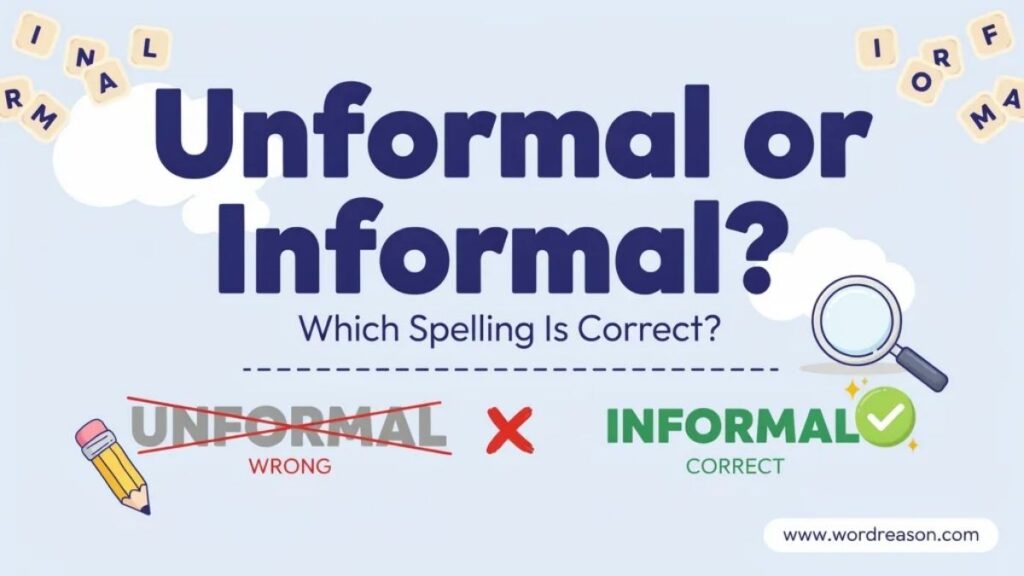
If you’ve paused over Unformal or Informal, you’re certainly not alone. English has a talent for making spelling seem wonderfully logical right until it decides otherwise. Since “formal” becomes “informal,” it’s easy to assume that “unformal” should be perfectly acceptable, too. Unfortunately, English doesn’t hand out prefixes quite that generously. In standard English, informal is the correct word for something casual, relaxed, or not formal. “Unformal” may look reasonable, but it isn’t the standard choice. In this guide, you’ll learn why the confusion happens, which word to use, and how to use informal correctly in everyday speech and writing.
Quick Answer Unformal or Informal?
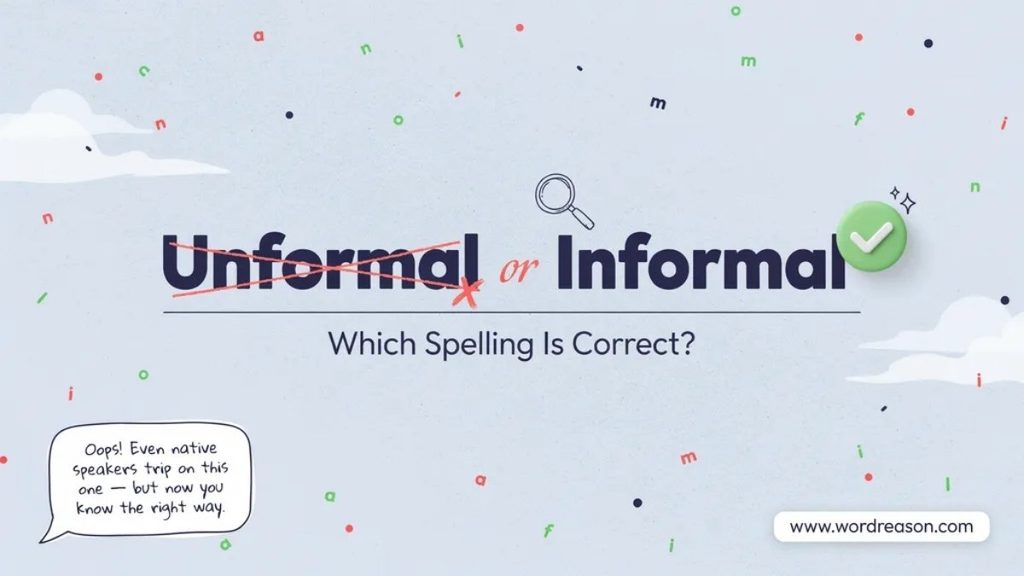
Informal is the correct and standard word. The spelling unformal isn’t standard English and generally shouldn’t appear in polished writing.
Here’s the difference at a glance
| Word | Status | Meaning | Example |
|---|---|---|---|
| Informal | Standard English | Casual, relaxed, unofficial, or less formal | “We had an informal meeting.” |
| Unformal | Nonstandard | Intended to mean “not formal” | “We had an unformal meeting.” |
The correct sentence is
“We had an informal meeting.”
Not
“We had an unformal meeting.”
This distinction matters because informal isn’t merely a preferred spelling. It is the established adjective used in standard English to describe something that lacks formality.
If you’re asking, “Is informal the correct word?” the answer is yes.
If you’re asking, “Is unformal correct?” the safest answer is no for standard English.
Learn the difference between confusing more English words
Girlie vs Girly Which Word Is Correct?
Is “Unformal” a Word?
Why “Unformal” Looks Like It Should Be Correct
At first glance, unformal seems perfectly reasonable.
English frequently uses the prefix un- to create words with an opposite meaning
happy → unhappy
clear → unclear
fair → unfair
certain → uncertain
common → uncommon
comfortable → uncomfortable
So it’s understandable that someone might reason:
formal + un- = unformal
Unfortunately, English doesn’t always work like a mathematical formula.
A prefix doesn’t automatically create an accepted English word simply because the resulting combination makes sense. English vocabulary developed over centuries, and many words became established through historical usage rather than through a neat set of modern rules.
That’s why informal became the standard word instead of unformal.
Is “Unformal” a Real Word?
You may encounter unformal in occasional writing or nonstandard usage. However, seeing a form somewhere doesn’t automatically make it the normal standard-English choice.
For contemporary standard writing, informal is the word to use.
This distinction is important because English contains many unusual, archaic, regional, and rarely used forms. A word can appear in written material without being the form you should choose for everyday standard English.
Therefore, if your question is, “Is unformal a word in English?” the practical answer is
Unformal can appear as an occasional or nonstandard formation, but it isn’t the standard adjective you should use when you mean “not formal.”
Is Unformal Grammatically Correct?
The issue isn’t that readers can’t understand unformal. Most people can probably work out what it means from context.
The problem is standard usage.
When you want to describe something as relaxed or not formal, established English uses informal. Using unformal can therefore make your sentence look like a spelling mistake or an invented word.
For example
“The professor used an unformal tone.”incorrect
Better
“The professor used an informal tone.”
The second sentence follows conventional English word choice.
Learn the difference between confusing more English words
in vs On the Same Day no confusion grammar guide
What Does “Informal” Mean?
Informal Definition
Informal is an adjective that describes something casual, relaxed, unofficial, or less formal.
The exact meaning depends on the context.
For example
- informal conversation = relaxed conversation
- informal clothing = casual clothing
- informal meeting = a meeting without a highly formal structure
- informal language = conversational or relaxed language
- informal agreement = an arrangement that isn’t expressed through a formal agreement
- informal behavior = relaxed behavior rather than strictly conventional behavior
The word doesn’t automatically mean careless, incorrect, or unprofessional.
That’s an important distinction.
Someone can use informal English correctly. In fact, native speakers use informal English every day.
Informal as an Adjective
Grammatically, informal functions primarily as an adjective.
It modifies a noun
- an informal discussion
- an informal interview
- an informal dress code
- informal speech
- informal writing
- informal communication
You can also place it after a linking verb:
“The meeting was informal.”
“Her writing style is informal.”
“Their conversation became informal.”
The adjective tells you about the nature or style of the noun or situation.
Informal Meaning in Different Contexts
The word can take on a slightly different shade of meaning depending on what it describes.
Language Informal language sounds more like everyday conversation.
Clothing Informal clothing is casual rather than ceremonial or highly professional.
Meeting An informal meeting may have a relaxed atmosphere and less rigid structure.
Behavior Informal behavior can be friendly, relaxed, or less constrained by conventional etiquette.
Communication Informal communication often happens between people who know each other or in situations where strict formality isn’t necessary.
So, informal meaning isn’t limited to grammar. It applies broadly to social behavior, communication, style, and situations.
Learn the difference between confusing more English words
Bougie vs Boujee which one is correct?
Why Is “Informal” Correct Instead of “Unformal”?
The Prefix In Explained
The word informal uses the prefix in.
In this word, in contributes a negative sense associated with the absence or opposite of the quality expressed by the base word.
The structure is
in + formal → informal
However, it’s worth avoiding an oversimplified rule such as “use in- whenever you mean not.”
English prefixes don’t behave that mechanically.
The history of individual words matters. Established vocabulary determines which formation English speakers recognize as standard.
Why You Can’t Add Un to Every Word
The prefix un is certainly productive in English. It forms many legitimate words:
known → unknown
usual → unusual
certain → uncertain
willing → unwilling
necessary → unnecessary
But that doesn’t mean you can attach un- to every adjective and automatically create a standard word.
For example, English doesn’t normally use unformal as the standard opposite of formal.
This is one reason English spelling and vocabulary can frustrate learners. The language contains patterns, but those patterns have limits.
Similar Words That Follow Established Patterns
Consider these established pairs
| Base Word | Standard Opposite |
|---|---|
| formal | informal |
| possible | impossible |
| regular | irregular |
| legal | illegal |
| responsible | irresponsible |
| mature | immature |
| relevant | irrelevant |
English uses several negative prefixes, including in, im, il, and ir
Their forms often depend on the word that follows them. That’s why English learners shouldn’t assume that un- is always the correct choice for expressing “not.”
learn the difference between confusing more English words
She or Her the Correct Way to Answer the Phone
What’s the Difference?

The difference between unformal and informal is mainly one of standard usage.
Informal is the established standard adjective.
Unformal is a nonstandard formation that attempts to express the same general idea.
| Point | Informal | Unformal |
|---|---|---|
| Standard English | Yes | No |
| Common usage | Yes | Rare |
| Standard adjective for “not formal” | Yes | No |
| Suitable for academic writing | Yes, when appropriate | No |
| Suitable for professional writing | Yes, when appropriate | Generally no |
| Meaning readers may infer | Casual or not formal | Intended as “not formal” |
So, unformal vs informal isn’t really a competition between two equally acceptable spellings.
One is the standard form.
The other is a formation you should generally avoid.
Learn the difference between confusing more English words
Masonary vs Masonry Which Spelling Is Correct?
What’s the Difference?
Formal Language
Formal language usually suits situations that require professionalism, seriousness, respect, or conventional structure.
You might use it in
academic papers
research writing
business reports
legal documents
official correspondence
job applications
professional proposals
For example
“I would appreciate your response at your earliest convenience.”
That’s formal.
Informal Language
Informal language sounds more natural and conversational.
For example
“I’d love to hear from you soon.”
That’s more informal.
Neither sentence is inherently better. They simply suit different situations.
Formal vs Informal Comparison Table
| Feature | Formal | Informal |
|---|---|---|
| Tone | Serious or professional | Relaxed or conversational |
| Vocabulary | More conventional | More familiar |
| Contractions | Less frequent | Common |
| Slang | Usually avoided | May appear |
| Typical audience | Professional, academic, official | Friends, family, familiar audiences |
| Example | “I would like to request additional information.” | “Could you send me more information?” |
The key isn’t to treat formal language as “good” and informal language as “bad.”
When Should You Use “Informal”?
Informal Conversations
Everyday conversation naturally contains informal language.
You might say
“Hey, are you coming over tonight?”
That’s perfectly normal in a casual conversation.
A formal version could sound unnecessarily stiff:
“Will you be attending my residence this evening?”
Technically, it communicates an idea. Socially, it sounds like a robot wearing a tie.
Text Messages and Online Chats
Text messaging is one of the most common settings for informal communication.
You may see
contractions
abbreviations
shortened expressions
conversational vocabulary
emojis
casual greetings
For example:
“Hey! Are you free later? I need to ask you something.”
That’s informal, but it’s also perfectly clear.
Informal doesn’t mean that you should abandon grammar altogether. A message can be relaxed and still well written.
Emails to Friends and Family
An email to a close friend doesn’t need the same tone as an email to a company director.
For example
“Hey Sam, just wanted to check if we’re still meeting Friday. Let me know!”
That’s an informal email.
A business email might instead say
“Hello Sam, I’m writing to confirm whether our meeting is still scheduled for Friday.”
Both are appropriate in the right context.
Social Media Posts
Social media encourages conversational writing.
A post such as
“Finally finished the project. That took forever!”
uses an informal tone.
The sentence feels natural because social platforms often function like public conversations.
Blogs and Personal Writing
Informal writing can also work well in blogs, personal essays, newsletters, and creative content.
A conversational style can make readers feel as if they’re being spoken to rather than handed a textbook.
However, informal doesn’t mean sloppy.
A strong informal writer still pays attention to
clarity
grammar
spelling
sentence structure
audience
tone
That’s the difference between informal writing and careless writing.
Learn the difference between confusing more English words
Time Off vs Time-Off Understanding the Hyphen Rule
When Should You Avoid Informal Language?
Academic Essays and Research Papers
Academic writing usually requires a more formal style.
That doesn’t mean every sentence needs complicated vocabulary. In fact, clear academic writing often beats unnecessarily fancy prose.
Avoid overly casual expressions such as
“The results were super weird.”
A more suitable version might be
“The results were unexpected.”
Always follow the specific style requirements of your school, instructor, journal, or institution.
Business Reports
Business communication often needs precision and professionalism.
Instead of
“The numbers look pretty bad.”
A report might say
“The results indicate a significant decline in sales.”
The second version communicates the situation more precisely.
Job Applications and Cover Letters
Job applications are usually professional documents.
Avoid language that sounds too casual
“I think I’d be a really great fit for this job.”
A stronger professional version could be
“I believe my experience and skills make me a strong candidate for this position.”
The point isn’t to make your writing cold. It’s to match the expectations of the situation.
Legal and Official Documents
Legal and official writing typically requires precise and established language.
An informal phrase can create ambiguity or sound inappropriate.
When a document carries legal, financial, governmental, or contractual significance, follow the relevant professional conventions rather than treating casual language as interchangeable with formal language.
Learn the difference between confusing more English words
Patients vs Patient Meaning Difference and Correct Usage
Real Life Examples of “Informal”
Seeing informal usage in a sentence makes the concept much easier to understand.
Everyday Conversation
“We had an informal chat after class.”
Here, informal means relaxed and conversational.
“The party has an informal dress code.”
Here, it means guests don’t need highly formal clothing.
Informal Email
“Hi Alex, just checking whether you’re still free tomorrow. Let me know!”
The wording is friendly and conversational.
Social Media Example
“That movie was surprisingly good. I’d watch it again!”
The sentence sounds like something you’d say to a friend.
Informal Workplace Conversation
“Let’s grab some coffee and talk about the project.”
In many workplaces, this kind of informal communication is completely normal.
The important factor is the relationship and setting. A workplace can contain both formal and informal communication.
Learn the difference between confusing more English words
Nosey vs Nosy Which Spelling Is Correct?
Unformal or Informal Examples Which Sentences Are Correct?
Here are several useful unformal or informal examples
| Incorrect or Nonstandard | Standard Form |
|---|---|
| “We had an unformal discussion.” | “We had an informal discussion.” |
| “She sent an unformal email.” | “She sent an informal email.” |
| “The event has an unformal dress code.” | “The event has an informal dress code.” |
| “They had an unformal conversation.” | “They had an informal conversation.” |
| “He prefers unformal language.” | “He prefers informal language.” |
| “The interview was quite unformal.” | “The interview was quite informal.” |
Common Mistakes With Informal
Mistake 1 Treating “Unformal” as the Natural Opposite
This is the biggest problem.
Because un- frequently expresses negation, learners may create unformal without realizing that English already has an established word.
Correct: informal
Mistake 2 Thinking Informal Means Incorrect
It doesn’t.
An informal sentence can be completely grammatical.
For example:
“I’m gonna call you later.”
This is informal. Depending on the context, it can still be perfectly understandable and natural.
However, formal writing might prefer
“I’m going to call you later.”
The distinction is about register, not simply correctness.
Mistake 3 Confusing Informal With Unprofessional
Informal communication isn’t automatically unprofessional.
A friendly conversation between coworkers may be informal while remaining respectful and productive.
The same wording might become inappropriate in a legal document or formal complaint.
Mistake 4 Making Informal Writing Too Casual
There’s a line between conversational and careless.
Using every abbreviation, slang expression, or shortcut available can make writing harder to understand.
Good informal English still respects the reader.
Learn the difference between confusing more English words
Memento or Momento which is the Correct Spelling?
Synonyms for Informal
Depending on context, these words can overlap with informal
casual
relaxed
conversational
unofficial
familiar
colloquial
easygoing
unceremonious
However, don’t treat these as perfect replacements.
For example, colloquial specifically refers to language associated with ordinary conversation. Unofficial emphasizes the absence of official status. Casual can describe clothing, behavior, or attitude.
Antonyms of Informal
Common opposites include
formal
official
professional
conventional
ceremonial
serious
Again, the best antonym depends on the sentence.
For example
“informal clothing” → “formal clothing”
But
“informal agreement” → “formal agreement”
And
“informal conversation” → “formal conversation”
Common Collocations With Informal
Learning common word combinations makes informal English easier to use naturally.
Some common collocations include
- informal language
- informal writing
- informal speech
- informal conversation
- informal communication
- informal meeting
- informal discussion
- informal setting
- informal clothing
- informal interview
- informal agreement
- informal tone
- informal style
- informal behavior
Consider the difference between these
“We had an informal meeting.”
and
“We had an informal language.”
The first is natural because informal meeting is a common collocation. The second doesn’t work because informal language is the natural combination.
Knowing vocabulary isn’t only about memorizing definitions. Word choice and context matter just as much.
Informal vs Unformal Usage at a Glance
If you’re still wondering about unformal or informal grammar, here’s the simplest explanation
Informal is the standard adjective.
Unformal isn’t the standard adjective used in contemporary English to mean “not formal.”
The practical grammar rule is
Use “informal” when describing something that is casual, relaxed, unofficial, or not formal.
Examples
- informal language
- informal speech
- informal writing
- informal behavior
- informal clothing
- informal meeting
The word informal can describe much more than writing. It can describe people, settings, clothing, conversations, meetings, communication, and behavior.
Is Informal Used in American and British English?
Yes. Informal is standard in both American English and British English.
The spelling remains
informal
The difference between American and British English doesn’t normally affect this word.
What may vary is the preferred vocabulary, tone, or degree of informality in a particular situation.
For example, a workplace culture in one country may favor a relaxed communication style while another organization expects more formal correspondence.
Still, the spelling question remains straightforward:
Informal is the standard form in both varieties of English.
Unformal vs Informal Quick Examples
Here are several examples to make the distinction stick
“We had an unformal meeting.” incorrect
“We had an informal meeting.” correct
“She prefers unformal clothing.” incorrect
“She prefers informal clothing.” correct
“The professor used an unformal tone.” incorrect
“The professor used an informal tone.” correct
“They had an unformal conversation.”
“They had an informal conversation.”
“This is an unformal agreement.”
“This is an informal agreement.”
Practice Session Unformal or Informal
Fill in the Blanks
- We had an ______ discussion about the project after lunch.
- The manager invited everyone to an ______ meeting.
- “Unformal” is generally considered a ______ form in standard English.
- She used an ______ tone when speaking with her close friends.
- The company allowed employees to wear ______ clothing on Friday.
- You should use ______ instead of “unformal” in standard English.
- His email was friendly and ______ rather than highly professional.
- The teacher encouraged an ______ conversation about the students’ concerns.
- “Formal” and “______” are commonly treated as opposites.
- The event had an ______ atmosphere, so guests did not need to dress formally.
- Writing “unformal meeting” is generally considered ______ usage.
- Text messages often contain ______ language and abbreviations.
- The interview was intentionally ______ because the employer wanted the conversation to feel relaxed.
- In academic writing, an overly ______ tone may not be appropriate.
- “Informal” is the standard English word, while “unformal” is generally ______.
- We had an ______ conversation instead of a formal business meeting.
- The dress code for the gathering was ______.
- If you mean “casual or relaxed,” the correct adjective is ______.
- The phrase “______ language” refers to everyday, conversational language.
- She wrote an ______ email to her friend about the weekend.
- “Unformal” may look logical, but ______ is the established standard form.
- The meeting was quite ______, with everyone speaking freely.
- Informal writing can be grammatically correct even though its style is more ______.
- When comparing “unformal or informal,” choose ______ for standard English.
- The professor explained that “unformal” should be replaced with ______ in formal writing.
Answer Key
- informal
- informal
- nonstandard
- informal
- informal
- informal
- informal
- informal
- informal
- informal
- nonstandard
- informal
- informal
- informal
- nonstandard
- informal
- informal
- informal
- informal
- informal
- informal
- informal
- relaxed
- informal
- informal
Here’s a trusted source for clear more words Comparison
FAQs
Is “unformal” a correct English word?
“Unformal” is not the standard English word used to mean “not formal.” In normal writing, use informal instead.
What is the correct spelling: unformal or informal?
Informal is the correct and standard spelling. “Unformal” is generally considered a nonstandard formation.
Is “unformal” grammatically correct?
No. Although you may occasionally encounter “unformal,” it is not the standard adjective in modern English. Informal is the appropriate choice.
Why is “informal” correct instead of “unformal”?
English does not always form opposites by simply adding un-. The established opposite of formal is informal, so standard English uses “informal.”
What does “informal” mean?
Informal means casual, relaxed, unofficial, or less formal. For example, an informal conversation may use everyday language rather than formal expressions.
Can I use “unformal” in a sentence?
You may encounter “unformal” in rare or nonstandard usage, but it is best to avoid it in standard English. Use informal instead, as in “The meeting was informal.”
Is “informal” the opposite of “formal”?
Yes. Formal describes something official, structured, or conventional, while informal describes something more relaxed, casual, or unofficial.
What is a simple synonym for “informal”?
Common synonyms include casual, relaxed, conversational, unofficial, and easygoing. The best synonym depends on the context.
Does informal mean incorrect?
No. Informal describes a style or level of formality. Informal language can be completely grammatically correct.
AEO Questions
Which is correct, “unformal” or “informal”?
Informal is correct and standard. Use “informal” when you mean casual, relaxed, unofficial, or not formal.
Is “unformal” a word in English?
“Unformal” can appear occasionally as a nonstandard or rare formation, but it is not the standard English adjective for the opposite of “formal.” Informal is the normal choice.
What does “unformal” mean?
“Unformal” is generally intended to mean not formal, but standard English uses informal for this meaning.
What is the difference between “unformal” and “informal”?
The main difference is usage and standardness. Informal is the established standard English word, while unformal is a nonstandard formation that should generally be avoided.
How do you use “informal” in a sentence?
You can use “informal” to describe something casual or relaxed. For example: “We had an informal discussion after the meeting.”
What are examples of “informal”?
Examples include informal language, informal conversation, informal writing, informal clothing, informal meetings, and informal communication.
Is “informal” used in American English?
Yes. Informal is a standard word in American English and is commonly used in everyday speech and writing.
What is the opposite of “informal”?
The opposite of informal is formal. Depending on context, related opposites can include official, conventional, professional, or ceremonial.
What is the easiest way to remember “informal”?
Remember the standard pair: formal → informal. When you mean “not formal,” choose informal, not “unformal.”
conclusion
The unformal or informal confusion may seem like a small spelling issue, but English has a talent for making simple rules surprisingly tricky. The answer, however, is straightforward: informal is the correct and standard word. Use it when you mean casual, relaxed, conversational, or less formal. Although “unformal” may seem logical, it isn’t the standard choice in modern English. So, before that extra “un” sneaks into your sentence, stop it at the door. Remember the easy rule: formal → informal. Choose “informal,” and your writing will sound clear, natural, and grammatically polished.

Bella AJS
Bella AJS is an experienced blogger and passionate language enthusiast at WordReason. She specializes in English grammar, word meanings, spelling, and commonly confused words. With a clear and practical writing style, Bella helps readers understand tricky language rules without the textbook headache. Her goal is simple: make English easier, clearer, and more enjoyable one word at a time.