
The confusion between opening or openning is a common spelling mistake, especially when words like “running” and “planning” make double consonants seem perfectly normal. The good news is that opening is the correct spelling, while openning is incorrect. But why does one “n” work here when other words double their final consonant? In this guide, you’ll discover the simple spelling rule behind opening, explore its meanings and grammatical uses, and see clear examples that make the difference easy to remember. No more second-guessing!
Opening or Openning Quick Answer
The correct spelling is opening.
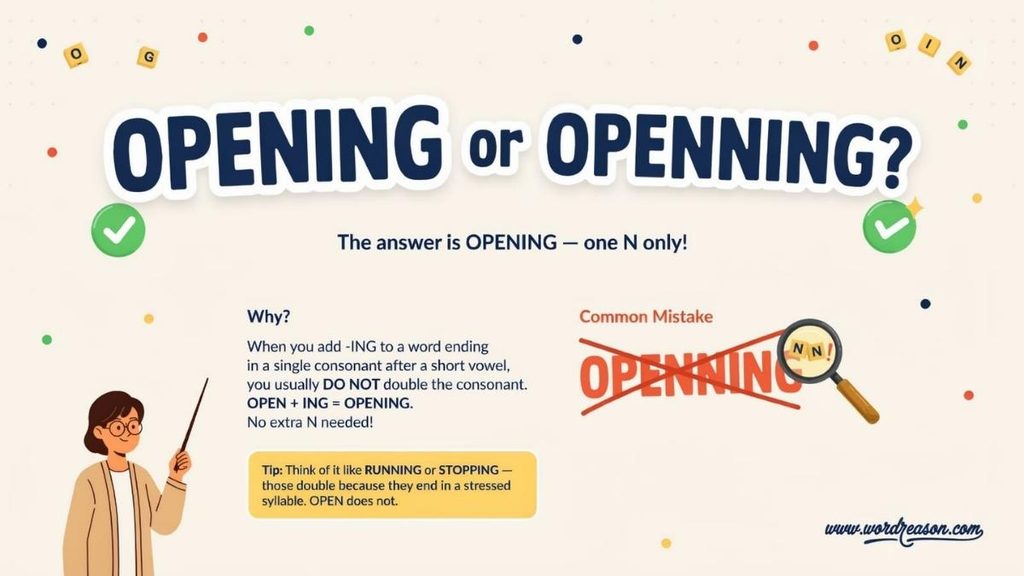
Openning is not the standard spelling of the English word. When you add “ing” to the verb “open,” you simply add the suffix:
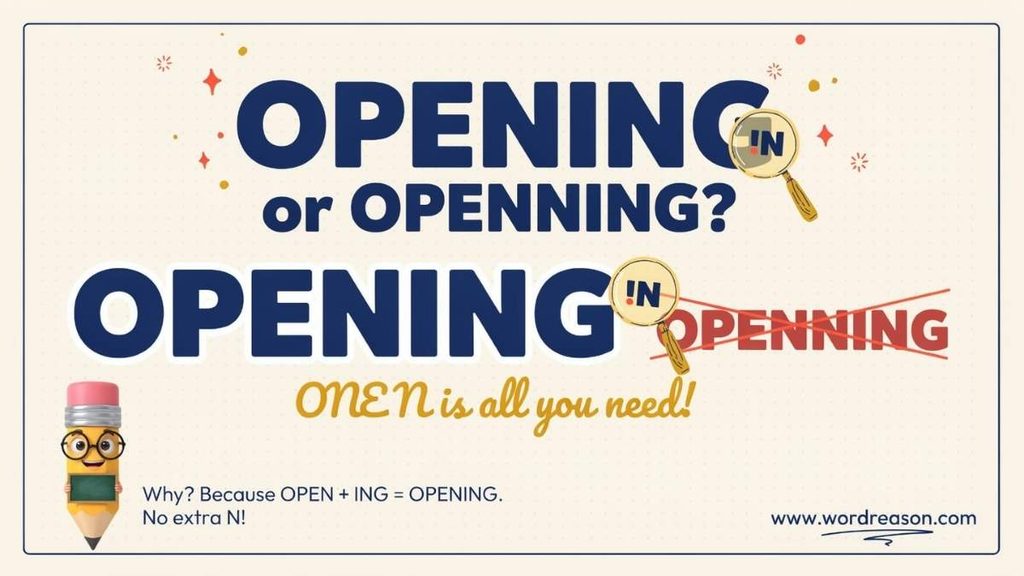
open + ing = opening
You don’t double the final “n.”
| Form | Correct? | Example |
|---|---|---|
| opening | Yes | The store is opening tomorrow. |
| openning | No | The store is openning tomorrow. |
The confusion usually comes from the consonant-doubling rule. English does double a final consonant in words such as “run → running” and “sit → sitting.” However, that rule doesn’t apply to every verb.
So, if you’re wondering is it opening or openning, choose opening.
Learn the difference between confusing more English words
Nosey vs Nosy Which Spelling Is Correct?
What Does Opening Mean?
The opening meaning depends on how you use the word in a sentence. Most commonly, opening describes the act of making something accessible, the beginning of something, or an available opportunity.
The word comes from the verb open and can function in several grammatical roles.
For example
She is opening the window.
The opening of the museum attracted hundreds of visitors.
There is a job opening at the company.
The opening ceremony begins at noon.
Although all four sentences use the same spelling, the word performs different jobs.
Opening as a Verb
As a verb,opening is the present participle of open. It commonly appears with forms of be to create the present continuous tense.
Examples include
I am opening the package.
He is opening the door.
They are opening a new branch.
The restaurant is opening at 11 a.m.
In these examples, opening describes an action that is happening now or around the present time.
The basic forms are
| Verb form | Example |
|---|---|
| Base form | open |
| Third-person singular | opens |
| Past tense | opened |
| Past participle | opened |
| Present participle | opening |
The important spelling change occurs when ing attaches to open. Nothing gets doubled:
open → opening
Opening as a Noun
Opening can also function as a noun. In this use, it often refers to a beginning, an event, an available position, or a gap.
Consider these examples
- The opening of the new theater is Friday.
- The company has a job opening.
- There is an opening in the fence.
- The movie’s opening was dramatic.
Notice how the meaning changes with context.
In job opening,it means an available position. opening of the theater, it means the beginning or launch of the theater’s operation. In opening in the fence, it means a gap or entrance.
Opening as an Adjective
The word opening can also modify a noun.
For example
The speaker gave the opening remarks.
Her opening statement was clear.
The opening paragraph introduces the main idea.
The team’s opening match starts Saturday.
Opening as a Gerund
An ing form can also work as a gerund when it functions like a noun.
For example
“Opening the windows helped cool the room.”
Here, opening the windows acts as the subject of the sentence.
This is one reason opening grammar can seem confusing. The same ing form can participate in different grammatical structures.
Learn the difference between confusing more English words
in vs On the Same Day no confusion grammar guide
Is Openning a Correct Word?
No. Openning is not the standard spelling of the word formed from open + -ing.
The correct form is
open → opening
Not
open → openning
The extra “n” is a spelling error.
You may occasionally encounter “openning” in online comments, informal posts, user-generated content, or other unedited writing. Repeated exposure can make a misspelling look strangely familiar. That doesn’t make it correct.
A useful test is to remove the ing ending:
openning → open + n + ing
The extra n has nowhere to come from. Standard English simply forms the word as
open + ing = opening
Learn the difference between confusing more English words
Happened or Happend which spelling is correct?
Why Is Opening Spelled With One N?
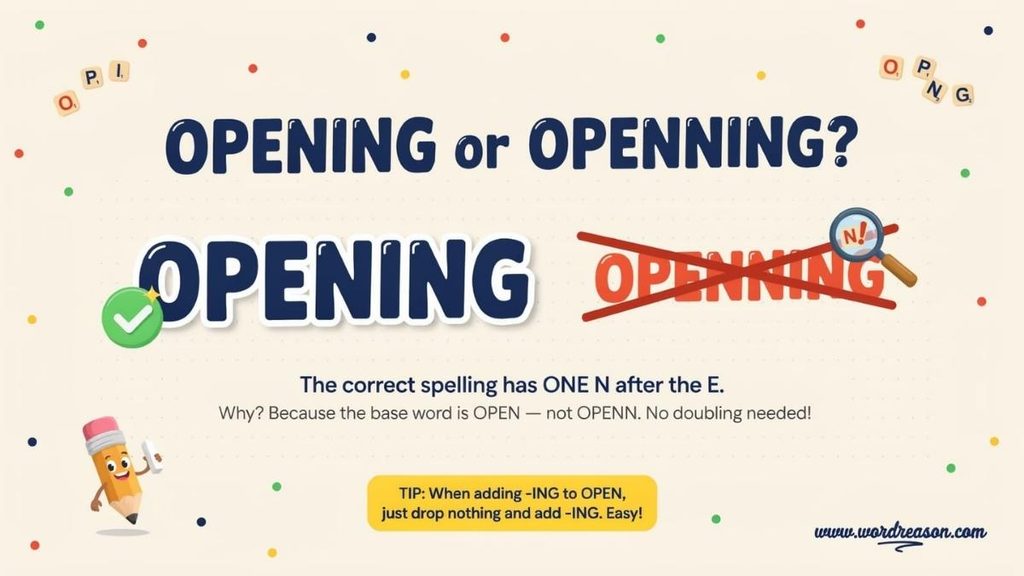
The key lies in understanding when English doubles a final consonant before adding ing.
Many short verbs follow a pattern in which the final consonant doubles
run → running
sit → sitting
stop → stopping
plan → planning
That pattern does not mean every verb ending in a consonant receives a doubled consonant.
The verb open doesn’t meet the conditions that normally trigger this doubling.
The Final N Doubling Rule
A common spelling rule applies to many one-syllable verbs that end in a single consonant after a single vowel.
For example
run
The word has one syllable and ends with the vowel-consonant pattern u-n. When ing is added, the final n doubles
run → running
Likewise
sit → sitting
plan → planning
stop → stopping
However, “open” has two syllables
o-pen
Its final syllable doesn’t follow the same pattern that causes the final consonant to double.
Therefore
open → opening
not
open → openning
Why Open Does Not Become Openning
Look at the difference
| Base verb | Correct -ing form | What happens? |
|---|---|---|
| run | running | Final consonant doubles |
| sit | sitting | Final consonant doubles |
| stop | stopping | Final consonant doubles |
| plan | planning | Final consonant doubles |
| open | opening | Final consonant stays single |
| visit | visiting | Final consonant stays single |
| listen | listening | Final consonant stays single |
| happen | happening | Final consonant stays single |
The important point is that word structure matters. You can’t apply the doubling rule simply because a word ends in a consonant.
English spelling rules depend on factors such as syllables, vowel-consonant patterns, and stress.
Learn the difference between confusing more English words
Bougie vs Boujee which one is correct?
The English Spelling Rule Behind this
The spelling of “opening” becomes much easier once you stop thinking of “n” as something that might need doubling automatically.
The word starts with
open
Then English adds
-ing
That produces
opening
No spelling change occurs inside the base word.
Common Verb +ing Spelling Patterns
English uses several patterns when forming -ing words.
Simply Add -ing
Some verbs take ing without changing the base spelling
open → opening
visit → visiting
listen → listening
happen → happening
clean → cleaning
jump → jumping
This is the pattern that applies to opening.
Double the Final Consonant
Some verbs double the final consonant
run → running
swim → swimming
sit → sitting
stop → stopping
plan → planning
These examples can cause the openning spelling mistake because learners may assume that every verb ending in a consonant behaves the same way.
It doesn’t.
Drop a Final Silent “E”
Some verbs lose the final silent e before ing.
make → making
write → writing
hope → hoping
come → coming
This is a different spelling pattern.
The word open already ends without a silent e, so there is no final e to remove.
A Useful Comparison
Consider these four transformations
| Base word | + -ing | Spelling change |
|---|---|---|
| open | opening | None |
| run | running | Double final consonant |
| make | making | Drop final silent e |
| sit | sitting | Double final consonant |
Learn the difference between confusing more English words
Memento or Momento which is the Correct Spelling?
American and British English
Unlike some English words that have different US and UK spellings, opening doesn’t change between American and British English.
Both varieties use
opening
Neither uses openning as the standard spelling.
| English variety | Correct spelling | Incorrect form |
|---|---|---|
| American English | opening | openning |
| British English | opening | openning |
So there is no American-versus-British spelling choice here.
Learn the difference between confusing more English words
Unformal or Informal Which Spelling Is Correct?
Which Spelling Should You Use?
The simple answer is
Use “opening.”
Whether you’re writing casually or formally, opening is the standard form.
You should use it when
- describing something becoming accessible
- describing the beginning of an event
- discussing a new business or facility
- referring to a job vacancy
- describing the first part of a speech or text
- discussing an opening ceremony
- describing an opening statement
- referring to opening hours
Use Opening in These Examples
- The bank is opening a new branch.
- We are opening the doors at 8 a.m.
- The company announced a new job opening.
- She delivered the opening statement.
- The store’s opening attracted many customers.
Don’t Use Openning as the Standard Form
The spelling openning contains an unnecessary second “n.”
Compare
The shop is openning tomorrow. — Incorrect
The shop is opening tomorrow. — Correct
That tiny difference matters in professional writing. A single extra letter can make an otherwise polished sentence look careless.
Learn the difference between confusing more English words
Optimize or Optimise which spelling is correct?
Common Mistakes With Opening
Mistake 1 Writing Openning
This is the most obvious error.
The incorrect version often appears when someone remembers that certain verbs double their final consonants.
For example
run → running
Then the same person may incorrectly reason
open → openning
The mistake is understandable, but the rule is more specific than that.
Mistake 2 Applying the Doubling Rule Everywhere
Knowing that “run” becomes “running” doesn’t mean every verb needs a doubled final consonant.
Compare
run → running
open → opening
The spelling pattern depends on the structure of the base verb.
Mistake 3 Confusing Pronunciation With Spelling
English pronunciation doesn’t always provide a perfect spelling guide.
You hear “opening” as a smooth sequence of sounds. That can make the number of written letters feel less obvious.
When spelling matters, return to the base word
open + ing
That immediately gives you the correct form.
Mistake 4 Copying Common Online Typos
A misspelling can spread because people copy what they see.
Imagine encountering “openning” on several websites. Eventually, the incorrect version may begin to look normal.
Frequency doesn’t equal correctness.
When you’re unsure, check the base word and the spelling rule instead of trusting repeated online usage.
Learn the difference between confusing more English words
Excel vs Accel which is correct spelling?
Opening Grammar and Sentence Examples
The opening grammar question often has a straightforward answer: “opening” is an “-ing” form of the verb “open,” but its grammatical function depends on the sentence.
Opening as a Present Participle
“The employee is opening the store.”
Here, “opening” forms part of the present continuous verb phrase “is opening.”
Another example
“They are opening the boxes.”
The action is in progress.
Opening as a Gerund
“Opening the windows improved the airflow.”
Here, “opening the windows” functions as the subject of the sentence.
Another example
“She enjoys opening old letters.”
In this sentence, “opening” follows the verb “enjoys” and functions as a gerund.
Opening as a Noun
“The opening was crowded.”
Here, “opening” refers to an event or beginning.
Another example
“The company advertised a job opening.”
Here, the word means an available position.
Opening as an Adjective
“The opening paragraph introduces the topic.”
Here, “opening” describes the paragraph that comes first.
This flexibility explains why opening appears in so many different contexts.
Learn the difference between confusing more English words
Bellies or Bellys Which Spelling Is Correct?
Common Phrases With Opening
The word opening appears in everyday English, business language, entertainment, sports, and formal communication.
1.Opening Ceremony
An opening ceremony is a formal event that marks the start of something.
“The opening ceremony begins at 6 p.m.”
You might hear this phrase when discussing sporting competitions, conferences, buildings, exhibitions, or other major events.
2.Grand Opening
A grand opening usually refers to a formal or promotional launch of a new business, store, restaurant, or facility.
“The restaurant will hold its grand opening on Saturday.”
The phrase often signals that a business has officially begun serving customers.
3.Job Opening
A job opening means an available position that an employer wants to fill.
“The company has a job opening for an accountant.”
Here, “opening” has nothing to do with physically opening a door. It means an available opportunity.
4.Opening Statement
An opening statement introduces the main subject of a speech, presentation, discussion, or formal proceeding.
“The attorney began with a brief opening statement.”
5.Opening Hours
Opening hours refers to the times when a business or service is available to customers.
“The museum’s opening hours are 9 a.m. to 5 p.m.”
6.Opening Remarks
Opening remarks are the first comments delivered at a meeting, event, conference, or ceremony.
“The director gave the opening remarks.”
7.Opening Day
Opening day refers to the first day of operation, performance, competition, or public availability.
“The team’s opening day attracted a large crowd.”
Opening Synonyms
The best opening synonym depends on what “opening” means in context.
When it refers to a beginning, possible alternatives include
beginning
start
launch
commencement
introduction
initiation
For example
“The opening of the exhibition was successful.”
Depending on context, this could become
“The launch of the exhibition was successful.”
However, these words aren’t always interchangeable.
When “opening” refers to a job vacancy, synonyms such as “beginning” or “launch” don’t work.
“There is a job opening.”
Here, vacancy or available position would better express the meaning.
Context does the heavy lifting.
Opening in Everyday Writing
The word opening is common in both casual and professional communication.
In Emails
You might write
“We’re opening registration next Monday.”
Or
“Thank you for opening the account.”
The word can describe either a current action or the act of making something available.
In Business Writing
Business communication frequently uses opening in phrases such as
1.job opening
2.store opening
3.opening hours
4.opening date
5.opening announcement
6.opening ceremony
For example
“Please review the job opening before submitting your application.”
In Social Media
Businesses often use “opening” when announcing launches
“We’re opening our doors this weekend!”
The word also appears in event announcements
“Opening night is finally here.”
In Academic and Formal Writing
Academic writing uses “opening” to describe the beginning of a text or argument
- opening paragraph
- opening sentence
- opening argument
- opening statement
- opening section
For example:
“The opening paragraph establishes the central argument.”
That sentence uses “opening” as an adjective.
Opening Spelling A Simple Memory Trick
Here’s an easy way to remember the correct spelling
Open has one n, and opening keeps one n.
Think of the transformation visually
OPEN + ING = OPENING
Not
OPEN + N + ING = OPENNING
Another useful comparison
run → running
but
open → opening
Don’t let “running” convince you that every verb needs a doubled consonant.
A Quick Spelling Check
Whenever you’re unsure about opening or openning, ask
- What is the base verb?
open - What suffix are you adding?
-ing - Does “open” require consonant doubling?
No. - What is the final form?
opening
That four-step check takes only a few seconds.
Opening vs Openning Comparison Table
| Feature | Opening | Openning |
|---|---|---|
| Standard English spelling | Yes | No |
| Form of “open + -ing” | Yes | No |
| American English | Yes | No |
| British English | Yes | No |
| Suitable for formal writing | Yes | No |
| Correct spelling | opening | openning |
| Example | “The store is opening soon.” | Incorrect spelling |
The difference is only one letter, but only opening follows the standard spelling pattern.
Opening vs Similar -ing Words
A few comparisons make the spelling rule easier to remember.
| Base verb | Correct form | Spelling pattern |
|---|---|---|
| open | opening | Simply add -ing |
| run | running | Double final consonant |
| swim | swimming | Double final consonant |
| plan | planning | Double final consonant |
| listen | listening | Simply add -ing |
| happen | happening | Simply add -ing |
| make | making | Drop final silent e |
| hope | hoping | Drop final silent e |
The main lesson isn’t simply “never double a consonant.” The real lesson is to recognize which spelling pattern applies to each verb.
Opening or Openning Common Examples
Here are practical opening or openning examples that show the correct form in different contexts:
- The store is opening at nine.
- She is opening the package.
- The museum’s opening attracted visitors.
- We attended the opening ceremony.
- The company posted a new job opening.
- His opening statement was concise.
Each sentence uses opening, never “openning.”
Opening or Openning Meaning Does the Extra “N” Change Anything?
No. Openning isn’t a separate standard English word with a different meaning.
The difference between the two forms is therefore not a difference in meaning. It’s a difference between the standard spelling and a misspelling.
That distinction matters because some English word pairs genuinely differ by spelling and meaning. For example, hoping and hopping are both correct words with different meanings.
- hoping = expecting or wishing
- hopping = jumping
But opening and openning don’t work that way.
There isn’t a standard meaning assigned to “openning” that makes it an alternative to “opening.”
Opening Spelling Mistake Why It Happens
The openning spelling error usually comes from a reasonable but incorrect assumption.
Someone knows that English sometimes doubles consonants before “-ing.” They see:
run → running
swim → swimming
Then they apply the same pattern to
open → openning
The mistake is understandable, but the rule is more specific than that.
English spelling doesn’t operate like a rubber stamp. One pattern doesn’t automatically apply to every word.
The safest approach is to recognize common patterns and pay attention to the structure of the base verb.
Is Opening a Word?
Yes. Opening is a standard English word with several grammatical and semantic uses.
It can refer to
the act of making something open
the beginning of an event
an available position
a gap or entrance
the first part of a speech, text, or performance
Its grammatical role can also change depending on context.
For example
“She is opening the door.”
it forms part of a verb phrase.
“The opening was successful.”
Here, it is a noun.
“The opening paragraph was strong.”
it modifies a noun.
So, is opening a word? Absolutely.
Opening or Openning Quiz
Test the spelling rule with these questions.
Choose the Correct Form
- The new store is (opening / openning) tomorrow.
- She is (opening / openning) the door.
- The company announced a new job (opening / openning).
- The museum’s grand (opening / openning) is Saturday.
- They are (opening / openning) registration next week.
- The speaker delivered the (opening / openning) remarks.
- We checked the business’s (opening / openning) hours.
- The (opening / openning) paragraph introduces the topic.
- The restaurant is (opening / openning) a second location.
- The theater’s (opening / openning) attracted a large crowd.
Answers
- opening
- opening
- opening
- opening
- opening
- opening
- opening
- opening
- opening
- opening
The pattern remains consistent
open + ing = opening.
Here’s a trusted source for clear more words Comparison
Practice Session
Test your understanding of opening vs openning and opened vs openned. Choose the correct word for each sentence.
Fill in the Blanks
- The store is ______ at 9 a.m. every morning.
(opening / openning) - She ______ the window to let in some fresh air.
(opened / openned) - The company announced a new job ______ yesterday.
(opening / openning) - He is ______ the package carefully.
(opening / openning) - The theater’s grand ______ attracted hundreds of visitors.
(opening / openning) - Maria ______ the door when she heard a knock.
(opened / openned) - The speaker began with an interesting ______ statement.
(opening / openning) - The museum is ______ to visitors today.
(open / opened) - ______ the door quietly, please.
(open / opening) - The restaurant’s ______ hours are listed on its website.
(opening / openning) - She is ______ a new account online.
(opening / openning) - The manager ______ the meeting with a short speech.
(opened / openned) - The first chapter provides an excellent ______ to the story.
(opening / openning) - The shop ______ its doors at eight o’clock yesterday.
(opened / openned) - We watched the ______ ceremony on television.
(opening / openning) - He is ______ the gift right now.
(opening / openning) - The teacher ______ the classroom door before the students arrived.
(opened / openned) - There is a job ______ in the marketing department.
(opening / openning) - The movie has a dramatic ______ scene.
(opening / openning) - She ______ the box and found a note inside.
(opened / openned) - The store will be ______ for business at 10 a.m.
(opening / openning) - ______ the curtains to let in more sunlight.
(open / opening) - The company is ______ a new branch next month.
(opening / openning) - His ______ remarks made the audience laugh.
(opening / openning) - The librarian ______ the main entrance at exactly nine.
(opened / openned)
Answer Key
- opening
- opened
- opening
- opening
- opening
- opened
- opening
- open
- open
- opening
- opening
- opened
- opening
- opened
- opening
- opening
- opened
- opening
- opening
- opened
- opening
- open
- opening
- opening
- opened
Quick Reminder
Remember the two key forms
- open + ing = opening
- open + ed = opened
Openning and openned are misspellings. The extra n isn’t needed.
Here is a shorter, cleaner, and more polished FAQ/AEO section with direct answers and no duplicate intent.
Frequently Asked Questions About Opening or Openning
Which spelling is correct, openning or opening?
Opening is correct. Openning is a misspelling.
Which is correct, opened or openned?
Opened is correct. Openned is incorrect.
How do you spell opening?
The correct spelling is opening: O-P-E-N-I-N-G.
What does opening mean?
Opening can mean a beginning, an act of making something accessible, a gap, or an available position.
What is the difference between opened and opening?
Opened describes a completed action, while opening describes an ongoing action or can function as a noun.
Why is it opened and not openned?
Because open doesn’t double its final consonant before -ed. The correct form is open + ed = opened.
Are you guys open or opened?
Use “Are you guys open?” when asking if a place is currently available for business.
How do you say open in the past tense?
The past tense of open is opened.
How do you use opened in a sentence?
Use opened for a completed action. For example: “She opened the door.”
What is a better word for opening?
Depending on the context, you could use beginning, start, launch, introduction, or vacancy.
What can I say instead of opening?
Use start or beginning for an event, launch for a business or product, or vacancy for a job.
What does opening mean in a job?
A job opening means an available position that an employer wants to fill.
AEO Questions About Opening
Is openning a word?
Openning is not the standard spelling. The correct form is opening.
Why doesn’t opening have two n’s?
Because open doesn’t follow the consonant-doubling pattern. The correct form is open + ing = opening.
Is opening a verb or a noun?
It can be both. In “She is opening the door,” it’s a verb form. In “The opening was successful,” it’s a noun.
Is opening a gerund?
Yes. In “Opening the windows helped,” the word opening functions as a gerund.
Is opening an adjective?
Yes. In “the opening paragraph,” opening describes the paragraph.
What is the spelling rule for opening?
Simply add -ing to open: open → opening.
What is the correct form of open + ing?
The correct form is opening, with only one n.
What is the difference between opening and beginning?
Both can mean a start, but opening often refers to the start of an event, business, speech, or text, while beginning has a broader meaning.
conclusion
When it comes to opening or openning, there’s no need to let that extra “n” sneak into your writing. Opening is the correct spelling, while openning is simply a spelling mistake. The rule is straightforward: open + ing = opening. Unlike words such as “running,” the final consonant in “open” doesn’t double before adding -ing. Remembering this small difference can save you from an embarrassing typo in an email, essay, or job post. So, the next time you’re unsure, keep it simple: one “n,” no confusion, and you’re officially opening the door to better spelling.

Bella AJS
Bella AJS is an experienced blogger and passionate language enthusiast at WordReason. She specializes in English grammar, word meanings, spelling, and commonly confused words. With a clear and practical writing style, Bella helps readers understand tricky language rules without the textbook headache. Her goal is simple: make English easier, clearer, and more enjoyable one word at a time.