
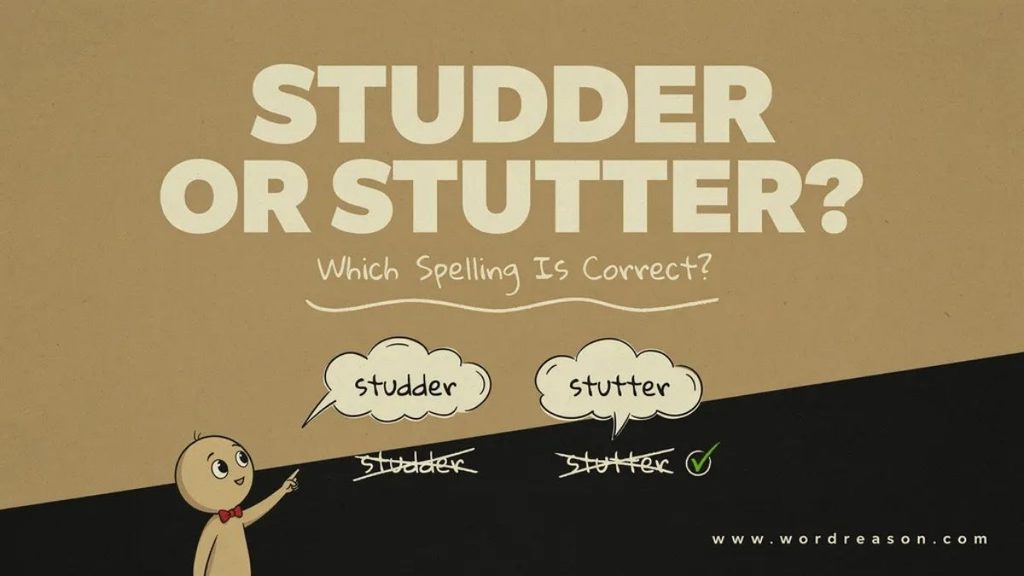
The confusion between studder or stutter often comes from pronunciation, especially because the middle sound in stutter can resemble a quick d in American English. However, English spelling does not always follow the way a word sounds. Stutter is the standard English word, while studder is generally a misspelling when referring to interrupted speech. This guide clears up the confusion, explains the meaning and pronunciation and shows you an easy way to remember the correct spelling without getting your letters tangled.
Studder or Stutter Quick Answer
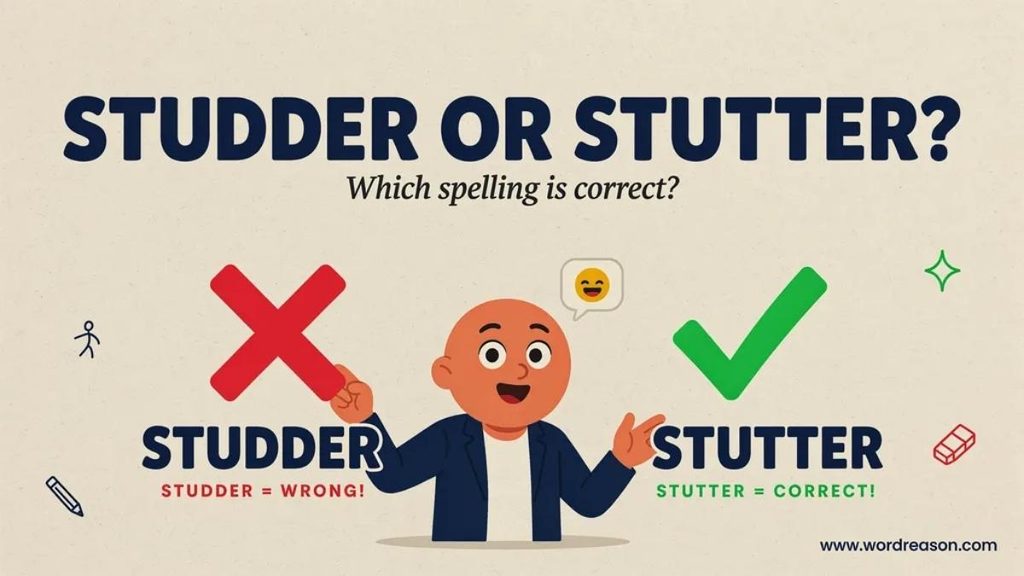
If you are wondering, Is it studder or stutter? choose stutter.
Stutter is the standard English spelling when you mean speech that includes repeated sounds, syllables, words, pauses or other interruptions in fluency. It can work as both a verb and a noun.
Studder is commonly written when someone hears the word and spells it according to its pronunciation. It is not the standard spelling for this meaning. Wiktionary records studder as a misspelling of stutter.
The difference becomes especially clear in the related forms. The correct forms are stutter, stutters, stuttered, and stuttering.
The incorrect versions studder, studders, studdered, and studdering should not be used in standard writing when you mean the speech-related word.
| Word | Standard spelling? | Meaning |
|---|---|---|
| Stutter | Yes | To speak with repeated sounds, pauses, or other interruptions |
| Studder | No, for this meaning | Common misspelling of stutter |
| Stuttered | Yes | Past tense of stutter |
| Studdered | No, for this meaning | Misspelling of stuttered |
| Stuttering | Yes | Present participle and noun form |
| Studdering | No, for this meaning | Misspelling of stuttering |
So, if you need the correct spelling of stutter for an email, essay, article, report, or everyday message, use stutter.
Learn the difference between confusing more English words
Bareable or Bearable Which Spelling Is Correct?
What Does Stutter Mean?
Stutter has a straightforward meaning when it refers to speech. As a verb, it means to speak with difficulty, often by repeating sounds or parts of words or by pausing before getting a word out. Cambridge Dictionary gives examples involving repeated parts of words and pauses.
For example
He began to stutter when he had to answer the unexpected question.
She sometimes stutters when she speaks very quickly.
I started to stutter during the presentation.
The word can also work as a noun. In that form, stutter refers to the speech pattern itself.
For example:
He has a stutter.
Her stutter became more noticeable when she was tired.
The speaker talked openly about living with a stutter.
Stutter also has a broader meaning outside human speech. Something that operates unevenly or repeatedly stops and starts can also be described as stuttering. Cambridge gives the example of an engine that stutters before stopping.
For instance
The engine began to stutter before it stopped.
The video started to stutter because of a poor connection.
That broader meaning explains why you may see the word in discussions about computers, engines, video, and other systems.
Learn the difference between confusing more English words
Optimize or Optimise which spelling is correct?
the Definition and Meaning in Speech
In speech, stutter refers to an interruption in fluent speaking. These interruptions can include repeated sounds, repeated syllables, prolonged sounds, or pauses and blocks.
The American Speech-Language-Hearing Association describes stuttering as an interruption in the flow of speaking caused by disfluencies. It identifies stuttering as the most common fluency disorder.
That definition is more precise than simply saying someone “cannot speak properly.” Stuttering can vary from person to person and can also vary for the same person from one situation to another.
For example, a person might repeat part of a word in one situation and experience a pause or block in another. Speech fluency is not always identical from one conversation to the next.
It is also important not to confuse every ordinary pause or repeated word with stuttering. Everyone can experience normal speech disfluencies from time to time. ASHA points out that ordinary disfluencies can occur in fluent speakers as well.
That distinction makes the word stutter more useful when it is used carefully.
Learn the difference between confusing more English words
Excel vs Accel which is correct spelling?
Is Studder a Word?
The question Is studder a word? often comes from seeing the spelling online or hearing someone pronounce stutter.
For the ordinary speech-related meaning, studder is not the standard spelling. It is commonly used as a misspelling of stutter. Wiktionary specifically identifies studder as a misspelling of stutter and records forms such as studders, studdering, and studdered as derived forms of that misspelling.
That does not mean the sequence of letters can never appear anywhere. A spelling can occur as a name, a specialized term, or an unusual historical reference without becoming the standard spelling of an everyday English word.
For normal writing about speech, the answer remains simple.
Incorrect
I tend to studder when I get nervous.
Correct
I tend to stutter when I get nervous.
The second sentence uses the standard spelling.
Learn the difference between confusing more English words
Bellies or Bellys Which Spelling Is Correct?
Why Do People Spell this words?
The studder spelling mistake has a logical source: pronunciation.
English spelling and pronunciation do not always match perfectly. In American English, the middle t in words such as stutter can be pronounced with a quick flap. Cambridge represents this sound in its American pronunciation as /t̬/.
To an ear that expects a strong t sound, that quick consonant can sound somewhat like d.
That can create a simple mental chain
The person hears the word.
The middle consonant sounds closer to d.
The person writes studder.
The problem is that spelling does not follow that pronunciation change.
Similar pronunciation patterns occur in other familiar American English words. The middle consonant in words such as butter and water can also sound different from the careful t sound many learners expect.
This is why the mistake is understandable. Still, understandable does not make it standard.
Fast conversation can make the confusion even stronger. When people speak quickly, individual sounds often blend together. If someone has mostly heard the word rather than read it, they may naturally rely on the sound when spelling it.
That is one reason searches for studder meaning and studder pronunciation exist even though stutter is the standard spelling.
Learn the difference between confusing more English words
Opening or Openning which Spelling is correct?
Stutter Spelling Why the Double T Matters

The correct spelling of stutter is
S-T-U-T-T-E-R
The important part is the double t in the middle.
The incorrect spelling changes those letters to d:
S-T-U-D-D-E-R
That single change creates the spelling mistake.
The same pattern continues when you add common endings.
Stutter becomes stuttered.
Stutter becomes stuttering.
Stutter becomes stutters.
The spelling does not change to studder when the word is used in a different grammatical form.
If you are trying to remember how to spell stutter, focus on the middle tt. It is the easiest feature to check.
Learn the difference between confusing more English words
Many or Meny Which Spelling Is Correct?
Studder vs Stutter The Main Difference
The studder vs stutter comparison does not involve two different standard words with two different meanings. For ordinary speech, one is the standard form and the other is generally a misspelling.
| Feature | Stutter | Studder |
|---|---|---|
| Standard spelling for speech | Yes | No |
| Verb | Yes | No, as the standard form |
| Noun | Yes | No, as the standard form |
| Past tense | Stuttered | Studdered is incorrect |
| -ing form | Stuttering | Studdering is incorrect |
| Refers to speech disfluency | Yes | No |
| Common spelling confusion | Yes | Common misspelling |
This is why the phrase studder vs stutter which is correct has such a direct answer: stutter is the standard spelling.
Learn the difference between confusing more English words
Happened or Happend which spelling is correct?
Stutter as a Verb
When stutter acts as a verb, it describes what someone does while speaking.
The basic form is stutter.
“He tends to stutter when he is under pressure.”
The third-person form is stutters.
“She stutters occasionally during long presentations.”
The past tense is stuttered.
“He stuttered when the interviewer asked an unexpected question.”
The continuous form is stuttering.
“She is stuttering more today than usual.”
These forms are useful because they show exactly where the spelling mistake tends to appear.
A writer who learns only stutter may still accidentally type studdered or studdering later. Learning the complete word family makes the pattern much easier to recognize.
Learn the difference between confusing more English words
Bareable or Bearable Which Spelling Is Correct?
Stutter as a Noun
Stutter can also function as a noun.
When used as a noun, it refers to the speech pattern or difficulty itself.
He has a stutter.
She described her experience with a stutter.
The speaker discussed how his stutter affected his confidence.
The difference between the noun and verb is easy to see in sentence structure.
He stutters when he speaks.
Here, stutters is the verb.
“He has a stutter.
Here, stutter is the noun.
Both forms use the same standard spelling.
Learn the difference between confusing more English words
Speach or Speech Which Is the Correct Spelling?
Which Is the Correct spelling?

If you are searching for stuttering vs studdering, the correct form is stuttering.
Stuttering contains the same double t found in the base word.
Stutter becomes stuttering.
Studdering is simply the incorrect form created by carrying the studder spelling mistake into the ing form.
The same pattern applies to the past tense.
Stuttered is correct.
Studdered is incorrect for the intended speech-related meaning.
| Incorrect | Correct |
|---|---|
| studder | stutter |
| studders | stutters |
| studdered | stuttered |
| studdering | stuttering |
This makes the spelling pattern easy to remember. Once the base word is correct, its common forms follow naturally.
Learn the difference between confusing more English words
Barrel or Barrell which is the Correct Spelling?
Stutter vs Stammer
Stutter and stammer are closely related words, but they are not simply two spellings of the same word.
Both can refer to disrupted or interrupted speech. Cambridge lists stammer as a related speech term alongside stutter.
In American English, stutter is especially familiar. In British English, stammer is also widely used.
That regional difference should not be confused with the studder spelling mistake.
Stutter and stammer are legitimate vocabulary choices.
Studder is not the standard spelling of stutter.
A simple way to remember the distinction is this
Stutter and stammer are words.
Studder is generally the spelling mistake.
Stutter vs Hesitate
Stutter and hesitate can overlap in everyday descriptions of speech, but they do not mean exactly the same thing.
To hesitate means to pause because you are uncertain, thinking, or deciding what to say.
For example
She hesitated before answering.
A stutter involves interruptions in speech fluency. Those interruptions can include repetitions or blocks.
For example
He stuttered while trying to finish the sentence.
Someone can hesitate without stuttering, and someone who stutters can speak confidently without simply being uncertain about what to say.
That difference matters when choosing the most accurate word.
Stutter vs Stumble Over Words
The phrase stumble over words is much broader.
You might stumble over words because you are nervous, tired, unfamiliar with a subject, or trying to explain something complicated.
For example
I stumbled over my words during the presentation because I had not practiced.
That sentence does not necessarily describe stuttering.
Stutter is more specific when discussing a pattern of disrupted speech.
Choosing the precise term keeps the writing clearer and avoids treating different speech experiences as though they were identical.
Stutter Synonyms and Related Words
Depending on the context, related terms include stammer, hesitate, falter, stumble over words, speak haltingly, repeat, and speech disfluency.
These words should not be treated as perfect substitutes.
For example, a pause is not automatically a stutter. A hesitation is not automatically stuttering. Likewise, stumbling over one sentence does not necessarily describe a continuing speech pattern.
In professional discussions, terms such as fluency disorder and speech disfluency can provide more specific descriptions. ASHA identifies stuttering and cluttering as the two main types of fluency disorders.
The right word depends on what the sentence actually describes.
Stutter in American English vs British English
One of the easiest points to clear up is the idea that American and British English use different spellings.
They do not.
The word is spelled stutter in both varieties.
The pronunciation differs. Cambridge gives the American pronunciation as /ˈstʌt̬.ɚ/ and the British pronunciation as /ˈstʌt.ər/.
British English also commonly uses the word stammer.
Therefore, these are two separate comparisons:
Stutter vs studder concerns standard spelling and a common misspelling.
Stutter vs stammer concerns related vocabulary and regional usage.
There is no rule in British English that changes stutter into studder.
Stutter in Adults
Stuttering is not limited to children.
The American Speech Language Hearing Association explains that stuttering typically begins in childhood. It reports that approximately 95 percent of children who stutter begin before age four, with an average onset of around 33 months.
Some people continue to stutter as they grow older.
ASHA also notes that stuttering can affect the rate and rhythm of speech and may involve more than repetitions or blocks. People who stutter can also experience reactions from other people or internal reactions to speaking.
These details matter because the word stutter describes a real speech experience rather than simply a person occasionally forgetting what to say.
More than three million Americans stutter, according to ASHA.
That figure also shows why accurate language matters. Stuttering is not merely a spelling topic. It is a speech and communication topic that affects many people.
Common Mistakes With Studder and Stutter
The most frequent error is replacing the middle tt with dd.
Wrong
He started to studder when everyone looked at him.
Correct
He started to stutter when everyone looked at him.
The same mistake appears in related forms.
Wrong:“She was studdering during the interview.
Correct
She was stuttering during the interview.
Wrong
He studdered before answering.
Correct
He stuttered before answering.
Wrong
He often studders when he speaks quickly.
Correct
He often stutters when he speaks quickly.
Once the spelling of the base word is fixed, the other forms become much easier to remember.
Stutter Pronunciation
Pronunciation is one of the main reasons this spelling causes trouble.
Cambridge lists the US pronunciation as /ˈstʌt̬.ɚ/ and the UK pronunciation as /ˈstʌt.ər/.
The first syllable receives the main stress.
The American pronunciation contains the flap sound represented by /t̬/. This can sound somewhat like a quick d to listeners who are not expecting the sound.
That explains why someone may write studder even after hearing the word correctly.
However, pronunciation does not provide a perfect spelling guide. English contains many words whose spoken forms differ from what a learner might expect from the letters.
So the safest approach is to remember the written form
Stutter has tt in the middle.
Stutter in Everyday Examples
The word appears naturally in casual conversation, professional writing, educational material, and discussions about communication.
In conversation, someone might say
I sometimes stutter when I am speaking in front of a large group.
In an email, a more neutral sentence could be
I may need a little extra time to answer because I sometimes stutter when speaking under pressure.
In formal writing
Stuttering can affect the fluency and rhythm of spoken communication.
On social media
I used to stutter during presentations, so practicing speeches helped me become more comfortable speaking in public.
In a news style sentence
The speaker discussed his experiences with stuttering at school and in the workplace.
These examples show that stutter is flexible. The word can fit casual, professional, and formal contexts without changing its spelling.
What Does Studder Mean?
People who search for studder meaning or studder definition are usually looking for the meaning of stutter.
In ordinary modern English, studder is generally used as a misspelling of stutter when someone is talking about interrupted speech. Wiktionary identifies the term as a misspelling of stutter.
For example
He began to studder while answering.
The intended meaning is almost certainly
He began to stutter while answering.
That is why searches such as is studder a word, is studder a real word, is studder correct, and is studder spelled correctly usually lead back to the same spelling question.
There is no need to invent a separate everyday definition for studder. For standard writing about speech, use stutter.
Is Studder Ever Used in a Different Context?
A spelling can occasionally appear in specialized contexts without becoming the normal spelling of a common English word.
For example, a surname, brand, historical reference, or niche technical term may contain unusual spelling. Such cases should not be confused with standard everyday English.
For the speech meaning, however, stutter is the form to use.
That remains true in school assignments, workplace documents, articles, emails, essays, and other forms of standard writing.
How to Remember the Correct Spelling of Stutter
The easiest memory trick is to focus on the two t’s.
Think of the word as
STU + TT + ER
The repeated t fits the idea of repetition in the word itself. It gives you a small visual reminder that stutter has a repeated letter in the middle.
Then keep that spelling when adding endings
stutter
stutters
stuttered
stuttering
If you see studder, stop for a second and check the middle letters.
That quick check can prevent the mistake before it reaches your final draft.
Correct Sentence Examples With Stutter
Here are natural examples that show how the word behaves in different sentences.
Some people stutter when they speak very quickly.
He stuttered when the interviewer asked him an unexpected question.
She is stuttering more than usual today.
He has a stutter.
She does not usually stutter during casual conversations.
Does he stutter when speaking in public?
The article discusses stuttering and speech fluency.
I started to stutter because I was nervous.
The engine began to stutter before it stopped.
The video started to stutter when the internet connection slowed.
The last two examples are especially useful because they show that stutter can describe more than human speech. Cambridge includes this broader meaning of something working or happening in an irregular or unsmooth way.
Practice Session Studder or Stutter
Test your understanding of the correct spelling, meaning, and usage of “stutter” and “stuttering.” Choose the correct word in each sentence.
Choose the Correct Word
- The correct spelling is ________.
- He began to ________ when he became nervous.
- She has been ________ since childhood.
- “Studder” is generally a ________ of “stutter.”
- The past tense of “stutter” is ________.
- He ________ while answering the question.
- “Stuttering” is the correct ________ form of “stutter.”
- The speaker started to ________ during the interview.
- “Studdering” is an incorrect ________ of “stuttering.”
- A person may repeat sounds or syllables when they ________.
- The correct form is “He ________,” not “He studders.”
- She was ________ over her words.
- “Stutter” can be used as both a noun and a ________.
- The word “studder” often appears because of spelling ________.
- “Stuttered” is the correct ________ tense of “stutter.”
- The speaker tried not to ________ during the presentation.
- His speech became less fluent because he started to ________.
- “Stuttering” describes interruptions in the normal flow of ________.
- “Studder” is not the standard spelling for a speech-related ________.
- If you are unsure, remember that “stutter” contains a double ________.
- She occasionally ________ when speaking in front of a large audience.
- The child was ________ while telling the story.
- “Stammer” is a closely related ________ for “stutter.”
- The word “stutter” refers to interrupted or repeated ________.
- Always use “stuttering,” not “________,” when referring to this speech pattern.
Answer Key
- stutter
- stutter
- stuttering
- misspelling
- stuttered
- stuttered
- -ing
- stutter
- spelling
- stutter
- stutters
- stuttering
- verb
- confusion
- past
- stutter
- stutter
- speech
- condition
- t
- stutters
- stuttering
- synonym
- speech
- studdering
Here’s a trusted source for clear more words Comparison
FAQs
Is studder a word?
“Studder” is generally a misspelling of “stutter” when referring to interrupted speech.
Is stutter the correct spelling?
Yes. “Stutter” is the standard spelling.
What does stutter mean?
“Stutter” means to speak with repeated sounds, syllables, words, or pauses that interrupt normal speech.
What does studder mean?
“Studder” usually means “stutter” when it appears as a spelling mistake.
Is it studder or stutter?
“Stutter” is correct. “Studder” is the common incorrect form.
Why do people spell stutter as studder?
The pronunciation of “stutter” can make the middle “t” sound similar to a quick “d,” especially in American English.
How do you spell stutter?
The correct spelling is S-T-U-T-T-E-R: “stutter.”
Is it stuttering or studdering?
“Stuttering” is correct. “Studdering” is a misspelling.
Is stutter a noun or a verb?
It can be both. As a verb, it means to speak with interruptions. As a noun, it refers to the interrupted speech pattern.
What is the past tense of stutter?
The past tense is “stuttered.”
Is stuttered or studdered correct?
“Stuttered” is correct. “Studdered” is a misspelling.
Is stutter the same as stammer?
They have similar meanings. “Stammer” is especially common in British English, while “stutter” is widely used in American English.
AEO Questions
Which spelling is correct, studder or stutter?
“Stutter” is the correct standard spelling.
What is the correct spelling of stuttering?
The correct spelling is “stuttering.”
Is studder a misspelling of stutter?
Yes. “Studder” is generally a misspelling of “stutter.”
What is the difference between studder and stutter?
“Stutter” is the standard English word, while “studder” is generally an incorrect spelling.
What does stuttering mean?
Stuttering is a disruption in the normal flow of speech that can involve repeated sounds, prolonged sounds, or pauses.
What does a stutter sound like?
A stutter may involve repeated sounds or syllables, stretched sounds, or noticeable pauses while speaking.
Is stuttering a speech disorder?
Yes. Stuttering is classified as a fluency disorder because it can interrupt the normal flow of speech.
Does stuttering mean low intelligence?
No. Stuttering does not indicate low intelligence.
Can stuttering be treated?
Yes. Speech-language therapy can help people manage stuttering and improve communication.
When does stuttering usually begin?
Stuttering most often begins during childhood, commonly before age four.
What is another word for stutter?
“Stammer” is the closest common alternative, particularly in British English.
What should you write He studders or He stutters?
Write “He stutters.” “Stutters” is the correct spelling.
conclusion
When it comes to studder or stutter, the spelling battle is finally over. Stutter is the correct standard English word, while studder is generally a misspelling. The confusion is understandable because the pronunciation of stutter can make the middle sound seem closer to a quick “d.” Still, English spelling loves to keep things interesting, so what you hear is not always what you write. Remember the double t in stutter, and you will have the correct form every time. Whether you are writing about stuttering, using the word as a verb, or describing interrupted speech, stick with stutter. Your spelling will stay smooth, even when the speech does not.

Bella AJS
Bella AJS is an experienced blogger and passionate language enthusiast at WordReason. She specializes in English grammar, word meanings, spelling, and commonly confused words. With a clear and practical writing style, Bella helps readers understand tricky language rules without the textbook headache. Her goal is simple: make English easier, clearer, and more enjoyable one word at a time.