
If you are searching for monkeys or monkies, which spelling is correct, the answer is simple monkeys is the standard modern spelling. However, the confusion is understandable because many English words ending in consonant + y change y to ies in the plural. Monkey follows a different pattern because its y comes after the vowel e. Therefore, the y stays, and s is added. This guide explains the rule, common mistakes, possessive forms, and examples, so you can spell monkeys correctly with confidence.
Monkeys or Monkies Quick Answer
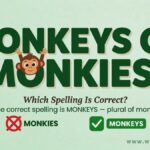
If you are looking for the answer to monkeys or monkies which spelling is correct, the answer is monkeys.
Monkeys is the standard plural form of the singular noun monkey in modern English. Major dictionaries list monkeys as the plural form.Collins also lists monkeys as the plural form, while Cambridge uses monkeys naturally in its definition and examples.
The basic forms are easy to separate
| Form | Correct use | Example |
|---|---|---|
| monkey | Singular | A monkey climbed the tree. |
| monkeys | Plural | Several monkeys climbed the trees. |
| monkey’s | Singular possessive | The monkey’s tail was long. |
| monkeys’ | Plural possessive | The monkeys’ enclosure was large. |
| monkies | Not the standard modern plural | Use monkeys instead. |
Therefore, if you are asking how to spell monkeys, write M-O-N-K-E-Y-S.
If you are asking what is the plural of monkey, the answer is monkeys.
Learn the difference between confusing more English words
Unformal or Informal Which Spelling Is Correct?
Why Is It Monkeys and Not Monkies?
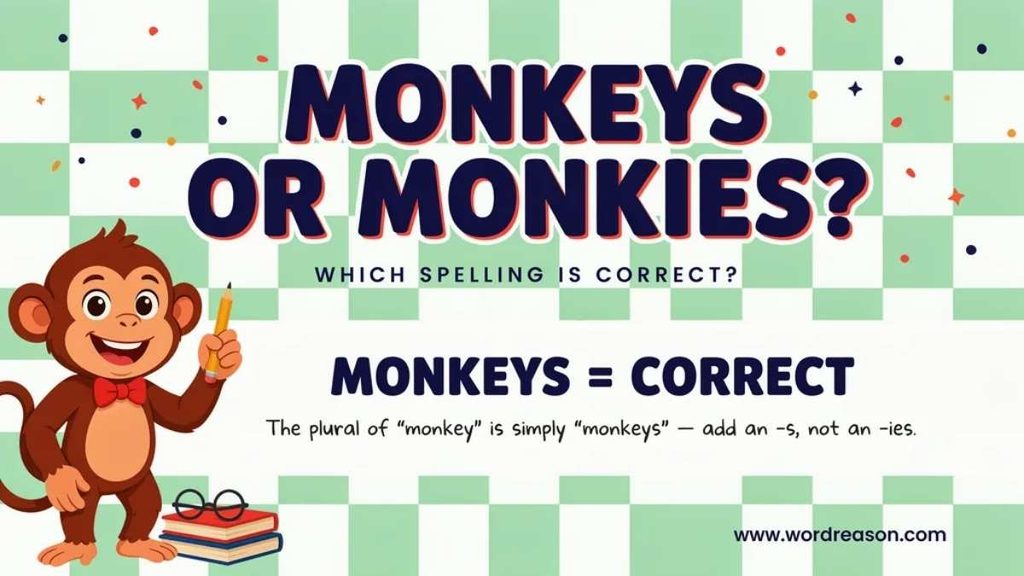
The question “why is it monkeys and not monkies” has a straightforward spelling answer.
English nouns ending in y do not all form their plurals in the same way. The letter that comes immediately before the y matters.
Look at monkey
m-o-n-k-e-y
The letter before y is e. Since e is a vowel, monkey follows the vowel + y plural pattern.
That means you keep the y and add s
monkey → monkeys
Now compare baby
b-a-b-y
The letter before y is b. Because b is a consonant, baby follows the consonant + y pattern
baby → babies
This difference is the key to understanding why monkeys is correct and monkies is not.
The spelling mistake happens when someone remembers only the second pattern. They know that some words ending in y change to ies, so they apply that rule to every word ending in y.
English does not work that way.
Instead, check what comes before the y.
Learn the difference between confusing more English words
Excel vs Accel which is correct spelling?
The Monkey Plural Spelling Rule

Monkey plural spelling follows a regular English plural pattern.
When a noun ends in a vowel followed by y, you generally keep the y and add s.
For example, monkey becomes monkeys. Donkey becomes donkeys. Boy becomes boys. Toy becomes toys. Key becomes keys. Day becomes days. Play becomes plays. Journey becomes journeys.
The pattern looks like this
vowel + y → add s
This is why the correct plural of monkey is monkeys.
However, nouns ending in a consonant followed by y commonly follow another pattern. In these words, the y changes to i and the plural ending becomes es.
For example
baby → babies
city → cities
party → parties
story → stories
family → families
country → countries
The two patterns are much easier to remember when you place them side by side.
| Singular ending | Plural pattern | Example |
|---|---|---|
| Vowel + y | Add s | monkey → monkeys |
| Vowel + y | Add s | toy → toys |
| Vowel + y | Add s | boy → boys |
| Consonant + y | Change y to ies | baby → babies |
| Consonant + y | Change y to ies | city → cities |
| Consonant + y | Change y to ies | party → parties |
So, when you see a word ending in y, do not immediately change the y to ies. First, look at the letter before it.
That one-second check can prevent the entire spelling mistake.
Learn the difference between confusing more English words
Bellies or Bellys Which Spelling Is Correct?
Why Does Monkey Become Monkeys?
The question why does monkey become monkeys becomes simple once you break the word apart.
The final part of monkey is ey.
Here, e is a vowel and y follows it. Therefore, the plural form keeps the original ending and adds s.
monkey + s = monkeys
There is no spelling change to the y.
This is similar to several familiar words
boy → boys
toy → toys
key → keys
day → days
play → plays
donkey → donkeys
The words may have different meanings, but their endings follow the same basic plural pattern.
That is also why monkey and donkey plural forms are useful to learn together. If you can remember monkey → monkeys, you can remember donkey → donkeys.
Learn the difference between confusing more English words
Opening or Openning which Spelling is correct?
Words ending with vowel y

The Words ending with vowel y can look tricky at first. However, their plural formation is usually quite predictable.
Consider these examples
| Singular | Plural |
|---|---|
| boy | boys |
| toy | toys |
| key | keys |
| day | days |
| play | plays |
| monkey | monkeys |
| donkey | donkeys |
| journey | journeys |
In each case, the y remains.
For example, you would never write “toies” as the plural of toy. You write toys. Similarly, you do not write “monkies” as the standard plural of monkey. You write monkeys.
The same spelling idea works with journey
journey → journeys
The y stays because a vowel comes before it.
Learn the difference between confusing more English words
Many or Meny Which Spelling Is Correct?
Words Ending With Consonant + Y

Now consider words ending in consonant + y.
Here, the plural often changes the y to ies.
For example
baby → babies
city → cities
party → parties
lady → ladies
story → stories
company → companies
family → families
The difference becomes clearer when you compare these words with monkey.
| Singular | Letter before y | Plural |
|---|---|---|
| monkey | e | monkeys |
| donkey | e | donkeys |
| boy | o | boys |
| baby | b | babies |
| city | t | cities |
| party | t | parties |
This is the heart of the monkeys spelling rule.
The word does not become monkies because the letter before y is a vowel.
Learn the difference between confusing more English words
Bareable or Bearable Which Spelling Is Correct?
Monkey Plural Form Monkey or Monkeys?
The monkey plural form is monkeys.
Use monkey when you mean one.
For example
A monkey climbed onto the branch.
Use monkeys when you mean more than one.
For example
Several monkeys climbed onto the branches.
The difference is exactly what you would expect from a regular singular and plural noun.
| Number | Correct form | Example |
|---|---|---|
| One | monkey | One monkey escaped. |
| More than one | monkeys | Three monkeys escaped. |
This also answers the question “what is the difference between monkey and monkeys?”
Monkey refers to one. Monkeys refers to more than one.
The spelling change is simply the addition of s.
Learn the difference between confusing more English words
Barrel or Barrell which is the Correct Spelling?
Is Monkies a Word?
The question “is monkies a word” deserves a careful answer because English dictionaries contain historical forms that can make the issue look more complicated than it really is.
In modern standard English, monkies is not the standard plural spelling of monkey. The form you should use in normal writing is monkeys.
However, the Oxford English Dictionary records monkies among historical plural forms of monkey. Its historical record shows that English spelling was not always fixed in the way it is today. The dictionary lists various older spellings of monkey and records monkies as a plural form in historical usage.
That historical detail explains why the spelling monkies may appear in older texts or historical records.
Still, historical usage does not change the modern spelling rule.
If you are writing an email, article, school assignment, report, website, or everyday message today, use monkeys.
So the practical answer is
Is monkies correct as the standard modern plural? No.
Is monkeys the standard modern plural? Yes.
Learn the difference between confusing more English words
Speach or Speech Which Is the Correct Spelling?
Is Monkeys a Word?
Yes. Monkeys is a standard English word and the plural form of monkey.
Dictionaries recognize monkey as a noun and list monkeys as its plural form. Cambridge identifies monkey as a countable noun and uses monkeys in its explanation of the animal group. Collins explicitly gives monkeys as the plural form.
For example
The monkeys climbed through the trees.
Here, monkeys is a plural noun because the sentence refers to more than one animal.
The same form works whether you are talking about animals in the wild, animals in a zoo, or monkeys in a general discussion.
Learn the difference between confusing more English words
Studder or Stutter Which Spelling Is Correct?
Monkeys or Monkies in American English and British English
There is no American versus British spelling difference here.
The plural of monkey is monkeys in both American English and British English.
| Variety of English | Singular | Plural |
|---|---|---|
| American English | monkey | monkeys |
| British English | monkey | monkeys |
This point matters because English does have genuine regional spelling differences.
For example, American English commonly uses color while British English commonly uses colour. American English uses favorite while British English commonly uses favourite.
Monkey does not follow that type of variation.
Therefore, the plural of monkey in British English is monkeys, and the plural of monkey in American English is also monkeys.
You do not need to choose between monkeys and monkies based on the country where the reader lives.
Monkey and Donkey Plural
The monkey and donkey plural forms make an excellent comparison because both words end in ey.
Monkey becomes monkeys.
Donkey becomes donkeys.
The spelling pattern is exactly the same.
| Singular | Correct plural | Incorrect modern form |
|---|---|---|
| monkey | monkeys | monkies |
| donkey | donkeys | donkies |
This comparison is especially useful if the word monkey keeps tempting you toward the ies ending.
Think of monkey and donkey as a pair.
1.Both take y
2. Both take s.
3. Both end with the same vowel + y pattern.
So if you know that donkey becomes donkeys, you already know the basic rule for monkey.
Monkey vs Baby Plural
The monkey vs baby plural comparison shows the opposite pattern.
Monkey ends in ey
monkey → monkeys
Baby ends in by
baby → babies
The difference comes from the letters before y.
In monkey, e is a vowel.
In baby, b is a consonant.
Therefore, the two words follow different plural spelling patterns.
This is why memorizing individual words is not always the best approach. Understanding the spelling pattern gives you a method you can use with other words.
Monkey vs City Plural
The same idea appears in the monkey vs city plural comparison.
Monkey becomes monkeys.
City becomes cities.
The final y looks similar, but the letters immediately before it are different.
Monkey has ey.
City has ty.
Because e is a vowel, monkey keeps its y. Because t is a consonant, city changes y to ies.
That gives you
monkey → monkeys
city → cities
Once you see the pattern, the spelling stops looking mysterious.
Monkey vs Party Plural
They follow different plural patterns for the same reason.
Monkey becomes monkeys.
Party becomes parties.
In monkey, the letter before y is e.
In party, the letter before y is t.
So
vowel + y → add s
consonant + y → usually change y to ies
This explains why “monkies” feels tempting but does not follow the correct modern spelling pattern.
Monkey vs Toy Plural
They follow the same plural pattern.
Monkey becomes monkeys.
Toy becomes toys.
The letter before y is a vowel in both words.
The same pattern appears in boy, key, day, and play.
So you can group these words together
monkey → monkeys
toy → toys
boy → boys
key → keys
day → days
play → plays
This is a useful way to understand English word formation rather than memorizing a single spelling in isolation.
Common Spelling Mistake Monkies
The common spelling mistake monkies usually comes from overapplying the y to ies rule.
A person may remember examples such as baby → babies and city → cities. Then, when faced with monkey, they assume the same change should happen.
That creates monkies.
However, the spelling rule depends on the letter before y.
The correct comparison is
monkey → monkeys
baby → babies
The two words look similar at the end, but they do not have the same letter pattern.
Therefore, the problem is not that monkey is an unusual exception. It follows the regular pattern for nouns ending in vowel + y.
Common English Spelling Errors With Plurals
Plural nouns ending in y often create spelling confusion because the same final letter can appear in two different patterns.
Consider these examples
| Correct singular | Correct plural |
|---|---|
| monkey | monkeys |
| donkey | donkeys |
| toy | toys |
| boy | boys |
| key | keys |
| baby | babies |
| city | cities |
| party | parties |
| story | stories |
| family | families |
The mistake happens when a writer treats every word ending in y as though it belongs in the second group.
Instead, identify whether the word has a vowel or consonant before y.
That gives you a much more reliable approach to English plural rules.
Monkey Plural Possessive
The monkey plural possessive is monkeys’.
This form shows possession or association with more than one monkey.
For example
The monkeys’ enclosure was cleaned.
Here, monkeys’ refers to an enclosure associated with several monkeys.
Compare that with monkey’s
The monkey’s enclosure was cleaned.
This sentence refers to one monkey.
The difference is important because the apostrophe tells you something about possession.
| Form | Meaning | Example |
|---|---|---|
| monkey | One | The monkey is eating. |
| monkey’s | Belonging to one | The monkey’s food is ready. |
| monkeys | More than one | The monkeys are eating. |
| monkeys’ | Belonging to more than one | The monkeys’ food is ready. |
The plural itself is still monkeys. The apostrophe does not change the plural spelling.
Monkey’s vs Monkeys
The difference between monkey’s vs monkeys is grammatical rather than simply a spelling choice.
Monkeys means more than one monkey.
For example
The monkeys are climbing.
Monkey’s indicates possession by one monkey.
For example
The monkey’s tail is long.
The apostrophe matters because it changes the role of the noun.
Now consider monkeys’
The monkeys’ tails are long.
That means the tails belong to several monkeys.
The easiest way to remember the difference is to first decide whether you mean one monkey or more than one.
1. If you mean one, use monkey.
2.If you mean more than one, use monkeys.
3.If you mean something belonging to one, use monkey’s.
4.If you mean something belonging to several, use monkeys’.
Learn the difference between confusing more English words
Happened or Happend which spelling is correct?
Monkeys vs Monkeys’
The difference between monkeys vs monkeys’ is equally straightforward.
Monkeys is plural.
Monkeys’ is plural possessive.
Compare
The monkeys are noisy.
The monkeys’ enclosure is noisy.
The first sentence simply tells you that more than one monkey is noisy.
The second sentence uses the possessive form to show that the enclosure belongs to or is associated with those monkeys.
Therefore, do not add an apostrophe simply because a noun is plural.
Most ordinary plurals do not need an apostrophe.
How to Spell Monkeys
If you are wondering how to spell monkeys, the answer is
M-O-N-K-E-Y-S
The easiest way to remember it is to start with the singular word monkey and add s.
monkey + s = monkeys
1.Do not remove the y.
2.Do not replace y with i.
3.Do not add es.
Just add s.
This makes monkeys a straightforward example of a regular plural noun.
Why Is Monkeys Not Monkies?
The answer to “why is monkeys not monkies” can now be reduced to one useful rule.
The word monkey ends in vowel + y.
Therefore, the plural keeps the y and adds s.
monkey → monkeys
The spelling monkies would make sense only if monkey followed the consonant + y pattern. It does not.
Compare
baby → babies
city → cities
party → parties
Those words have consonants before their final y.
Monkey has a vowel before its final y.
That is the entire spelling distinction.
Does Monkey Follow the Y to IES Rule?
No.
Monkey does not follow the consonant + y pattern that produces forms such as babies and cities.
Instead, it follows the vowel + y pattern.
That means
monkey → monkeys
The same pattern appears in
donkey → donkeys
boy → boys
toy → toys
key → keys
day → days
journey → journeys
So, when you see a noun ending in y, do not automatically change the y to ies.
First, look one letter to the left.
What Happens When a Word Ends in Vowel + Y?
When a regular noun ends in vowel + y, the plural generally keeps the y and adds s.
For example
boy → boys
toy → toys
key → keys
monkey → monkeys
donkey → donkeys
journey → journeys
This pattern is one of the most useful noun spelling rules for avoiding unnecessary changes.
However, English has many plural patterns, so the safest approach is always to check the specific word when you are uncertain.
What Words Follow the Same Rule as Monkey?
Several familiar words follow the same basic rule as monkey.
Boy becomes boys.
Toy becomes toys.
Key becomes keys.
Day becomes days.
Play becomes plays.
Donkey becomes donkeys.
Journey becomes journeys.
Each word has a vowel immediately before the final y.
That gives you a useful group of words that simply add s.
By contrast, words such as baby, city, party, story, and family change y to ies because a consonant comes before y.
Monkeys or Monkies in Everyday Sentences
The easiest way to make the distinction feel natural is to see the word in context.
A monkey climbed onto the branch.
Several monkeys climbed onto the branches.
The young monkey stayed close to its mother.
The monkeys moved through the forest.
One monkey grabbed the fruit.
Three monkeys gathered near the water.
The zookeeper watched the monkeys carefully.
In each plural example, monkeys has the same spelling.
There is no situation in standard modern English where you need to change monkeys to monkies simply because the sentence becomes more formal, informal, British, American, singular, or plural.
The plural form remains monkeys.
A Simple Way to Remember Monkeys Spelling
Here is the easiest mental check.
Look at the ending
monk-ey
The e comes before y.
Because e is a vowel, keep the y and add s.
monkey → monkeys
Then compare
bab-y
The b comes before y.
Because b is a consonant, the y changes to ies.
baby → babies
This small comparison is more useful than memorizing a long list of exceptions.
Think
vowel before y = keep y and add s
consonant before y = usually change y to ies
That rule will help with many words ending in y.
Monkeys or Monkies Final Comparison
| Question | Correct answer |
|---|---|
| Monkeys or monkies? | Monkeys |
| Monkeys vs monkies? | Monkeys is the standard spelling. |
| What is the plural of monkey? | Monkeys |
| What is the monkey plural form? | Monkeys |
| Is monkies a word? | Not the standard modern plural of monkey. |
| Is monkies correct? | No, not as the standard plural. |
| Is monkeys a word? | Yes. |
| How do you spell monkeys? | M-O-N-K-E-Y-S |
| Why is it monkeys and not monkies? | Monkey ends in vowel + y. |
| Does monkey change y to ies? | No. |
| What is the plural possessive? | Monkeys’ |
| What is the singular possessive? | Monkey’s |
| British English plural | Monkeys |
| American English plural | Monkeys |
Practice Session
Test your understanding of the correct plural spelling of monkey. Complete each sentence with the correct word or form.
Fill in the Blanks
- The plural of monkey is __________.
- Several __________ were playing in the trees.
- The spelling __________ is not the standard modern plural of monkey.
- One monkey becomes two __________.
- Monkey ends with a vowel followed by the letter __________.
- Words ending in vowel + y usually form their plurals by adding __________.
- The plural of donkey is __________.
- The plural of toy is __________.
- The plural of baby is __________.
- The plural of city is __________.
- Unlike baby, monkey does not change y to __________.
- The correct spelling is monkey → __________.
- The singular possessive form is __________.
- The plural possessive form is __________.
- “The __________ habitat was protected.” Use the plural possessive form.
- “The __________ tail was covered in mud.” Use the singular possessive form.
- Monkey is a __________ noun when it refers to one animal.
- Monkeys is a __________ noun because it refers to more than one animal.
- Boy becomes __________ in the plural.
- Key becomes __________ in the plural.
- Party becomes __________ in the plural.
- Monkey and donkey both keep the letter __________ when forming their plurals.
- “Three __________ climbed onto the branch.” Complete the sentence with the correct plural.
- The correct spelling is “monkeys,” not “__________.”
- To spell the plural of monkey correctly, keep the y and add __________.
Answer Key
- monkeys
- monkeys
- monkies
- monkeys
- y
- s
- donkeys
- toys
- babies
- cities
- ies
- monkeys
- monkey’s
- monkeys’
- monkeys’
- monkey’s
- singular
- plural
- boys
- keys
- parties
- y
- monkeys
- monkies
- s
FAQs
What is the plural of monkey?
The plural of monkey is monkeys.
Which is correct, monkeys or monkies?
Monkeys is the correct modern spelling. Monkies is not the standard plural.
Why is monkey spelled monkeys?
Monkey ends in vowel + y, so you keep the y and add s.
Does monkey follow the y-to-ies rule?
No. The y-to-ies rule applies when a consonant comes before y, as in baby → babies.
Is monkies a word?
Monkies appears as a historical variant, but monkeys is the standard modern spelling.
What is the difference between monkey and monkeys?
Monkey means one animal, while monkeys means more than one.
What is the plural possessive of monkey?
The plural possessive is monkeys’. For example: “The monkeys’ habitat is protected.”
What is the difference between monkey’s and monkeys’?
Monkey’s shows possession by one monkey. Monkeys’ shows possession by multiple monkeys.
AEO
How do you spell the plural of monkey?
It is spelled monkeys: M-O-N-K-E-Y-S.
Why is monkeys not monkies?
Because monkey ends with vowel + y. The y stays, and s is added.
Is monkeys singular or plural?
Monkeys is plural and refers to two or more monkeys.
What words follow the same rule as monkey?
Boy, toy, key, day, and donkey follow the same vowel + y pattern: boys, toys, keys, days, and donkeys.
What is the plural of donkey?
The plural of donkey is donkeys.
Is monkeys correct in American and British English?
Yes. Monkeys is the standard spelling in both American and British English.
Can monkey be used as a verb?
Yes. In informal English, monkey can mean to fool around or interfere with something.
What is an example of monkeys in a sentence?
“Several monkeys were climbing through the trees.”
conclusion
The confusion between monkeys or monkies may look like a tiny spelling problem, but that little y can certainly cause trouble. The correct modern plural of monkey is monkeys because the y follows the vowel e. Therefore, the y stays in place, and s is added. Unlike words such as baby and city, monkey does not change y to ies. The same pattern applies to words such as donkey, boy, toy and key. So, whenever monkies tries to sneak into your writing, remember the simple rule: vowel + y keeps the y and takes s. Once this pattern clicks, monkeys becomes easy to spell correctly every time.

Bella AJS
Bella AJS is an experienced blogger and passionate language enthusiast at WordReason. She specializes in English grammar, word meanings, spelling, and commonly confused words. With a clear and practical writing style, Bella helps readers understand tricky language rules without the textbook headache. Her goal is simple: make English easier, clearer, and more enjoyable one word at a time.