
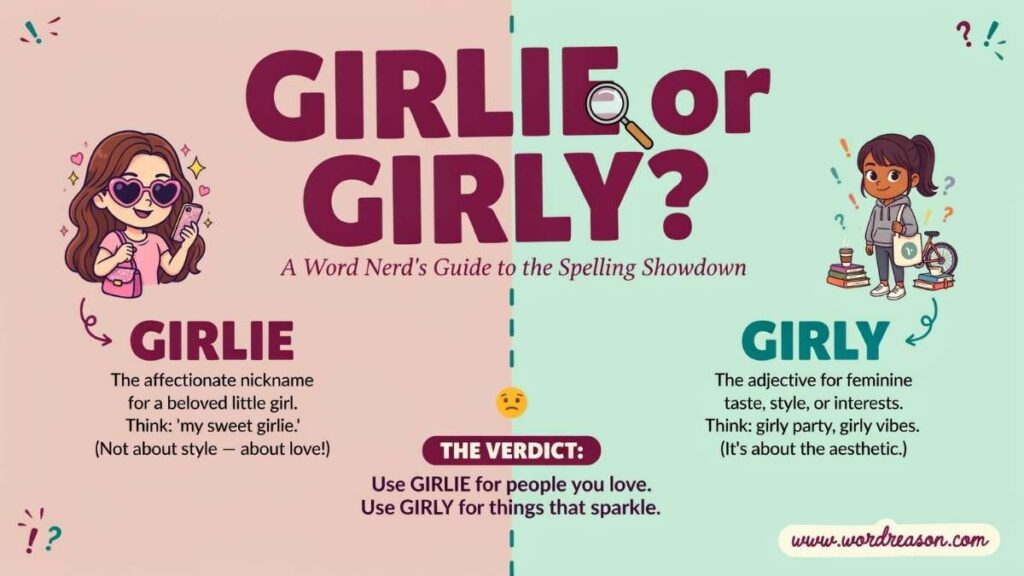
Two words look almost identical, sound similar, and often carry nearly the same meaning of Girlie vs Girly, which makes that tiny “e” surprisingly powerful. The good news is that neither word needs to be sent to the spelling police. Both girly and girlie are legitimate English words, but they don’t always fit the same situations. One commonly describes feminine styles, qualities, or interests, while the other can also appear as a playful way to address someone. Let’s untangle their meanings, usage, grammar, tone, and examples without the usual word choice headache.
Girlie vs Girly The Quick Answer
“Girly” and “girlie” can both be correct when they are used as adjectives to describe something associated with girls or traditionally feminine qualities.
For example:
- She wore a girly dress.
- She wore a girlie dress.
- The room has a very girly style.
- The room has a very girlie style.
However, the two words aren’t completely interchangeable in every situation.
Girly is commonly used as an adjective meaning feminine, traditionally associated with girls, or suitable for girls.
Girlie can have the same adjective meaning, but it also appears in informal expressions such as “Hey, girlie!” It can also function as a noun in some dictionary-recognized uses.
So, if you’re asking “Is it girlie vs girly?”, the answer is:
Both are correct. Choose the one that fits your meaning and context.
Masonary vs Masonry Which Spelling Is Correct?
What Does “Girly” Mean?
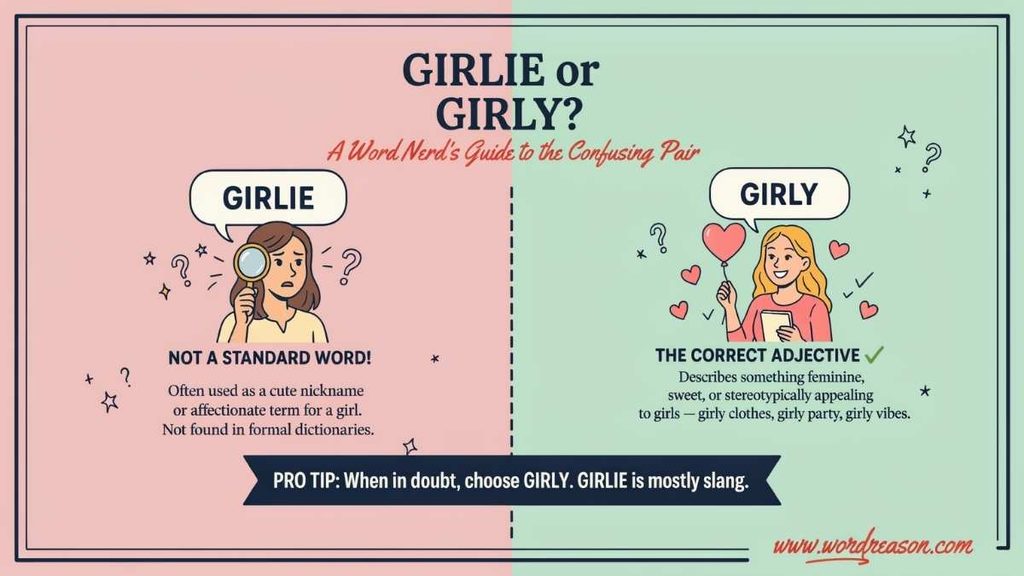
Girly is primarily an adjective. It describes something considered typical of girls or traditionally associated with femininity.
The word can describe clothing, colors, behavior, interests, styles, decorations, or personalities.
Examples of “girly”
- She loves girly fashion.
- Her bedroom has a girly aesthetic.
- Pink is often considered a girly color, although colors aren’t inherently feminine.
- She bought a girly dress for the party.
- The movie has a very girly style.
- Her friends describe her personality as playful and girly.
The exact meaning depends on context. Something described as “girly” might be cute, delicate, feminine, youthful, or traditionally associated with girls.
Girly definition
A simple girly definition is
Girly means characteristic of, associated with, or considered suitable for girls or traditionally feminine qualities.
The word is generally informal. In some contexts, it can also sound dismissive or stereotypical if someone uses it to suggest that certain interests are naturally “for girls.”
For example:
“She likes dresses and flowers, so she’s very girly.”
This may simply describe her style. However, saying something like “That hobby is too girly for a man” introduces a judgment about gender expectations.
What Does “Girlie” Mean?
Girlie can also work as an adjective with a meaning very similar to girly.
For example:
- She bought a girlie dress.
- The room has a girlie look.
- She prefers girlie accessories.
- The design has a cute, girlie feel.
So, when it comes to adjective use, girlie vs girly often isn’t a question of right versus wrong.
However, girlie has some additional uses that make it stand out.
Girlie as an informal term of address
You may hear someone say:
“Hey, girlie!”
or:
“Thanks, girlie!”
In these examples, girlie is being used informally to address another girl or woman.
This usage is especially common in conversational language and online communication. Depending on the relationship between the speakers, it can sound friendly, affectionate, playful, teasing, or patronizing.
For example:
“Hey, girlie! How have you been?”
A close friend might use it warmly. The same word from a stranger could feel condescending.
Girlie vs Girly Key Differences
At first glance, these words look like twins wearing different shoes. Their meanings overlap considerably, but their grammatical roles and tones can differ.
| Feature | Girly | Girlie |
| Adjective | Yes | Yes |
| Describes feminine qualities | Yes | Yes |
| Informal | Usually | Usually |
| Can describe clothing/style | Yes | Yes |
| Common in casual speech | Yes | Yes |
| Informal term of address | Less common | Common |
| Can function as a noun | Yes, informally | Yes, informally |
| Modern social-media usage | Common | Very common |
| Suitable for formal writing | Usually avoid | Usually avoid |
The most important point is simple:
As adjectives, “girly” and “girlie” often have the same basic meaning.
The bigger difference appears when “girlie” is used as a noun or a form of address.
Girly vs Girlie Meaning
If you’re searching for the girlie vs girly meaning, here’s the easiest way to remember it
Girly
Girly = feminine, traditionally associated with girls, or considered typical of girls.
Example
“She chose a girly pink dress.”
Girlie
Girlie = feminine or girl like, often with a more informal or playful tone.
Example
“She chose a girlie pink dress.”
Both sentences can communicate essentially the same idea.
However, “girlie” can also refer informally to a girl or woman, especially in expressions such as:
“Hey, girlie!”
That extra usage gives “girlie” a broader range in casual English.
Is “Girlie” a Real Word?
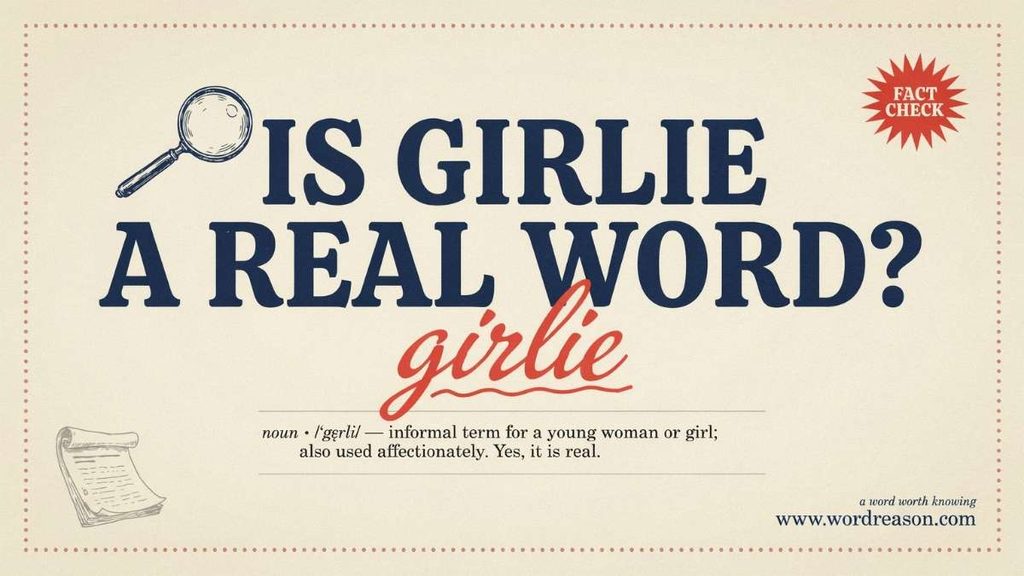
Yes. Girlie is a real English word.
It isn’t simply a misspelling of girly.
Major dictionaries recognize girlie as an adjective. Dictionaries also record noun uses of the word, although those uses can be informal, old-fashioned, or offensive depending on the context.
This distinction matters because you may see people correcting “girlie” to “girly” as though the former doesn’t exist.
That’s not accurate.
If you write:
“She has a girlie style.”
you haven’t automatically made a spelling mistake.
The sentence is grammatically possible. Whether girlie is the best choice depends on the tone and context.
Is Girlie Slang?
Not necessarily.
“Girlie” is a recognized English word, so it would be inaccurate to label every use of it as slang.
However, many modern uses are informal and conversational.
Social media has also made expressions such as these increasingly visible
- Hey, girlie
- Thanks, girlie
- Book girlie
- Coffee girlie
- Travel girlie
- Hot girlie
- That girlie
- Girlies
These expressions can feel playful or slang like because they belong strongly to casual internet culture.
So the better description is
“Girlie” is a standard dictionary word with informal uses. Some modern social media uses are colloquial or slang-like.
Girly vs Girlie Which One Should You Use?
Your choice should depend on what you’re trying to say.
Use “girly” when
- You are describing something feminine.
- You are discussing clothing or style.
- You want a familiar adjective.
- You are writing a casual description.
Examples:
She has a girly style.
That’s a very girly outfit.
The room looks girly and colorful.
Use “girlie” when:
- You want a more playful or informal tone.
- You’re using it as a casual form of address.
- You’re writing dialogue or social-media language.
- The context naturally calls for the “ie” ending.
Examples:
“Hey, girlie!”
“Thanks, girlie!”
“She’s into all things girlie.”
Girly vs Girlie in a Sentence
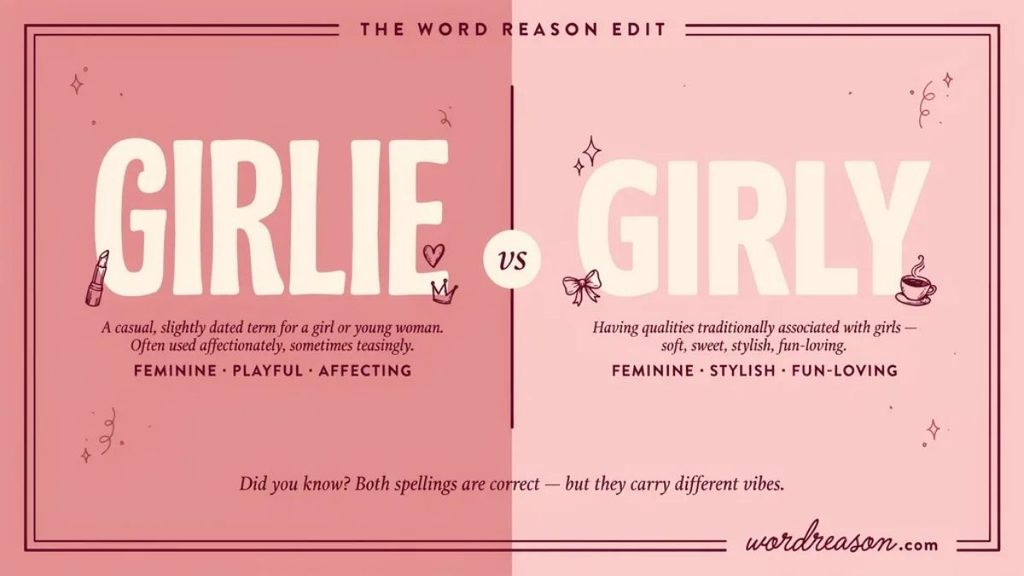
Seeing the words side by side makes the distinction easier.
Girly examples
- She bought a girly dress for the celebration.
- Her bedroom has a girly aesthetic.
- The gift has a cute, girly design.
- She enjoys traditionally girly activities.
- The pink decorations give the room a girly look.
Girlie examples
- She loves a girlie aesthetic.
- “Hey, girlie, are you coming with us?”
- “Thanks, girlie!”
- The store sells girlie accessories.
- She chose a cute and girlie outfit.
Notice something important the adjective examples often work with either spelling.
The form of address, however, strongly favors girlie.
Girlie vs Girly Tone and Connotation
Grammar isn’t the whole story. Tone matters.
“Girly” can sound neutral, descriptive, playful, or stereotypical depending on the sentence.
For example:
“She chose a girly floral dress.”
That’s mostly descriptive.
But:
“Men shouldn’t like girly colors.”
Now the word carries a judgment about gender.
The same issue can arise with “girlie.”
“Hey, girlie! Come sit with us.”
This may sound affectionate between friends.
But
“Listen, girlie, you don’t know what you’re talking about.”
Here, “girlie” can sound patronizing or insulting.
The relationship between the speakers and the surrounding words can completely change the tone.
Girly and Girlie in Formal Writing
Neither word is usually the best choice for highly formal or professional writing.
Instead of
The product has a very girly appearance.
you might write
The product has a feminine appearance.
Instead of
The design uses girly colors.
you could write
The design uses traditionally feminine colors.
This approach is often clearer and more precise.
Better formal alternatives
Depending on your meaning, consider
- feminine
- delicate
- youthful
- playful
- traditionally feminine
- ornamental
- romantic
- colorful
- soft
- cute
The best replacement depends on what you actually want to describe.
Common Mistakes With Girlie and Girly
Mistake 1 Thinking “girlie” is always wrong
Some people assume the correct spelling must always be girly.
That’s incorrect.
Girlie is a recognized word.
Fix
Look at the context instead of automatically changing the spelling.
Mistake 2 Thinking the two words always mean different things
They don’t.
As adjectives, girly and girlie frequently overlap in meaning.
Fix
Remember that both can describe something associated with girls or traditionally feminine qualities.
Mistake 3 Calling every use of “girlie” slang
“Girlie” has dictionary-recognized uses beyond internet slang.
Fix
Call it informal when that better describes the context.
Mistake 4 Using “girlie” in formal situations
A word can be correct yet still be unsuitable for a particular setting.
For example, calling a professional client “girlie” could sound patronizing.
Fix
Use neutral language such as woman, girl, colleague, or the person’s name when appropriate.
Common Phrases With “Girly”
Here are some common combinations:
Girly fashion
Fashion that is traditionally associated with feminine styles.
She loves girly fashion.
Girly dress
A dress perceived as feminine, cute, delicate, or traditionally associated with girls.
She wore a girly dress to the party.
Girly outfit
An outfit with traditionally feminine styling.
Her girly outfit included a floral skirt and ballet flats.
Girly style
A feminine or traditionally feminine appearance.
She prefers a soft girly style.
Girly colors
Colors culturally associated with femininity.
The designer used soft girly colors.
Girly personality
A personality someone perceives as traditionally feminine or youthful.
She has a playful, girly personality.
Remember that these descriptions reflect cultural associations, not universal rules.
Common Phrases With “Girlie”
“Girlie” appears frequently in casual speech and online language.
Hey girlie
A friendly or playful way to address a girl or woman.
Hey girlie! How’s everything going?
Thanks girlie
An informal way to thank someone.
Thanks, girlie! That helped a lot.
Girlies
A playful plural referring to girls or women in informal conversation.
The girlies are going out tonight.
Book girlie
A playful internet expression for someone who loves books or reading.
She’s a total book girlie.
Coffee girlie
A casual social media style expression for someone strongly associated with coffee culture.
I’m officially a coffee girlie.
These expressions aren’t usually appropriate in formal writing. They’re designed for personality, familiarity, and casual conversation.
What Does “Girly Pop” Mean?
“Girly pop” is a playful internet expression rather than a formal English term.
People often use it affectionately to address a girl or woman or to describe a particular playful, feminine online persona.
For example
“Okay, girly pop, tell me what happened.”
Its meaning depends heavily on the online community and the relationship between speakers.
This is a good example of how language evolves. A word can begin as ordinary vocabulary, gain a particular social tone, and then develop new uses through internet culture.
What Does “Hey Girlie” Mean?
“Hey girlie” usually means something like “Hey, girl!” or “Hi, girl!” in casual conversation.
It can express
- friendliness
- affection
- excitement
- familiarity
- playfulness
For example:
“Hey girlie! I haven’t seen you in forever.”
However, tone matters. If a stranger or superior uses “girlie” toward an adult woman, it may sound condescending.
So don’t judge the phrase by the dictionary meaning alone. Listen for the social meaning too.
Can “Girlie” Be Used as a Noun?
Yes.
Dictionaries recognize girlie as a noun in informal usage. It can refer to a girl or young woman.
However, this use can sound old fashioned, patronizing, or offensive, depending on how it’s used.
That’s why modern speakers often prefer more neutral words.
For example, instead of:
“That girlie works here.”
a more natural choice would be
“That woman works here.”
or:
“That girl works here,”
depending on the person’s age and context.
Can “Girly” Be Used as a Noun?
Yes. Girly can also appear as an informal noun meaning a girl or young woman.
However, like the noun use of girlie, it may sound dated, dismissive, or offensive.
Therefore, although a dictionary may recognize a word, that doesn’t mean it’s appropriate in every conversation.
This is an important English lesson
Correct grammar doesn’t automatically guarantee appropriate language.
Girlie vs Girly A Practical Case Study
Imagine you’re describing two dresses.
The first is pink, covered in small flowers, and decorated with ribbons.
You could write
“It’s a very girly dress.”
You could also write
“It’s a very girlie dress.”
Both are understandable.
Now imagine you’re texting your friend
“Hey, girlie! Did you buy the dress?”
Here, girlie feels much more natural.
Finally, imagine you’re writing a product description for a professional fashion website.
Instead of
“This is the perfect girly dress.”
you might choose
“This floral dress features a feminine and playful design.”
The vocabulary changes because the audience and purpose have changed.
Dictionary Style Word Guide
Girly
Part of speech Adjective; noun in informal usage
Meaning Feminine or characteristic of, associated with, or considered suitable for girls.
Tone Usually informal; can be playful or stereotypical depending on context.
Example
She prefers a girly style.
Girlie
Part of speech Adjective; noun in informal usage
Meaning Feminine, girl like, or associated with girls. It can also be an informal term for a girl or young woman.
Tone Informal, playful, conversational, or potentially patronizing depending on context.
Example
“Hey, girlie! How are you?”
Girlie Spelling vs Girly Spelling
If you’re specifically checking the girlie spelling or girly spelling, both forms exist.
Correct forms
Girly ✓
Girlie ✓
Incorrect assumption
Girlie = always a misspelling of girly ✗
That’s not true.
The spelling you choose should reflect the intended meaning and tone.
For a straightforward adjective, both may work
girly clothes
girlie clothes
For a casual form of address, girlie is much more natural
Hey, girlie!
Is It Girlie vs Girly?
If you’re still wondering “is it girlie vs girly?”, use this quick rule
Talking about a feminine quality or style?
→ Girly or girlie may work.
Addressing someone casually?
→ Girlie is the more natural choice.
Writing formally?
→ Consider feminine, youthful, or a more specific description.
Talking about a word’s social media usage?
→ Girlie often carries the playful internet tone you’re looking for.
Girlie vs Girly Quick Reference
| Question | Answer |
| Is “girly” correct? | Yes |
| Is “girlie” correct? | Yes |
| Is “girlie” just a misspelling? | No |
| Can both describe feminine things? | Yes |
| Can “girlie” be a noun? | Yes, informally |
| Can “girly” be a noun? | Yes, informally |
| Is “girlie” always slang? | No |
| Is “girly” formal? | Usually informal |
| Is “girlie” formal? | Usually informal |
| Which is better for “Hey ___!”? | Girlie |
| Which is safer in professional writing? | Use a more precise word such as feminine |
Here’s a trusted source for clear more words Comparison:
25 Fill in the Blank Questions
- She bought a ______ floral dress for the summer.
- “Hey, ______! I haven’t seen you all week.”
- Her room has a very ______ aesthetic.
- “Thanks, ______, for helping me choose this outfit.”
- The store sells cute and ______ accessories.
- She prefers a simple style rather than an overly ______ one.
- “Okay, ______, what’s the big news?”
- Her friends describe her as feminine and ______.
- The designer created a soft, romantic, and ______ collection.
- “Come on, ______! We’re going to miss the movie.”
- She decorated her bedroom with a cute ______ theme.
- “Hey, ______, do you want some coffee?”
- The dress has a playful and ______ design.
- She doesn’t consider herself particularly ______.
- “Thanks for the advice, ______!”
- Her outfit looked feminine without being too ______.
- “Listen, ______, I have something important to tell you.”
- She loves ______ fashion and colorful accessories.
- “Hey, ______! How was your weekend?”
- The room has a bright and ______ atmosphere.
- She chose a ______ outfit for the birthday party.
- “Don’t worry, ______. Everything will be fine.”
- Her style is feminine but not overly ______.
- “Okay, ______, let’s get started.”
- The boutique specializes in youthful and ______ clothing.
Answer Key
- girly
- girlie
- girly / girlie
- girlie
- girly / girlie
- girly / girlie
- girlie
- girly / girlie
- girly / girlie
- girlie
- girly / girlie
- girlie
- girly / girlie
- girly / girlie
- girlie
- girly / girlie
- girlie
- girly / girlie
- girlie
- girly / girlie
- girly / girlie
- girlie
- girly / girlie
- girlie
- girly / girlie
FAQs About Girly and Girlie
Can I Call a Girl “Girlie”?
Yes, you can, especially in casual and friendly conversations. “Girlie” can sound warm, playful, or affectionate when used between friends or people who are comfortable with each other.
For example
“Hey, girlie! How have you been?”
However, context matters. When used toward an adult woman by a stranger, coworker, or someone in a position of authority, girlie may sound patronizing or overly familiar.
Is It “Hey Girly” or “Hey Girlie”?
When you’re using the word as a casual way to address someone, “Hey girlie” is the more natural choice.
For example
“Hey girlie! I have something to tell you.”
By contrast, girly is more commonly used as an adjective
“She has a very girly style.”
A simple way to remember it is
Girly → usually describes something.
Girlie → can describe something or address someone informally.
Is “Girlie” Derogatory?
Not inherently. The word can be affectionate, friendly, or playful. However, its tone depends heavily on the speaker, listener, and situation.
Compare these examples
“Hey, girlie! Come sit with us.”
This sounds friendly.
“Listen, girlie, you don’t understand.”
This can sound dismissive or condescending.
So, the word itself isn’t automatically derogatory. The context gives it its social meaning.
What Does It Mean When a Guy Calls You “Girlie”?
When a guy calls you “girlie,” he may simply be using a casual or playful form of address. He could also be trying to sound friendly, affectionate, teasing, or familiar.
It doesn’t automatically mean he’s flirting.
If you’re trying to understand whether he likes you, consider the whole pattern of his behavior rather than focusing on one word. Frequent conversations, personal attention, compliments, and efforts to spend time with you may tell you more than “girlie” itself.
What Does “Girly” Mean in Slang?
In informal language, girly can describe someone or something perceived as traditionally feminine, cute, delicate, playful, or associated with girls.
For example:
“She loves everything girly.”
The word can be positive, neutral, or slightly dismissive depending on the speaker’s intention. It isn’t automatically slang simply because it appears in casual conversation.
What Does “Girlie” Mean in Slang?
In modern informal and online language, girlie is often used as a playful or affectionate way to address a girl or woman.
Examples include
“Hey, girlie!”
“Thanks, girlie!”
“Okay, girlie, tell me everything.”
Social media has helped popularize expressions such as book girlie, coffee girlie, and travel girlie. These phrases usually create a playful sense of identity around someone’s interests.
What Is a “Girly Girl”?
A girly girl is a girl or woman who strongly enjoys or expresses qualities that a particular culture traditionally associates with femininity.
This might include
- feminine fashion
- dresses and skirts
- makeup and beauty
- traditionally feminine aesthetics
- cute accessories
- romantic styles
- activities culturally associated with girls
The expression describes a style or personality, not a strict category. Someone can enjoy traditionally feminine things without considering herself a “girly girl.”
What Does Being Girly Mean?
Being girly generally means expressing, enjoying, or preferring things that are traditionally viewed as feminine.
For example, someone might describe herself as girly because she enjoys
- feminine clothing
- makeup
- floral designs
- cute accessories
- soft or romantic aesthetics
- traditionally feminine hobbies
However, the idea of what counts as “girly” changes across cultures and generations. There is no universal checklist for femininity.
What’s a Better Word for “Girly”?
If you want a more neutral or professional word, feminine is usually the strongest alternative.
Depending on your intended meaning, you could also use
- feminine — associated with qualities traditionally linked to women or girls
- delicate — soft or fine in appearance
- cute — attractive in a youthful or charming way
- youthful — having a young or fresh quality
- playful — lighthearted and fun
- romantic — associated with a soft or romantic aesthetic
- traditionally feminine — more precise when discussing gender-related conventions
The best replacement depends on what you mean by “girly.”
What Does “Girly” Mean in Urban Dictionary?
Urban Dictionary contains user submitted definitions, so its entries can vary considerably. Different users may give “girly” different slang meanings based on their communities or experiences.
For a reliable definition, it’s better to use established dictionaries for the core meaning and treat crowdsourced slang sites as evidence of informal usage rather than formal authority.
What Is the Male Version of “Girlie”?
There isn’t one exact male equivalent of girlie.
Depending on the situation, informal terms such as bro, dude, buddy, or guy may serve a similar conversational purpose. However, none carries exactly the same combination of femininity, familiarity, and playfulness that “girlie” can express.
What Is a Flirty Word to Call a Girl?
There isn’t one universally appropriate flirty word. The best choice depends on the relationship and the person’s comfort level.
Words such as beautiful, gorgeous, cutie, or babe can sound affectionate or romantic in the right context.
Girlie, however, isn’t automatically a flirty term. It can simply be a friendly nickname.
Why Do Guys Like “Girly Girls”?
There isn’t one answer because attraction is highly personal. Some men may appreciate traditionally feminine fashion, behavior, or personality traits. Others may prefer women with very different styles.
Attraction isn’t governed by a universal preference for “girly” women. People are attracted to different personalities, appearances, interests, and qualities.
How Do Men Hint That They Like You?
There is no single behavior that proves romantic interest. Someone may show interest by
- initiating conversations regularly
- remembering small details about you
- looking for opportunities to spend time with you
- giving sincere compliments
- showing curiosity about your life
- making an effort to stay connected
Still, these behaviors can have other explanations. The clearest way to know someone’s intentions is through honest communication rather than trying to decode one word.
If a Girl Is a Tomboy, What Is a Boy?
There isn’t a perfect opposite of tomboy that is universally accepted.
A boy who enjoys interests or styles traditionally associated with girls might simply be described as feminine or gender-nonconforming, depending on the context.
Some older terms have been used historically, but several carry insulting or offensive meanings today. It’s usually better to describe the person’s actual interests or style rather than attach a potentially negative label.
What Does It Mean When a Guy Says “Girlie”?
When a guy says “girlie,” the meaning depends on the relationship and the tone.
It might be
- friendly
- playful
- affectionate
- teasing
- flirtatious
- patronizing
For example
“Hey, girlie, what’s up?”
could simply be a friendly greeting.
On the other hand:
“Listen, girlie…”
could sound dismissive or condescending.
The word alone doesn’t tell you what he means. Context, tone, and his behavior toward you matter more.
AEO Quick Answers About Girly vs Girlie
Is “girlie” a positive or negative word?
It can be either. Between friends, “girlie” may sound affectionate and playful. In a different context, it can sound patronizing or dismissive.
Does “girlie” mean feminine?
Yes. As an adjective, “girlie” can describe something feminine, girl like, or traditionally associated with girls.
Does “girly” mean feminine?
Yes. “Girly” commonly describes something perceived as feminine or traditionally associated with girls.
Is “Hey girlie” friendly?
It can be. “Hey girlie” is commonly used as a casual, affectionate greeting. However, the relationship between the speakers affects how the phrase is received.
Is “girlie” a flirty word?
Not necessarily. Someone may use “girlie” simply as a friendly nickname. It can sound flirtatious in certain situations, but the word itself doesn’t prove romantic interest.
Is “girly” an insult?
No, not inherently. “Girly” can be a neutral or positive description. It may become insulting when someone uses it to mock femininity or belittle a person.
What does “girly” describe?
“Girly” commonly describes clothing, fashion, colors, behavior, interests, appearance, or styles that people traditionally associate with girls or femininity.
What does “girlie” describe?
“Girlie” can describe something feminine or girl-like. In informal speech, it can also refer to or address a girl or woman.
What does “girlies” mean online?
“Girlies” is an informal plural form often used on social media to address or refer to girls or women in a playful, familiar way.
For example
“Girlies, we need to talk.”
The expression is casual and is generally better suited to social media, texting, or friendly conversation than formal writing.
Is “girlie” appropriate in professional communication?
Usually, no. In professional settings, “girlie” can sound overly familiar or patronizing. Using someone’s name or a neutral term is generally safer.
Can “girly” describe a man?
Yes, grammatically it can. Girly describes qualities perceived as feminine, so it isn’t restricted by the person’s gender. However, calling a man “girly” can sound judgmental or insulting depending on the context.
Can “girlie” describe a style?
Yes. For example:
“She has a cute, girlie style.”
Here, “girlie” describes a style perceived as feminine or traditionally associated with girls.
Is “girlie” more informal than “girly”?
Generally, girlie can feel more playful and informal, particularly when used as a form of address. As adjectives, however, the two forms can overlap considerably in meaning and tone.
What’s the simplest way to remember “girly” and “girlie”?
Think of the common patterns
Girly → “That dress is girly.”
Girlie → “Hey, girlie!”
This isn’t an absolute grammar rule, but it’s a useful guide for everyday English.
Conclusion
The girly vs girlie debate may look like a tiny spelling showdown, but the real difference is all about usage, tone, and context. Both words are correct, and neither deserves a trip to the grammar jail. Girly commonly describes something feminine or traditionally associated with girls, while girlie can carry the same meaning and also works as a playful, informal way to address someone. Just remember that “Hey, girlie!” can sound friendly among friends but patronizing in the wrong setting. For formal writing, choose a precise word such as feminine. Once you understand the context, choosing between girly and girlie becomes as easy as picking the right outfit for the occasion.

Bella AJS
Bella AJS is an experienced blogger and passionate language enthusiast at WordReason. She specializes in English grammar, word meanings, spelling, and commonly confused words. With a clear and practical writing style, Bella helps readers understand tricky language rules without the textbook headache. Her goal is simple: make English easier, clearer, and more enjoyable one word at a time.