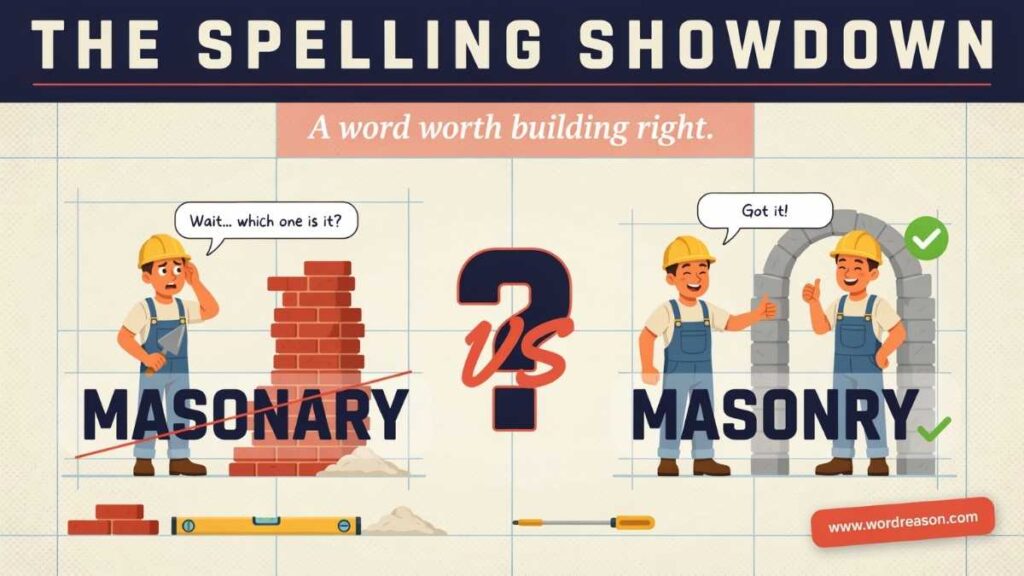
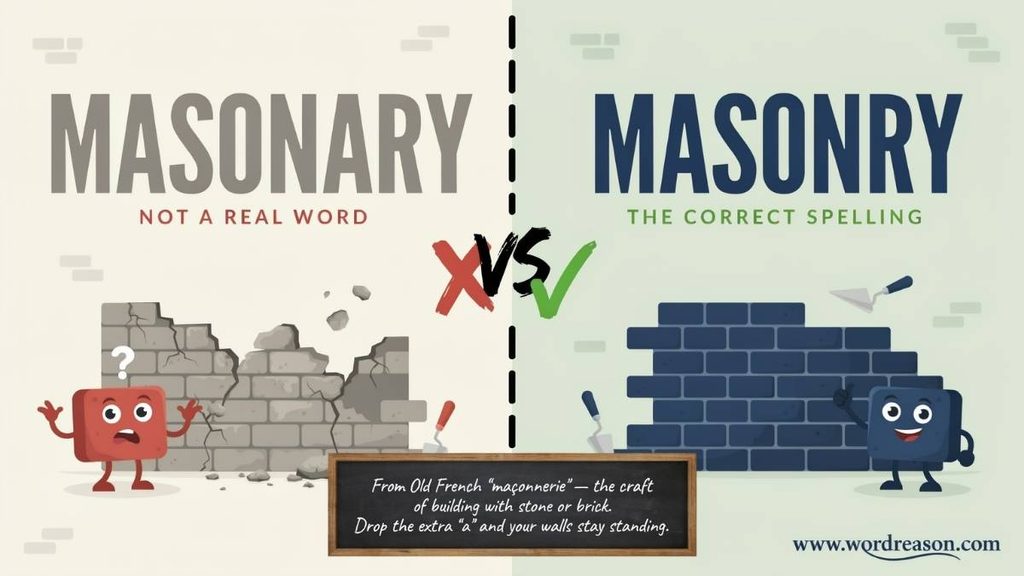
Masonary vs Masonry these two words look almost the same, but there’s one clear winner. Masonry is the correct spelling, while masonary is a common spelling mistake. That extra “a” may look innocent, but it doesn’t belong there! English spelling can be tricky, especially when a word sounds different from how it looks. In this guide, you’ll learn the correct spelling of masonry, what it means, why people write it incorrectly, and how to use it in a sentence. By the end, this spelling mix up will be easy to avoid.
Why Do People Spell Masonry as Masonary?
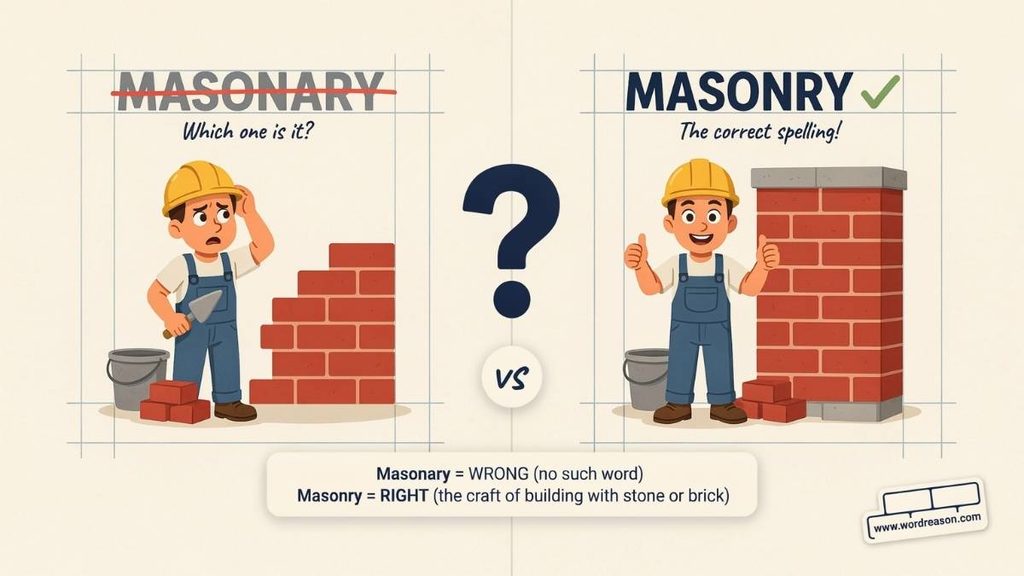
The Masonary vs Masonry confusion isn’t completely random. English spelling Masonary vs Masonry of often encourages this kind of mistake.
One reason involves familiar word patterns. English contains many words ending in ary, including ordinary, stationary, necessary, and imaginary. Because these words are so familiar, writers may instinctively assume that masonry follows the same pattern.
That assumption leads to
mason + ary = masonary
It looks plausible.
Unfortunately, English doesn’t work that neatly.
The standard form is:
mason + ry = masonry
Girlie vs Girly Which Word Is Correct?
The Pronunciation Can Add to the Confusion
Pronunciation can make the ending harder to identify when you’re writing the word from memory.
Cambridge Dictionary gives the US pronunciation of masonry as /ˈmeɪ.sən.ri/, while Oxford Learner’s Dictionaries gives /ˈmeɪsənri/. The word has three syllables, with the main stress on the first syllable.
Because the final sounds flow together naturally in speech, someone who has mostly heard the word rather than seen it written may guess the spelling incorrectly.
That’s a common feature of English. Sound and spelling don’t always line up perfectly such as Masonary vs Masonry.
The Word “Mason” Can Also Cause Confusion
The relationship between mason and masonry provides another clue.
A mason is a skilled worker who builds or works with materials such as brick and stone. Masonry refers to the craft, work, material, or construction associated with that trade.
The spelling doesn’t become masonary simply because the word starts with mason.
Remember the established form:
MASON + RY = MASONRY
That simple pattern is one of the easiest ways to avoid the mistake.
What Does Masonry Mean?
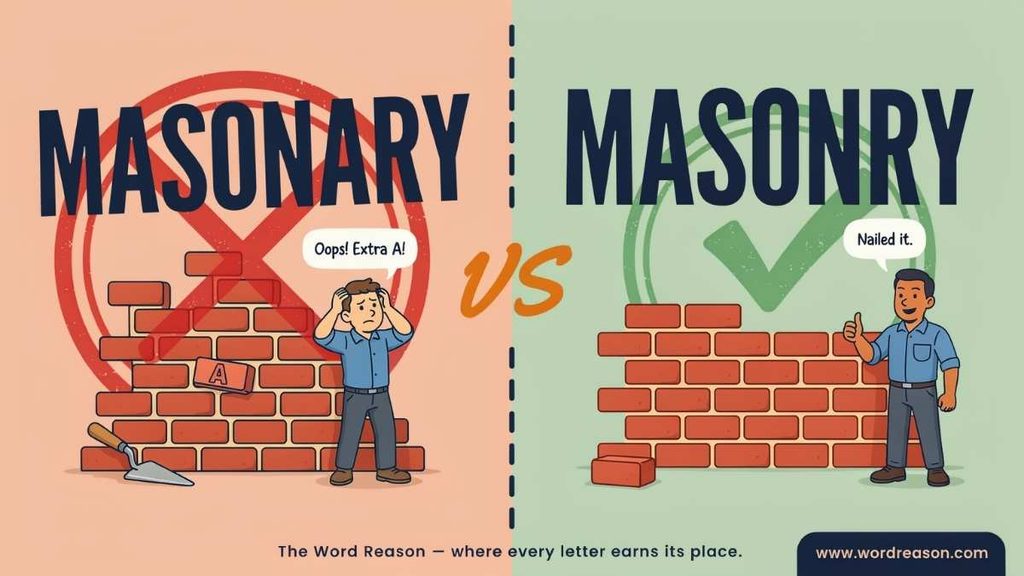
Now that the spelling is clear between Masonary vs Masonry, let’s look at what masonry actually means.
Masonry is a broad construction term for building with units or materials such as brick, stone, and concrete masonry units. The term can describe the material or finished construction itself, as well as the craft or work involved in creating it.
For example, if someone says
“The masonry has deteriorated over time,”
they could be referring to the brick, stone, or other masonry construction that has suffered damage.
Likewise
“He works in masonry,”
refers to the craft or trade.
This makes masonry a flexible word, but its core idea remains the same: construction involving masonry materials or the craft of working with them.
Masonry vs masonary in Construction
Look at a traditional brick building and you’ll quickly see why the term matters.
Masonry construction brings individual building units together to form walls, structures, facades, chimneys, foundations, and other architectural or structural elements.
Common masonry materials include
- Brick
- Natural stone
- Concrete masonry units
- Manufactured masonry units
- Mortar and related jointing materials
Different masonry systems have different characteristics. Brick masonry behaves differently from natural stone masonry, while concrete masonry units provide another set of construction options.
Still, they all fall within the broader category of masonry.
Common Masonry Applications
Masonry appears in many types of construction, including
- Exterior walls
- Interior walls
- Building facades
- Chimneys
- Fireplaces
- Foundations
- Retaining walls
- Piers
- Arches
- Decorative features
- Landscaping walls
The exact application depends on the material, design, structural requirements, climate, and construction method.
Masonry Materials Explained
Understanding the materials associated with masonry can make the word easier to understand.
| Material | Common Uses |
| Brick | Walls, facades, chimneys, decorative features |
| Natural stone | Walls, facades, foundations, landscaping |
| Concrete masonry units | Structural and partition walls |
| Manufactured masonry units | Walls, facades, paving, architectural features |
| Mortar | Joining and bedding masonry units in many masonry systems |
Brick Masonry
Brick masonry refers to construction using brick units. It appears in residential, commercial, institutional, and historic buildings.
Example
The architect selected brick masonry for the building’s exterior.
Stone Masonry
Stone masonry involves building with natural or manufactured stone.
Example
The historic property contains carefully preserved stone masonry.
Concrete Masonry
Concrete masonry commonly involves concrete masonry units, often called CMUs.
Example
The warehouse uses concrete masonry units for several walls.
These phrases all use masonry, never masonary.
Mason, Masonry, and Masonry Work What’s the Difference?
These terms are related, but they don’t mean the same thing.
Mason
A mason is the person who performs masonry work. The term generally describes a skilled worker who builds or repairs structures using materials such as brick, stone, or concrete masonry units.
Example
The mason repaired the damaged brick wall.
Here, mason identifies the person.
Masonry
Masonry refers to the craft, work, material, or construction associated with masonry.
Example
The building’s masonry shows signs of weathering.
Here, masonry refers to the construction or material.
Masonry Work
Masonry work describes the actual work involved in constructing, repairing, installing, or restoring masonry.
Example
The contractor completed the masonry work around the fireplace.
A useful way to remember the distinction is:
Mason = person
Masonry = craft, material, or construction
Masonry work = work performed
Once you understand that relationship of Masonary vs Masonry vs Mason , the vocabulary becomes much easier to use correctly.
Masonary vs Masonry at a Glance
If you’re looking for the answer in five seconds, this table has you covered.
| Feature | Masonry | Masonary |
| Standard spelling | Yes | No |
| Standard English word for construction | Yes | No |
| Refers to masonry construction | Yes | No |
| Related word | Mason | — |
| Common usage | Construction, architecture, engineering | Spelling mistake |
| Extra “a” | No | Yes |
The practical rule is simple:
Whenever you mean the construction term, write “masonry.”
How to Use Masonry vs Masonary Correctly in a Sentence
A definition tells you what a word means. Examples show you how it actually works.
Construction Examples
- The contractor repaired the damaged masonry wall.
- The building contains historic brick masonry.
- The engineer inspected the existing masonry structure.
- The project requires extensive masonry work.
- The architect selected stone masonry for the exterior.
- The crew repaired the deteriorated masonry around the chimney.
Professional Examples
- The inspection identified cracks in several masonry walls.
- The restoration plan includes repairs to the historic masonry facade.
- The engineer evaluated the existing masonry construction.
- The contractor submitted an estimate for masonry repair.
- The project specifications describe the required masonry units.
Everyday Examples
- The old brick masonry gives the building a distinctive appearance.
- Rain damaged part of the masonry wall.
- The fireplace has a traditional masonry surround.
- The garden includes a small masonry wall.
- The historic building is known for its detailed stone masonry.
Common Phrases That Use “Masonry”
Learning common word combinations can help you remember the correct spelling naturally.
Masonry Wall
A masonry wall is a wall constructed with masonry units or materials.
Example
The inspector found several cracks in the masonry wall.
Masonry Construction
Masonry construction refers to construction methods that use masonry materials or units.
Example
The project combines masonry construction with a steel structural frame.
Masonry Work
Masonry work is a broad term for construction, repair, restoration, and related tasks.
Example
The contractor specializes in residential masonry work.
Masonry Building
A masonry building is a building that incorporates masonry construction.
Example
The historic masonry building has undergone extensive restoration.
Masonry Repair
Masonry repair involves fixing or restoring damaged masonry.
Example
The property requires masonry repair around several window openings.
Other useful combinations include
- brick masonry
- stone masonry
- concrete masonry
- masonry structure
- masonry units
- masonry contractor
- masonry facade
- masonry veneer
- reinforced masonry
- masonry restoration
Seeing masonry repeatedly in these natural combinations makes the correct spelling easier to remember.
Masonry vs Brickwork vs Stonework
Here’s another distinction worth knowing.
Masonry is the broader category. Brickwork and stonework refer to more specific types of construction or craftsmanship.
| Term | Meaning |
| Masonry | Broad term covering construction and work involving masonry materials |
| Brickwork | Work or construction involving brick |
| Stonework | Work or construction involving stone |
| Concrete masonry | Construction involving concrete masonry units |
So, brickwork can fall under masonry, but masonry isn’t limited to brick.
That distinction becomes especially useful in technical writing because using the broader term when you mean a specific material can reduce precision.
Is “Masonary” Ever Correct?
For the standard English construction term, no.
If you’re referring to construction involving brick, stone, concrete masonry units, or similar materials, the correct spelling is masonry.
You may still encounter masonary online. That doesn’t make it a standard spelling. Websites contain typos. User generated content contains mistakes. Search engines can index those mistakes.
A word appearing frequently online isn’t automatically correct.
For professional, academic, educational, and formal writing, use:
Masonry.
Masonry Word History Where Does It Come From?
The history of masonry helps explain why its modern spelling doesn’t follow the pattern that produces masonary.
The word dates back to Middle English. The Online Etymology Dictionary traces masonry to the mid 14th century, with historical forms such as masonrie, referring to stonework and construction. It connects the term with Old French maçonerie and ultimately with mason.
The related word mason dates to around 1200 in English and referred to a worker in stone. Its history also connects to Old French forms such as maçon.
That historical relationship gives us a useful word family
mason → masonry
It also explains why adding an a isn’t simply a harmless variation. The established English form developed as masonry.
Masonry Pronunciation and Spelling
Pronunciation is another reason people sometimes struggle with masonry spelling.
The word is generally pronounced with the first syllable stressed. Cambridge lists the US pronunciation as /ˈmeɪ.sən.ri/, while Oxford gives /ˈmeɪsənri/.
The middle and final sounds flow together quickly in normal speech. As a result, someone may know the word perfectly well when speaking yet hesitate when writing it.
That’s an important distinction
Knowing how a word sounds doesn’t always guarantee knowing how to spell it.
English contains many words whose pronunciation doesn’t provide a perfect letter by letter guide.
For masonry, the safest approach is to remember the written pattern:
MASON + RY
Why “Masonary” Is Such a Common Spelling Mistake

The mistake follows a logical looking pattern.
A writer sees
mason
Then remembers words with an ary ending.
The brain combines the two
mason + ary = masonary
The result looks perfectly reasonable at first glance.
That’s what makes this error tricky.
English spelling often contains exceptions to patterns that seem obvious. A spelling can look familiar without being correct.
The solution isn’t complicated. Store the correct word as a complete unit or use the memory pattern
MASON + RY = MASONRY
Once you’ve seen the correct form enough times, masonary begins to look unusual.
Common Masonary vs Masonry Mistakes
The same spelling error appears in many different phrases.
| Incorrect | Correct |
| masonary | masonry |
| masonary work | masonry work |
| masonary wall | masonry wall |
| brick masonary | brick masonry |
| stone masonary | stone masonry |
| masonary construction | masonry construction |
| masonary building | masonry building |
| masonary repair | masonry repair |
| concrete masonary | concrete masonry |
| masonary contractor | masonry contractor |
Notice the pattern: the correction is always the same.
Remove the unnecessary “a.”
Why Correct Spelling Matters in Professional Writing
A single spelling mistake won’t bring a construction project crashing down. Still, repeated terminology errors can weaken a document’s credibility.
Professional Documents
The correct spelling matters in
- Construction reports
- Architecture documents
- Engineering reports
- Building specifications
- Estimates
- Contracts
- Inspection reports
- Resumes
- Job descriptions
- Educational materials
- Website content
Technical writing depends on consistent terminology.
If a report repeatedly says masonary wall, readers may question whether the writer understands the terminology, even when the underlying technical information is accurate.
Search and Digital Content
Correct terminology also matters online.
People search for established terms. Using the standard spelling makes your content clearer to readers and helps search engines understand the subject.
That doesn’t mean stuffing masonry spelling and masonary vs masonry into every paragraph. Natural usage works better.
Write for the reader first. Use relevant terminology where it genuinely belongs.
Masonry in Architecture and Engineering
Masonry has applications far beyond a simple brick wall.
In architecture, masonry can contribute to both structure and appearance. Designers may use brick, stone, or other masonry materials for walls, facades, arches, columns, piers, fireplaces, and decorative features.
Engineering discussions may use terms such as
- Structural masonry
- Reinforced masonry
- Unreinforced masonry
- Masonry units
- Masonry walls
- Mortar joints
- Load-bearing masonry
These terms describe different aspects of masonry construction.
The specific performance of a masonry structure depends on factors such as material properties, design, workmanship, connections, loads, environmental exposure, and applicable building requirements.
That complexity is another reason precise terminology matters. Masonry isn’t just a synonym for “brick.” It’s a broader construction term.
Masonry and Historic Buildings
Walk through an older neighborhood and you’ll often find masonry that has survived for decades or even centuries.
Historic brick and stone buildings can reveal construction techniques, material choices, and architectural styles from different periods. Their masonry may include carefully laid brick, dressed stone, arches, decorative patterns, and distinctive mortar joints.
Preserving these structures often requires specialized masonry work.
Common restoration activities include
- Repairing damaged brick or stone
- Repointing mortar joints
- Replacing severely deteriorated units
- Cleaning masonry surfaces
- Addressing moisture-related deterioration
- Matching replacement materials
- Preserving historic architectural details
In this context, using the correct term matters just as much as using it in a modern construction report.
It’s still masonry.
Case Study Correcting “Masonary” in a Construction Report
Consider this fictional report excerpt
“The property requires masonary repair along the south wall. The masonary contains damaged brick and deteriorated mortar.”
The intended meaning is perfectly understandable. However, masonary appears twice.
A professional revision would read
“The property requires masonry repair along the south wall. The masonry contains damaged brick and deteriorated mortar.”
The correction improves the document without changing its meaning.
What caused the mistake?
The writer probably assumed the word followed the pattern
mason + ary
What fixes it?
Remember
masonry = mason + ry
This example shows why understanding the word’s structure can be more useful than repeatedly memorizing a correction.
How to Remember the Correct Spelling of Masonry
Still tempted to type masonary? Try one of these simple strategies.
Use “Mason + Ry”
Break the word mentally into two parts
MASON | RY
That keeps the unwanted a out of the word.
Watch for the Extra A
When proofreading, pay special attention to the sequence
masonary
If you see an a between n and r, remove it.
Memorize Common Phrases
Instead of learning the word in isolation, remember phrases such as
- masonry wall
- brick masonry
- stone masonry
- masonry work
- masonry construction
Context gives the word something to attach to in your memory.
Write It Repeatedly in Real Sentences
For example
The contractor repaired the masonry wall.
The project includes masonry work.
Three meaningful sentences are far more useful than staring at the word alone.
Masonary vs Masonry Quick Correction Guide
Keep this mini reference handy
| If you wrote… | Use instead |
| masonary | masonry |
| masonary wall | masonry wall |
| masonary work | masonry work |
| brick masonary | brick masonry |
| stone masonary | stone masonry |
| masonary construction | masonry construction |
| masonary repair | masonry repair |
| masonary building | masonry building |
The rule couldn’t be simpler
Masonry is the correct spelling. Drop the extra “a.
Here’s a trusted source for clear more words Comparison:
Practice Masonry Spelling Exercises
Fill in the Blanks
Choose the correct word or phrase to complete each sentence.
Questions
1. The correct spelling of the construction term is __________.
2. The word __________ is a common misspelling of masonry.
3. A skilled worker who builds or repairs structures with brick or stone is called a __________.
4. The workers used __________ to form the joints between the bricks.
5. The old building has beautiful stone __________.
6. The contractor specializes in __________ construction.
7. Which spelling is correct: __________ or masonary?
8. The engineer inspected the __________ wall for signs of damage.
9. The company provides professional __________ repair services.
10. Brick, stone, and concrete masonry units are commonly used in __________.
11. “Masonary” is considered a spelling __________ rather than the standard form of the word.
12. The craft of building with brick and stone is known as __________.
13. The __________ repaired the damaged brick wall.
14. The building contains several sections of historic __________.
15. The phrase “brick __________” describes construction that uses brick as the primary masonry unit.
16. If you are unsure how to spell the word, remember: mason + ry = __________.
17. The contractor examined the building’s __________ before beginning the repairs.
18. The workers replaced several damaged bricks in the __________ wall.
19. A person who performs professional masonry work is called a __________.
20. The phrase “stone __________” refers to construction using stone masonry units.
21. In a professional construction report, you should write masonry, not __________.
22. The house has a strong __________ structure made from brick.
23. The spelling mistake often occurs because the pronunciation of __________ can be misleading.
24. The builder specializes in both brick and stone __________.
25. Complete the rule: Masonry is correct; __________ is incorrect.
Answer Key
1. masonry
2. masonary
3. mason
4. mortar
5. masonry
6. masonry
7. masonry
8. masonry
9. masonry
10. masonry
11. mistake
12. masonry
13. mason
14. masonry
15. masonry
16. masonry
17. masonry
18. masonry
19. mason
20. masonry
21. masonary
22. masonry
23. masonry
24. masonry
25. masonary.
Frequently Asked Questions About Masonary vs Masonry
Is “Masonary” a word?
No. “Masonary” is a common misspelling of “masonry.” The standard English spelling is masonry, which refers to the craft of building with materials such as brick and stone, as well as structures made from those materials.
Which is correct: masonry or masonary?
Masonry is correct. “Masonary” is an incorrect spelling. If you’re writing a construction document, school assignment, professional report, or website article, use masonry.
How do you spell masonry correctly?
The correct spelling is M A S O N R Y masonry. A simple way to remember it is to connect the word to mason. A mason performs masonry work, so think mason + ry = masonry.
Why do people spell masonry as masonary?
The confusion usually comes from pronunciation. When spoken aloud, the ending of masonry can make it sound as though an extra vowel belongs in the word. People may also associate the ending with familiar ary words, which makes masonary look plausible even though it isn’t correct.
What does masonry mean?
Masonry refers to the craft or work of building with materials such as brick, stone, or concrete masonry units. The word can also describe a structure or part of a building made from these materials, such as a masonry wall.
What is masonry in construction?
In construction, masonry is a building method that uses individual units such as bricks, concrete blocks, or stone. Depending on the system, these units may be joined with mortar or assembled using another approved construction method.
What is a person who does masonry called?
A person who performs masonry work is called a mason. A mason may build, repair, maintain, or restore structures made from brick, stone, concrete masonry units, and other masonry materials.
What is the difference between a mason and masonry?
A mason is the person who performs the work, while masonry refers to the craft, work, or construction itself.
For example
- The mason repaired the brick wall.
- The masonry needed extensive repairs.
The first sentence refers to the worker. The second refers to the construction.
What do masons use between bricks?
Masons commonly use mortar between bricks in traditional brick masonry. Mortar forms the joints between masonry units and helps create a stable, finished wall system.
Is brick masonry the same as brickwork?
The terms are closely related, but brick masonry is more specific. It describes masonry construction that uses brick as the primary building unit. Brickwork can refer more broadly to brick construction or brick elements within a building.
What are the main types of masonry?
Common types of masonry include brick masonry, stone masonry, and concrete masonry. The exact classification can vary depending on the materials and construction method being discussed.
Why does the spelling of masonry matter?
Correct spelling matters because it makes your writing clearer, more professional, and easier to understand. Using masonary in a construction document or professional article can make the writer appear careless, even when the intended meaning remains obvious.
Is “masonary” ever the correct spelling?
For the standard English construction term, no. Masonary is a misspelling. The correct form is masonry.
How can you remember the correct spelling of masonry?
Try this simple memory trick
A mason does masonry.
Start with mason, then remember that the word ends in ry, giving you:
mason + ry = masonry
This can help you avoid inserting the unnecessary a found in masonary.
AEO Quick Answers
Is it masonry or masonary?
Masonry is the correct spelling. Masonary is a common spelling mistake.
Is masonary spelled correctly?
No. The standard spelling is masonry.
What is the correct spelling of masonry?
The correct spelling is masonry, spelled M A S O N R Y.
What does masonry mean?
Masonry means the craft or work of building with materials such as brick and stone. It can also refer to structures made from masonry materials.
What is a masonry wall?
A masonry wall is a wall constructed using masonry units such as brick, stone, or concrete masonry units.
What is masonry work?
Masonry work includes building, repairing, maintaining, or restoring structures made from masonry materials.
What is a mason?
A mason is a skilled worker who builds or repairs structures using materials such as brick, stone, or concrete masonry units.
What is mortar?
Mortar is a building material commonly used to form joints between masonry units and help bond them together in traditional masonry construction.
What is brick masonry?
Brick masonry is masonry construction in which brick serves as the primary building unit.
What is stone masonry?
Stone masonry is construction that uses natural or manufactured stone units to create structures such as walls and other building elements.
Conclusion
The masonary vs masonry confusion is easy to solve once you know the rule. Masonry is the correct spelling, while masonary is simply a common spelling mistake. That extra “a” may try to sneak into the word, but it doesn’t belong there!Remember the simple trick: a mason does masonry. Masonry refers to the work or construction involving materials such as brick and stone. So, whether you’re writing about a masonry wall, brick masonry, or masonry work, stick with masonry. One small spelling choice can make your writing look much cleaner and more professional. Now you can leave “masonary” behind and build your vocabulary on the right foundation.

Bella AJS
Bella AJS is an experienced blogger and passionate language enthusiast at WordReason. She specializes in English grammar, word meanings, spelling, and commonly confused words. With a clear and practical writing style, Bella helps readers understand tricky language rules without the textbook headache. Her goal is simple: make English easier, clearer, and more enjoyable one word at a time.