

The debate over time off vs time-off is a perfect example. You might write, “I need some time off,” and then wonder whether that hyphen belongs in your next sentence. Don’t worry your keyboard isn’t judging you. The difference depends mainly on how the phrase functions in a sentence. In this guide, you’ll learn when to write time off, when time-off can work as a compound modifier, and when the hyphen simply doesn’t belong. By the end, you’ll know the rule and avoid this common grammar mistake with confidence.
Quick Answer Is It “Time Off” or “Time-Off”?
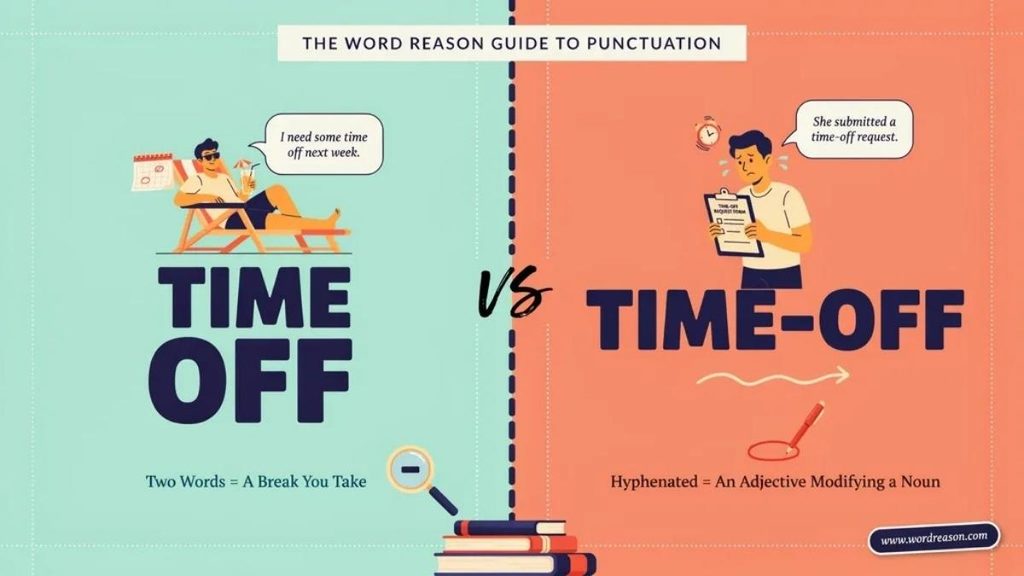
In most ordinary sentences, time off is the correct form.
Use time off when the phrase functions as a noun and refers to a period away from work or another regular responsibility.
Examples
- “I need some time off.”
- “She requested time off for Friday.”
- “He took time off to visit his family.”
- “Employees receive paid time off.”
The hyphenated form time-off can appear when the words function together as a compound modifier
- “Review the time-off policy.”
- “Submit your time-off request.”
- “Check your time-off balance.”
The basic distinction is
Use “time off” as the ordinary noun phrase. Use “time-off” when the words function together as a compound modifier and the hyphen helps establish their relationship.
That rule handles most everyday uses.
Learn the difference between confusing word pairs;
What Does “Time Off” Mean?
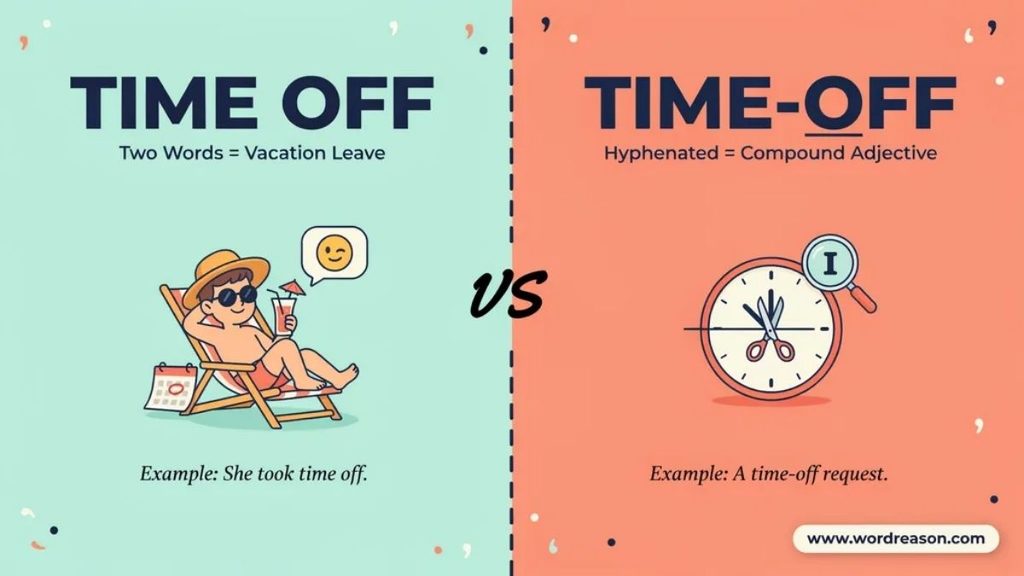
Before tackling the hyphen, it helps to understand what time off means.
Time off refers to a period when someone isn’t working or carrying out their usual duties. In workplace English, it can refer to vacation, personal leave, illness, holidays, or another approved absence.
For example
- “I’m taking time off next week.”
- “She needs time off to attend a family event.”
- “The manager approved his time off.”
- “Employees can request time off through the HR system.”
Cambridge Dictionary defines time off as a period when someone is not working, including time away because of holidays, illness, or an employer’s permission.
The phrase commonly appears in expressions such as
- take time off
- request time off
- get time off
- need time off
- use time off
- approve time off
- paid time off
- unpaid time off
“Time Off” as a Noun Phrase
The key to understanding time off grammar is recognizing that time off can function as a noun phrase.
Consider
“I need time off.”
What do you need?
Time off.
The phrase identifies the thing being needed, so it functions as a noun phrase.
The same thing happens here
“She requested time off.”
What did she request?
Time off.
Because the phrase functions as a noun, the standard form remains open: time off.
Learn the difference between confusing word pairs;
Girlie vs Girly Which Word Is Correct?
When Should You Write Without a Hyphen?
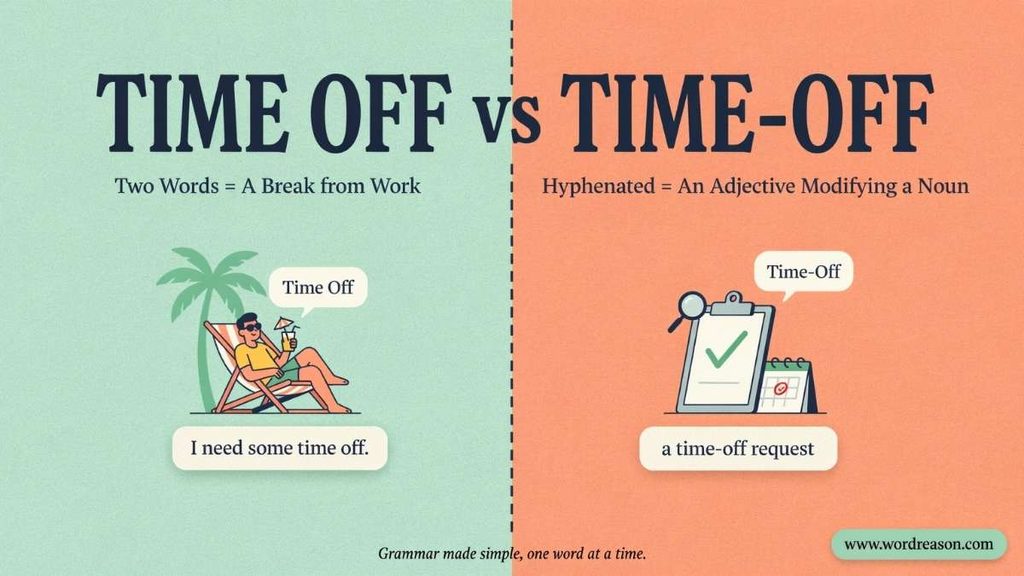
The open form time off is the normal choice when you’re referring to the period of absence itself.
“Time Off” as a Noun
Use time off after verbs such as
- take
- request
- need
- receive
- use
- approve
- schedule
- get
Examples
“I need some time off.”
“She requested time off for Monday.”
“The manager approved his time off.”
“We should schedule our time off in advance.”
In each sentence, time off identifies the absence being discussed.
“Time Off” After Prepositions
The open form also appears naturally after prepositions.
Examples include
- “She returned after time off.”
- “He came back from time off.”
- “I’m taking time off from work.”
- “They discussed the request for time off.”
There is no reason to insert a hyphen simply because time and off appear together.
Common Workplace Uses
Professional writing frequently uses time off in expressions such as
- paid time off
- unpaid time off
- personal time off
- time off work
- time off from work
- time off for vacation
- time off for illness
For example
“Employees receive 15 days of paid time off each year.”
Here, paid time off functions as a noun phrase. The words don’t need to be joined with hyphens.
Learn the difference between confusing word pairs;
Patients vs Patient Meaning Difference and Correct Usage
When Can “Time-Off” Be Hyphenated?
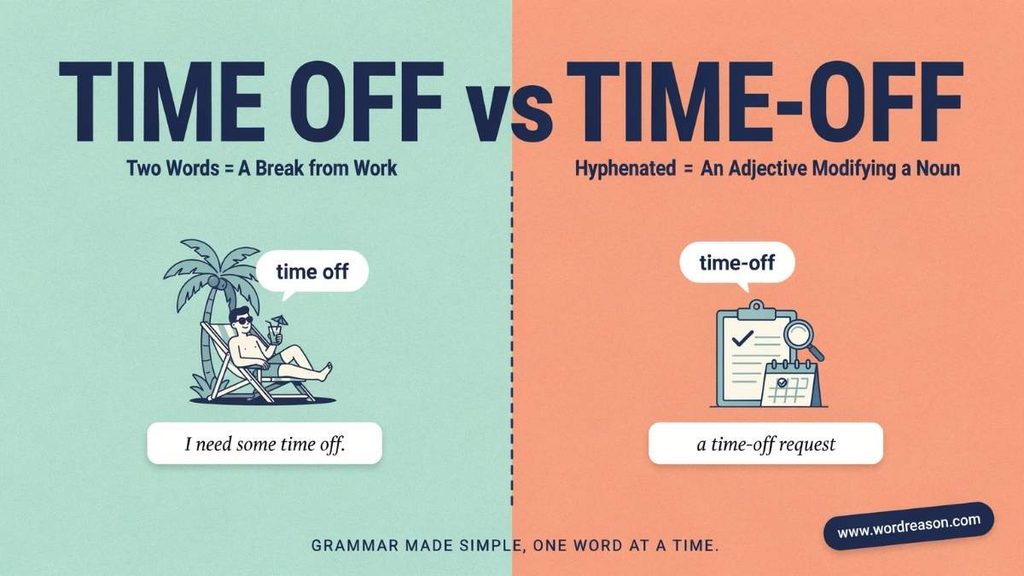
The hyphen becomes relevant when time off functions as a compound modifier.
A compound modifier consists of two or more words that work together to describe another word. Hyphens can show readers that those words belong together as a unit.
For example
“The company updated its time-off policy.”
Here, time-off modifies policy.
Likewise
“Please submit your time-off request.”
The phrase time-off describes the type of request.
This is different from
“Please request time off.”
In the second sentence, time off functions as the object of request, so the open form is appropriate.
Common Compound Uses
You may see time-off in expressions such as
- time-off policy
- time-off request
- time-off balance
- time-off calendar
- time-off system
- time-off allowance
These constructions are common in workplace and HR writing.
However, it’s important not to treat the hyphen as mandatory in every possible construction. Style guides and organizational conventions can differ. Some publications may leave an established open compound open when the meaning remains clear.
The Grammar Rule Behind “Time Off” vs “Time-Off”
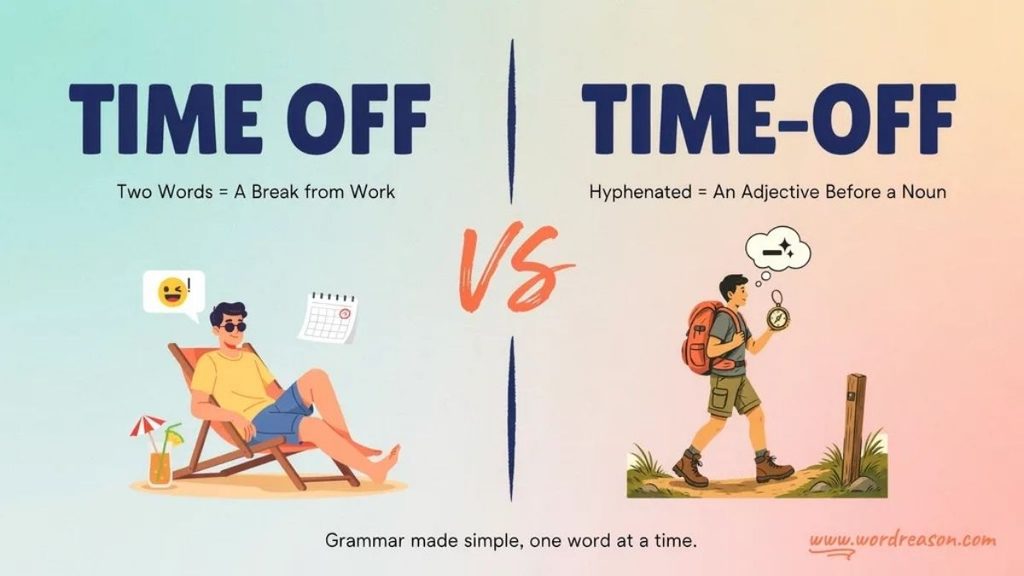
The central principle is simple
Hyphens help readers understand how words work together.
English uses hyphens frequently in compound modifiers
- full-time employee
- long-term strategy
- well-known author
- high-speed connection
- decision-making process
The hyphen signals that the words work together to modify another word.
The same principle can apply to time-off.
Compare
“She requested time off.”
with
“She submitted a time-off request.”
The meaning remains closely related, but the grammatical structure changes.
In the first example, time off functions as a noun phrase.
In the second, time-off functions as a modifier describing request.
That’s why asking only “is time off hyphenated?” doesn’t always produce a complete answer. The surrounding sentence matters.
Open Compounds, Hyphenated Compounds, and Closed Compounds
English combines words in several ways.
Open Compounds
The words remain separate
- time off
- high school
- real estate
- ice cream
- post office
Hyphenated Compounds
A hyphen connects the words
- time-off
- full-time
- long-term
- decision-making
- well-known
Closed Compounds
The words eventually become one word
- workplace
- notebook
- bedroom
- website
English doesn’t always provide a perfectly predictable system. Some compounds begin as separate words, develop hyphenated forms, and eventually become closed compounds as usage changes.
That’s why dictionaries and established style guides remain useful when a compound isn’t obvious.
Compare the Functions
| Example | Function | Preferred Form |
|---|---|---|
| “I need time off.” | Noun phrase | time off |
| “She requested time off.” | Object of a verb | time off |
| “He returned after time off.” | Noun phrase | time off |
| “Submit a time-off request.” | Compound modifier | time-off |
| “Read the time-off policy.” | Compound modifier | time-off |
| “Check your time-off balance.” | Compound modifier | time-off |
The important lesson is that word position alone doesn’t determine hyphenation.
You need to consider what the words are doing.
Time Off vs Time-Off at a Glance
| Form | Typical use | Example |
|---|---|---|
| time off | Noun phrase | “I need some time off.” |
| time off | Object of a verb | “She requested time off.” |
| time off | After a preposition | “He returned from time off.” |
| time-off | Compound modifier | “Review the time-off policy.” |
| time-off | Compound modifier | “Submit a time-off request.” |
There’s one important qualification time-off isn’t automatically required before every noun.
Established open compounds can sometimes remain open when the meaning is clear. That’s why style guides may differ on specific constructions.
The goal isn’t to add a hyphen wherever possible. The goal is to create clear, consistent, readable English.
Real world Example
The distinction becomes much clearer when you see how these forms appear in professional writing.
Workplace Emails
Suppose an employee writes
“I’d like to request time off from August 12 through August 16.”
That’s the standard noun phrase.
Now compare
“I’ve submitted my time-off request.”
Here, time-off modifies request.
Another example
“Could you approve my time-off request before Friday?”
The grammatical relationship is clear because the hyphen connects the modifier.
HR Policies
HR documents often contain both forms
“Employees receive paid time off each year. All employees must submit a time-off request before taking planned leave.”
The first phrase names a benefit.
The second describes a type of request.
Later, the same document might say
“Managers must approve time off before employees make travel arrangements.”
There’s no contradiction. The grammatical function has changed.
HR Software and Scheduling Systems
Workplace software often uses labels such as
- Time Off
- Request Time Off
- Time-Off Request
- Time-Off Balance
- Time-Off Calendar
- Paid Time Off
Interface labels may follow product terminology rather than the exact conventions used in running prose.
That’s why two systems can display slightly different forms without either one necessarily representing a grammatical disaster.
Time Off, PTO, Vacation, and Leave What’s the Difference?
The phrase time off often appears alongside workplace terms such as PTO, vacation, and leave. These terms overlap, but they aren’t always interchangeable.
What “Time Off” Means
Time off is the broadest expression.
It can refer to time away from work for many reasons, including
- vacation
- illness
- personal matters
- holidays
- family responsibilities
- appointments
- other approved absences
What PTO Means
PTO usually stands for paid time off.
It describes paid time away from work. The exact structure varies between employers.
For example
“You have 80 hours of PTO remaining.”
Depending on the employer’s policy, that balance might cover vacation, personal days, or other approved absences.
Vacation vs. Time Off
Vacation generally refers to planned time away for rest, travel, or leisure.
Time off has a broader meaning.
For example
“She took time off to attend her sister’s wedding.”
That’s time off, but it isn’t necessarily vacation.
Sick Leave vs Vacation Time
Sick leave generally relates to illness or medical needs.
Vacation time generally relates to planned personal breaks.
Both can fall under broader workplace leave policies, although the exact definitions depend on the employer and applicable rules.
Personal Time Off vs Paid Time Off
These terms shouldn’t automatically be treated as synonyms.
Paid time off focuses on compensation during the absence.
Personal time off focuses on the category or purpose of the absence.
An employer may define these categories differently in its own policies.
Common “Time Off” and “Time-Off” Grammar Mistakes
Hyphens are small, but they can cause surprisingly large editing headaches.
Hyphenating “Time Off” Everywhere
A common mistake looks like this
“I need some time-off.”
A cleaner standard form is
“I need some time off.”
The phrase functions as a noun, so the hyphen isn’t necessary.
Assuming Every Phrase Before a Noun Needs a Hyphen
This rule sounds convenient, but it’s too broad.
English contains many established open compounds. Some remain open before nouns when the meaning is already clear.
That’s why you shouldn’t automatically hyphenate a phrase just because another noun follows it.
Forgetting the Hyphen in a Compound Modifier
The opposite problem can occur with a construction such as
“Please submit your time off request.”
Many editors would prefer
“Please submit your time-off request.”
Here, time-off works as a compound modifier.
However, workplace terminology can vary. If an organization has formally adopted time off request as its preferred terminology, consistency with that established style may matter more than forcing a different convention into every document.
Mixing Both Forms Randomly
A professional document shouldn’t casually alternate among:
- time off request
- time-off request
- timeoff request
unless there’s a genuine reason.
Choose the appropriate convention and use it consistently.
Trusting Grammar Software Without Checking Context
Grammar software can be helpful, but automated suggestions aren’t infallible.
Different tools may follow different dictionaries or style systems. A software suggestion doesn’t automatically override:
- grammatical function
- established usage
- organizational style
- publication requirements
- clarity
A good editor uses technology as a tool—not as the final authority.
Time Off vs. Time-Off in Formal and Informal Writing
The appropriate choice can also depend on the type of writing.
Workplace Emails
When requesting an absence, use the open form
“I’d like to request time off next Friday.”
HR Policies
Compound modifiers are common
“Employees must submit a time-off request at least two weeks in advance.”
Academic Writing
Follow the required style guide and choose the construction that communicates the meaning most clearly.
Business Websites
Consistency is especially important on websites.
If a company consistently uses time-off policy, suddenly switching to time off policy on another page can make the site look poorly edited.
Informal Writing
In ordinary conversation, time off is the natural form
“I really need some time off.”
No hyphen required.
AP Style and Chicago Style Guidance
Style guides become particularly useful when grammar leaves room for editorial choice.
AP Style Approach
AP style generally uses hyphens to clarify compound modifiers when multiple words work together before a noun.
The main principle is readability: readers should understand which words belong together.
For professional publications, the current edition or official guidance should take priority over old rules copied from unrelated websites.
Chicago Style Approach
The Chicago Manual of Style provides extensive guidance on compound words and hyphenation. Its approach recognizes that some compounds are open, some are hyphenated, and some are closed.
Chicago also emphasizes the role of clarity and readability when deciding whether a compound needs a hyphen.
This is particularly relevant to time off vs time-off because not every construction requires the same treatment.
Your Organization’s Style Guide
Companies often establish their own terminology.
An HR department might consistently use
time-off request
while another organization might prefer
time off request
If you’re writing internal documents, follow the organization’s established style unless there’s a strong reason to change it.
Consistency is part of professional editing.
Correct “Time Off” Examples in Sentences
Correct Uses of “Time Off”
- “I need some time off.”
- “She requested time off for Monday.”
- “He took time off after finishing the project.”
- “Employees receive paid time off.”
- “You can request time off through the employee portal.”
- “She returned after several days of time off.”
- “They used their time off to travel.”
- “The manager approved his request for time off.”
The Correct Uses of “Time-Off”
When the phrase functions as a compound modifier, a hyphen can be appropriate
- “Review the time-off policy.”
- “Submit your time-off request.”
- “Check your time-off balance.”
- “The HR system tracks time-off requests.”
- “The company updated its time-off calendar.”
These examples demonstrate the grammatical distinction rather than suggesting that every writer must hyphenate every instance before a noun.
Incorrect Examples and Their Corrections
| Incorrect or less appropriate | Improved version | Reason |
|---|---|---|
| “I need some time-off.” | “I need some time off.” | Noun phrase |
| “She requested time-off.” | “She requested time off.” | Object of the verb |
| “Take your time-off next week.” | “Take your time off next week.” | Noun phrase |
| “Submit a time off request.” | “Submit a time-off request.” | Compound modifier |
| “Review the time off policy.” | “Review the time-off policy.” | Compound modifier |
| “He is taking time-off from work.” | “He is taking time off from work.” | Noun phrase |
The pattern becomes much easier once you stop looking at the hyphen as a spelling issue and start looking at grammatical function.
Case Study One HR Policy, Three Different Uses
Consider this fictional policy
“Employees receive 15 days of paid time off each year. Employees who need an absence must submit a time-off request through the HR portal. Managers review each request before approving time off.”
Three different constructions appear here.
Paid Time Off
This names a workplace benefit.
Time-Off Request
This identifies a particular type of request.
Time Off
This refers to the actual absence.
The forms differ because their grammatical functions differ.
That’s an important lesson for professional writing
Consistency doesn’t mean forcing the same form into every sentence. It means using each form correctly and applying your chosen style consistently.
Similar Hyphen Rules You Should Know
Understanding time off grammar becomes easier when you compare it with other familiar constructions.
Full Time vs Full-Time
“She works full time.”
But
“She has a full-time job.”
Part Time vs Part-Time
“He works part time.”
But
“He has a part-time position.”
Long Term vs Long-Term
“We need to think long term.”
But
“This is a long-term strategy.”
Decision Making vs Decision-Making
“Effective decision making takes practice.”
But
“The decision-making process takes time.”
These examples demonstrate a broader English grammar pattern:
A phrase can change its punctuation when its grammatical role changes.
A Simple Test for Choosing “Time Off” or “Time-Off”
When you’re editing quickly, use this practical method.
The One Second Rule
First, identify the function.
Is the phrase naming the period away from work?
Use
time off
Next, check whether it modifies another noun.
If the words work together as a compound modifier, consider
time-off
Then, check clarity.
Would the hyphen make the relationship between the words easier to understand?
Finally, check your style guide.
If you’re writing for a publication, employer, or academic institution, follow its preferred conventions.
The shortcut is
Naming the absence? “Time off.”
Modifying a noun? Consider “time-off.”
It isn’t a perfect substitute for editorial judgment, but it solves most everyday cases.
Quick Editing Checklist for “Time Off” and “Time-Off”
- Is time off functioning as a noun phrase?
- Am I referring to the actual period away from work?
- Is time-off functioning as a compound modifier?
- Does the hyphen improve clarity?
- Am I following the appropriate style guide?
- Does the document use terminology consistently?
- Can I rewrite the sentence to make the meaning clearer?
That last question deserves more attention than it gets.
Sometimes you don’t need to decide whether the hyphen belongs.
You can simply rewrite the sentence.
For example
“Review the time-off policy.”
can become
“Review the policy on time off.”
The second version removes the compound modifier altogether.
Good editing isn’t about squeezing punctuation into every possible space. It’s about making the reader’s job easier.
Here’s a trusted source for clear more words Comparison
Practice Session
Choose the Correct Form
Choose time off vs time-off to complete each sentence.
- I need some ________ after a busy month.
- Please submit your ________ request before Friday.
- She took three days of ________ from work.
- The manager approved his ________ request.
- Employees should review the company’s ________ policy.
- I’m planning to take some ________ next week.
- He asked for ________ to attend a family event.
- The HR team created a new ________ policy.
- We all need ________ sometimes to recharge.
- Please let your supervisor know when you need ________.
Correct the Mistake
Each sentence contains a mistake involving time off vs time-off. Rewrite it correctly.
- I need some time-off after this project.
- She requested time-off from work.
- Please complete the time off request form.
- He took some timeoff last month.
- The company changed its time off policy.
- I’m taking time-off next Friday.
- Employees can request timeoff when necessary.
- She needs time-off to recover from a busy schedule.
Think About the Grammar
Answer these questions in your own words
- Why is time off normally written without a hyphen?
- When can time-off be used as a compound modifier?
- Is timeoff a standard spelling?
- Why can style guides differ when dealing with compound modifiers?
- What is the easiest way to decide whether a hyphen is useful?
25 Fill in the Blank Questions
- I really need some ________ after working all weekend.
- Please submit your ________ request at least one week in advance.
- Sarah took two days of ________ to visit her family.
- The employee handbook explains the company’s ________ policy.
- We should take some ________ and relax this weekend.
- Mark requested ________ from work for a personal appointment.
- The manager approved my ________ request yesterday.
- Employees can check their ________ balance through the HR system.
- She decided to take a week of ________ during the summer.
- Please speak with your supervisor before requesting ________.
- The company recently updated its ________ policy.
- I haven’t taken enough ________ this year.
- He submitted a ________ request for next Monday.
- Taking regular ________ can help you return to work refreshed.
- The HR department explained how employees can request ________.
- We were given extra ________ after completing the project.
- Please check the ________ rules before planning your vacation.
- She needs some ________ to handle a family matter.
- The manager reviewed the employee’s ________ request.
- Don’t forget to use your available ________ before the end of the year.
- The company’s ________ benefits vary by position.
- I asked my supervisor for ________ next Friday.
- The new ________ policy applies to all full-time employees.
- He took several days of ________ after finishing the major project.
- Remember: time off is normally written as two words, not ________.
Answer Key
- time off
- time-off
- time off
- time-off
- time off
- time off
- time-off
- time-off
- time off
- time off
- time-off
- time off
- time-off
- time off
- time off
- time off
- time-off
- time off
- time-off
- time off
- time-off
- time off
- time-off
- time off
- timeoff — but the correct spelling is time off.
Frequently Asked Questions About “Time Off” vs
“Time-Off”
Is “time off” hyphenated?
Usually, no Write time off as two separate words when it functions as a noun phrase.
Example “I need some time off.”
A hyphen can appear when the phrase works together as a compound modifier before another noun, such as time-off request. However, hyphenation can vary by style guide and context.
What does “time off” mean?
Time off means a period when you are not working, usually because you are on vacation, taking leave, or have permission to be away from work.
Example “She took some time off to visit her family.”
How do you say “time off from work”?
The most natural expression is time off from work. You can also say time off work, depending on the variety of English and the context.
Example “I’m taking three days off from work next week.”
Does “paid time off” have a hyphen?
Generally, paid time off is written as three separate words when it refers to paid leave as a benefit.
Example“Employees receive paid time off each year.”
If the phrase becomes part of a longer compound modifier, its hyphenation may depend on the sentence structure and the style guide you follow.
When should I not use a hyphen?
Don’t add a hyphen when time off functions as an ordinary noun phrase rather than a compound modifier.
Correct “I need time off.”
Correct “He requested time off for Friday.”
Hyphens aren’t necessary simply because two words frequently appear together.
How do you say “have a good time off”?
“Enjoy your time off” or “Have a good break” sounds more natural in everyday English.
Example “Enjoy your time off. See you next week!”
“Have a good time off” is understandable, but it isn’t the most natural expression for most situations.
What is another word for “time off”?
Depending on the context, you can use break, leave, vacation, rest, personal leave, or paid leave.
These terms aren’t always interchangeable. For example, vacation usually refers to planned leisure time, while leave can describe several types of approved absence from work.
What is time off from work called?
Time away from work can be called time off, leave, vacation, paid leave, personal leave, sick leave, or PTO.
The appropriate term depends on why you’re away and how your employer classifies the absence.
What’s the difference between time off and PTO?
Time off is a broad term for time when you aren’t working. PTO, which stands for paid time off, specifically refers to paid leave provided by an employer.
In simple terms, PTO is a type of time off, but not all time off is necessarily paid.
What is another word for taking time off work?
Common alternatives include taking leave, taking a break, taking a day off, going on vacation, and being away from work.
The best choice depends on the reason and length of your absence.
Example “I’m taking a few days of leave next month.”
Is it “timeoff” or “time off”?
The standard spelling is time off, with a space between the two words.
Correct: “I need some time off.”
Incorrect: “I need some timeoff.”
Timeoff isn’t the standard spelling in formal English.
What is another word for paid time off?
Depending on the workplace, alternatives include paid leave, paid vacation, vacation leave, and PTO.
These terms can have slightly different meanings. For example, some employers use PTO as a single bank that combines vacation, personal days, and sick time.
AEO Quick Answers About “Time Off” and “Time-Off”
Is it “time off” or “time-off”?
Use time off when the phrase functions as a noun. Use time-off when the words work together as a compound modifier and the hyphen improves clarity or follows your chosen style guide.
Is “time off” one word?
No. The standard form is time off, written as two words.
Is “time-off” grammatically correct?
Yes, time-off can be grammatically correct when it functions as part of a compound modifier. However, it shouldn’t replace time off in every sentence.
What is the correct spelling of “time off”?
The standard spelling is time off: two words with no hyphen when used as an ordinary noun phrase.
Should I write “time off request” or “time-off request”?
Time-off request is a common choice because time-off works together to modify “request.”
Example “Please submit your time-off request by Friday.”
However, style guides differ in how they handle some open compounds, so consistency within the same document is important.
Should I write “time off policy” or “time-off policy”?
Time-off policy is commonly used because the phrase modifies the noun policy.
Example: “Please review the company’s time-off policy.”
The open form time off policy can also appear in real-world writing, particularly under style systems that allow certain open compounds to remain unhyphenated. When clarity matters, the hyphenated form can make the relationship between the words easier to understand.
What is the easiest way to remember the time-off hyphen rule?
Focus on how the phrase functions in the sentence.
- Time off = an ordinary noun phrase: “I need time off.”
- Time-off = a compound modifier: “Submit a time-off request.”
Here’s a polished conclusion that keeps the tone humorous, professional, clear, and grammatically educational while wrapping up the key rule naturally.
Conclusion
When it comes to time off vs time-off, the hyphen isn’t there to make your sentence look fancy. It has a job to do. In most cases, write time off as two separate words when you’re talking about a break from work, such as “I need some time off.” Use time-off when the words work together as a compound modifier, such as “time-off request,” when that hyphenation fits your chosen style. The golden rule is simple don’t hyphenate automatically. Look at how the phrase functions in the sentence. Once you understand that difference, this little punctuation puzzle becomes much easier and your hyphen can finally take a well deserved break.

Bella AJS
Bella AJS is an experienced blogger and passionate language enthusiast at WordReason. She specializes in English grammar, word meanings, spelling, and commonly confused words. With a clear and practical writing style, Bella helps readers understand tricky language rules without the textbook headache. Her goal is simple: make English easier, clearer, and more enjoyable one word at a time.