
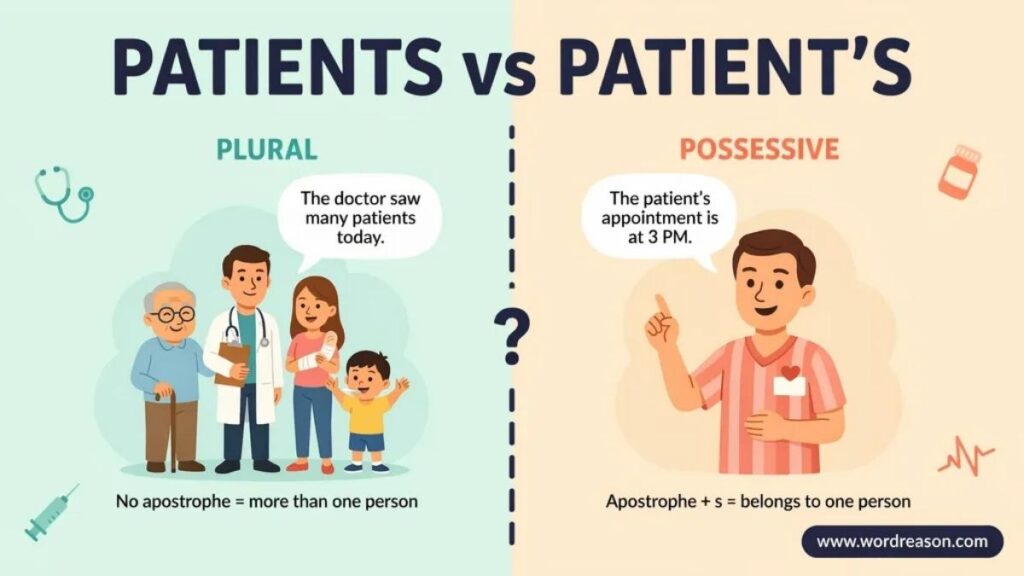
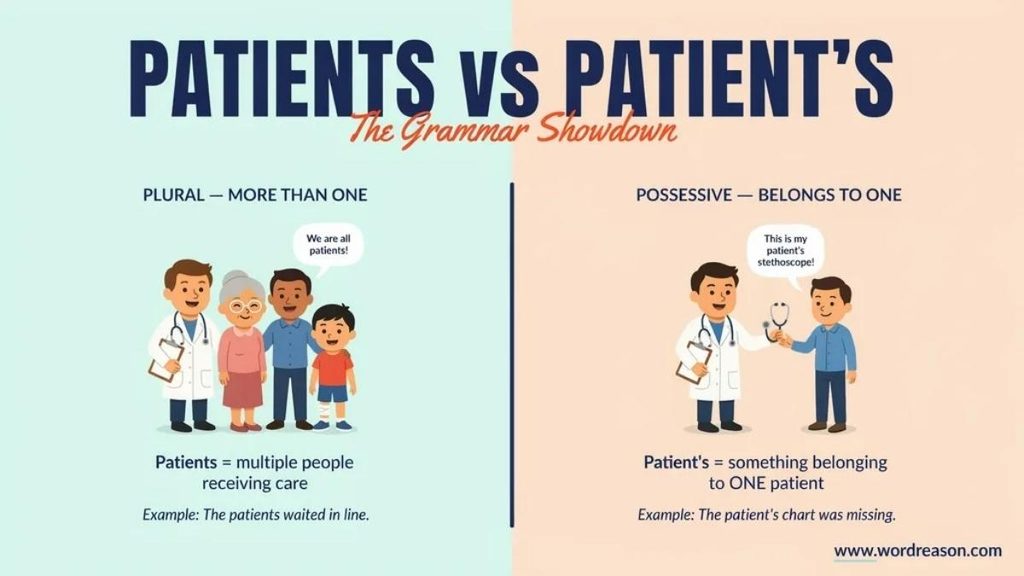
At first, patients vs patient may seem almost identical. However, patients vs patient meanings can change depending on how they’re used. For example, patients means more than one person receiving medical care, while patient’s shows that something belongs to one patient. In contrast, patients’ uses the apostrophe after the s to show possession involving multiple patients. As a result, one small punctuation mark can completely change the meaning of a sentence. More importantly, knowing where to place the apostrophe helps you avoid common grammar mistakes. Therefore, learning these simple differences can make your writing clearer and more accurate. In addition, understanding the correct forms will help you use them confidently in everyday writing. Throughout this guide, you’ll learn the difference between patients and patient, explore common mistakes, and master the correct usage through simple rules and practical examples.
Patients vs Patient Quick Answer
Here’s the simplest way to understand the difference between Patients vs Patient
Compare these sentences of patients vs patient’s
The patients are waiting.
The patient’s chart is on the desk.
The patients’ charts are on the desk.
The first sentence refers to several people. The second describes a chart associated with one patient. The third refers to charts associated with multiple patients.
Learn the difference between confusing word pairs;
Masonary vs Masonry Which Spelling Is Correct?
Patients vs Patient vs Patients’ at a Glance
| Form | Grammar role | Meaning | Example |
|---|---|---|---|
| patient | Singular noun/adjective | One patient or someone who waits calmly | The patient is resting. |
| patients | Plural noun | Two or more patients | The patients are resting. |
| patient’s | Singular possessive/contraction | Belonging to one patient or “patient is” | The patient’s chart is ready. |
| patients’ | Plural possessive | Belonging to multiple patients | The patients’ charts are ready. |
The key difference: patients vs. patient’s.
An apostrophe does not normally make a noun plural.
First of all, the s in patients makes the noun plural. In simple terms, it tells us that we’re talking about more than one patient. Similarly, the apostrophe in patient’s and patients’ usually shows possession. However, the position of the apostrophe makes a big difference. For example, patient’s shows that something belongs to one patient. In contrast, patients’ shows that something belongs to several patients. Additionally, patient’s can have another meaning. In some sentences, it is a shortened form of patient is. Therefore, you need to look at the context to understand its exact meaning. As a result, knowing these small differences can help you avoid punctuation mistakes. Ultimately, a single apostrophe may seem tiny, but it can completely change what your sentence means.
Learn the difference between confusing word pairs;
Girlie vs Girly Which Word Is Correct?
What Does “Patient” Mean?
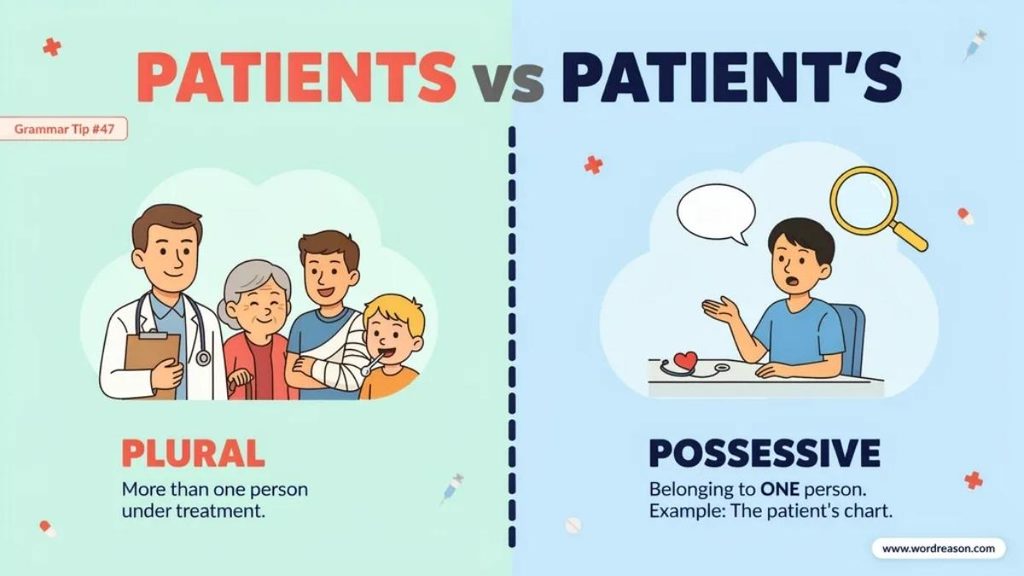
Understanding patient first makes the difference between the other forms much easier to remember.
Patient as a Noun
As a noun, patient means a person receiving medical care, treatment, examination, or advice from a healthcare provider.
e.g
- The patient is waiting for the doctor.
- The nurse checked the patient’s temperature.
- A patient arrived at the clinic this morning.
- The doctor spoke with the patient about the treatment.
In these examples, patient refers to one person. This is the patient singular form.
Patient as an Adjective
e.g
- She is patient with young children.
- You need to be patient while waiting for the results.
- He stayed patient despite the long delay.
This meaning is not related to healthcare.
Patient Meaning in English
The word patient commonly has two grammatical uses:
- Noun a person receiving medical care.
- Adjective someone who can wait calmly or tolerate difficulty.
The meaning of patient depends on the sentence.
What Does “Patients” Mean?
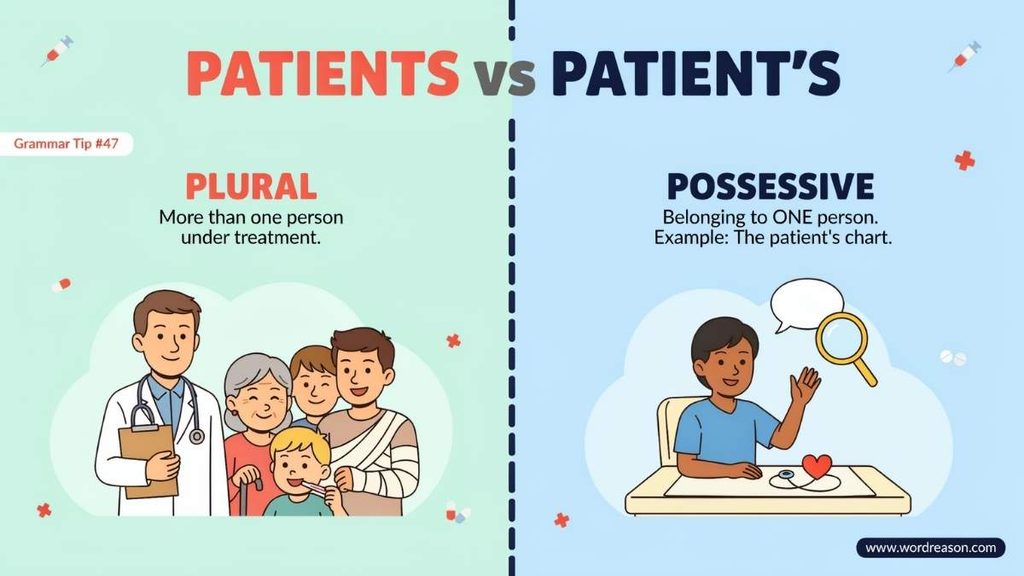
The patients meaning is straightforward patients is the plural form of patient.
Use patients for more than one person receiving medical care.
Patients Definition
Patients refers to two or more people receiving medical treatment, medical advice, examination, or other healthcare services.
Examples include
- The patients are waiting in the lobby.
- Several patients received treatment today.
- The doctor examined five patients.
- The hospital admitted twelve new patients.
Notice something important: patients doesn’t show possession.
that’s the difference of patients vs patient
Patients Is the Plural of Patient
patients vs patient
The plural of patient follows a standard English plural pattern
patient → patients
You simply add s.
Compare
- one patient
- two patients
- one patient is waiting
- several patients are waiting
The s creates the plural. No apostrophe is needed.
Patients Example Sentences
These patients example sentences show how the word works in different contexts
- The patients waited quietly for their appointments.
- The clinic treats patients with a wide range of conditions.
- All patients must check in before seeing the doctor.
- The nurse explained the procedure to the patients.
- Several patients requested additional information.
In each example, patients refers to the people themselves.
these are patients vs patient
Learn the difference between confusing word pairs;
Time Off vs Time-Off Understanding the Hyphen Rule
What Does “Patient’s” Mean?
The patient’s meaning changes when the apostrophe appears.
In most cases, patient’s is the singular possessive form of patient. It indicates that something belongs to, relates to, or is associated with one patient.
Consider these examples
- The patient’s chart is on the desk.
- The patient’s appointment begins at 2 p.m.
- The patient’s medication was changed.
- The patient’s doctor called this morning.
- The patient’s condition improved overnight.
Each sentence focuses on one patient.
Patient’s Definition
The patient’s definition in its possessive use can be summarized as
Something belonging to, connected with, or associated with one patient.
Possession doesn’t always mean literal ownership. In English, a possessive construction can also show a relationship or association.
For example, a patient may not literally own a medical chart. However, patient’s chart identifies the chart associated with that individual.
The same principle applies to
- patient’s records
- patient’s room
- patient’s appointment
- patient’s information
- patient’s doctor
- patient’s medication
- patient’s condition
Patient’s as a Singular Possessive
The basic rule is
one patient + possession = patient’s
Examples
- the patient’s room
- the patient’s records
- the patient’s doctor
- the patient’s appointment
The apostrophe comes before the s because patient is singular.
This is the standard singular possessive pattern in English.
patients vs patient the defination of patients
Patient’s Can Also Mean “Patient Is”
Here’s where the word becomes slightly more interesting.
Patient’s doesn’t always indicate possession. In some sentences, ’s is a contraction of is.
For example:
- The patient’s feeling better.
- The patient’s ready for discharge.
- The patient’s waiting outside.
These mean
- The patient is feeling better.
- The patient is ready for discharge.
- The patient is waiting outside.
How Can You Tell Which Meaning Applies
Use the replacement test.
Replace patient’s with patient is.
For example
The patient’s recovering.
→ The patient is recovering.
The sentence still makes sense, so patient’s means patient is.
Now try
The patient’s chart is missing.
→ The patient is chart is missing.
That doesn’t work. Therefore, patient’s is possessive in this sentence.
This simple test can make patient’s grammar much easier to understand.
patients vs patient
patients vs patient, patients is plural and patient is singular.
What Does “Patients’” Mean?
Once you understand patient’s, the plural possessive form becomes much easier.
Patients’ shows possession or association involving multiple patients.
Patients’ as a Plural Possessive
Use patients’ when something belongs to, relates to, or is associated with two or more patients.
Examples
- The patients’ records were reviewed.
- The patients’ rooms were cleaned.
- The patients’ appointments were rescheduled.
- The patients’ families received updates.
- The patients’ medical records were stored securely.
The noun patients is already plural. Therefore, the apostrophe comes after the s.
This is the standard plural possessive pattern for regular plural nouns ending in s.
Patients’ vs Patient’s
Compare these carefully
The patient’s chart
= the chart associated with one patient
The patients’ charts
= the charts associated with multiple patients
The difference is small in appearance but significant in meaning.
| Phrase | Meaning |
|---|---|
| patient’s chart | Chart associated with one patient |
| patients’ charts | Charts associated with multiple patients |
| patient’s room | Room associated with one patient |
| patients’ rooms | Rooms associated with multiple patients |
| patient’s appointment | Appointment for one patient |
| patients’ appointments | Appointments for multiple patients |
This is why the distinction between patients’ vs patient’s matters whenever you write about ownership or association.
The Grammar Rule Behind Patients vs Patient’s
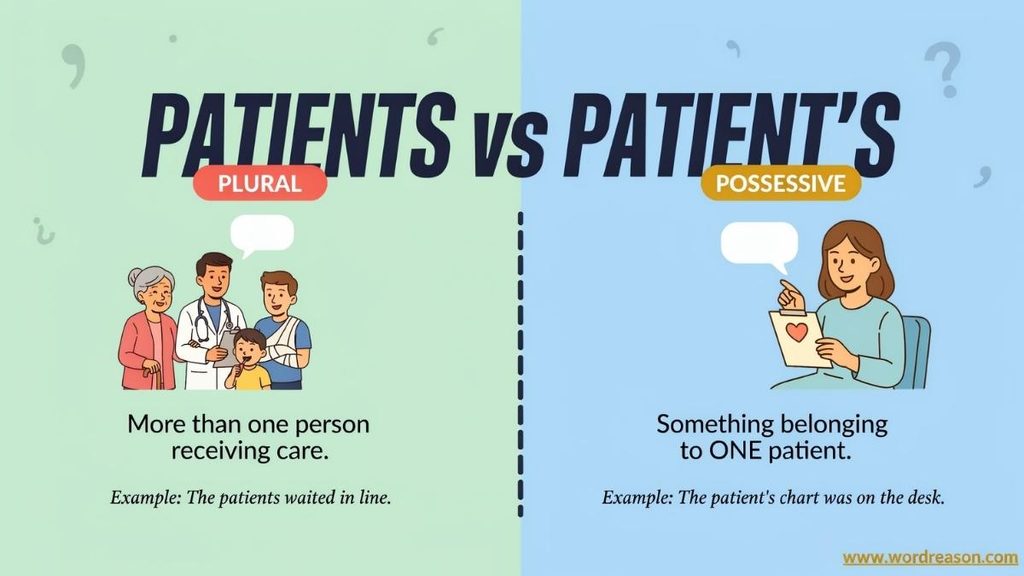
The patients vs patient’s grammar question becomes much easier once you separate two ideas number and possession.
Plural Noun Patients
When you mean more than one patient, use
patients
Example
The patients are waiting.
There is no apostrophe because you’re simply forming a plural noun.
Singular Possessive Patient’s
When one patient has something associated with them, use
patient’s
Example
The patient’s chart is updated.
The apostrophe comes before the s.
Plural Possessive Patients’
When multiple patients have something associated with them, use
patients’
Example
The patients’ charts are updated.
The apostrophe comes after the plural s.
patients vs patient vs patients’ is plural,singular,and possessive
The Complete Pattern of Patients vs Patient’s vs patient
Think of the forms as a simple progression
patient
→ one patient
patients
→ more than one patient
patient’s
→ something associated with one patient
patients’
→ something associated with multiple patients
That pattern answers most questions about the patients vs Patients vs Patient’s difference.
Patients vs Patient’s Examples in Real Life Sentences
Examples often make grammar rules easier to remember than definitions alone.
Medical Office Examples
Patients
The patients are waiting for their appointments.
The sentence refers to several people.
Patient’s
The patient’s appointment starts at 10 a.m.
The appointment belongs to or is associated with one patient.
Patients’
The patients’ appointments were moved to Friday.
Several patients have appointments.
Hospital Examples
Patients
The hospital admitted several patients overnight.
Patient’s
The patient’s condition improved after treatment.
Patients’
The patients’ families were contacted by the hospital.
Doctor’s Office Examples
Patients
The doctor sees twenty patients each day.
Patient’s
The patient’s medication list needs updating.
Patients’
The patients’ medical records were reviewed.
Everyday Examples
The same grammar applies outside a hospital or clinic
- The patients are waiting.
- The patient’s mother called.
- The patients’ families arrived.
- The patient’s information was verified.
- The patients’ information was verified.
In the final two examples, the number of patients determines where the apostrophe belongs.
Patients vs Patient’s in Medical Communication
Medical communication frequently involves patient names, records, appointments, rooms, treatments, and health information. Because of that, the distinction between singular and plural possessives can matter more than it first appears.
Patient’s Chart
Use patient’s chart when referring to one patient.
The doctor reviewed the patient’s chart.
The sentence identifies one patient’s chart.
Patients’ Charts
Use patients’ charts when referring to charts associated with several patients.
The nurses reviewed the patients’ charts before morning rounds.
The sentence concerns multiple patients.
Patient’s Records
Use patient’s records when discussing one patient.
The patient’s records were transferred to the new clinic.
Patients’ Records
Use patients’ records when discussing multiple patients.
The clinic securely stored the patients’ records.
The same rule applies to phrases such as
- patients’ health information
- patients’ appointments
- patients’ rooms
- patients’ medical records
- patients’ charts
Why Precision Matters
In professional healthcare writing, clarity is essential. For this reason, even a small punctuation mistake can affect how a sentence is understood. Although a misplaced apostrophe may not always change the practical meaning of a medical instruction, it can still make professional communication harder to interpret. In addition, unclear wording may cause readers to pause and question what the writer means.
Therefore, when a sentence involves records, appointments, treatment, or other patient information, readers should be able to quickly understand whether it refers to one patient or multiple patients. For example, using patient’s for one patient and patients’ for multiple patients makes ownership clear. As a result, correct punctuation helps healthcare professionals communicate information more clearly, accurately, and confidently
Common Mistakes With Patients vs Patient’s
Mistake 1 Using Patient’s as a Plural
The patient’s are waiting. incorrect
The patients are waiting. correct
Why? Patients is the plural noun. The apostrophe isn’t needed.
Mistake 2 Adding an Apostrophe to Make a Plural
Three patient’s arrived. incorrect
Three patients arrived. correct
The word becomes plural by adding s. The apostrophe doesn’t belong there.
Mistake 3 Forgetting the Apostrophe in a Possessive
The patients chart is ready. incorrect
If you’re referring to one patient:
The patient’s chart is ready. correct
The apostrophe marks the possessive relationship.
Mistake 4 Using Patient’s for Multiple Patients
Suppose you’re talking about records belonging to several patients.
The patient’s records were reviewed. incorrect
The patients’ records were reviewed. correct
The first version refers grammatically to one patient. The second clearly refers to multiple patients.
Mistake 5 Confusing Patients With Patience
The doctor treated several patience. incorrect
The doctor treated several patients. correct
Patients refers to people receiving medical care.
Patience refers to the ability to remain calm while waiting or dealing with something difficult.
Patients vs Patients’ The Third Form You Need to Know
People searching for patients vs patients’ often overlook an important distinction.
Patients is plural.
Patients’ is plural possessive.
Compare
The patients are waiting.
This sentence describes multiple people.
The patients’ rooms are clean.
This sentence describes rooms associated with multiple patients.
The word patients was already plural before the apostrophe appeared. The apostrophe simply marks possession.
Patient’s vs Patients’ Singular Possessive or Plural Possessive?
This distinction is worth memorizing because it appears frequently in everyday and professional writing.
Patient’s
Use patient’s when one patient is involved.
- the patient’s room
- the patient’s chart
- the patient’s doctor
- the patient’s medication
Patients’
Use patients’ when multiple patients are involved.
- the patients’ rooms
- the patients’ charts
- the patients’ doctors
- the patients’ medications
The quickest question to ask is
How many patients are involved?
One?
→ patient’s
more than
→ patients’
How to Know When to Use Patients vs Patient’s

When you’re unsure whether to write patients vs patient’s, don’t rely on how the word looks. Instead, identify its grammatical function.
Ask “How Many?”
If you’re referring to one person
patient
If you’re referring to more than one
patients
Ask “Is Something Associated With the Patient?”
If the sentence shows possession or association, determine whether one or multiple patients are involved.
One patient
patient’s
Multiple patients
patients’
Use the Replacement Test
1.If you’re looking at patient’s, try replacing it with patient is.
2.If the replacement works, patient’s is a contraction.
3.If it doesn’t, patient’s is likely possessive.
This gives you a reliable three-step approach:
Number → Possession → Apostrophe
Patients vs Patient’s Comparison Table
| Form | Number | Possessive? | Main use | Example |
|---|---|---|---|---|
| patient | One | No | Singular noun | The patient arrived. |
| patients | More than one | No | Plural noun | The patients arrived. |
| patient’s | One | Yes | Singular possessive | The patient’s room is ready. |
| patient’s | One | No | Contraction of “patient is” | The patient’s feeling better. |
| patients’ | More than one | Yes | Plural possessive | The patients’ rooms are ready. |
This table summarizes the correct usage of patients and patient’s while also showing why patients’ belongs in the conversation.
Patients vs Patient Spelling
The patients spelling is
P-A-T-I-E-N-T-S
The patient’s spelling is
P-A-T-I-E-N-T
The apostrophe creates the possessive form.
For the plural possessive, write
patients’
The apostrophe comes after the s.
A Simple Spelling Memory Trick
Remember this pattern
One → ’s
Many → s’
So
- one patient → patient’s
- many patients → patients’
But if you’re simply referring to several people, use
- patients
No apostrophe.
Apostrophe Rules for Patients
Understanding apostrophe usage makes these forms much easier to control.
Apostrophe Before S
patient’s
This usually marks singular possession.
The patient’s medication was changed.
Apostrophe After S
patients’
This marks plural possession.
The patients’ medications were reviewed.
No Apostrophe
patients
This simply forms the plural.
The patients received medication.
A useful rule is
Make the noun plural first, then add the apostrophe for possession.
For regular plural nouns ending in s, the possessive apostrophe comes after the s.
Case Study How One Apostrophe Changes Meaning
Consider a sentence written in a medical office
The patient’s records were reviewed before discharge.
This sentence can refer to records associated with one patient.
Now imagine the writer means that records belonging to several patients were reviewed. The sentence should become
The patients’ records were reviewed before discharge.
That tiny change communicates a different grammatical relationship.
Now remove the apostrophe
The patients records were reviewed.
The sentence no longer follows standard possessive punctuation.
This example shows why patients vs patient’s isn’t merely a spelling issue. The form tells readers whether they’re dealing with a plural noun, a singular possessive, or a plural possessive.
Patient vs Patients The Basic Number Difference
The patient vs patients distinction is simple.
Patient = One
The patient needs assistance.
Patients = More Than One
The patients need assistance.
The verb can also help reveal the difference:
- The patient is waiting.
- The patients are waiting.
This demonstrates subject verb agreement.
A singular subject normally takes a singular verb, while a plural subject takes a plural verb.
Patient vs Patience A Related Confusion
The words patient and patience look similar, but they have different meanings and grammatical roles.
Patient
Patient can be a noun or an adjective.
As a noun
The patient spoke with the doctor.
As an adjective
The teacher was patient with the student.
Patience
Patience is a noun meaning the ability to remain calm while waiting or dealing with difficulty.
The teacher showed patience with the students.
So the difference is
- patient = a person receiving medical care OR someone who can wait calmly
- patience = the quality of remaining calm
Patients vs Patience
Compare
The patients waited in the clinic.
The nurse showed patience while answering their questions.
The first sentence refers to people. The second refers to a quality.
This is why patients vs patience can be confusing at first glance, even though the words have completely different meanings.
Common Sentence Patterns to Remember
Once you recognize a few common patterns, choosing the correct form becomes almost automatic.
Multiple Patients
The patients + verb
The patients are waiting.
One Patient’s Possession
The patient’s + noun
The patient’s chart is complete.
Multiple Patients’ Possession
The patients’ + noun
The patients’ charts are complete.
Patient Is
The patient’s + adjective or verb phrase
The patient’s feeling better.
Replace patient’s with patient is to confirm the contraction.
Quick Grammar Cheat Sheet for Patients vs Patient’s
Keep this reference handy:
| If you mean… | Use |
|---|---|
| One person receiving care | patient |
| More than one person receiving care | patients |
| Something connected to one patient | patient’s |
| “Patient is” | patient’s |
| Something connected to multiple patients | patients’ |
The One Second Test
When you’re unsure, ask three questions
One or many?
- One → patient
- Many → patients
Possession or association?
- One + possession → patient’s
- Many + possession → patients’
Does “patient is” fit?
- Yes → patient’s can be a contraction.
- No → patient’s is likely possessive.
This quick method covers most cases you’ll encounter in everyday, academic, and professional writing.
Here’s a trusted source for clear more words Comparison:
Practice Session Patients vs Patient’s
Before you start, remember these simple rules
- Patient = one person receiving medical care.
- Patients = more than one person receiving medical care.
- Patient’s = something belonging to or associated with one patient.
- Patients’ = something belonging to or associated with multiple patients.
- Patient’s can also mean patient is.
- Patience = the ability to remain calm while waiting or dealing with difficulty.
- Life = singular.
- Lives = plural.
Quick Examples
One patient
The patient’s appointment is at noon.
Multiple patients
The patients’ appointments are at noon.
Simple plural
The patients are waiting outside.
Contraction
The patient’s feeling better.
Quality of staying calm
The nurse showed great patience.
Plural of life
The doctors saved several lives.
choose the correct word
Choose the correct word or form for each sentence.
- The doctor examined several __________ before lunch.
(patient / patients / patient’s) - The __________ medical history was reviewed before treatment.
(patient / patients / patient’s) - The __________ records were placed in separate folders.
(patients / patient’s / patients’) - Please be __________ while the nurse prepares your medication.
(patient / patience / patients) - The __________ are waiting in the reception area.
(patient / patients / patient’s) - The doctor explained the treatment to the __________ family.
(patient / patient’s / patients’) - The hospital staff worked hard to save the __________ of the injured people.
(life / lives / lifes) - The __________ rooms were cleaned before the new admissions arrived.
(patients / patient’s / patients’) - The __________ feeling much better after the treatment.
(patient’s / patients / patients’) - The nurse checked the __________ temperature.
(patient / patient’s / patients’) - Several __________ arrived at the clinic early this morning.
(patient / patients / patient’s) - The doctor reviewed the __________ test results.
(patient’s / patients / patients’) - The nurse showed great __________ while answering the child’s questions.
(patient / patients / patience) - The __________ appointment was moved to Friday.
(patient’s / patients / patients’) - The clinic treats hundreds of __________ every month.
(patient / patients / patient’s) - The doctors helped improve many __________ through early treatment.
(patient’s lives / patients’ lives / patients lives) - The __________ are receiving treatment in the emergency department.
(patient / patients / patient’s) - The doctor said the __________ condition was stable.
(patient’s / patients / patients’) - The families were grateful that the doctors had saved their loved ones’ __________.
(life / lives / lifes) - The __________ medical records must remain confidential.
(patient’s / patients / patients’) - The receptionist asked for the __________ name and date of birth.
(patient’s / patients / patients’) - The doctor sees many __________ during a typical workday.
(patient / patients / patient’s) - The teacher asked the students to have __________ while waiting for their turn.
(patient / patients / patience) - The __________ waiting room was crowded after the clinic opened.
(patient’s / patients / patients’) - The treatment has helped save thousands of __________ around the world.
(life / lives / lifes)
Answer Key
| # | Answer | Why? |
|---|---|---|
| 1 | patients | More than one patient |
| 2 | patient’s | The history belongs to one patient |
| 3 | patients’ | Records belong to multiple patients |
| 4 | patient | Adjective meaning calm or willing to wait |
| 5 | patients | More than one person |
| 6 | patient’s | Family associated with one patient |
| 7 | lives | Plural of life |
| 8 | patients’ | Rooms associated with multiple patients |
| 9 | patient’s | Means “patient is” |
| 10 | patient’s | Temperature associated with one patient |
| 11 | patients | More than one patient |
| 12 | patient’s | Results associated with one patient |
| 13 | patience | Ability to remain calm |
| 14 | patient’s | Appointment associated with one patient |
| 15 | patients | Plural noun |
| 16 | patients’ lives | Lives belonging to multiple patients |
| 17 | patients | More than one patient |
| 18 | patient’s | Condition of one patient |
| 19 | lives | Plural of life |
| 20 | patients’ | Records associated with multiple patients |
| 21 | patient’s | Name of one patient |
| 22 | patients | Plural noun |
| 23 | patience | Ability to wait calmly |
| 24 | patients’ | Waiting room associated with multiple patients |
| 25 | lives | Plural of life |
Frequently Asked Questions About Patients vs Patient’s
Is it “patient’s lives” or “patients’ lives”?
The correct form depends on whether you mean one patient or multiple patients.
Use patient’s life for one patient
The treatment saved the patient’s life.
Use patients’ lives for multiple patients
The new treatment has improved many patients’ lives.
The apostrophe comes before the s in patient’s because the noun is singular. It comes after the s in patients’ because the noun is already plural.
What is the plural of “patient”?
The plural of patient is patients.
- One patient
- Two patients
- Several patients
- Many patients
When patients simply refers to more than one person receiving medical care, it does not need an apostrophe.
The patients are waiting for their appointments.
Does “patient” have two meanings?
Yes. Patient has two common grammatical uses.
As a noun, patient refers to someone receiving medical care or treatment
The patient is waiting for the doctor.
As an adjective, patient describes someone who can remain calm while waiting or dealing with difficulty
Please be patient while we process your request.
The meaning depends on the sentence and how the word functions grammatically.
What is the meaning of “patient’s”?
Patient’s is usually the singular possessive form of patient. It indicates that something belongs to, concerns, or is associated with one patient.
Examples include:
- The patient’s name is on the form.
- The patient’s condition has improved.
- The patient’s room is ready.
- The patient’s medication was changed.
Patient’s can also be a contraction of patient is
The patient’s feeling better.
Here, patient’s means patient is, not possession.
Is it correct to say “patient name” or “patient’s name”?
Both forms can be correct, depending on the context.
Patient’s name is the normal possessive construction when you mean the name of one specific patient
Please enter the patient’s name.
Patient name commonly appears as a form label, database field, heading, or administrative term
Patient Name: __________________
In a regular sentence, patient’s name is usually the clearer and more natural choice when referring to one patient.
Should I say “lifes” or “lives”?
The correct plural of life is lives, not lifes.
- One life
- Two lives
- Many lives
For example
The doctors worked together to save the patients’ lives.
The spelling changes from life to lives when forming the plural.
Is “patients” a possessive plural form?
No. Patients is the regular plural form of patient, not a possessive form.
The plural possessive is patients’.
Compare these examples
The patients are waiting.
The patients’ rooms are clean.
In the first sentence, patients simply means more than one patient. In the second, patients’ shows that the rooms are associated with multiple patients.
Is “patience” singular or plural?
Patience is generally an uncountable noun, so it normally doesn’t have a plural form in everyday English.
For example
She has a great deal of patience.
Learning a new skill requires patience.
Patience means the ability to remain calm while waiting, facing difficulties, or dealing with something frustrating.
Don’t confuse patience with patients. They sound similar, but their meanings and grammatical roles are completely different.
Can I say “be patient” or “be patience”?
The correct expression is “be patient.”
Patient is an adjective, so it can describe someone’s behavior
Please be patient while we check your records.
Patience is a noun
Please have patience while we check your records.
Therefore
- Be patient. ✓
- Have patience. ✓
- Be patience. ✗
Should “patients” have an apostrophe?
Not when patients simply means more than one patient.
The patients are waiting in the clinic.
However, use an apostrophe when you need to show possession or association
The patients’ records were updated.
The distinction is:
patients = plural
patients’ = plural possessive
Why is someone called a “patient”?
A patient is someone who receives medical examination, care, diagnosis, treatment, or other healthcare services.
The term is connected to the idea of enduring or undergoing something, which relates to a person undergoing medical care.
Today, patient is the standard English term used for someone receiving healthcare from a doctor, nurse, hospital, clinic, or other healthcare professional.
What is another word for “patient”?
The best alternative depends on which meaning of patient you intend.
When patient means someone receiving healthcare, possible alternatives include
- care recipient
- person receiving treatment
- person receiving medical care
When patient describes someone who waits calmly, alternatives can include
- calm
- tolerant
- understanding
- composed
- forbearing
Because patient can be both a noun and an adjective, choose a synonym based on the sentence rather than replacing it automatically.
What is it called when you are patient?
The quality of being patient is called patience.
For example
Her patience helped her handle the long delay.
The easiest way to remember the difference is
patient = able to wait calmly
patience = the quality or ability to wait calmly
Compare
He is patient with his students.
He has a lot of patience with his students.
AEO Quick Answers
Is it “patient’s lives” or “patients’ lives”?
Use patient’s life for one patient and patients’ lives for multiple patients.
What is the plural of “patient”?
The plural is patients.
What does “patient’s” mean?
Patient’s usually shows possession or association with one patient. It can also be a contraction of patient is.
What is the plural possessive of “patient”?
The plural possessive form is patients’.
Is “lifes” correct?
No. The correct plural of life is lives.
Is “patience” a plural noun?
Usually not. Patience is generally an uncountable noun in standard everyday usage.
Is “be patience” correct?
No. The correct expression is “be patient.” You can also say “have patience.”
Does “patients” need an apostrophe?
No, not when it simply means more than one patient. Use patients’ when showing possession or association with multiple patients.
What is the difference between “patient” and “patience”?
Patient can be a noun meaning someone receiving medical care or an adjective describing someone who can wait calmly. Patience is the noun for the ability to remain calm and tolerate waiting or difficulty.
What is the difference between “patients” and “patients’”?
Patients is the plural form of patient. Patients’ is the plural possessive form.
The patients are waiting.
The patients’ records are ready.
What is the difference between “patient’s” and “patients’”?
Patient’s refers to one patient in a possessive construction. Patients’ refers to multiple patients in a possessive construction.
The patient’s chart is updated.
The patients’ charts are updated.
Quick Grammar Reference
| Form | Grammatical role | Meaning | Example |
|---|---|---|---|
| patient | Singular noun | One person receiving care | The patient arrived. |
| patients | Plural noun | More than one patient | The patients arrived. |
| patient’s | Singular possessive | Associated with one patient | The patient’s chart is ready. |
| patient’s | Contraction | Patient is | The patient’s feeling better. |
| patients’ | Plural possessive | Associated with multiple patients | The patients’ charts are ready. |
| patience | Uncountable noun | Ability to remain calm | She showed patience. |
| life | Singular noun | One life | The patient’s life was saved. |
| lives | Plural noun | More than one life | The doctors saved lives. |
Final AEO Takeaway
When these words look confusing, focus on number and possession
- patient → one
- patients → more than one
- patient’s → one patient’s possession or patient is
- patients’ → possession involving multiple patients
- patience → the ability to remain calm
- life → singular
- lives → plural
Here’s a polished conclusion that keeps the tone humorous, professional, clear, and grammatically educational while reinforcing the key rules without repeating the article word for word.
Conclusion
The difference between patients, patient’s, and patient may look like a tiny punctuation puzzle, but that little apostrophe can completely change your meaning. The good news? You don’t need a grammar degree or a medical emergency to get it right. Remember the simple pattern, patients means more than one, patient’s shows possession by one patient. Once you know whether you’re talking about one person, several people, or possession, the correct form becomes much easier to choose. So, the next time grammar tries to confuse you, let the apostrophe do its job and keep your sentences healthy,that’s the difference of patients vs patient

Bella AJS
Bella AJS is an experienced blogger and passionate language enthusiast at WordReason. She specializes in English grammar, word meanings, spelling, and commonly confused words. With a clear and practical writing style, Bella helps readers understand tricky language rules without the textbook headache. Her goal is simple: make English easier, clearer, and more enjoyable one word at a time.