
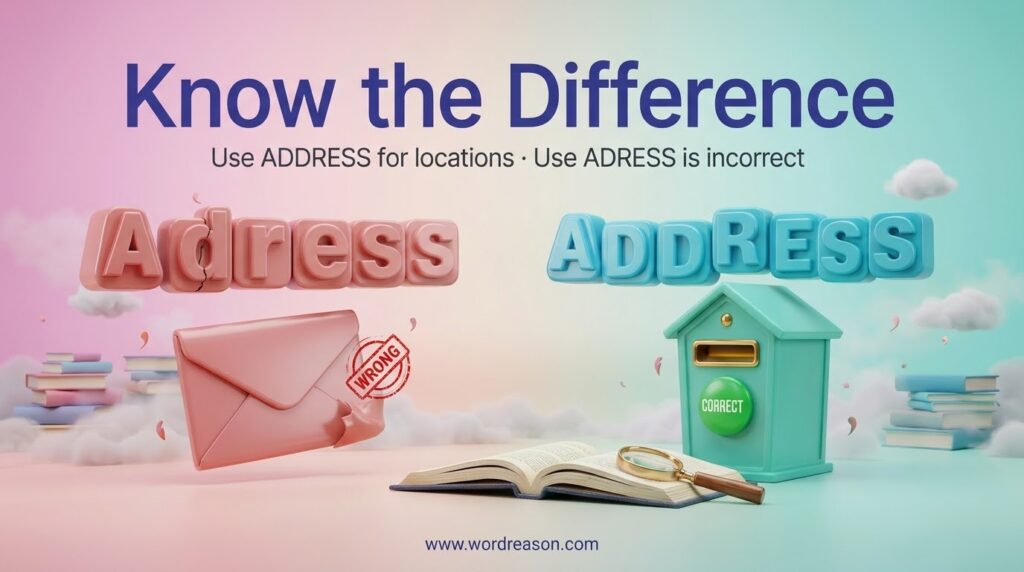
Adress or Address one tiny spelling mistake can make your writing look less polished than you intended. So, is it adress or address? If you have ever typed one and wondered whether your keyboard was playing tricks on you, you are not alone. The correct spelling is address, with two Ds and two Ss. However, this common mistake can still sneak into emails, letters, forms, and everyday messages. Beyond spelling, address has several meanings and works as both a noun and a verb. Let’s clear up the confusion with simple explanations, practical examples, and easy memory tricks.
Adress or Address Which Spelling Is Correct?
Adress or Address,address is the correct spelling in English. It contains two consecutive Ds followed by two consecutive Ss. You should use this spelling in American English, British English, and other standard varieties of English.
On the other hand, adress is a spelling mistake. It does not represent an accepted alternative spelling of the standard English word.
The confusion often happens because people pronounce the word quickly or forget to double one of its letters while typing. Since the incorrect form looks similar to the correct one, the mistake can easily go unnoticed.
Address Is the Correct Spelling
The word address has several meanings. As a noun, it commonly refers to a location where someone lives, works, or receives mail. It can also describe a formal speech or an electronic destination.
As a verb, it means speaking to someone, directing a message toward someone, or dealing with a particular subject or problem.
Consider these examples
| Example | Usage |
|---|---|
| Please write your complete address on the application form. | Noun |
| I sent the invitation to her email address. | Noun |
| The manager will address the employees during the meeting. | Verb |
| We must address the issue before it becomes more serious. | Verb |
Notice that the spelling stays the same in every example. Only the grammatical function and meaning change.
Adress Is a Common Misspelling
Adress is not the correct spelling of the English word. It is a typographical or spelling error that occurs when someone leaves out one of the two Ds.
For example
| Incorrect sentence | Correct sentence |
|---|---|
| Please confirm your current adress. | Please confirm your current address. |
| The company changed its office adress. | The company changed its office address. |
| Enter your email adress below. | Enter your email address below. |
Although readers may understand what you mean when you write adress, the mistake can make your writing look careless. It is particularly important to avoid it in professional emails, business documents, academic assignments, and official applications.
Adress or Address Quick Comparison
The following comparison makes the difference easy to understand.
| Feature | Address | Adress |
|---|---|---|
| Spelling | Correct | Incorrect |
| First letter | A | A |
| Double D | Yes | No |
| Double S | Yes | Yes |
| Dictionary recognition | Standard English word | Misspelling |
| Formal writing | Accepted | Not accepted |
| Everyday use | Correct choice | Avoid |
The easiest way to settle the Adress or Address question is to remember that the correct word contains two Ds and two Ss.
Learn the difference between confusing more English words
Creator vs Creater Which Spelling Is Correct?
What Does Address Mean?
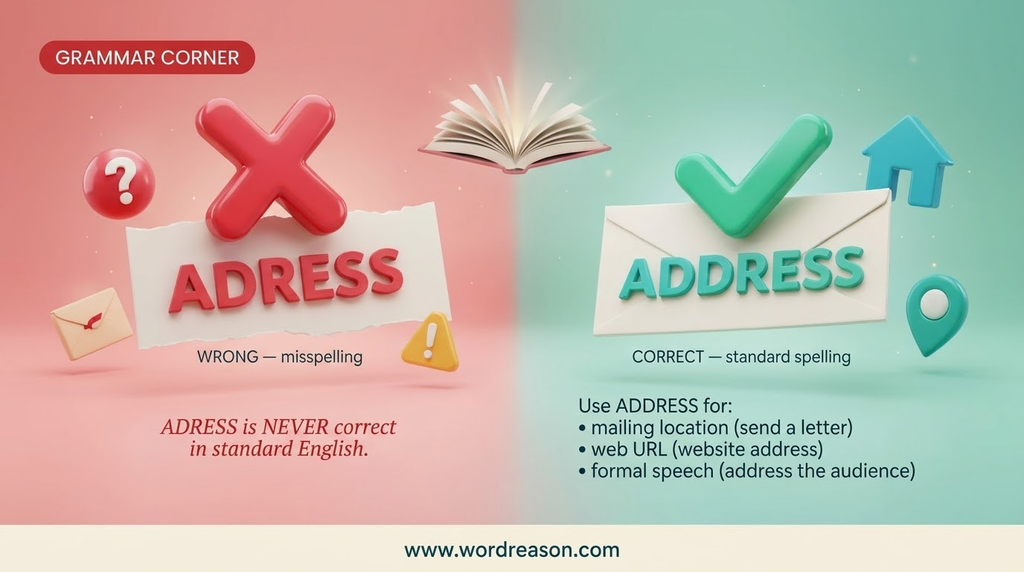
The word address has more than one meaning. Its definition depends on how you use it in a sentence.
Most people associate it with a home or mailing location. However, English speakers also use it when discussing communication, public speaking, technology, and problem solving.
Understanding these meanings will help you recognize the correct word in different situations.
Address as a Noun
A noun names a person, place, thing, or idea. When you use address as a noun, it can refer to several things.
The most familiar meaning is a person’s or property’s location. It identifies where someone lives, works, or receives mail.
For example
My home address is 25 Park Avenue, New York.
The delivery driver could not find the correct street address.
Please update your permanent address before submitting the form.
A complete mailing address generally contains several details, including the recipient’s name, house or building number, street name, city, state or province, postal code, and country when necessary.
The exact address format varies by country. For example, American addresses generally use a five-digit ZIP code, while British postal addresses use alphanumeric postcodes.
Another meaning relates to a formal speech or public statement. When someone delivers an address, they speak to an audience about a particular subject.
For example
The president delivered an important address to the nation.
The principal gave a welcoming address at the graduation ceremony.
Everyone listened carefully to the speaker’s opening address.
In this context, address does not refer to a physical location. It describes spoken communication directed toward an audience.
The word also appears in technology. An email address identifies an electronic mailbox, while an IP address identifies a network interface using the Internet Protocol. A memory address identifies a location where a computer stores information.
Address as a Verb
A verb describes an action or state. When address functions as a verb, it commonly means speaking to someone, directing communication, or dealing with a particular matter.
One common use involves speaking or communicating with another person.
For example
The teacher addressed the students before the examination.
Please address your letter to the department manager.
The speaker addressed the audience with confidence.
Another important meaning involves dealing with a problem or giving attention to a particular issue.
For example
The company must address customer complaints.
We need to address the spelling mistakes in this document.
The government plans to address the housing shortage.
In these examples, address means to consider, discuss, or take action on a particular matter.
You can also use the verb when directing a letter, package, or other communication to someone.
For example:
She addressed the envelope to her grandmother.
The invitation was addressed to the department head.
Address in Different Contexts
The meaning of address changes according to the situation. This table summarizes its most common uses.
| Context | Meaning | Example |
|---|---|---|
| Residential | A place where someone lives | What is your home address? |
| Postal | A destination for mail | Write the postal address clearly. |
| Digital | An electronic destination | Enter your email address. |
| Public speaking | A formal speech | She delivered an opening address. |
| Communication | Speaking to someone | He addressed the audience. |
| Problem-solving | Dealing with an issue | We must address this concern. |
Learn the difference between confusing more English words
Emphasise or Emphasize which spelling is correct?
Why Is Address Spelled With Two Ds and Two Ss?
English spelling can be tricky because many words contain repeated letters that are easy to overlook. Address is one of them.
The correct spelling contains two consecutive Ds and two consecutive Ss. Both pairs belong to the established spelling of the word.
The Double D Spelling
The first important feature is the double D.
Many people accidentally write adress because they remember the sound but overlook the second D. However, the correct spelling always includes both letters.
Compare these forms
Adress Incorrect.
Address Correct.
The easiest approach is to break the word into smaller visual parts:
A + DD + R + E + SS
This pattern makes the double D easier to remember.
The Double S Ending
The second feature is the double S at the end.
Even when someone remembers the two Ds, they may still wonder whether the word needs one S or two. The answer is two.
Here is the complete letter pattern
| Position | Letter |
|---|---|
| First | A |
| Second | D |
| Third | D |
| Fourth | R |
| Fifth | E |
| Sixth | S |
| Seventh | S |
Therefore, the complete spelling is ADDRESS.
Why Adress Is a Spelling Mistake
The spelling adress usually results from a typographical error or an incorrect memory of the word.
Several factors can cause this mistake. Writers sometimes leave out the second D because they type quickly. Others remember the pronunciation but overlook the repeated letters. Some simply become familiar with the incorrect spelling after seeing it several times.
However, none of these reasons makes adress an accepted spelling.
The safest approach is to check both letter pairs whenever you use the word in an important document.
Learn the difference between confusing more English words
Totaling or Totalling? which spelling is correct?
The Origin and History of Address

The word Adress or Address has an interesting history that goes back several centuries. Its spelling and meaning developed through different stages of the English language.
Address Comes From Old French
The English word address entered the language through Old French and Middle French forms related to directing, guiding, and setting something straight.
Its history connects to the Old French verb adrecier and the Latin word directus, meaning straight or direct.
This historical connection helps explain why the modern verb address can mean directing words toward someone or directing attention toward a problem.
How the Word Developed in English
The verb appeared in English during the early 14th century. At first, it carried meanings related to guiding, directing, and putting something in order.
Later, English speakers began using it in communication and correspondence.
The noun developed additional meanings over the following centuries.
| Period | Historical development |
|---|---|
| Early 14th century | The verb appeared with meanings related to guiding and directing. |
| Late 14th century | It developed a sense of setting something in order or correcting it. |
| Mid-15th century | It gained the meaning of directing a letter or message toward a destination. |
| Late 15th century | It developed the sense of directing spoken words toward someone. |
| 16th century | The noun became established in English. |
| 18th century | The meaning of a formal speech to an audience became established. |
| 19th century | The residential-location meaning became widely established. |
| 20th century | The word gained additional technical meanings in computing. |
These dates describe the development of particular meanings rather than the first appearance of every modern use.
How Its Meaning Expanded Over Time
Today, address covers several areas of everyday life. You can use it to identify a building, send a letter, communicate with an audience, or discuss a difficult situation.
Consider these examples
A residential address identifies where someone lives.
A mailing address identifies where someone receives postal correspondence.
A formal address describes a speech delivered to an audience.
A computer address identifies a particular location within a digital system.
Although these meanings may seem unrelated, they share a central idea: directing something toward a particular person, place, or subject.
Learn the difference between confusing more English words
Tying or Tieing Which Spelling Is Correct?
How to Use Address Correctly in a Sentence
Knowing the correct spelling is only the beginning. You also need to understand how to use address naturally in different situations.
The word can function as a noun or a transitive verb. A transitive verb takes a direct object, such as a person, message, or issue.
Address as a Noun Sentence Examples
When address acts as a noun, it identifies a location, communication destination, or formal speech.
| Example sentence | Meaning |
|---|---|
| Please provide your home address. | The place where someone lives |
| I forgot to update my mailing address. | The location where someone receives mail |
| Her email address is listed on the website. | An electronic communication destination |
| The company moved to a new business address. | The location of a workplace |
| The president delivered a national address. | A formal speech |
| The package arrived at the wrong address. | An incorrect delivery location |
Notice that the word describes something rather than an action in these sentences.
Address as a Verb Sentence Examples
When you use address as a verb, it describes an action involving communication, direction, or problem-solving.
The teacher will address the students before the lesson begins.
We should address the customers concerns immediately.
Please address the envelope before mailing it.
The director addressed the audience during the ceremony.
The report addresses several important environmental issues.
The verb changes form depending on the tense and grammatical structure.
| Verb form | Example |
|---|---|
| Base form: address | We must address the issue. |
| Third-person singular: addresses | She addresses every concern. |
| Past tense: addressed | He addressed the audience. |
| Present participle: addressing | They are addressing the problem. |
| Past participle: addressed | The complaint has been addressed. |
All these forms retain the same double-D and double-S spelling pattern.
Learn the difference between confusing more English words
Reinforce vs Reenforce Which spelling Is Correct?
Address in Questions and Formal Communication
In professional and academic writing, address often appears when someone needs to direct a message, discuss a concern, or identify a recipient.
For example
Please address your application to the admissions office.
The report addresses the main causes of unemployment.
Who should I address in this formal letter?
The manager will address the teams concerns tomorrow.
You can also use address when referring to someones preferred title or form of respect.
For example
Please address the professor as Dr. Wilson.
The employees addressed their director as Mr. Brown.
The context determines whether the word refers to communication, a title, or a particular issue.
Address in Digital and Technical Contexts
Modern communication has introduced several additional uses of the word.
An email address identifies an electronic mailbox. A web address identifies a location on the internet. An IP address identifies a network interface.
A memory address serves a different purpose. It identifies a location where a computer stores information.
| Type of address | What it identifies |
|---|---|
| Email address | An electronic mailbox |
| Web address | A location on the internet |
| IP address | A network interface |
| Memory address | A location in computer memory |
| Physical address | A real-world location |
For example, when a website asks you to enter your email address, it needs your electronic contact destination. It does not need your home or residential address.
Learn the difference between confusing more English words
Discard vs Disgard Which Spelling Is Correct?
Address British English vs American English
Adress or Address english spelling differences often confuse writers. Words such as color and colour, organize and organise, and center and centre have different regional spellings.
Fortunately, address has the same standard spelling in British and American English.
Is Address Spelled the Same in British and American English?
Yes. Adress or Address both varieties use address with two Ds and two Ss.
| English variety | Correct spelling | Incorrect spelling |
|---|---|---|
| American English | Address | Adress |
| British English | Address | Adress |
| Canadian English | Address | Adress |
| Australian English | Address | Adress |
You do not need to change the spelling when writing for readers in the United States, United Kingdom, Canada, or Australia.
Address Spelling in Other English Speaking Countries
The same spelling applies across other standard English varieties.
A student in the United States writes their home address.
A business in the United Kingdom lists its office address.
An Australian customer enters a delivery address.
A Canadian company publishes its mailing address.
Although address formats and postal conventions vary between countries, the spelling of the word remains unchanged.
Is There Any Regional Spelling Difference?
There is no standard British versus American spelling difference. However, pronunciation can vary.
American English commonly allows two pronunciations for the noun: AD-dress and uh-DRESS. British English commonly uses uh-DRESS.
The verb generally takes the second-syllable stress in both American and British English.
These pronunciation differences do not affect the written spelling.
Learn the difference between confusing more English words
Thiefs or Thieves Which Spelling Is Correct?
Common Spelling and Grammar Mistakes With Address
Even when you know the correct spelling, other mistakes can appear when you use the word in everyday writing.
Some involve missing letters, while others relate to plural forms, verb tenses, or punctuation.
Writing Adress Instead of Address
This is the most common mistake associated with the topic.
People sometimes remove one D because they remember the sound but forget the spelling.
Incorrect Please send the documents to my new adress.
Correct Please send the documents to my new address.
Remember that address contains two Ds and two Ss. Check both letter pairs before submitting an important document.
Confusing Address and Addresses
The words address and addresses have different grammatical forms.
Address is the singular form of the noun. Addresses is its plural form. The plural-looking form also functions as the third-person singular form of the verb.
Examples
She has one permanent address.
The company has several office addresses.
He addresses the audience every morning.
Do not write adressess or address’s when you simply want the regular plural.
Using Address and Addressed Incorrectly
The verb changes according to the tense of the sentence.
| Tense or form | Correct example |
|---|---|
| Present | The manager addresses the complaint. |
| Past | The manager addressed the complaint. |
| Future | The manager will address the complaint. |
| Present continuous | The manager is addressing the complaint. |
| Present perfect | The manager has addressed the complaint. |
A common mistake is using the wrong verb form after an auxiliary verb.
Incorrect: She has address the problem.
Correct: She has addressed the problem.
The helping verb has requires the past participle addressed in this construction.
Confusing Address as a Noun and a Verb
The same spelling can perform different grammatical functions. Therefore, you should examine the surrounding words to understand its role.
| Sentence | Grammatical function |
|---|---|
| What is your address? | Noun |
| Please address the letter. | Verb |
| The address is incorrect. | Noun |
| We must address the complaint. | Verb |
A useful trick is to ask yourself what the word does in the sentence.
If it names a location or speech, it functions as a noun. If it describes directing communication or dealing with an issue, it functions as a verb.
Incorrectly Using the Possessive Form Addresss
The apostrophe can also cause confusion.
Addresss is not the correct possessive spelling. The correct singular possessive form is addresss with an apostrophe before the final S: addresss.
For example
The addresss location makes the office easy to find.
The addresss format needs correction.
However, the apostrophe does not create the ordinary plural form.
Compare these forms
| Form | Example |
|---|---|
| Singular | One address |
| Plural | Two addresses |
| Singular possessive | The addresss location |
| Plural possessive | The addresses locations |
The possessive forms use apostrophes to show ownership or association. The regular plural does not need one.
Learn the difference between confusing more English words
Programming or Programing Which Spelling Is Correct?
Address vs Similar Looking Words
Some words look or sound similar to address. However, they have different meanings and grammatical functions.
Understanding these related words can help you avoid confusion and expand your vocabulary.
Address vs Addresses
These two forms share the same spelling pattern but serve different grammatical purposes.
Address is the singular form of the noun.
Addresses is the plural form of the noun or the third-person singular form of the verb.
Examples
My address is on the application.
The company has three office addresses.
She addresses the audience confidently.
Address vs Addressed
Both words are forms of the same verb, but they refer to different grammatical situations.
Address is the base form, while addressed is the simple past and past participle.
Examples
I will address your concerns tomorrow.
The manager addressed the employees yesterday.
The issue has already been addressed.
Remember that adding ed does not remove either of the double-letter pairs.
Learn the difference between confusing more English words
Bellow or Below Which spelling Is Correct?
Address vs Addressee
These words are related, but they do not mean the same thing.
Address refers to a location or the act of directing communication.
Addressee refers to the person who receives a letter, message, or other communication.
For example
Please write your return address on the envelope.
The addressee must sign for the package.
Think of it this way: the address identifies where a message goes, while the addressee identifies who receives it.
Learn the difference between confusing more English words
Customize or Customise Which Spelling Is Correct?
How to Remember the Correct Spelling of Address
A simple memory trick can save you from repeatedly making the same spelling mistake.
Instead of trying to memorize the entire word every time, focus on its repeated letters.
Remember the Two Ds and Two Ss
The easiest method is to remember that address contains two consecutive Ds and two consecutive Ss.
Write the word several times
1.ADDRESS
2.ADDRESS
3.ADDRESS
Pay attention to the middle and ending letters. Once you become familiar with the pattern, the incorrect spelling will look unusual.
Use the Double Letter Memory Trick
Break the word into smaller parts
A + DD + R + E + SS
This visual method makes the spelling easier to remember.
You can also create a short reminder: An address needs two Ds and two Ss. Never leave one behind!
It is simple, memorable, and useful for spelling practice.
Adress or Address Examples in Everyday Writing
The words Adress or Address, address appears in many everyday situations. From filling out a delivery form to writing a professional email, you will encounter it in different contexts.
Here are some practical examples.
Mailing and Residential Addresses
A residential or mailing address identifies a location where someone lives or receives correspondence.
Examples
Please enter your complete residential address.
My mailing address has changed.
The postal service returned the package because the address was incomplete.
Write your street address clearly on the application.
When writing a physical address, make sure you include the necessary location details.
For example, a typical American mailing address follows this general format
| Address component | Example |
|---|---|
| Recipient | John Smith |
| Street address | 125 Main Street |
| City and state | Boston, MA |
| ZIP code | 02108 |
| Country | United States |
The correct address format depends on the destination countrys postal conventions.
Business and Professional Communication
Businesses use addresses for correspondence, deliveries, invoices, official documents, and customer communication.
Examples
The company recently changed its business address.
Please send the invoice to our office address.
The customer provided an incorrect delivery address.
Our return address appears at the top of the envelope.
In professional writing, always double-check the spelling. A missing letter may not prevent someone from understanding your message, but spelling errors can weaken the impression your document creates.
Emails and Formal Letters
Email communication uses an email address to identify the recipients electronic mailbox.
Examples
Please confirm your email address.
I sent the proposal to your business email address.
Make sure you enter the correct recipient address.
The message was sent to an outdated email address.
In formal letters, address can also refer to the recipients name and mailing details.
For example:
Please address the letter to the Human Resources Department.
Academic and Educational Writing
Students encounter the word in essays, assignments, applications, research papers, and formal presentations.
Examples
The university requires a permanent address on the admission form.
The researcher will address the limitations of the study.
The professor addressed the students during the lecture.
The report addresses the relationship between education and employment.
In academic writing, the verb address often introduces an important subject or research question.
For instance, a research paper might address the causes of environmental pollution or examine ways to address educational inequality.
Online Forms and Digital Communication
Online forms frequently ask users to provide different types of addresses.
These may include a home address, permanent address, temporary address, mailing address, shipping address, billing address, or email address.
Each field serves a different purpose.
For example, your billing address may identify the location associated with your payment method, while your shipping address identifies where you want an order delivered.
Entering the correct information matters because even a small mistake can cause delivery or communication problems.
Fill in the Blanks
Test your spelling Adress or Address and understanding with these fill in the blank questions.
- The correct spelling is ______.
- Please write your home ______ on the form.
- Adress is an incorrect ______.
- She forgot to update her mailing ______.
- The company has three office ______.
- Please ______ the envelope to the recipient.
- The manager will ______ the customer complaint.
- My email ______ is easy to remember.
- He delivered a speech to ______ the audience.
- Always double-check the postal ______.
- The correct spelling contains two Ds and two ______.
- A billing ______ is used for payment verification.
- We need to ______ this problem immediately.
- The website requires your complete mailing ______.
- The speaker will ______ the students tomorrow.
- Address can be used as a noun and a ______.
- The package has the wrong delivery ______.
- She knows how to ______ difficult situations.
- Please check the recipient ______ carefully.
- The plural of address is ______.
- Adress is a common spelling ______.
- The teacher asked us to write our home ______.
- The company changed its business ______.
- He will ______ the issue during the meeting.
- Both British and American English use the spelling ______.
Answer Session
- Address
- Address
- Spelling
- Address
- Addresses
- Address
- Address
- Address
- Address
- Address
- Ss
- Address
- Address
- Address
- Address
- Verb
- Address
- Address
- Address
- Addresses
- Mistake
- Address
- Address
- Address
- Address
Here’s a trusted source for clear word meanings:
FAQs About Address or Adress
Is Address Correct Spelling?
Yes. Address is correct; adress is incorrect.
What Does It Mean to Address a Situation?
It means to deal with a problem or take action to resolve it.
What Are the Two Different Meanings of Address?
Address can mean a location or a formal speech. As a verb, it means to speak to someone or handle an issue.
What Is the Difference Between a Billing Address and an Address?
An address is any location, while a billing address is linked to a payment account.
Are There Two Ways to Spell Address?
No. Address is the only correct standard spelling.
What Is the Proper Way to Write an Address?
Include the recipient name, street, city, postal code, and country when needed.
Does Address Have Two Meanings?
Yes. It can refer to a location or a formal speech.
What Can I Say Instead of To Address?
You can say handle, discuss, tackle, or deal with.
How Do You Address a Situation?
Identify the problem, consider solutions, and take appropriate action.
What Is Another Way to Say To Address Something?
You can say deal with, handle, discuss, or resolve something.
What Does Address Mean?
Address means a location, formal speech, or the act of dealing with an issue.
Is Addresses the Plural Form of Address?
Yes. Addresses is the plural form of address.
conclusion
The spelling confusion between adress or address may seem small, but one missing letter can make a noticeable difference. Remember, address is the only correct spelling, with two Ds and two Ss. Whether you are writing a mailing address, sending an email, or addressing an important issue, those double letters deserve their place. The good news? You no longer need to let this spelling mistake sneak into your writing. Keep the simple memory trick in mind, practice with the examples, and give adress the address book treatment: leave it out!

Bella AJS
Bella AJS is an experienced blogger and passionate language enthusiast at WordReason. She specializes in English grammar, word meanings, spelling, and commonly confused words. With a clear and practical writing style, Bella helps readers understand tricky language rules without the textbook headache. Her goal is simple: make English easier, clearer, and more enjoyable one word at a time.