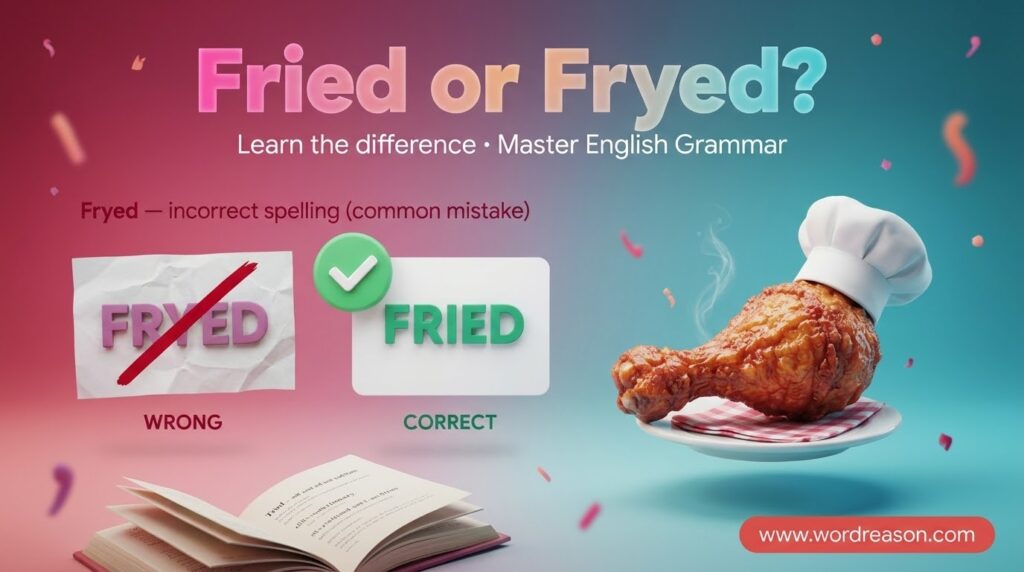
IF you ever typed a simple word, only to stop and wonder whether it is actually correct? The confusion between fryed or fried is a perfect example of how one tiny spelling mistake can leave even confident writers scratching their heads. At first glance, fryed may seem logical, especially when you think about adding -ed to a verb. However, English spelling has its own rules, and this little word is no exception! So, before your grammar takes an unexpected trip to the frying pan, let us clear up the confusion. Discover why fried is correct, why fryed is incorrect, and how to remember the difference effortlessly.
What Does Fried Mean?
Fried is the past tense and past participle of the verb fry. It describes the action of cooking food in hot oil or fat. It can also function as an adjective when you want to describe food prepared in this way.
For example, when you cook potatoes in hot oil, you fry them. Once they finish cooking, you can describe them as fried potatoes.
The word also appears in familiar food names, including fried chicken, fried rice, fried eggs, and fried fish.
Fried as a Verb
As a verb, fried tells you that someone completed the action of frying something in the past.
For example, you can say, I fried two eggs for breakfast. Similarly, She fried the potatoes until they turned golden brown describes an action that happened and finished in the past.
You can also use it in sentences such as We fried the fish in vegetable oil and My mother fried chicken for dinner yesterday.
In each example, fried describes a completed action.
Fried as an Adjective
Fried can also describe food that someone has cooked in hot oil or fat. In this role, it gives you more information about a noun.
For example, We ordered fried chicken at the restaurant describes the type of chicken. Likewise, She prefers fried eggs over boiled eggs uses fried to explain how someone prepared the eggs.
You can also write, The menu includes fried rice and grilled vegetables or He enjoyed the crispy fried potatoes.
Notice that fried does not always describe a past action. Sometimes, it simply tells you how someone prepared the food.
Learn the difference between confusing more English words
Tying or Tieing Which Spelling Is Correct?
What Does Fryed Mean?
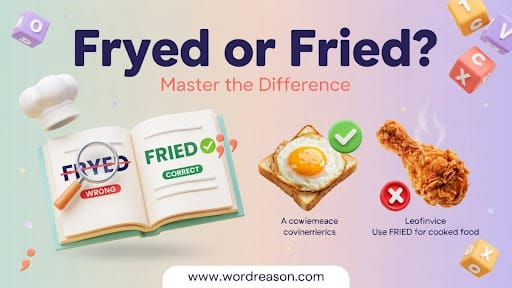
Fryed is a nonstandard spelling of fried. You may occasionally see it in informal writing, online comments, old documents, or spelling mistakes. However, standard modern English does not recognize it as the correct past tense or past participle of fry.
The confusion usually happens because writers try to form the past tense by adding -ed directly to the base verb. That method works for many regular verbs, but verbs ending in a consonant followed by y follow a different spelling rule.
For example, you write tried instead of tryed and carried instead of carryed. The same rule gives you fried instead of fryed.
Therefore, avoid fryed in school assignments, professional emails, articles, essays, and other standard writing.
Is Fryed Ever Correct?
No. Fryed is not the standard spelling of the past tense or past participle of fry.
You should use fried in both American and British English. Even if a search engine or social media post displays fryed, that does not make it an accepted spelling.
For clear and correct writing, always choose fried.
Learn the difference between confusing more English words
Reinforce vs Reenforce Which spelling Is Correct?
Why Is Fried the Correct Spelling?
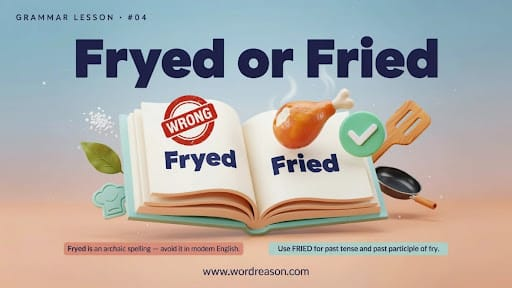
The spelling fried follows a common English rule for forming the past tense of verbs that end in a consonant followed by y.
When you add -ed to a verb with this ending, you usually change the final y to i before adding the suffix.
The spelling process is simple:
Fry + ed = Fried
The final y changes to i, and the verb takes the -ed ending. This creates fried, the correct past tense and past participle.
The same spelling pattern appears in several familiar verbs.
| Base verb | Correct past tense | Incorrect spelling |
|---|---|---|
| Fry | Fried | Fryed |
| Try | Tried | Tryed |
| Cry | Cried | Cryed |
| Carry | Carried | Carryed |
| Hurry | Hurried | Hurryed |
| Study | Studied | Studyed |
| Apply | Applied | Applyed |
As you can see, the pattern stays consistent. The final y changes to i before the verb takes -ed.
What Happens When a Verb Ends in a Vowel Plus Y?
There is one important difference to remember. When a verb ends in a vowel followed by y, you usually keep the y and add -ed.
For example, play becomes played, enjoy becomes enjoyed, and stay becomes stayed. The same pattern applies to employ and destroy, which become employed and destroyed.
This distinction explains why you write played but fried. The word play ends in a vowel plus y, while fry ends in a consonant plus y.
Do not apply the same spelling pattern to every word ending in y. Instead, check the letter immediately before the final y.
Learn the difference between confusing more English words
Discard vs Disgard Which Spelling Is Correct?
Fry Verb Forms: Fry, Fries, Fried and Frying
The verb fry changes its form depending on the tense and grammatical role in a sentence. Learning these forms will help you use the word correctly.
| Verb form | Correct spelling | Example |
|---|---|---|
| Base form | Fry | I fry eggs every morning. |
| Third-person singular | Fries | She fries potatoes for lunch. |
| Simple past | Fried | He fried the chicken yesterday. |
| Past participle | Fried | They have fried the fish. |
| Present participle | Frying | The onions are frying in the pan. |
The most important point is that both the simple past tense and past participle use fried. You do not need a separate spelling for either form.
Present Tense: Fry and Fries
Use fry with I, you, we, and they in the simple present tense.
For example, you can write, I fry eggs for breakfast, or They fry fish every Friday. The same form appears in We fry vegetables in olive oil.
However, use fries with he, she, and it.
For example, She fries potatoes for her children and He fries chicken at his restaurant are both correct. You can also write, The chef fries the vegetables before serving them.
Past Tense Fried
Use fried when an action happened and finished in the past.
For example, I fried an egg this morning describes a completed action. Similarly, She fried the onions before adding the tomatoes and They fried fresh fish for dinner both use the correct past-tense form.
Remember that fryed is not a correct alternative. The past tense always uses fried in standard English.
Past Participle Fried
The past participle usually appears with helping verbs such as has, have, and had. It can also appear in passive constructions.
For example, I have fried the eggs already” and “She has fried the chicken for lunch use fried correctly.
You can also write, They had fried the fish before the guests arrived or The potatoes have been fried in vegetable oil.
In these examples, fried helps form a perfect or passive verb construction.
Present Participle Frying
When you describe an action that is happening, add -ing to fry. Unlike the past-tense form, the present participle keeps the original y.
For example, She is frying an egg describes an action happening now. Similarly, The cook was frying potatoes and They are frying fish in a large pan” use the present participle correctly.
The correct spelling is frying, not friing or fried-ing.
Learn the difference between confusing more English words
Thiefs or Thieves Which Spelling Is Correct?
Fried or Fryed in American and British English
Some English words have different spellings in American and British English. For example, Americans often write color, while British writers usually use colour. Similarly, Americans prefer center, while British writers commonly use centre.
However, fried does not have this kind of regional variation.
Both American and British English use fried as the correct past tense and past participle of fry.
| English variety | Correct spelling | Incorrect spelling |
|---|---|---|
| American English | Fried | Fryed |
| British English | Fried | Fryed |
| Canadian English | Fried | Fryed |
| Australian English | Fried | Fryed |
You can use fried confidently regardless of which standard variety of English you follow.
Learn the difference between confusing more English words
Programming or Programing Which Spelling Is Correct?
Fried vs Deep Fried vs Pan Fried
Although these expressions contain the same word, they describe slightly different cooking methods. Understanding the distinction can help you use them accurately.
Fried is the general term. It describes food cooked in hot oil or fat. Deep-fried and pan-fried provide more specific information about how someone cooks the food.
| Term | Meaning | Example |
|---|---|---|
| Fried | Food cooked in hot oil or fat | Fried eggs |
| Deep-fried | Food fully or mostly submerged in hot oil | Deep-fried chicken |
| Pan-fried | Food cooked in a pan with a smaller amount of oil or fat | Pan-fried fish |
For example, a restaurant might offer fried chicken as a general menu item. If the chicken cooks while submerged in hot oil, deep-fried gives you a more specific description. If someone cooks it in a shallow layer of oil in a pan, pan-fried describes the method more accurately.
Therefore, all deep-fried and pan-fried foods are types of fried foods, but the terms do not describe exactly the same cooking technique.
Learn the difference between confusing more English words
Bellow or Below Which spelling Is Correct?
Common Mistakes When Using Fried
Even though fried is a familiar word, people sometimes misspell it or use the wrong verb form. A little attention can help you avoid these mistakes.
Writing Fryed Instead of Fried
This is the most common spelling mistake related to the word.
Incorrect I fryed an egg for breakfast.
Correct I fried an egg for breakfast.
The final y changes to i before the -ed ending. Therefore, fried is the standard spelling.
Using Fried Instead of Frying
Fried and frying have different grammatical uses.
Incorrect She is fried potatoes.
Correct She is frying potatoes.
Use frying when an action is happening. Use fried when you describe a completed action or food prepared by frying.
Using Fry Instead of Fries
The third-person singular form requires fries in the simple present tense.
Incorrect He fry eggs every morning.
Correct He fries eggs every morning.
The final y changes to i before adding -es. This gives you fries.
Confusing Different Meanings of Fried
The word fried can appear in different expressions. For example, fried food refers to food cooked in hot oil, while fried may also appear informally in expressions about exhaustion or mental overload.
Context helps you understand the intended meaning. Do not assume that every use of fried refers to cooking.
Learn the difference between confusing more English words
Customize or Customise Which Spelling Is Correct?
Everyday Examples of Fried in Sentences
Examples make spelling rules easier to understand. The following sentences show how you can use fried in everyday conversations and writing.
Examples Related to Cooking
I fried an egg before leaving for work.
My father fried fish for the family dinner.
She fried the potatoes until they became crispy.
Learn the difference between confusing more English words
Adress or Address Which Spelling Is Correct?
Examples in Everyday Conversation
Have you fried the eggs yet?
I fried some potatoes for everyone.
The food smelled delicious while it fried.
Learn the difference between confusing more English words
Cocoon vs Cacoon Which Spelling Is Correct?
How to Remember the Correct Spelling of Fried
If you often confuse fried and fryed, use a simple memory trick: change the y to i before adding -ed.
Think of fry as the starting point. When you describe the action in the past, replace y with i and add -ed.
Fry becomes fried.
You can also remember the pattern through similar words. Try becomes tried, cry becomes cried, dry becomes dried, carry becomes carried, and study becomes studied.
Once you recognize this pattern, you will find it easier to spell many other English verbs correctly.
Another helpful trick is to remember this short rule: consonant plus y changes to i before -ed. This simple reminder can save you from several common spelling mistakes.
Learn the difference between confusing more English words
Annual vs Anual Which Spelling Is Correct?
Fill in the Blanks
Complete each sentence with the correct word or verb form.
- I ______ an egg for breakfast yesterday.
- She has ______ chicken for dinner.
- He usually ______ potatoes in hot oil.
- The chef is ______ fish in the kitchen.
- We enjoyed the ______ rice at lunch.
- My mother ______ vegetables last night.
- They have ______ the potatoes already.
- He ______ eggs every morning.
- The children love ______ chicken.
- I am ______ some onions for the soup.
- She ______ fish for her guests yesterday.
- The restaurant serves ______ shrimp.
- We ______ potatoes for dinner last night.
- He is ______ an egg right now.
- My father has ______ fresh fish.
- She usually ______ chicken on Sundays.
- They were ______ vegetables when I arrived.
- I have never ______ a whole fish.
- The cook ______ the onions before adding the tomatoes.
- We ordered ______ potatoes at the restaurant.
- She is ______ rice for lunch.
- He ______ an egg yesterday morning.
- The chef has ______ the chicken perfectly.
- I prefer ______ eggs for breakfast.
- They ______ fish for dinner last night.
Answer Session
Check your answers after completing all 25 questions.
- Fried
- Fried
- Fries
- Frying
- Fried
- Fried
- Fried
- Fries
- Fried
- Frying
- Fried
- Fried
- Fried
- Frying
- Fried
- Fries
- Frying
- Fried
- Fried
- Fried
- Frying
- Fried
- Fried
- Fried
- Fried
Here’s a trusted source for clear word meanings:
Frequently Asked Questions
What Does Fryed Mean?
Fryed is a misspelling of fried. It is not standard English.
What Does I Am Fried Mean?
It means feeling extremely tired, mentally exhausted, or overwhelmed.
What Does Fried Mean in Slang?
In slang, fried means mentally drained, confused, or exhausted.
What Is Another Word for Fried?
Depending on the cooking method, alternatives include browned, crisped, or sautéed.
What Is the Difference Between Fry and Fried?
Fry is the base verb, while fried is its past tense and past participle.
What Is the Plural of Fry?
Fries is the plural for fried potato strips. Fry can also refer to a group of young fish.
AEO: Quick Answers
Is It Fryed or Fried?
Fried is correct. Fryed is incorrect.
How Do You Spell Fryed?
The correct spelling is fried.
What Is the Past Tense of Fry?
The past tense is fried.
What Is the Past Participle of Fry?
The past participle is fried.
What Is the Present Participle of Fry?
The present participle is frying.
What Is the Third-Person Form of Fry?
The correct form is fries.
Is Fryed Correct in American or British English?
No. Both use fried.
Can Fried Be a Verb and an Adjective?
Yes. It describes a past action or food cooked in oil.
conclusion
The next time you find yourself choosing between fryed and fried, remember that English spelling does not always follow the shortcuts we expect. Fried is the correct spelling, while fryed is a common mistake you should leave off your plate. The trick is simple: change the final y to i before adding -ed when a verb ends in a consonant followed by y. That is why fry becomes fried, try becomes tried, and cry becomes cried. Once you understand this little grammar rule, the confusion practically disappears. So, keep your spelling crispy, your grammar mistake-free, and remember: fried is always the right recipe for correct writing!

Bella AJS
Bella AJS is an experienced blogger and passionate language enthusiast at WordReason. She specializes in English grammar, word meanings, spelling, and commonly confused words. With a clear and practical writing style, Bella helps readers understand tricky language rules without the textbook headache. Her goal is simple: make English easier, clearer, and more enjoyable one word at a time.