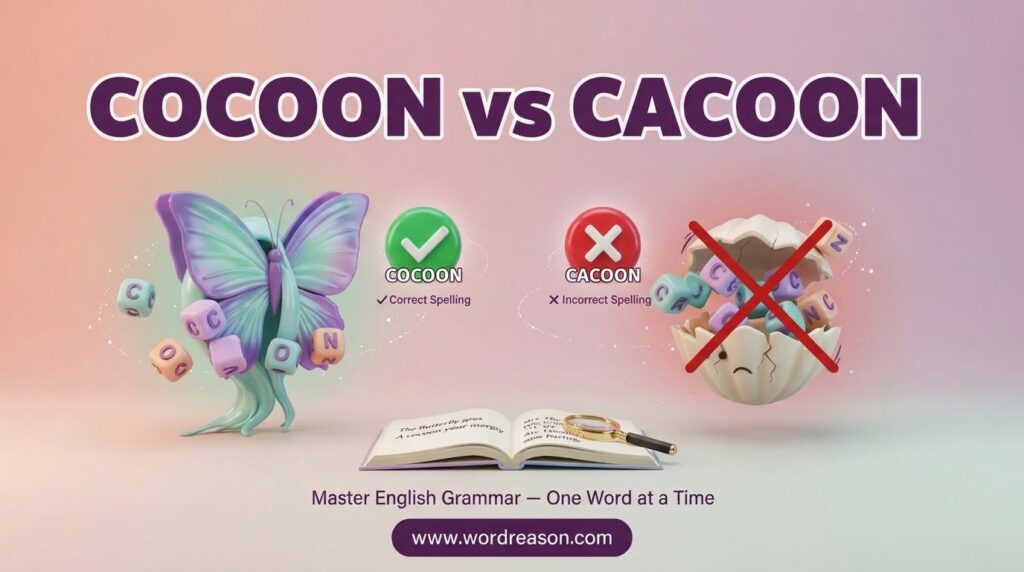
Cocoon vs Cacoon one tiny spelling mistake can turn a simple word into a surprisingly tricky puzzle! When comparing Cocoon vs Cacoon, the difference may look small, but choosing the wrong version can make your writing look careless. Is it cocoon, or has cacoon secretly become an accepted spelling? Before you let that extra letter create more confusion, here is the simple truth: only one is the standard English spelling. Whether you are describing the silky covering that protects a developing insect or using the word to express comfort and safety, knowing the correct form helps you write with confidence. Let’s unravel this spelling mystery!
Cocoon vs Cacoon Quick Answer
Cocoon is the correct spelling in standard English. Cacoon is an incorrect spelling that people sometimes use when they confuse the arrangement of letters.
The word cocoon describes a protective covering that certain insects produce around themselves during development. It can also refer to a comfortable, sheltered, or isolated place.
For example of Cocoon vs Cacoon
| Incorrect sentence | Correct sentence |
|---|---|
| The silkworm spun a protective cacoon. | The silkworm spun a protective cocoon. |
| I found a cacoon on the tree. | I found a cocoon on the tree. |
| She spent the afternoon in her cozy cacoon. | She spent the afternoon in her cozy cocoon. |
The difference is easy to remember. Cocoon contains the letter O after the first C, while cacoon uses A in that position.
Whenever you refer to an insect protective covering or a comfortable environment, use cocoon.
Learn the difference between confusing more English words
Emphasise or Emphasize which spelling is correct?
Cocoon vs Cacoon What Is the Difference?
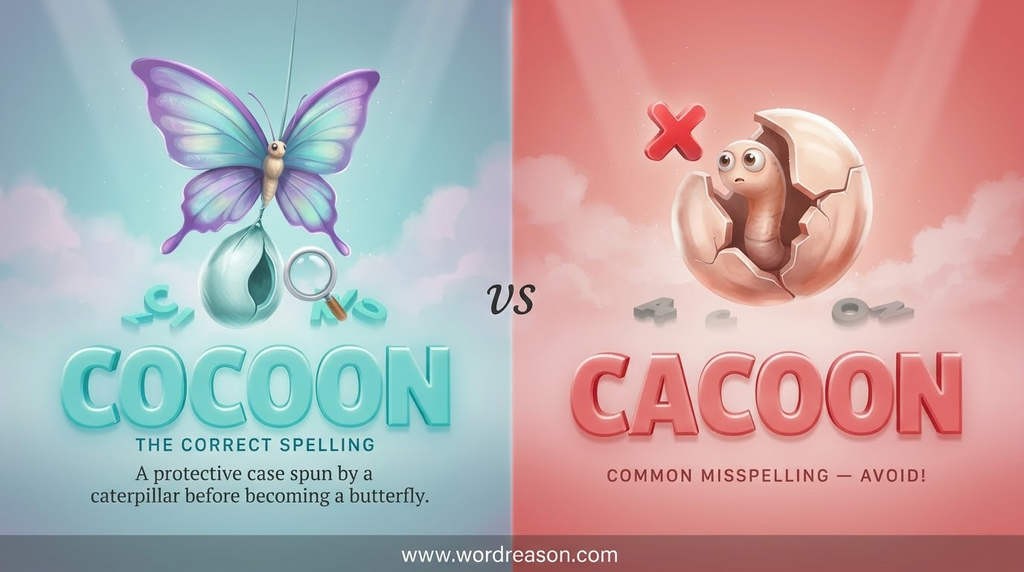
The cocoon vs cacoon may look like alternative spellings, but they do not have equal status in English.
The cocoon is a recognized word with established meanings and grammatical functions. It appears in standard dictionaries and works in both literal and figurative contexts.
Cacoon, on the other hand, is not an accepted standard spelling of this word. People generally write it because they remember how the word sounds but forget its correct letter arrangement.
Consider these examples
| Incorrect | Correct |
|---|---|
| The moth created a cacoon. | The moth created a cocoon. |
| The insect remained inside its cacoon. | The insect remained inside its cocoon. |
| She built a peaceful cacoon at home. | She built a peaceful cocoon at home. |
| The silkworm produces cacoon silk. | The silkworm produces cocoon silk. |
The important point is that this comparison concerns spelling, not two different grammatical forms. You cannot use cacoon as an alternative simply because the sentence is informal or conversational.
Is Cocoon vs Cacoon a Grammar, Vocabulary or Spelling Issue?
The difference between cocoon vs cacoon is primarily a spelling issue.
Spelling determines the correct arrangement of letters in a word. Grammar explains how that word functions within a sentence, while vocabulary concerns its meaning and use.
For example, cocoon is the correct spelling. Grammatically, it can function as a noun or a verb. Its vocabulary meaning includes a protective covering or a sheltered environment.
Understanding these distinctions helps you avoid confusing spelling mistakes with grammatical errors.
Formal vs Informal Usage
The spelling remains the same in formal and informal writing. You should always use cocoon.
However, the context can change its meaning.
In formal writing, cocoon commonly appears in discussions about insects, silk production, and biological development. In everyday conversation, people often use it to describe a peaceful or comfortable environment.
Consider these examples
Formal: The moth larva produces a protective cocoon before entering the pupal stage.
Informal: I love to cocoon myself in warm blankets during winter.
Both sentences use the word correctly. The difference lies in their tone and subject matter, not spelling.
Academic Usage
Academic writing requires accurate spelling and precise terminology. Students, researchers, and teachers should use cocoon when discussing insect development or silk production.
For example
“The silkworm produces a silk cocoon that protects the developing pupa.”
This sentence uses the word in its biological context. However, academic writers should also distinguish a cocoon from a chrysalis because the terms describe different structures.
Using the wrong spelling or biological term can make an otherwise accurate explanation confusing.
Learn the difference between confusing more English words
Totaling or Totalling? which spelling is correct?
What Does Cocoon Mean?
Cocoon has two main meanings in modern English. Its literal meaning describes a protective covering associated with certain insects. Its figurative meaning describes a safe, comfortable, or sheltered environment.
The word appears in biology, everyday conversations, literature, and descriptive writing. Understanding both meanings helps you use it naturally.
Cocoon as a Noun
As a noun, cocoon refers to a protective covering that certain insect larvae produce during their development.
Many moth caterpillars spin silk cocoons before entering the pupal stage. These structures surround the developing insect and provide protection during an important period of transformation.
Silkworms offer a familiar example. They produce silk fibers and wrap them around themselves to create cocoons.
The word also describes a comfortable or protected environment in everyday English.
Examples include the following sentences
The moth remained inside its cocoon during development.
The silkworm produced a thick silk cocoon.
Her bedroom became a peaceful cocoon during winter.
The small cabin provided a cozy cocoon away from the busy city.
The first two examples use the biological meaning. The last two use the figurative meaning.
Cocoon as a Verb
Cocoon also functions as a verb. It means to surround, enclose, or protect someone or something.
You can use it when describing physical protection or a persons decision to withdraw into a comfortable environment.
For example, she cocooned herself in a warm blanket. Similarly, thick curtains cocooned the room in darkness.
Consider these additional examples
He spent the weekend cocooned in his comfortable home.
The family cocooned themselves away from the winter cold.
The word follows regular English verb patterns.
| Verb form | Example |
|---|---|
| Cocoon | I like to cocoon myself in winter. |
| Cocoons | The protective covering cocoons the developing insect. |
| Cocooned | She cocooned herself in a blanket. |
| Cocooning | He enjoys cocooning at home during cold weather. |
Notice that the spelling changes slightly when you form different verb tenses, but the original word remains recognizable.
Cocoon in Compound Expressions
Cocoon can also appear in compound expressions that describe something resembling a protective covering.
One common example is cocoon like. The suffix like means resembling or having the qualities of something.
For example, a child might sleep in a cocoon-like sleeping bag. Similarly, soft blankets can create a cocoon-like atmosphere.
Writers use this expression to describe warmth, comfort, protection or isolation.
Learn the difference between confusing more English words
Tying or Tieing Which Spelling Is Correct?
Why Is Cocoon the Correct Spelling?
Cocoon is the correct spelling because it is the established form recognized in standard English dictionaries.
The spelling follows a specific letter pattern
C-O-C-O-O-N
The incorrect form changes the second letter from O to A, producing C-A-C-O-O-N.
That small difference creates a spelling mistake rather than a recognized alternative word.
There is no British or American spelling rule that allows writers to replace the O with an A in cocoon.
Why Do People Spell Cocoon as Cacoon?
Several factors can explain this confusion.
Pronunciation-based spelling is one common reason. People sometimes remember how a word sounds but struggle to recall its exact written form. Since the opening syllable has an unstressed vowel sound, some writers may choose the wrong letter.
Visual similarity also contributes. Both forms contain six letters and share most of the same sequence. As a result, the incorrect version may look familiar to someone who has seen it repeatedly.
Typing habits create another problem. If someone frequently writes cacoon, the incorrect form may become familiar through repetition.
Finally, autocorrect does not catch every mistake. Some tools may overlook unusual words, proper names, or errors that appear in a context they do not recognize.
The simplest solution is to remember the standard spelling and check unfamiliar words in a reliable dictionary.
Origin and History of the Word Cocoon
The history of cocoon connects the English language with French vocabulary and the natural process of insect development.
English borrowed the word from French cocon. Its older roots connect to Provençal words referring to a shell or eggshell.
The word entered English during the late seventeenth century. Initially, it described the protective silk covering that certain insect larvae produce before their pupal development.
As knowledge of insects and silk production expanded, cocoon became a familiar term in natural history and biology.
Its meaning later developed beyond the insect world. Writers began using it figuratively to describe a protected environment or a place where someone could withdraw from outside pressures.
Today, cocoon has several established uses. In biology, it describes a protective covering produced by certain insect larvae. In textile production, it refers to the silk structure produced by silkworms. Literature also uses the word as a metaphor for protection, isolation, and transformation.
The spelling has remained cocoon throughout its established English use. Cacoon does not have the same historical or dictionary standing.
Learn the difference between confusing more English words
Reinforce vs Reenforce Which spelling Is Correct?
British vs American English Is the Spelling Different?
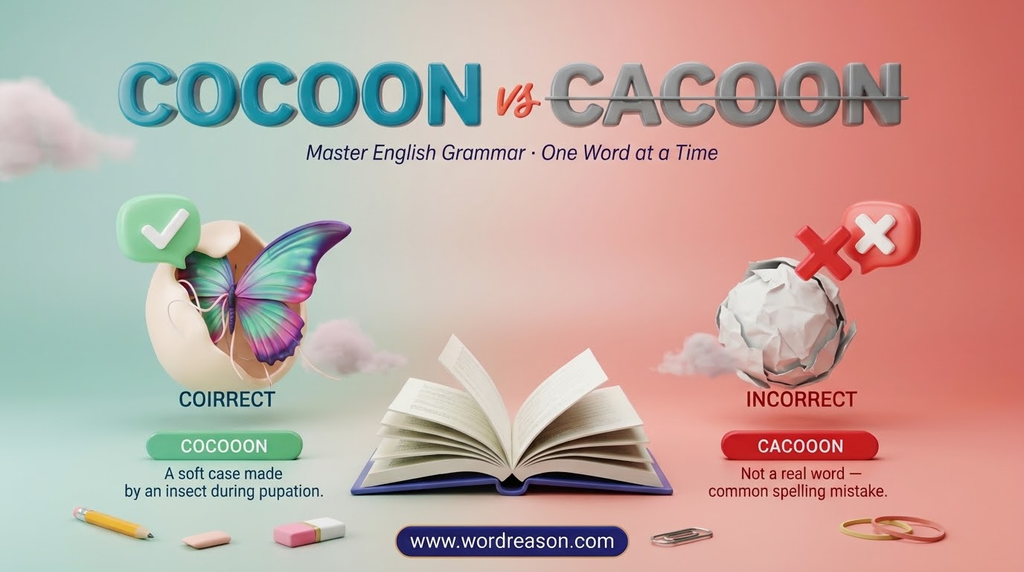
English contains several words with different British and American spellings. For example, British English generally uses colour, while American English uses color. Similarly, British writers often use organise, whereas organize is standard in American English.
However, cocoon does not follow this pattern.
Both British and American English use cocoon as the correct spelling. Neither variety recognizes cacoon as a standard alternative.
| Feature | British English | American English |
|---|---|---|
| Correct spelling | Cocoon | Cocoon |
| Incorrect spelling | Cacoon | Cacoon |
| Plural form | Cocoons | Cocoons |
| Noun usage | Yes | Yes |
| Verb usage | Yes | Yes |
| Figurative meaning | Yes | Yes |
Therefore, you do not need to change the spelling when writing for readers in different English-speaking countries.
Whether you are preparing a school assignment, research paper, business email, or blog post, cocoon remains correct.
How Do You Pronounce Cocoon?
Cocoon has two syllables and is commonly pronounced /kəˈkuːn/.
The stress falls on the second syllable. Its final sound rhymes with moon, spoon, and soon.
British and American English dictionaries give essentially the same standard pronunciation.
Pronunciation differences between individual speakers do not change the spelling. Even if someones accent affects the sound slightly, the written form remains cocoon.
Learn the difference between confusing more English words
Discard vs Disgard Which Spelling Is Correct?
How to Use Cocoon Correctly in Sentences
Knowing the correct spelling is important, but understanding how to use the word makes your writing more effective.
Cocoon appears in biological discussions, everyday conversations, literature, and professional communication. Its meaning depends on the surrounding words.
Cocoon in Biology and Nature
In biology, a cocoon is a protective structure that certain insect larvae produce around themselves.
Many moth caterpillars create silk coverings before entering the pupal stage. These structures help protect the developing insect from physical disturbance and some environmental conditions.
Silkworms provide one of the best-known examples. They produce silk from specialized glands and wrap the fibers around themselves to form a cocoon.
However, not every insect produces a cocoon. Some insects develop through different processes, and most butterflies form chrysalises rather than traditional silk cocoons.
For example, the moth caterpillar spun a protective cocoon. Silkworms produce cocoons containing valuable silk fibers. Researchers also examine cocoon structures under microscopes to understand insect development.
Cocoon in Everyday Conversation
In everyday English, cocoon often describes a peaceful environment where someone feels comfortable and protected.
You might use it when discussing a quiet home, a warm bedroom, or a relaxing personal space.
For example, you might say, I love cocooning myself in blankets on cold mornings.
Another natural example is, Her apartment feels like a warm cocoon.
This figurative meaning creates an image of warmth, comfort, and safety.
Cocoon in Literature and Descriptive Writing
Writers frequently use cocoon as a metaphor for protection, personal growth, and emotional comfort.
The comparison works because an insects development inside a cocoon represents a period of change.
For example
The quiet room became her cocoon as she recovered from a difficult year.
Here, cocoon describes a protected environment where someone can rest and regain confidence.
Consider another example
After moving to the countryside, he slowly emerged from his cocoon and began meeting new people.
The expression emerged from his cocoon suggests that someone has moved beyond isolation and started engaging with the outside world.
Writers can use this metaphor to communicate emotional safety, temporary isolation, personal development, and a peaceful environment for rest.
Cocoon in Business and Professional Writing
Although cocoon is more common in descriptive writing than in technical business language, it can still appear naturally in professional communication.
For example, a writer might describe a quiet office as a cocoon that helps employees concentrate.
“The redesigned workspace offers employees a quiet cocoon for focused work.”
Similarly, remote work might allow someone to create a peaceful environment away from unnecessary distractions.
However, choose the word carefully. In formal business writing, terms such as protected environment, private workspace, or isolated setting may communicate your meaning more precisely.
Cocoon in Emails, News Articles, and Social Media
The figurative meaning of cocoon makes it useful in digital communication. It can describe personal experiences, comfortable surroundings, and peaceful moments.
For example, an email might include the sentence, “Thank you for creating such a welcoming space. It felt like a little cocoon away from the busy office.”
A news article might describe how a small community became a cocoon of support during a difficult winter.
On social media, someone might write, “Rainy day, warm coffee, soft blankets, and my cozy cocoon!”
In a formal publication, the word might appear in a sentence such as, “The protective cocoon plays an important role in the development of several moth species.”
Each example uses the same correct spelling, even though the writing style and context change.
Learn the difference between confusing more English words
Thiefs or Thieves Which Spelling Is Correct?
Cocoon vs Chrysalis Are They the Same Thing?
People sometimes use cocoon and chrysalis interchangeably when discussing insect development. However, these terms describe different biological structures.
A cocoon is a protective covering that certain insect larvae produce around themselves. A chrysalis is the pupal stage of a butterfly. It develops when a butterfly caterpillar sheds its final larval skin and enters the pupal stage.
The distinction matters because most butterflies do not produce traditional silk cocoons. Instead, their caterpillars develop into chrysalises.
| Feature | Cocoon | Chrysalis |
|---|---|---|
| Definition | Protective covering produced by certain insects | Pupal stage of a butterfly |
| Common association | Many moths | Butterflies |
| Structure | Often made of silk | The insects pupal covering |
| Purpose | Protects the developing insect | Contains the developing butterfly |
| Silk production | Common in many species | Does not usually involve a complete silk cocoon |
| Development | Surrounds the pupa in certain insects | Develops directly from the caterpillars final molt |
Do Butterflies Make Cocoons?
Most butterflies do not make traditional silk cocoons. Instead, their caterpillars develop into chrysalises.
For example, a monarch caterpillar attaches itself to a suitable surface before hanging in a characteristic position. It then sheds its final larval skin and forms a green chrysalis.
Inside the chrysalis, the insect undergoes the biological changes required to become an adult butterfly.
Moths commonly produce cocoons, although their methods and structures vary between species.
Remember the distinction: many moths form cocoons, while most butterflies develop inside chrysalises. A cocoon is a protective covering, whereas a chrysalis is the pupal stage of a butterfly.
Learn the difference between confusing more English words
Programming or Programing Which Spelling Is Correct?
What Is Inside a Cocoon?
A cocoon may look like a simple bundle of silk from the outside. However, the developing insect inside goes through an important biological process.
Depending on the species, the cocoon contains a pupa or protects an insect during its transition from the larval stage to adulthood.
The complete metamorphosis life cycle generally includes four stages.
| Stage | What happens |
|---|---|
| Egg | The insect begins life inside an egg. |
| Larva | The egg hatches, and the young insect feeds and grows. |
| Pupa | The insect undergoes major developmental changes. Some species form cocoons around the pupa. |
| Adult | The mature insect emerges, completing its transformation. |
How Do Caterpillars Make Cocoons?
Certain caterpillars produce silk through specialized glands. They release a liquid silk material that hardens into fine fibers when exposed to air.
The caterpillar moves its head and body repeatedly, laying down silk strands until it creates a protective covering.
The resulting structure can differ in thickness, shape, color, and texture depending on the species.
Silkworms provide a familiar example. Their cocoons consist of silk fibers that humans can process to produce natural silk.
Learn the difference between confusing more English words
Bellow or Below Which spelling Is Correct?
Cocoon in Silk Production Why Is It Important?
Cocoon has a special connection to the textile industry because silkworm cocoons provide the raw material for natural silk.
The domesticated silkworm, scientifically known as Bombyx mori, produces a cocoon made from a continuous silk filament. Sericulture, the practice of raising silkworms for silk production, uses these cocoons to obtain silk fibers.
The basic silk production process involves several steps. Farmers first raise silkworm larvae, commonly feeding them mulberry leaves. Mature larvae then spin protective silk coverings. Producers collect suitable cocoons and unwind their silk filaments through a process called reeling. Finally, manufacturers prepare the fibers for weaving and other textile applications.
A single silkworm cocoon can contain a continuous silk filament hundreds of meters long. The exact length varies according to the silkworm and cocoon.
This connection makes cocoon an important word in biology, agriculture, and textile production.
Learn the difference between confusing more English words
Customize or Customise Which Spelling Is Correct?
Common Spelling Mistakes with Cocoon vs Cacoon
Even though cocoon has a straightforward spelling, people sometimes make mistakes when writing it. Most errors happen because the word is unfamiliar or someone relies too heavily on pronunciation.
Here are some common mistakes and ways to avoid them.
Writing Cacoon Instead of Cocoon
This is the main spelling mistake in this comparison.
| Incorrect | Correct |
|---|---|
| The insect formed a cacoon. | The insect formed a cocoon. |
| I found a cacoon on the tree. | I found a cocoon on the tree. |
| The silkworm produces cacoon silk. | The silkworm produces cocoon silk. |
| The moth emerged from its cacoon. | The moth emerged from its cocoon. |
The correction is simple: Replace the A with an O.
Confusing Cocoon With Similar Sounding Words
Some English words have similar sounds but different meanings and spellings. This can make unfamiliar vocabulary difficult to remember.
Cocoon has a recognizable double-O pattern near the end.
Compare these words:
| Word | Meaning |
|---|---|
| Cocoon | A protective insect covering |
| Cartoon | An illustrated drawing or animated production |
| Balloon | An inflatable object |
| Baboon | A type of Old World monkey |
These words have different meanings, but their similar endings can help you remember the spelling of cocoon.
Singular and Plural Forms of Cocoon
The plural form of cocoon is cocoons.
English generally forms the plural of regular nouns by adding -s. Cocoon follows this rule without changing its original spelling.
For example, one cocoon might hang from a branch, while several cocoons might be collected for examination.
| Form | Correct spelling | Example |
|---|---|---|
| Singular | Cocoon | A cocoon hung from the branch. |
| Plural | Cocoons | The cocoons were collected. |
Avoid writing cacoons when you mean the plural of cocoon. The correct form is cocoons.
Possessive Forms Cocoons and Cocoons
Possessive forms show ownership or association. However, the placement of an apostrophe depends on whether the noun is singular or plural.
For a single cocoon, the possessive form is cocoon followed by an apostrophe and s.
Example: The cocoon’s outer layer protected the developing insect.
For multiple cocoons, place the apostrophe after the final s.
Example: The cocoons’ silk fibers were examined by researchers.
The apostrophe placement changes according to whether the noun is singular or plural.
Cocoon vs Cacoon Examples in Everyday Writing
Understanding the spelling difference becomes easier when you see how the word works in different situations.
The following examples demonstrate how to use cocoon naturally while avoiding the incorrect form.
| Context | Correct example |
|---|---|
| Biology | The caterpillar formed a cocoon before entering the pupal stage. |
| Education | Students studied the structure of a silkworm cocoon. |
| Workplace | The quiet office felt like a cocoon away from distractions. |
| Thank you for creating such a welcoming and comfortable space. | |
| Literature | She slowly emerged from her cocoon of isolation. |
| Social media | Spending the weekend in my cozy cocoon. |
| News | The community became a cocoon of support during difficult times. |
A Practical Example Correcting a Spelling Mistake
Consider a biology student preparing a report about the silkworm life cycle.
In the first draft, the student writes:
“The silkworm produces a cacoon before becoming an adult moth. The cacoon protects the insect during its transformation.”
Although readers can understand the intended meaning, both uses of cacoon contain a spelling error.
After checking the spelling, the student revises the paragraph:
“The silkworm produces a cocoon before becoming an adult moth. The cocoon protects the insect during its transformation.”
The corrected version follows standard English spelling.
This example highlights an important lesson. A spelling mistake can appear several times in one paragraph, and repeating an incorrect spelling does not make it correct. Checking unfamiliar vocabulary helps improve writing accuracy.
Context helps readers understand a word, but it does not make an incorrect spelling acceptable.
Learn the difference between confusing more English words
Adress or Address Which Spelling Is Correct?
How to Remember the Correct Spelling of Cocoon
Remembering cocoon becomes easier when you focus on its letter pattern rather than relying only on pronunciation.
Use the Double-O Memory Trick
The easiest way to remember cocoon is to focus on the double O.
The word contains two consecutive O letters near the end:
CO + COON = COCOON
Whenever you think about the protective covering made by a silkworm, remember the double O.
Connect Cocoon With Moon
Another useful technique is to connect cocoon with moon.
Both words share the same ending sound. Cocoon rhymes with moon, spoon, and soon.
You can remember the spelling by thinking about the relationship between cocoon and moon. A silkworm creates a cocoon, and the word ends with the same sound as moon.
Remember Its Biological Meaning
Visual memory can also help.
Picture a silkworm surrounded by its white silk covering. When you connect that image with the word cocoon, the correct spelling becomes easier to recall.
Practice With These Sentences
Read the following examples and pay attention to the spelling.
“The caterpillar formed a cocoon.”
“The silkworm produced several cocoons.”
“The moth emerged from its cocoon.”
“She wrapped herself in a cozy cocoon of blankets.”
Repeated exposure to correctly spelled words helps strengthen your vocabulary.
Cocoon vs Cacoon Final Comparison Table
If you need a quick reference, the following table summarizes the important differences.
| Feature | Cocoon | Cacoon |
|---|---|---|
| Spelling status | Correct | Incorrect |
| Standard English word | Yes | No |
| Meaning | Protective covering or sheltered environment | No established standard meaning |
| Part of speech | Noun and verb | Not a standard English word |
| Biological usage | Yes | No |
| Figurative usage | Yes | No |
| British English | Correct | Incorrect |
| American English | Correct | Incorrect |
| Plural form | Cocoons | Not applicable |
| Recommended usage | Yes | No |
One small exception deserves attention Cacoon may appear as a proper name, brand name, or stylized product name. A company might choose an unconventional spelling for branding purposes.
That does not make cacoon an accepted alternative spelling of the ordinary English word cocoon. Proper names follow their owners chosen spellings, while standard vocabulary follows established spelling conventions.
Fill in the Blanks
Complete the following sentences with the correct words.
- The correct spelling is __________.
- __________ is an incorrect spelling of cocoon.
- A cocoon protects certain insects during their __________.
- A cocoon is often __________ or capsule-shaped.
- The word cocoon contains two consecutive __________ letters.
- A butterfly develops inside a __________.
- Many moth caterpillars spin __________ cocoons.
- A cocoon provides __________ to a developing insect.
- The plural form of cocoon is __________.
- Cocoon is a __________ in standard English.
- The word cocoon has __________ letters.
- The pronunciation of cocoon has __________ syllables.
- The stress in cocoon falls on the __________ syllable.
- A cocoon can be made from __________.
- A silkworm produces a __________ cocoon.
- A butterfly chrysalis is part of its __________ cycle.
- Cocoon can also be used as a __________.
- The past tense of cocoon is __________.
- Cocooning can describe staying in a comfortable and __________ place.
- A cocoon is not the same as a butterfly __________.
- The correct spelling has double __________ near the end.
- Certain insect larvae create cocoons before becoming __________.
- The word cocoon can describe a feeling of safety and __________.
- Cacoon should be avoided in __________ writing.
- Cocoon rhymes with the word __________.
Answer Session
- Cocoon
- Cacoon
- Development
- Oval
- O
- Chrysalis
- Silk
- Protection
- Cocoons
- Word
- Six
- Two
- Second
- Silk
- Silk
- Life
- Verb
- Cocooned
- Protected
- Chrysalis
- O
- Adults
- Comfort
- Formal
- Moon
Here’s a trusted source for clear word meanings:
FAQs
What Is the Meaning of Cacoon?
Cacoon is an incorrect spelling of cocoon.
How Do You Spell Butterfly Cocoon?
The correct spelling is butterfly cocoon.
What Shape Is a Cocoon?
A cocoon is usually oval or capsule-shaped.
What Is the Use of a Cocoon?
A cocoon protects certain insects during their development.
What Does Cocoon Mean in Slang?
It means staying in a comfortable, private or protected space.
Can Two Butterflies Be in the Same Cocoon?
No. Butterflies generally develop individually inside their own chrysalises.
What Is Another Name for a Butterfly Cocoon?
Chrysalis is the term for the butterfly pupal stage.
Are Cocoon Dresses Flattering?
Yes. Their loose, rounded shape can create a relaxed and stylish look.
AEO Questions
Is It a Cocoon vs Cacoon?
Cocoon is the correct spelling; cacoon is incorrect.
Is Cocoon Spelled Correctly?
Yes, cocoon is the standard English spelling.
What Is Cocoon in Simple Words?
A cocoon is a protective covering made by certain insects.
What Is Another Name for Cocoon?
A protective covering or silk case can describe a cocoon.
conclusion
Just like that, the Cocoon vs Cacoon confusion has come out of its shell! The correct spelling is cocoon, with a double O, while cacoon is simply a common misspelling. Although the two forms may sound alike, only one belongs in standard English. Whether you are describing a silken shelter for a developing insect or a peaceful place where someone feels safe and comfortable, cocoon is the word to remember. Here is a little trick to keep it straight: cocoon rhymes with moon, and both share that memorable double O. So, the next time this spelling puzzle appears, you will not have to guess. Choose cocoon, write with confidence, and let that tiny spelling mistake fly away!

Bella AJS
Bella AJS is an experienced blogger and passionate language enthusiast at WordReason. She specializes in English grammar, word meanings, spelling, and commonly confused words. With a clear and practical writing style, Bella helps readers understand tricky language rules without the textbook headache. Her goal is simple: make English easier, clearer, and more enjoyable one word at a time.