

IF you ever told someone to look bellow when you actually meant below? That tiny spelling slip can turn a simple instruction into a noisy surprise! The confusion between Bellow or Below is common because these words look almost identical, yet their meanings are worlds apart. One describes a loud shout or deep roar, while the other points to a lower position, level, or amount. So, which spelling belongs in your sentence? Do not let one extra letter create a grammar blunder. In this guide, you will discover their meanings, differences, correct usage, and practical examples to keep your writing clear and confident.
Bellow or Below Quick Answer
The correct choice depends on what you want to express. Both words are valid English spellings, but they serve different purposes.
It means to shout loudly, roar or produce a deep and powerful sound. You can use it to describe an angry person, an excited crowd, or an animal making a loud noise. It also works as a noun when you want to identify the sound itself.
Below means at a lower physical position, level, rank, or amount. It commonly appears when discussing locations, temperatures, measurements, standards, and written information.
Consider these examples
| Sentence | Correct Word | Reason |
|---|---|---|
| The angry customer began to bellow at the manager. | Bellow | Describes loud shouting. |
| The temperature dropped below freezing. | Below | Describes a lower temperature. |
| Please find the details below. | Below | Refers to information farther down. |
| A deep bellow echoed through the forest. | Bellow | Identifies a loud, deep sound. |
The easiest way to remember the difference is to associate this with a loud voice and below with a lower position.
Learn the difference between confusing more English words
Fiend or Feen Which Spelling Is Correct?
What Does Bellow Mean?

The word describes a loud, deep, and often powerful sound. As a verb, it means to shout, roar, or call out in a forceful voice. As a noun, it refers to the loud sound itself.
People commonly bellow when they feel angry, excited, frustrated, or desperate to get someone attention. Animals can also bellow when they communicate through deep, powerful vocal sounds.
Unlike ordinary speaking, bellowing involves considerable volume. Imagine a teacher trying to get the attention of students in a noisy classroom. Instead of speaking normally, the teacher might bellow, Everyone, settle down!
The word often suggests a rough, booming, or forceful quality rather than simply a high volume. Dictionaries also recognize its use for loud animal sounds, particularly the deep roar of a bull. definition in the Cambridge English Dictionary+1
Bellow as a Verb
As a verb, It describes the action of making a loud, deep sound. It often appears in situations involving shouting, anger, excitement, or strong emotions.
For example, an angry driver might bellow at another motorist after a dangerous turn. Similarly, a coach might bellow instructions from the sidelines during an important match.
Here are more examples
The angry driver began to bellow at the traffic officer.
The coach bellowed instructions from the sidelines.
A frightened man bellowed for help.
The bull bellowed loudly when the farmer approached.
The father bellowed his sons name across the playground.
The captain bellowed orders during the emergency.
Notice how the word adds intensity to each sentence. A person who speaks simply communicates information, while someone who bellows delivers it with considerable force.
You can also use different grammatical forms of the verb.
| Verb Form | Example |
|---|---|
| Base form: Bellow | Do not bellow at your coworkers. |
| Third person singular: Bellows | The bull bellows when disturbed. |
| Past tense: Bellowed | The man bellowed in frustration. |
| Present participle: Bellowing | The children heard someone bellowing outside. |
These forms follow the regular English verb pattern. Add s, ed, or ing when the sentence requires a different tense or grammatical form.
Bellow as a Noun
Although people often use bellow as a verb, it also functions as a noun. In this form, it describes a loud, deep shout, roar, or cry.
For example, a sudden bellow might interrupt a quiet meeting. An angry bellow could frighten children, while an animal bellow might echo across an open field.
Consider these sentences
A terrifying bellow came from the dark forest.
His angry bellow silenced the entire room.
We heard a loud bellow from the nearby farm.
The actor delivered his final line with a powerful bellow.
Here, bellow names the sound rather than describing the action of producing it.
Compare these two examples
The man began to bellow. The word functions as a verb because it describes an action.
The man released a loud bellow. The word functions as a noun because it identifies the sound.
This distinction matters because English frequently allows the same word to perform different grammatical jobs.
Bellows The Related Noun Form
The word bellows has another meaning worth understanding. A bellows is a device that pushes air through a narrow opening. Traditional blacksmiths and fireplace users have relied on bellows to supply oxygen to fires.
For example, a blacksmith might use bellows to strengthen the fire inside a forge. Similarly, an old fireplace might have a hand-operated bellows beside it.
The word also describes a folding air chamber used in certain musical instruments and mechanical equipment.
A bellows can help a blacksmith keep a fire burning.
My grandfather kept an old fireplace bellows beside the hearth.
The musician repaired the bellows of the traditional instrument.
There is a grammatical detail worth remembering here. Bellows can refer to the air-blowing device, which has the same form in singular and plural constructions. For example, you can say a bellows or a pair of bellows. This use is different from the regular verb form bellows, as in The bull bellows.
Learn the difference between confusing more English words
Enquiries or Inquiries Which Spelling Is Correct?
What Does Below Mean?

The word below refers to something at a lower physical position, level, amount or rank. It helps you describe where something is located or how one measurement compares with another.
Unlike bellow, which relates to sound, below generally expresses position or comparison.
For example, a basement sits below the ground floor. A temperature of 5 degrees is below 10 degrees. Likewise, a student whose score falls below the required mark has not reached the expected standard.
The word appears frequently in everyday conversations, academic writing, reports, instructions, and professional communication.
Here are some examples
The village lies below the mountains.
Her test score was below average.
Please find the details below.
The temperature dropped below zero.
The submarine traveled below the surface.
His performance fell below expectations.
In each example, below communicates a lower position, measurement or standard.
Below as a Preposition
A preposition connects a noun or pronoun to another part of a sentence. IT works as a preposition when it introduces something at a lower position or level.
For example, consider the sentence The basement is below the kitchen. Here, below connects the basement with the kitchen and describes their relative positions.
Other examples include
The airplane flew below the clouds.
The temperature remained below freezing.
The village stands below sea level.
Her name appears below the heading.
The parking garage is below the shopping center.
In these sentences, below introduces a reference point. It tells you where something is located or how its level compares with another point.
An important grammar distinction is that below does not always mean directly underneath. It can describe something at a lower level without placing it immediately beneath another object.
For instance, a village may sit below a mountain even if a river, road, or open field separates the two.
Below as an Adverb
An adverb modifies a verb, adjective, or another adverb. Below can function as an adverb when it describes a lower location without introducing a noun immediately afterward.
Consider these examples
The apartment downstairs is directly below.
Please scroll below to find the answer.
The instructions are listed below.
The birds flew high above while the boats remained below.
The temperature dropped several degrees below.
In these sentences, below provides additional information about position or direction.
The difference between its prepositional and adverbial uses depends on sentence structure.
| Grammatical Function | Example | Explanation |
|---|---|---|
| Preposition | The cat slept below the table. | Below introduces the noun phrase the table. |
| Adverb | The cat slept below. | Below describes the cat location without an object immediately following it. |
Understanding this distinction will help you recognize how below works in different sentence structures.
Common Expressions With Below
You will frequently encounter below in familiar expressions and everyday English. Learning these phrases can improve your grammar and make your writing sound more natural.
| Expression | Meaning | Example |
|---|---|---|
| Below average | Lower than the usual standard | His performance was below average. |
| Below zero | A temperature lower than zero | The temperature fell below zero overnight. |
| Below sea level | Lower than the average sea surface | Some coastal areas lie below sea level. |
| Below the surface | Underneath the outer layer | The problem runs deeper below the surface. |
| Below expectations | Worse than expected | Sales remained below expectations. |
| Below the line | Under a particular line or boundary | Write your answer below the line. |
| Below the limit | Less than an established maximum | The reading stayed below the limit. |
| Please see below | Look at the information farther down | Please see below for further details. |
These expressions show why below is such a useful word in English. It describes physical locations, numerical comparisons, written directions, and abstract levels.
Learn the difference between confusing more English words
Creator vs Creater Which Spelling Is Correct?
Key Differences
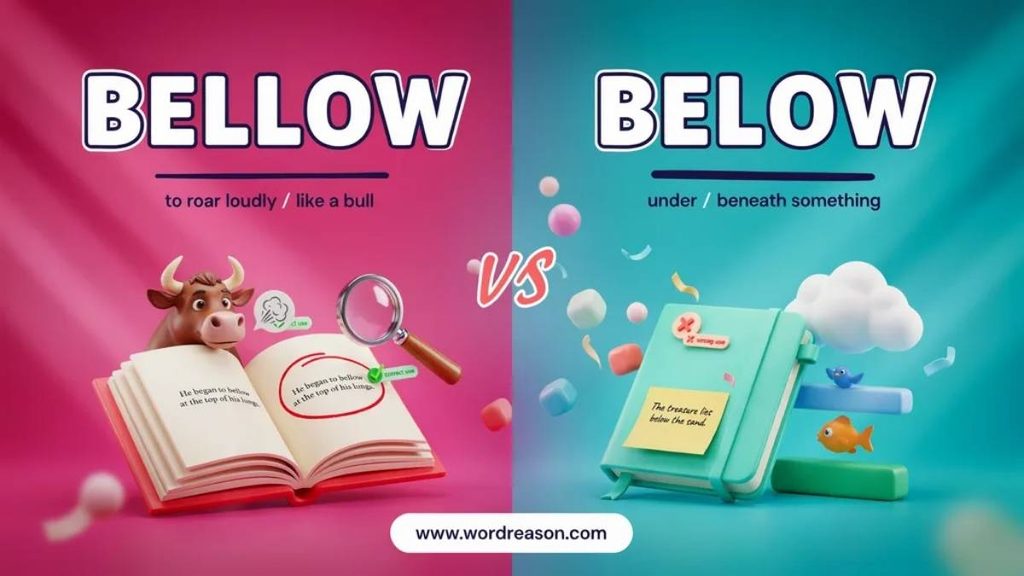
At first glance, they look like minor spelling variations of the same word. However, their meanings, pronunciation, and grammatical functions make them quite different.
Their meaning distinction becomes easier once you understand what each word communicates. One describes a sound, while the other describes a position or comparison.
Here is a closer look at their main differences.
| Feature | Bellow | Below |
|---|---|---|
| Meaning | A loud, deep shout or roar | A lower position or level |
| Part of speech | Verb and noun | Preposition and adverb |
| Main purpose | Describes loud sounds | Describes position, direction, or comparison |
| Human usage | Bellow in anger or excitement | Stand below someone |
| Animal usage | A bull may bellow | An animal may live below a mountain |
| Writing usage | Describes a loud voice | Directs readers to information farther down |
| Example | The man began to bellow. | Look at the chart below. |
Below or Bellow Difference in Meaning
The most important difference concerns the action or situation each word describes.
Bellow focuses on sound. It tells you that someone or something produces a loud, deep noise. You might hear a person bellow during an argument or an animal bellow across an open field.
Below, on the other hand, focuses on position or comparison. It tells you that something exists at a lower point, level, or amount.
Compare these sentences
The soldier began to bellow orders. He shouted loudly.
The soldier stood below the balcony. He occupied a lower position.
The first sentence describes an action, while the second describes a location. Changing one word to the other completely changes the meaning.
Difference Between Below and Bellow in Grammar
Their grammatical roles also help distinguish them.
Bellow functions as a verb or noun. As a verb, it describes the action of shouting or roaring. As a noun, it identifies the sound itself.
Below functions as a preposition or adverb. It describes where something is located or how one value compares with another.
For example
The manager bellowed at the workers. This is a verb.
A sudden bellow interrupted the meeting. This is a noun.
The garage is below the apartment. This is a preposition.
The information is provided below. This is an adverb.
Understanding these grammatical functions makes it easier to recognize the correct word, even when you encounter an unfamiliar sentence.
Learn the difference between confusing more English words
Emphasise or Emphasize which spelling is correct?
When to Use this
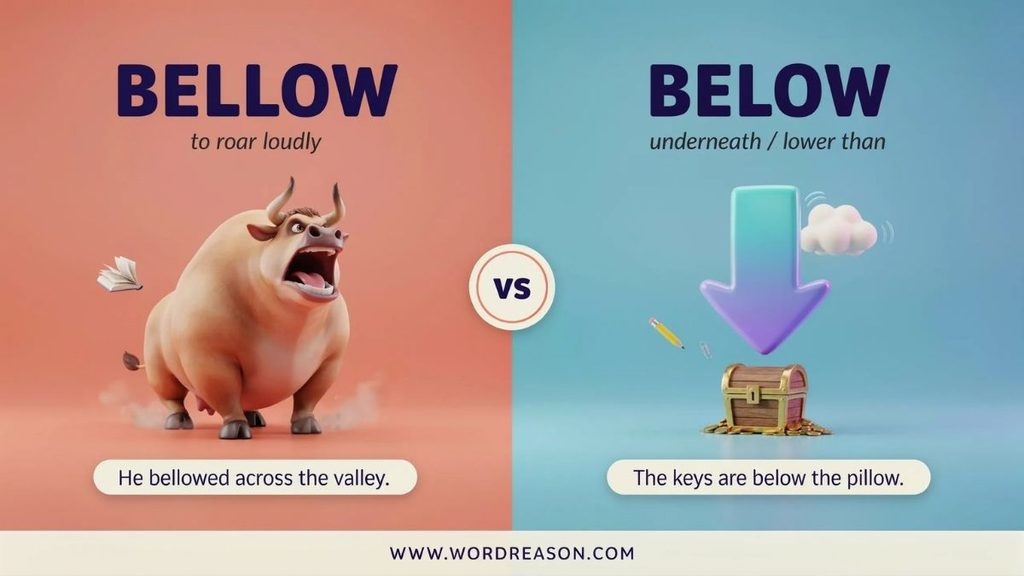
Choosing between these words becomes simple when you focus on the intended meaning. Instead of memorizing complicated grammar rules, ask yourself one question: Am I describing a loud sound or something at a lower level?
If you are describing a loud, deep voice, choose bellow. If you are describing a lower position, amount, or level, choose below.
When to Use Bellow
Use bellow when someone or something makes a loud, deep, and forceful sound.
It works particularly well in storytelling, descriptive writing, conversations, and situations involving strong emotions.
For example, use bellow when describing angry shouting, calling someone from a distance, animal sounds, forceful instructions, or an excited crowd.
The frustrated customer began to bellow at the cashier.
She bellowed her brothers name across the street.
The bull bellowed when the farmer approached.
The coach bellowed orders from the sidelines.
The fans bellowed with excitement after the winning goal.
You can also use bellow as a noun when referring to the sound itself.
For example, “A deep bellow echoed through the stadium.”
In descriptive writing, this word adds emotion and intensity. It helps readers imagine a voice that is much louder and deeper than ordinary speech.
When to Use Below
Use below when you want to describe something at a lower physical position, measurement, amount, or standard.
It appears in many everyday situations, including directions, weather reports, academic discussions, business documents, and comparisons.
The parking area is below the shopping center.
The temperature fell below freezing.
The water level dropped below the marked line.
Her score was below the class average.
Please see the examples below.
The price is below the market average.
Several coastal areas lie below sea level.
Remember that below does not always describe physical distance. It can also indicate a lower level of quality, performance, rank, or value.
For example, a business may earn below its expected revenue. No physical object needs to sit underneath anything. The word simply expresses an amount lower than the expected figure.
Learn the difference between confusing more English words
Totaling or Totalling? which spelling is correct?
Bellow or Below in Sentences Common Mistakes and Corrections

Spelling mistakes often happen when two words look similar and readers type one without considering its meaning. The bellow vs below confusion is a perfect example.
Fortunately, practical comparisons can help you recognize the correct spelling and avoid these mistakes.
Please See Below or Please See Bellow
Incorrect: Please see the instructions bellow.
Correct: Please see the instructions below.
The sentence directs readers to information located farther down the page, document, or message. Therefore, below is the correct word.
This expression is especially common in professional emails, reports, articles, and online instructions.
For example, Thank you for your message. Please see below for the requested information.
Using bellow here would introduce an unrelated meaning involving a loud shout.
Bellow or Below When Describing Loud Sounds
Incorrect: The crowd started to below in excitement.
Correct: The crowd started to bellow in excitement.
The sentence describes people making loud vocal sounds. Since bellow means to shout or roar loudly, it expresses the intended action.
Here are two more examples.
Incorrect The coach belowed at the players.
Correct The coach bellowed at the players.
Incorrect The angry man started belowing.
Correct The angry man started bellowing.
Notice that bellowed and bellowing follow regular verb patterns.
Learn the difference between confusing more English words
Tying or Tieing Which Spelling Is Correct?
His Voice Was a Low Bellow or Below
Correct His voice was a low bellow as he read the notes.
Incorrect His voice was a low below.
In this sentence, bellow functions as a noun. It identifies the deep, loud sound of the persons voice.
The adjective low describes the sounds pitch or quality. Together, these words create a clear picture of a deep, booming voice.
Temperatures Fell Below Zero or Bellow Zero
Incorrect Temperatures fell bellow zero.
Correct Temperatures fell below zero.
The sentence describes a temperature lower than zero. Therefore, below is the correct choice.
This expression appears frequently in weather reports, scientific explanations, and everyday conversations.
For example, The temperature dropped below zero during the night, so the roads became icy.
Other Commonly Confused Bellow and Below Examples
Here are additional examples to help you understand correct word usage.
| Incorrect or Correct | Sentence | Explanation |
|---|---|---|
| Incorrect | The dog began to below at strangers. | Use bellow for a loud sound. |
| Correct | The dog began to bellow at strangers. | Describes a loud vocal sound. |
| Incorrect | The answer is written bellow. | Use below for a lower location. |
| Correct | The answer is written below. | Refers to information farther down. |
| Incorrect | The water level dropped bellow the limit. | Use below for a lower measurement. |
| Correct | The water level dropped below the limit. | Describes a lower level. |
| Incorrect | The man let out a loud below. | Use bellow as a noun. |
| Correct | The man let out a loud bellow. | Identifies a deep, loud sound. |
One useful habit is to read your sentence again before submitting it. If the sentence describes a position or amount, check for below. If it describes a powerful sound, check for bellow.
Learn the difference between confusing more English words
Reinforce vs Reenforce Which spelling Is Correct?
Bellow and Below in Everyday English
Although these words have different meanings, both appear in ordinary English. You may encounter them in conversations, workplace communication, stories, educational materials, and news reports.
However, their contexts rarely overlap.
Bellow in Conversations and Writing
People use bellow when they want to describe a powerful voice or loud sound. It often appears in situations involving anger, excitement, urgency, or animals.
For example, a father might bellow when he discovers a broken window. A coach might bellow instructions during a match, while a bull might produce a deep bellow in a field.
Here are some additional examples.
The father bellowed when he discovered the broken window.
A deep bellow came from the bull in the field.
The coach bellowed instructions during the final minutes of the match.
The audience let out a collective bellow of excitement.
The teacher bellowed to get everyones attention.
Writers also use the word to create vivid scenes. Instead of saying that a character spoke loudly, they can write that the character bellowed. This gives readers a stronger sense of volume and emotion.
Nevertheless, bellow is more forceful than ordinary words such as say or speak. Using it for every conversation would exaggerate the situation.
Below in Conversations and Writing
The word below appears in everyday instructions, comparisons, and descriptions of location.
For example, your shoes might be below the bed, an office might be two floors below, or a river might flow below a bridge.
Here are some more examples.
Your shoes are below the bed.
The temperature is below normal.
The office is two floors below.
Please read the paragraph below.
The price is below $50.
The river flows below the bridge.
In professional writing, below is particularly useful for directing readers to information.
For example, “Please review the table below before completing the application.”
It also appears in academic and technical writing when discussing measurements, standards, and numerical values.
A report might explain that a particular reading remained below the recommended threshold. Similarly, a science textbook might describe water temperatures below freezing.
Learn the difference between confusing more English words
Discard vs Disgard Which Spelling Is Correct?
A Practical Case Study Choosing the Right Word
Imagine that an office manager sends an email to employees after a difficult meeting.
The manager wants to explain that a supervisor shouted during the discussion. Later in the email, the manager directs employees to a list of revised instructions.
Here is how the two words work in this situation.
Situation A Describing the supervisor
The supervisor began to bellow during the meeting.
The word bellow describes the supervisors loud and forceful voice.
Situation B Directing employees to information
Please find the revised instructions below.
The word below directs employees to information farther down in the email.
Although both sentences appear in the same message, each word serves a different purpose.
This example demonstrates why context matters more than spelling similarity.
Learn the difference between confusing more English words
Thiefs or Thieves Which Spelling Is Correct?
Bellow vs Below Pronunciation and Spelling
Spelling is not the only thing that separates these words. Their pronunciation also differs, particularly in the placement of stress.
Both words contain six letters and share the final four letters. However, their first two letters create different sounds and help distinguish their meanings.
How to Spell Below
The correct spelling is B-E-L-O-W.
The word below contains one initial B, followed by E, L, O, and W. It is pronounced with the main stress on the second syllable.
American English pronunciation: /bɪˈloʊ/
For example, the temperature remained below freezing, the airplane flew below the clouds, and the instructions appeared below the heading.
A helpful spelling trick is to associate the word with the idea of being beneath something. This simple memory aid can help you recall the correct spelling.
How to Spell Bellow
The correct spelling is B-E-L-L-O-W.
Unlike below, bellow contains two consecutive Ls. Its first syllable receives the main stress.
American English pronunciation: /ˈbɛloʊ/
For example, the angry man began to bellow, a bull released a powerful bellow, and the coach bellowed instructions to the players.
Remember the double L in bellow. You can associate it with a loud, lengthy call that seems to roll through the air.
Bellow vs Below Pronunciation Comparison
| Feature | Bellow | Below |
|---|---|---|
| Syllables | 2 | 2 |
| Phonetic transcription | /ˈbɛloʊ/ | /bɪˈloʊ/ |
| Main stress | First syllable | Second syllable |
| Initial vowel sound | As in bed | As in bit |
| Final sound | /oʊ/ | /oʊ/ |
Both words have two syllables, but they do not sound exactly alike. The difference in their first vowel and stress pattern helps distinguish them. definition in the Cambridge English Dictionary+1
Learn the difference between confusing more English words
Programming or Programing Which Spelling Is Correct?
Are Bellow and Below Interchangeable?
No. Bellow and below are not interchangeable because they express different ideas.
One describes a loud vocal expression, while the other indicates a lower position or level. Replacing one with the other can change the intended meaning or make a sentence grammatically incorrect.
Consider these comparisons.
| Bellow | Below |
|---|---|
| The man began to bellow. | The man stood below the window. |
| A loud bellow startled the children. | The instructions appear below. |
| The bull bellowed in the field. | The field lies below the hill. |
| She bellowed for help. | The temperature fell below zero. |
Each word has its own grammatical purpose. You cannot replace bellow with below simply because the spellings look similar.
For example, The manager began to below is incorrect when you intend to describe shouting. Likewise, Please see bellow is incorrect when directing someone to information farther down a page.
The best approach is to understand the meaning first and choose the spelling afterward.
Is Bellow or Below Different in American and British English?
Neither word has a separate standard American or British spelling. Both bellow and below retain the same spellings and basic meanings in American English and British English.
For example, an American writer might say, The temperature dropped below freezing. A British writer can use exactly the same sentence.
Likewise, both varieties use bellow to describe loud shouting or a deep roaring sound.
| Word | American English | British English |
|---|---|---|
| Bellow | Bellow | Bellow |
| Below | Below | Below |
There is no need to change either spelling when switching between these varieties of English.
Pronunciation can vary slightly among regional accents. However, such variations do not create different spelling rules.
Therefore, if you are wondering whether bellow is an American spelling and below is British, the answer is no. Both words belong to standard English on both sides of the Atlantic.
Synonyms of Bellow and Below
Synonyms can help expand your vocabulary and make your writing more expressive. However, you should choose them according to context because similar meanings do not always make words interchangeable.
Synonyms of Bellow
The word bellow has several synonyms associated with loud shouting, roaring, and powerful vocal expressions.
| Synonym | Meaning | Example |
|---|---|---|
| Shout | Speak very loudly | He shouted across the room. |
| Yell | Cry out in a loud voice | She yelled for help. |
| Holler | Call or shout loudly | The farmer hollered at his workers. |
| Roar | Make a deep, powerful sound | The lion roared in the distance. |
| Scream | Make a very loud, often high-pitched cry | The child screamed in fear. |
| Howl | Produce a long, loud cry | The dog howled at night. |
| Cry out | Call loudly or suddenly | He cried out for assistance. |
| Vociferate | Express something loudly and forcefully | The protester vociferated his objections. |
Although these words share related meanings, they are not perfect substitutes.
For example, scream often suggests a high-pitched sound, while bellow generally suggests a deeper and more booming voice. Similarly, roar can describe both human and animal sounds, but it often emphasizes a powerful, resonant noise.
Synonyms of Below
The word below has synonyms that describe lower positions, levels, or amounts.
| Synonym | Meaning | Example |
|---|---|---|
| Under | At a lower position | The shoes are under the bed. |
| Beneath | Directly or generally lower than something | The keys were beneath the cushion. |
| Underneath | In a lower position, often covered by something | The cat hid underneath the table. |
| Lower than | At a smaller height or level | The shelf is lower than the cabinet. |
| Downstairs | On a lower floor | My office is downstairs. |
| Inferior | Lower in quality, rank, or status | The product was inferior in quality. |
| Subordinate | Lower in rank or authority | A subordinate employee reported to the manager. |
Be careful when choosing replacements. For instance, downstairs usually describes a lower floor in a building. It cannot replace below in every sentence.
Similarly, inferior refers to lower quality or status rather than physical position.
Understanding these differences will help you use synonyms naturally instead of creating awkward expressions.
Fill in the Blanks
Test your understanding of the difference between bellow and below. Choose the correct word to complete each sentence.
- The temperature dropped ______ freezing last night.
- The angry man began to ______ at the driver.
- The children hid ______ the staircase.
- A bull may ______ when it feels threatened.
- Please read the instructions ______ before starting.
- The airplane flew ______ the clouds.
- The coach had to ______ to get the players attention.
- The village lies ______ sea level.
- We heard a loud ______ coming from the barn.
- The price fell ______ the expected amount.
- The teacher asked the students to look at the examples ______.
- The captain began to ______ orders across the ship.
- The basement is directly ______ the kitchen.
- The crowd started to ______ with excitement.
- The answer appears ______ the question.
- The old man gave a deep ______ of frustration.
- Her test score was ______ the class average.
- The lion began to ______ loudly.
- The river flows through a valley ______ the surrounding hills.
- The manager had to ______ over the noise.
- The temperature remained ______ zero throughout the night.
- A loud ______ echoed through the building.
- The parking area is ______ the main entrance.
- The actor had to ______ his lines so everyone could hear.
- The information you need is listed ______.
Answer Session
Check your answers after completing all 25 sentences.
- Below
- Bellow
- Below
- Bellow
- Below
- Below
- Bellow
- Below
- Bellow
- Below
- Below
- Bellow
- Below
- Bellow
- Below
- Bellow
- Below
- Bellow
- Below
- Bellow
- Below
- Bellow
- Below
- Bellow
- Below
Here’s a trusted source for clear word meanings:
Frequently asked questions
What is a bellow used for?
A bellow is a loud, deep sound made by a person or animal. As a verb, bellow means to shout or roar loudly. A bellows is also a device that pushes air, often used to fan flames.
What does bellow mean?
Bellow means to make a loud, deep, powerful sound. A person might bellow in anger, while a bull might bellow to communicate.
How do you spell bellow correctly?
The correct spelling is bellow, with two Ls. It refers to a loud shout, roar, or deep cry.
What is the spelling of below?
The correct spelling is below, with one B, one L, and the ending -low. It means at a lower level, position, or amount.
What is another word for bellow?
Depending on the context, synonyms for bellow include shout, yell, roar, holler, howl, and cry out. For example, you can use yell instead of bellow when describing a loud human voice.
Are bellows still used today?
Yes. Bellows are still used in some fireplaces, blacksmithing workshops, and traditional instruments. They push air through a nozzle to increase airflow and help feed a fire or produce sound.
What is the difference between below and bellow?
Below refers to a lower position, level, or amount, while bellow means to shout or roar loudly. For example, “The temperature fell below zero” uses below, while “The man began to bellow” uses bellow.
What does a bellow look like?
A bellow is a sound, so it does not have a physical appearance. However, a bellows is an air-blowing device, often made of a flexible, expandable body with handles and a nozzle.
Does below mean under?
Yes. Below can mean under or at a lower level than something. For example, “The shoes are below the shelf” means they are at a lower position than the shelf.
What is a better word for below?
Depending on the sentence, you can use under, beneath, underneath, lower than, or less than. For example, “The temperature is below freezing” can become “The temperature is under the freezing point.”
When should you use below?
Use below when you describe something at a lower position, level, rank, or amount. For example, “The village lies below the mountain” describes its lower location.
What is the right word for below?
Below is the correct word when you mean under, beneath, or at a lower level. Do not use bellow for this meaning because bellow refers to a loud shout or roar.
AEO: Quick Answers
Is bellow the same as below?
No. Bellow means to shout or roar loudly, while below means at a lower position or level.
Is bellow a real word?
Yes. Bellow is a real English word used as both a verb and a noun. It describes a loud, deep sound or the act of making that sound.
Is below a preposition or an adverb?
Below can function as both a preposition and an adverb. It describes a lower position, level, or amount.
Can animals bellow?
Yes. Large animals, such as bulls and cows, can bellow. The word describes their loud, deep calls.
Is bellow a noun or a verb?
Bellow can be both. As a verb, it means to shout loudly. As a noun, it refers to a loud, deep shout or roar.
What is the opposite of below?
Above is the most common opposite of below. It describes a higher position or level.
Can below and under be used interchangeably?
Sometimes. Both can describe a lower position, but their grammar and natural usage differ depending on the sentence. For example, “below the surface” and “under the surface” are both correct.
conclusion
The difference between bellow and below may be just one letter, but their meanings are worlds apart! Remember, below takes you to a lower level, while bellow makes a loud noise that might wake up the neighbors. Now that you know their meanings, spelling, and correct usage, you can avoid this common grammar mistake with confidence. Whenever you describe something underneath, choose below. When someone shouts loudly or an animal roars, use bellow. After all, your sentences should point readers in the right direction, not make them wonder why the page suddenly started shouting!

Bella AJS
Bella AJS is an experienced blogger and passionate language enthusiast at WordReason. She specializes in English grammar, word meanings, spelling, and commonly confused words. With a clear and practical writing style, Bella helps readers understand tricky language rules without the textbook headache. Her goal is simple: make English easier, clearer, and more enjoyable one word at a time.