
The confusion between lying vs lieing trips up many English learners and even experienced writers. Add laying, lied, and lain to the mix, and grammar can quickly become a head scratcher. But don’t worry you don’t need to lie down from frustration just yet! In this guide, you’ll discover the correct spellings, understand the differences between commonly confused words, explore practical examples, and avoid frequent grammatical mistakes. Let’s make learning grammar simple, useful, and fun!
Learn the difference between confusing more English words
Wierd or Weird Which Spelling Is Correct?
Lieing or Lying Quick Comparison
| Word or phrase | Correct spelling | Meaning | Example |
|---|---|---|---|
| Lying | Yes | Resting or telling an untruth | She is lying on the sofa. |
| Lieing | No | Incorrect spelling of lying | She is lieing on the sofa. |
| Laying | Yes | Putting something down | He is laying the book on the desk. |
| Lay | Yes | Past tense of lie when it means resting | She lay on the bed yesterday. |
| Lied | Yes | Past tense of lie when it means telling an untruth | He lied about his age. |
| Dying | Yes | The -ing form of die | The plant is dying. |
| Tying | Yes | The -ing form of tie | She is tying her shoes. |
The main rule is simple write lying, not lieing. However, choosing between lying and laying requires you to understand what the sentence means.
Learn the difference between confusing more English words
Proove or Prove What Is the Correct Spelling?
What Does Lying Mean?
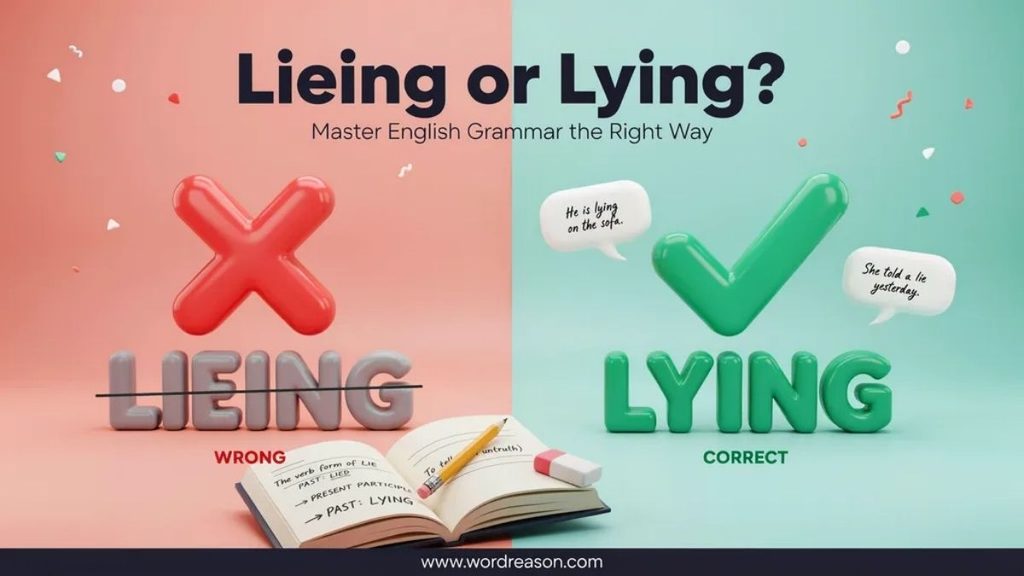
The word lying has two common meanings. It can describe the act of telling an untruth, or it can describe someone or something resting in a particular position. Although the meanings differ, the spelling remains identical.
Lying Means Telling an Untruth
When lying refers to dishonesty, it describes making a false statement or deliberately misleading someone.
For example, someone might lie about their age, hide the truth about a mistake, or give a false account of an event. In each case, the person misleads someone through their words.
Consider these sentences
| Sentence | Explanation |
|---|---|
| He is lying about his age. | He is giving false information about his age. |
| She admitted to lying to her parents. | She acknowledged that she had been dishonest. |
| They were lying about what happened. | They gave a false account of an event. |
| Lying can damage relationships. | The sentence describes dishonesty as an action. |
Notice that lying can serve different grammatical roles. In the sentence He is lying about his age, it forms part of the verb phrase is lying. In Lying can damage relationships, it functions as a gerund, which means a verb form ending in -ing that acts like a noun.
Both sentences use the same spelling. The surrounding words make the meaning clear.
Lying Means Resting in a Horizontal Position
The second meaning of lying describes someone or something resting, reclining, or occupying a particular position.
For example, a person might lie in bed while reading, lie on a sofa after work, or lie on the ground while exercising. An object can also lie on a surface, such as a book lying on a table.
Here are some everyday examples
| Sentence | Meaning |
|---|---|
| The baby is lying in bed. | The baby is resting in bed. |
| My dog is lying on the floor. | The dog is resting on the floor. |
| She spent the afternoon lying on the sofa. | She rested on the sofa during the afternoon. |
| The keys were lying on the table. | The keys were located on the table. |
This meaning does not involve dishonesty. Instead, lying describes a physical position or location.
How Context Changes the Meaning of Lying
Because lying has two meanings, readers rely on context to understand the intended message.
Compare these sentences
She is lying to her friend suggests that she is being dishonest.
She is lying beside her friend describes her physical position.
Likewise, He is lying about his experience refers to dishonesty, while He is lying on the grass describes someone resting outdoors.
The words around lying usually make the intended meaning clear. Phrases such as about his experience often signal dishonesty, while expressions such as on the grass or in bed generally describe a physical position.
Learn the difference between confusing more English words
Families vs Family’s Which Is the Correct spelling?
Why Is Lying Correct Instead of Lieing?
The answer comes from an established English spelling rule. When certain verbs end in -ie, you change the ending to -y before adding -ing.
That is why lie becomes lying rather than lieing.
The IE to Y Spelling Rule
Many writers assume that adding -ing means attaching those letters directly to the base verb. That approach works for words such as walk and read, which become walking and reading.
However, verbs ending in -ie follow a different pattern.
The spelling changes like this
| Base verb | Correct -ing form | Incorrect form |
|---|---|---|
| Lie | Lying | Lieing |
| Die | Dying | Dieing |
| Tie | Tying | Tieing |
| Vie | Vying | Vieing |
The pattern replaces the final ie with y before adding ing.
For example, when you need the present participle of lie, you do not keep the original ie. Instead, you change the ending and form lying.
This spelling convention also explains why dying and tying are correct. Learning these words together makes the pattern easier to remember.
Why English Changes IE to Y Before Adding ING
English spelling developed through many historical influences, so not every spelling rule follows a pattern that feels obvious to modern readers. Some forms simply reflect established conventions that writers learn through regular use.
The ie to y rule gives you a practical way to spell these verbs correctly. Rather than memorizing lying as an isolated exception, you can recognize its relationship to dying, tying, and vying.
The key point is that the spelling change affects the written form, not the basic meaning of the verb.
More Examples of Verbs Ending in IE
The same pattern appears in several familiar words.
| Base verb | Correct form | Example sentence |
|---|---|---|
| Lie | Lying | The cat is lying near the window. |
| Die | Dying | The flowers are dying without water. |
| Tie | Tying | She is tying her shoes. |
| Vie | Vying | Several teams are vying for the championship. |
English uses other spelling rules when adding -ing. For example, make becomes making because the final e disappears. Run becomes running because the final consonant doubles.
Therefore, it helps to learn the spelling pattern that applies to each type of verb instead of assuming that every word behaves the same way.
Learn the difference between confusing more English words
Feet or Foot Which is the correct spelling?
Lie, Lying, Lay, Lain Lieing or Lying and Lied Understanding the Difference

Once you understand why lying is correct, the next challenge is choosing between lying, laying, lay, lain, and lied.
These words belong to different verb forms and meanings. The most important distinction is between lie, meaning to recline, and lie, meaning to tell an untruth. The separate verb lay adds another layer of confusion.
Lie, Lying, Lay and Lain The Verb for Resting
When lie means to recline or remain in a position, it follows an irregular pattern.
| Verb form | Correct word | Example |
|---|---|---|
| Base form | Lie | I need to lie down. |
| Present participle | Lying | I am lying on the sofa. |
| Simple past | Lay | I lay on the sofa yesterday. |
| Past participle | Lain | I have lain here for an hour. |
The surprising part is that lay serves two purposes. It can mean the past tense of lie, or it can be the present form of the separate verb lay, meaning to put something down.
For example, I lay on the bed yesterday describes a past resting position. By contrast, I lay the book on the bed” describes placing an object somewhere.
The tense and meaning determine which use applies.
Lie, Lying, and Lied The Verb for Dishonesty
When lie means to tell an untruth, its forms follow a different pattern.
| Verb form | Correct word | Example |
|---|---|---|
| Base form | Lie | Do not lie to me. |
| Present form | Lies | He lies about small things. |
| Present participle | Lying | She is lying about the results. |
| Simple past | Lied | He lied to his parents. |
| Past participle | Lied | She has lied before. |
Unlike the reclining verb, the dishonesty-related verb uses lied for both the simple past and past participle.
Compare He lay on the bed yesterday with He lied to me yesterday. The first sentence describes a physical position, while the second describes dishonesty.
Both are grammatically correct, but they communicate entirely different things.
Lie vs Lay Which One Should You Use?
The easiest way to distinguish lie from lay is to ask whether someone is resting or putting something somewhere.
Use lie when the subject rests or occupies a position. Use lay when the subject places an object somewhere.
For example:
| Sentence | Correct verb | Why |
|---|---|---|
| I am lying on the bed. | Lie | I am resting on the bed. |
| I am laying the blanket on the bed. | Lay | I am placing the blanket on the bed. |
| The dog lay near the door yesterday. | Lie | Lay is the past tense of reclining lie. |
| She laid the book on the desk. | Lay | Laid is the past tense of placing lay. |
The verb lay normally takes a direct object in its meaning of placing something. In the sentence She laid the book on the desk, the book receives the action.
By contrast, the reclining verb lie does not take a direct object. You lie on the bed, but you lay a blanket on the bed.
This distinction explains why lying and laying are not interchangeable in standard grammar when they describe these actions.
Learn the difference between confusing more English words
Likeable or Likable Which Spelling Is Correct ?
Lying or Lieing in Everyday Sentences

Practical examples make spelling rules easier to apply. The following expressions show how to use lying in common situations, from resting at home to describing dishonest behavior.
Lying Down
The correct phrase is lying down.
It describes someone resting or moving into a reclining position.
Examples include
I am lying down because I feel tired.
The children are lying down after lunch.
He enjoys lying down for a few minutes after work.
Writing lieing down is incorrect because the word follows the ie-to-y spelling rule.
Learn the difference between confusing more English words
Cosy or Cozy Which Spelling Is Correct?
Lying in Bed
The correct expression is lying in bed.
It describes someone resting or remaining in bed, whether they are sleeping, reading, or relaxing.
For example, She is lying in bed and reading a book describes someone resting in bed while reading.
Similarly, I was lying in bed when the phone rang describes a position that continued until another event occurred.
The phrase does not automatically mean that someone is asleep. Context determines what the person is doing while in bed.
Lying on the Floor
Use lying on the floor when describing a person or object resting on the floor.
Examples include
The puppy is lying on the floor.
My phone was lying on the floor beside the chair.
He was lying on the floor while doing stretches.
The phrase describes a physical position rather than dishonesty. The spelling remains lying in every example.
Learn the difference between confusing more English words
Kindergarten or Kindergarden what it really means?
Lying on the Sofa
The phrase lying on the sofa follows the same rule.
For example, She is lying on the sofa and watching television describes someone resting while watching a program.
You could also write, The cat spends most afternoons lying on the sofa. In this sentence, lying describes the cat position.
American and British English use the same spelling for this expression.
Learn the difference between confusing more English words
Outting or Outing What it really means?
Lying to Someone
When lying refers to dishonesty, writers often use to identify the person being deceived.
Examples include
He is lying to his parents.
I knew she was lying to me.
They accused the company of lying to its customers.
You can also use about to identify the subject of the false statement. For example, She was lying about her qualifications means she was giving false information about her qualifications.
These sentences show how context separates dishonesty from physical position.
Lying Around
The expression lying around can describe relaxing without doing much or remaining in a place.
For example, We spent Sunday lying around the house means the group relaxed without doing much.
The phrase can also describe objects that remain scattered or unused. The clothes were lying around the bedroom”means the clothes were left in different places around the room.
Although the meaning changes with context, the spelling stays the same.
Common Spelling and Grammar Mistakes to Avoid
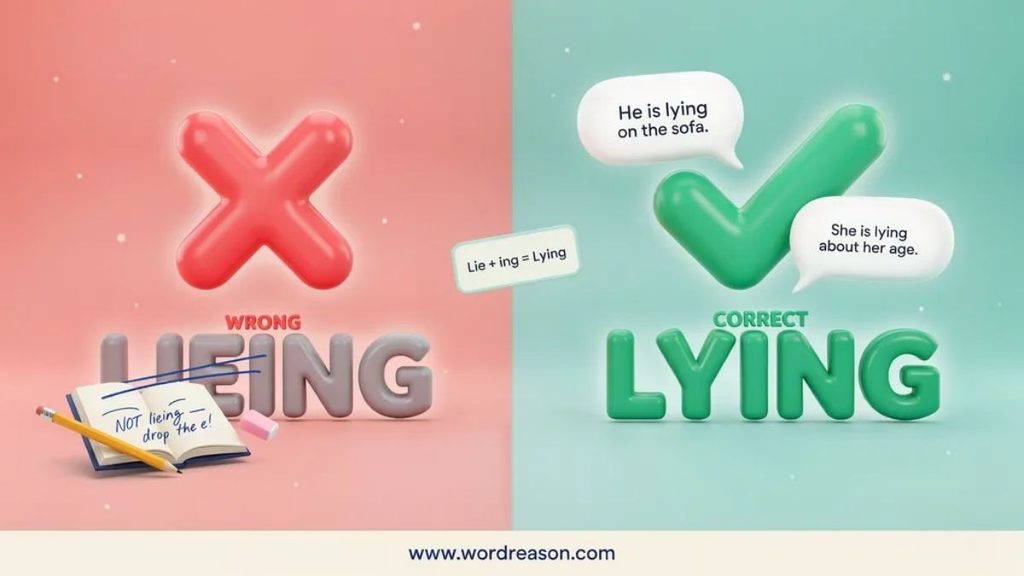
Writers often make mistakes because they apply the wrong spelling rule or confuse similar verb forms. Understanding the differences will help you avoid these errors.
Writing Lieing Instead of Lying
The most direct mistake is writing lieing instead of lying.
Incorrect The dog is lieing on the carpet.
Correct The dog is lying on the carpet.
The error happens when someone adds ing without changing the original -ie ending. Remembering the pattern lie, die, and tie can help you avoid this mistake.
Confusing Lying With Laying
Lying and laying have different meanings when they describe resting and placing something down.
Incorrect in standard usage for the intended meaning: She is laying on the bed.
Correct She is lying on the bed.
However, She is laying the blanket on the bed is correct because she is placing an object on the bed.
The key is to identify what receives the action. If the subject rests, use a form of lie. If the subject places something, use a form of lay.
Using Lay Instead of Lain
The words lay and lain can also cause confusion because both belong to the reclining verb.
For example, I lay on the sofa yesterday uses lay as the simple past.
However, I have lain on the sofa for an hour uses lain as the past participle.
In standard formal English, the sentence I have lay on the sofa uses the wrong verb form. After have, has, or had, the correct past participle is lain when lie means to recline.
Confusing Lying With Lied
The difference between lying and lied depends on tense.
1.He is lying about his age describes an ongoing action.
2.He lied about his age describes a past action.
3.He has lied about his age before uses lied as the past participle.
Remember that lied belongs to the verb meaning to tell an untruth. When lie means to recline, its simple past is lay and its past participle is lain.
Writing Dieing Instead of Dying
The same spelling error appears when writers use dieing instead of dying.
Incorrect: The plant is dieing.
Correct: The plant is dying.
The correct form replaces ie with y before adding ing. This pattern also explains tying and lying.
Learning these related forms can help you recognize the spelling rule whenever you encounter a similar verb.
Is Lying Correct in American and British English?
Yes. Lying is the standard spelling in both American and British English.
Unlike words such as color and colour or center and centre, lying does not have separate American and British spellings.
| Usage | American English | British English |
|---|---|---|
| Reclining | Lying | Lying |
| Telling an untruth | Lying | Lying |
| Past tense of dishonest lie | Lied | Lied |
| Past tense of reclining lie | Lay | Lay |
| Incorrect spelling | Lieing | Lieing |
This consistency makes the word easy to use across English-speaking regions. Whether you are writing an academic paper, a work email, or a casual message, lying remains the correct form.
Learn the difference between confusing more English words
Ambience or Ambiance Which Spelling Is Correct?
Lying vs Lieing More Examples and Quick Reference
A short comparison can help you recognize the correct spelling and distinguish it from related words.
| Word | Correct or incorrect | Meaning | Example |
|---|---|---|---|
| Lying | Correct | Resting or telling an untruth | He is lying on the sofa. |
| Lieing | Incorrect | Nonstandard spelling of lying | Avoid this form in standard writing. |
| Laying | Correct | Putting something down | She is laying the book on the desk. |
| Lie | Correct | Resting or telling an untruth | I need to lie down. |
| Lay | Correct | Past tense of reclining lie or present form of placing lay | I lay down yesterday. |
| Lain | Correct | Past participle of reclining lie | She has lain there for an hour. |
| Lied | Correct | Past tense or past participle of dishonest lie | He lied about the mistake. |
| Dying | Correct | The -ing form of die | The plant is dying. |
| Tying | Correct | The -ing form of tie | She is tying her shoes. |
Learn the difference between confusing more English words
Curtsy or Curtsey Which Spelling Is Correct?
Fill in the Blanks Lying vs Lieing
Complete each sentence with the correct word.
- The correct spelling is ______, not lieing.
- She is ______ on the bed.
- He was ______ about his age.
- I need to ______ down for a while.
- Yesterday, I ______ awake all night.
- She is ______ the book on the table.
- He ______ to his parents yesterday.
- The cat is ______ on the sofa.
- The past tense of lie (to tell an untruth) is ______.
- The past tense of lie (to rest) is ______.
- She has ______ on the bed for an hour.
- He is ______ about what happened.
- The baby is ______ in the crib.
- She is ______ her shoes.
- The plant is ______.
- I often ______ awake at night.
- He has ______ about his results before.
- Please stop ______ to me.
- The correct phrase is “______ in bed.”
- She ______ the keys on the desk.
- The correct spelling of the -ing form of die is ______.
- He is ______ the blanket on the bed.
- The book was ______ on the floor.
- “I am lying” is a ______ correct sentence.
- Lying can mean resting or telling an ______.
Answers key
- Lying
- Lying
- Lying
- Lie
- Lay
- Laying
- Lied
- Lying
- Lied
- Lay
- Lain
- Lying
- Lying
- Tying
- Dying
- Lie
- Lied
- Lying
- Lying
- Laid
- Dying
- Laying
- Lying
- Grammatically
- Untruth
Here’s a trusted source for clear word meanings:
Frequently asked questions
1. How do you spell lying correctly?
The correct spelling is lying, not lieing.
2. Does lying mean telling an untruth?
Yes, lying means deliberately saying something false.
3. What is the difference between lying and laying?
Lying means resting; laying means putting something down.
4. Is lying in bed or laying in bed correct?
Lying in bed is correct when describing rest.
5. Is I am lying grammatically correct?
Yes, it can mean telling an untruth or reclining.
6. Is I’m having a lying correct?
No. Say I am lying or I am telling a lie.
7. What is the past tense of lying?
Lied means told an untruth; lay means rested.
8. What phrases do liars commonly use?
They may say Trust me, but no phrase proves dishonesty.
9. What are seven signs of lying?
Inconsistent details may raise questions, but no signs reliably prove lying.
10. What are the three types of lying?
Common examples include false statements, lies by omission, and misleading exaggerations.
11. What does Jesus say about liars?
John 8:44 discusses lying in connection with falsehood and truth.
12. Is lie awake or lay awake correct?
Both are correct lie awake is present tense; lay awake is past tense.
conclusion
Mastering lying vs lieing doesn’t have to feel like a grammar nightmare! Remember, lying is the correct spelling, while lieing is a mistake best left out of your writing. Use lying for resting or telling an untruth, and laying when placing something down. Keep in mind that lay, lain, and lied have different uses depending on the meaning and tense. With a little practice and attention to context, you’ll avoid these common mistakes and write with greater confidence.

Bella AJS
Bella AJS is an experienced blogger and passionate language enthusiast at WordReason. She specializes in English grammar, word meanings, spelling, and commonly confused words. With a clear and practical writing style, Bella helps readers understand tricky language rules without the textbook headache. Her goal is simple: make English easier, clearer, and more enjoyable one word at a time.